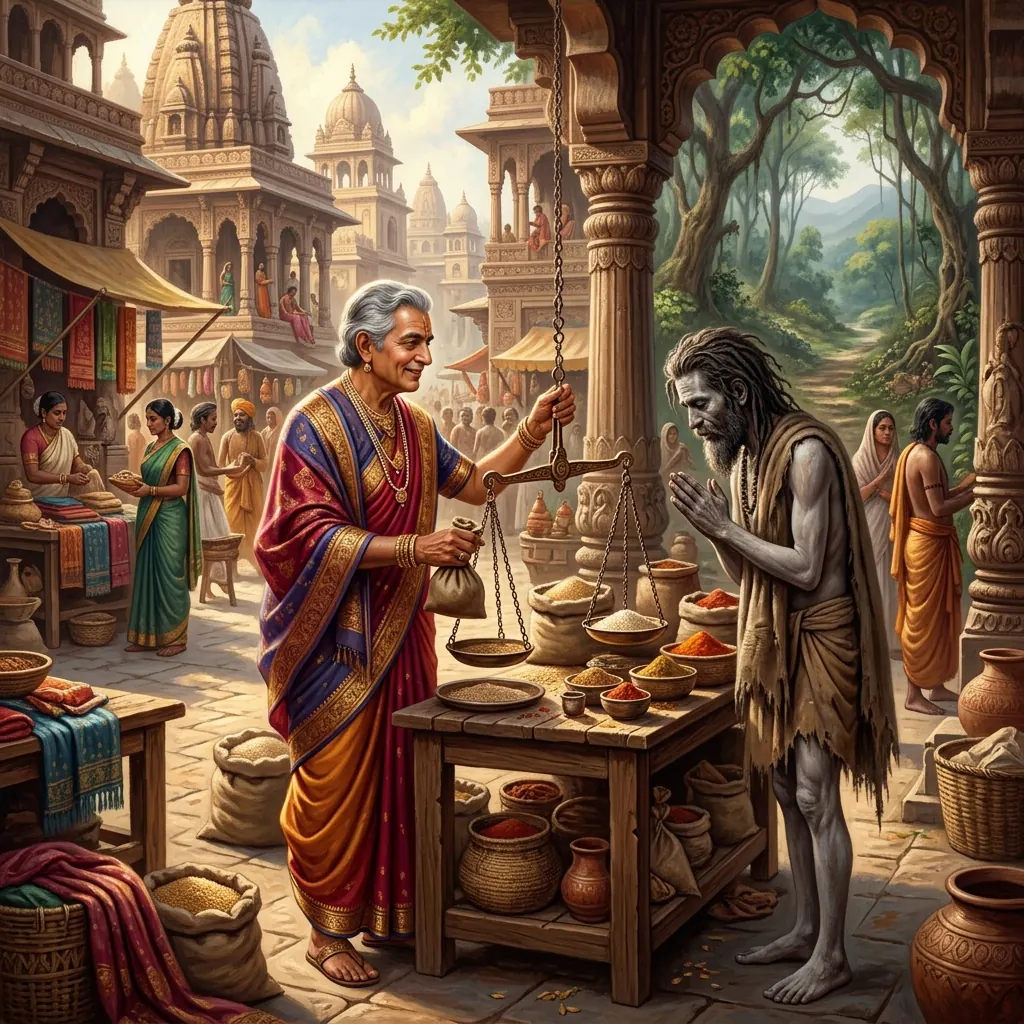
The Guest Who Smiled
Vyasa and Maitreya argue over gift, penance and knowledge at Baranasi
In short
Yudhishthira asks which is superior: knowledge, penance, or gift. Bhishma answers with an old conversation. Vyasa, wandering the world in disguise, is fed at Baranasi by the sage Maitreya, and smiles with delight at the meal, because a promise about gifts that he had always read as scriptural exaggeration has just come true in front of him. Maitreya argues back that the gift is only worth the ground it falls on, and Vyasa concedes it and then names something higher still.
Told in the Anushasana ParvaSet in Kashi and Kurukshetra16 min read
Knowledge, Penance, or the Gift
Bhishma had just finished the history of the worm, who had climbed out of a cart-track and through a kshatriya's body into the status of a brahmana and from there into the region of Brahman himself, all of it by doing what Vyasa told him to do. Do not mourn for the men who fell on this field, the old man had said at the end of it. They spent their lives the way that creature spent his.
Yudhishthira had listened to the whole of it, and what he took away from it was a question about the currency.
"Which of these three is greatest," he said, "knowledge, penances, or gifts? I am asking you, the most righteous of men. Tell me this, grandsire."
It is the question underneath the entire Anushasana. The three are the only things a man can actually spend. Knowledge is what he learns and holds. Penance is what he burns off himself. Gift is what he hands to another person and does not get back. Every teaching the grandsire had given since the coronation could be sorted into one of the three heaps, and the king wanted to know which heap was worth the most, because he was a man who had been given a kingdom he did not want by killing people he did want, and he was still trying to find out what could be done with what was left.
Bhishma did not answer it in his own voice. He almost never did.
"On this," he said, "there is an old story of a conversation between Maitreya and the Island-born Krishna."
The Island-born Krishna is Vyasa. He is called that because he was born on an island in the Yamuna, dark-skinned, to a fisherman's daughter, and he is the man who fathered Dhritarashtra and Pandu and Vidura and then wrote down what their children did to each other. He is the one figure in the epic who is inside it and above it at once.
And once, said Bhishma, he went walking over the world in disguise, and came to a house in Baranasi, and was fed.
The Guest Who Smiled at the Meal
Baranasi is the city on the Ganga that the site elsewhere calls Varanasi, or Kashi, the oldest place of learning in the country, and the man Vyasa went to see there was Maitreya, who belonged by birth to a race of Munis.
That clause about birth is not decoration. It is going to be half the argument. Maitreya came of a line of sages, he had the lineage and the Vedic learning and the vows that go with it, and he knew what he had. He was, Bhishma says, a worshipper of acts: a man who believed that what you do and what you are born into are the things that make you.
Vyasa came to his door in disguise, which is to say that he came as a plain wanderer and not as the author of the world.
He did what a householder does. He gave the stranger a seat. He worshipped him with due rites, the water and the honey and the words, all of it performed properly for a wandering ascetic. Then he fed him with excellent food, and the text pauses over that food long enough to say what kind it was: very wholesome, and giving every kind of satisfaction. A good meal, given away by a man who lived on very little, to somebody who had walked in off the road.
When he had eaten it, the great-souled Krishna was overjoyed.
And as he sat there, he smiled.
Consider the position that leaves the host in. He has emptied his stores for a guest, he has said the correct words over him, and the guest has finished the food and is now sitting in his house smiling with open delight at nothing that anybody else can see. An ascetic who has mastered himself is not supposed to be carried away by joy over a meal.
Maitreya was too well brought up to be offended and too intelligent to pretend he had not noticed. So he asked.
What Is My Penance Worth
"Tell me, righteous one, why you are smiling," said Maitreya. "You are an ascetic, able to master your feelings. Yet great joy, it seems, has come over you."
That is the whole of the complaint, and it is put as a compliment. You are a man who governs himself. Something has got past your guard. What was it.
Then he asked the real question, and he asked it kneeling.
"I salute you and worship you with my head bowed, and I ask you this: what is the power of my penances, and what is the high blessedness that is yours?"
He wanted to be told what his own austerities were worth. Not in general. His, the ones he had performed, measured against the man in front of him. And having asked it, he answered it himself, out loud, in the most exposed sentence in the episode.
"The acts I do are different from yours. You are already emancipated, though you still draw breath. I am not yet free. For all that, I think there is not much difference between you and me. And I am the better born."
Read the movement in that. He begins by granting everything. You are free while still alive, which is the highest thing that can be said of anybody. I am not free. Then, having said it, he cannot leave it there, and he adds that there is not much difference between the two of them anyway, and then, in case that was not clear enough, that he has the better birth.
It is the most human moment in the Anushasana Parva. A learned man has just given away his dinner to a stranger, and what he wants in return is a ruling that his life has counted for something, and he cannot help supplying the ruling himself while he waits.
Vyasa, who had been smiling a moment before, took the question seriously. He did not correct the pride. He explained the smile.
The Three Tracks
"The wonder that has filled me comes from an ordinance that sounds like exaggeration," Vyasa said, "and from the way it is put as a paradox so that people will understand it. What the Vedas declare seems untrue. But why would the Vedas say something untrue?"
He was smiling at a text. Somewhere in the scriptures there is a promise about gifts so extravagant that a reasonable man reads it and assumes it has been inflated for the benefit of simple people, and Vyasa had just watched the promise come true across a plate of food, and the collision of the two things had gone through him as delight.
Then he named the ordinance.
"It is said that a man's best vows run along three tracks. Never injure. Always tell the truth. And give. The rishis of old proclaimed this, following what the Vedas declare. These commands were heard long ago, and we should certainly follow them even in our own times."
Three tracks, and nothing else on the list. Not sacrifice, not learning, not the disciplines that Maitreya had spent his life on. Do no harm, speak the truth, give.
"Even a small gift, made as the rules lay down, bears great fruit. You have given a little water to a thirsty man with a sincere heart."
And then the sentence that is the point of the visit, and the reason there is a story here at all.
"Though you were thirsty and hungry yourself, you gave me such food, and by it you have won many high regions of happiness, mighty one, as others do by many sacrifices."
Maitreya had not eaten. That is the detail the text drops in without underlining it. The excellent and wholesome food had been set in front of the guest by a man who was hungry, and who had gone hungry so that it could be set there, and the guest had known it while he was eating.
"I am delighted with your most sacred gift," said Vyasa, "and with your penances too. Your power is the power of Righteousness. You look like Righteousness itself. The fragrance of Righteousness is all about you."
Superior to Ablutions in Sacred Waters
After praising the man, Vyasa went on to rank the act, and the ranking is put with a bluntness that is unusual even for him.
"Giving is greater than bathing in sacred waters, greater than keeping all the Vedic vows. Indeed, brahmana, a gift is more auspicious than every sacred act. All the rites laid down in the Vedas that you praise cannot equal a gift, for a gift, I hold, certainly carries a far higher merit."
He was standing in Baranasi when he said it, a few streets from the river where men come from the whole of the country to wash off what they have done. Nothing you can do in that water, he said, is worth what you did in your kitchen.
"The track made by those who give is the track the wise walk on. Those who give are counted as givers of life itself. A gift is like the Vedas well studied, like the restraint of the senses, like a life of complete Renunciation."
Then he sorted the whole of humanity into three groups, and the sorting is worth having in full, because it is short and it leaves very little room to stand outside it.
Some men are righteous. Those are the ones devoted to sacrifices, to gifts, and to penances.
Some are sinful. Those are the ones who injure other creatures and are unfriendly to them, and with them are counted the men who take what belongs to others, and these certainly fall into Hell and meet with misery.
And some are neither. The man devoted to Brahma is not reckoned either way, and his sins are never regarded as sins. So too the man who simply performs the duties laid down for him: for that, he is neither righteous nor sinful. All the other acts that men do are indifferent.
So the great mass of what a person does in a lifetime does not register at all. Only three things put a man on the righteous side of the ledger, and only two things put him on the other, and one of the two is taking what is not his.
"Take your delight, and grow, and rejoice, and give, and perform sacrifices," Vyasa finished. "Then neither men of knowledge nor men of penance will be able to get the better of you."
Which was an answer to the question Maitreya had asked, and Maitreya had noticed that it was.
The Well Tilled Field
"Wise one, it is certainly as you say," Maitreya answered. "Mighty one, with your permission I would like to say something."
"Whatever you want to say, Maitreya, say it," said Vyasa, "for I want to hear you."
That exchange is the hinge of the episode. This is not a sage instructing a pupil. It is two learned men who disagree, and the elder has just invited the younger to argue back, and the younger does.
"What you say about Gift is faultless and pure," said Maitreya. "Your soul has certainly been cleansed by knowledge and penances."
The concession carries the whole objection inside it. You praise gift. But look at what made you the man whose praise is worth having. Knowledge and penances. As for us, said Maitreya, we prosper merely by seeing people like you.
Then he set out his case.
"Penances, knowledge of the Vedas, and birth in a pure race: these are what make a man a brahmana. When a man has all three, he is called twice-born. If the brahmana is pleased, the Pitris and the gods are pleased too. There is nothing higher than a brahmana learned in the Vedas. Without the brahmana all would be darkness. Nothing would be known. The four orders would not exist. The line between Righteousness and Unrighteousness, Truth and Falsehood, would vanish."
And having built that, he brought it round to gift, and the image he used to do it is the best thing he says.
"A well-tilled field yields an abundant harvest. In the same way, one can reap great merit by giving to a brahmana of great learning. If there were no brahmanas learned in the Vedas and good in conduct to accept gifts, the wealth of the wealthy would be useless."
That is the argument, and it is a real one. A gift is not a self-contained good. It is a seed, and a seed is worth what the ground is worth. Somebody has to have spent a life on penance and study for there to be anywhere fit to put the gift, and a man who praises the sowing while ignoring the field has not thought it through.
The Food That Eats the Eater
Maitreya then followed his own argument into the place where it cuts against him, which is the mark of a man who means it.
"The ignorant brahmana who eats the food offered to him destroys what he eats," he said, "for it earns no merit for the one who gave it. And the food destroys the eater too, for he incurs sin by eating what was offered to him."
The transaction can fail from either end. A gift laid on bad ground is not a small good. It is nothing at all, and worse than nothing, because two people are damaged by it. Only food given to a deserving man, he said, can properly be called food fit to eat. In all other cases the giver has thrown his gift away and the receiver is ruined for having wrongly accepted it.
Then he pressed it further, into a claim about what learning actually is.
"The learned brahmana becomes the master of the food he eats. When he has eaten it, he brings forth more food."
The learned man converts what he is given back into something the world can eat. The teaching, the rite, the counsel he gives out afterwards, that is the second harvest, and it is why feeding him was not merely charity.
And the ignorant man who eats what is offered to him loses his right to the children he begets, for they become the possession of the man whose food enabled him to beget them. This too, said Maitreya, is the subtle fault that clings to people who eat other people's food when they lack the power to win that food for themselves. Take what you have not earned the standing to take, and something of what you make afterwards is not yours.
Then he set the scales level, and it is the fairest sentence in his speech.
"The merit the giver gains by giving is equal to what the taker gains by accepting the food. Giver and receiver depend on each other equally. That is what the rishis have said."
Men of pure lineage, devoted to penance, who make gifts and study the Vedas, are worthy of the most reverent worship. "It is those good men who have marked out the path that keeps a man from going astray. It is they who lead others to heaven. They carry the burden of the sacrifices on their shoulders and live for ever."
May Mansions Be Yours
Vyasa did not defend his position. He conceded the point and then went past it.
"By good luck you have knowledge. By good luck your understanding is of this kind. It is by good luck that beauty and youth and prosperity have not overwhelmed you."
Then: "Listen while I tell you of something even more powerful than a gift."
The man who had just called gift more auspicious than all sacred acts now said there was something above it, and named the thing his host had been defending.
"Penances are sacred. Penances are the way to win the Vedas, and heaven too. It is by penances that one destroys one's sins and every other evil."
And then the list, which is the least comfortable thing in the section and the reason it exists. The man who drinks alcohol. The man who takes by force what belongs to others. The man guilty of foeticide. The man who violates the bed of his teacher. All four cross over with the aid of penances, and are cleansed. There is no crime named there that penance cannot take off a man.
"One who has all knowledge, and so sees truly, and an ascetic of any kind, are equals. One should always bow to these two."
So the ruling, when it came, refused the ranking that had been asked for. Bow to the knower. Bow to the ascetic. And as for the giver: those men who are adored by all themselves adore him who makes gifts, and wherever the giver goes, he hears himself praised.
Then, to the young man in front of him, the smallest instruction of the evening.
"Learn from me the duties you should follow first, the duties of householders. In a house where the husband is happy with his wedded wife and the wife with her husband, every good thing follows. As water washes dirt from the body, as the splendour of fire drives away darkness, so gifts and penances wash away sin."
Water and fire, gift and penance, named in one breath at the end of an argument about which of them stood higher.
"Blessings on you, Maitreya; may mansions be yours. I leave here in peace. Keep in mind what I have said, and you will reap many benefits."
Maitreya walked round his illustrious guest and bowed his head to him, and joined his hands, and said, "Blessings on you too, holy one."
The text never says whether he knew who had eaten his dinner.
Dharma Lesson
The debate is never settled, and the refusal to settle it is the teaching. Vyasa ranks the gift above bathing in sacred rivers because he has just watched a hungry man feed a stranger; Maitreya answers that a gift laid on unfit ground ruins both the giver and the taker, and that somebody must have spent a life on study and austerity for there to be anywhere worth giving to. Both are right, and the last word gives penance the power to burn off even the gravest things a man has already done. Water washes the body and fire clears the dark, and the sentence names them together.