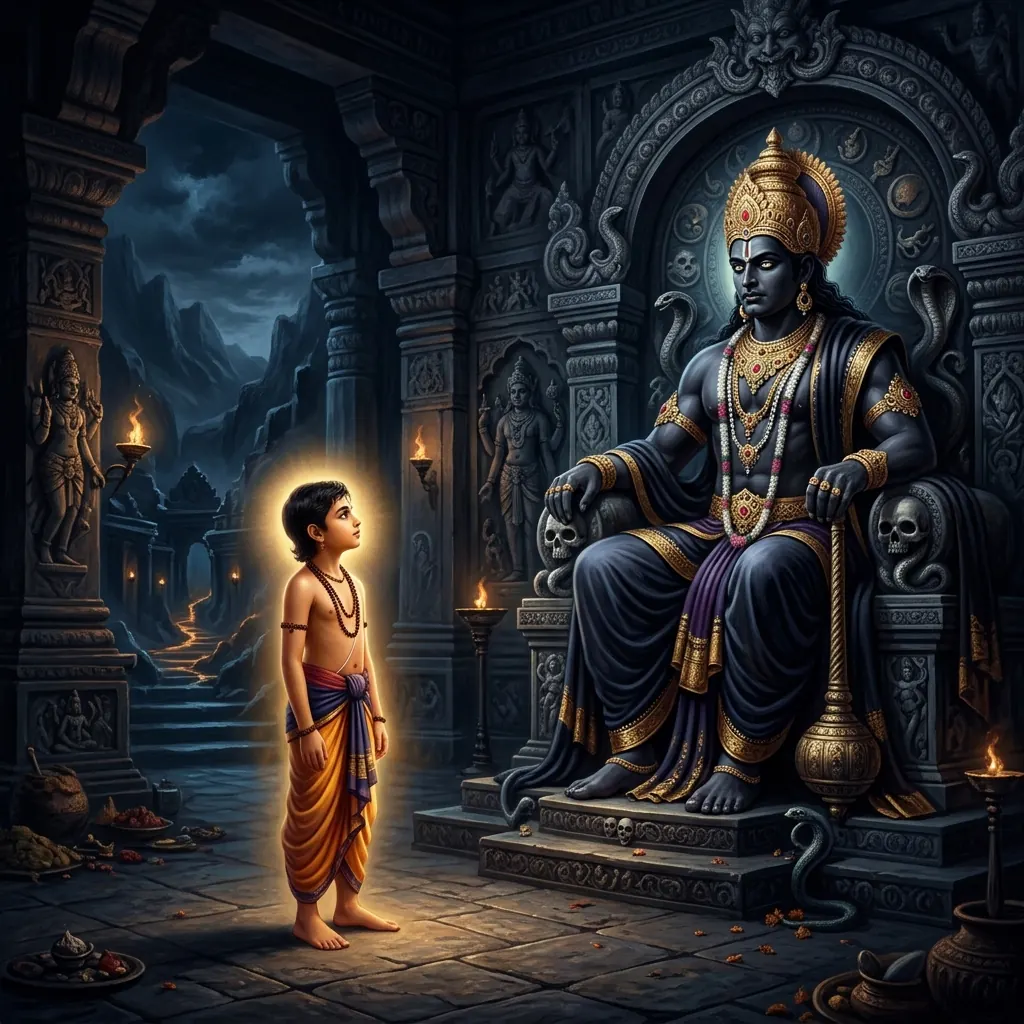
Righteousness, the Only Friend
Brihaspati comes down from the sky to tell Yudhishthira what follows a man past death
In short
Yudhishthira asks the grandsire what accompanies a man when his body is left behind like a clod of earth, and Bhishma sends the question up to Brihaspati, teacher of the gods, who comes down from the sky to answer it. Brihaspati says that kinsmen mourn for a moment and turn away, and that Righteousness alone follows the dead. He then counts out the animal births earned by every kind of sin, the merit of repentance and gifts of food, and finally the whole of dharma in one sentence, before ascending bodily to heaven in front of the assembly.
Told in the Anushasana ParvaSet in Kurukshetra20 min read
The Question the Grandsire Would Not Answer
Vaishampayana said that the king came to the bed of arrows that morning as he had come on every other morning of that long season, and put his question, and waited.
Bhishma had by then answered him about kings and about gifts, about vows and fasts and fords, about the conduct of householders and the merit of cows. Yudhishthira had grown used to the shape of it. He asked, and the old man on the arrows opened his mouth and the answer came out whole.
"Grandsire," he said, "you are a man of great wisdom and you know all the scriptures. I want to know the high ordinances under which mortal creatures must travel through their rounds of rebirth. What is the conduct that lets men reach high heaven, and what is the conduct by which one sinks into Hell?"
Then he asked the part of it that he had really come to ask.
"When people leave behind the dead body, as lifeless as a piece of wood or a clod of earth, and go on to the other world, what is it that follows them there?"
It was not an idle question in that place. The field had been quiet only a few weeks by then and the man he was asking had been lying on the arrows since the tenth day of the war, waiting for the sun to turn north before he would consent to die. Yudhishthira had buried more of his own than he could count. He wanted to know what, if anything, goes with them.
And Bhishma, for once, did not answer.
"There comes the illustrious Brihaspati, a being of great intelligence," he said. "Ask him, the blessed one. The subject is an eternal mystery. No one else can explain it."
Then he said the thing that settled it, and that no man on that field would have said lightly.
"There is no speaker like Brihaspati."
The Teacher of the Gods Comes Down
While the son of Pritha and the son of Ganga were still speaking with each other, the illustrious Brihaspati, whose soul was cleansed, came down to that spot from the sky.
He is the teacher of the gods. When the gods have a question they cannot settle among themselves they take it to him, and he is the one being in the three worlds of whom it is said flatly that there is no better speaker. He did not send word ahead. He came down out of the sky onto a plain full of the debris of a war, where an old man lay on a bed made of the arrows of his own grandson.
King Yudhishthira and all the others, with Dhritarashtra at their head, stood up and received Brihaspati with proper honours.
That detail is worth pausing over. Dhritarashtra was there. The blind king who had lost a hundred sons on that ground rose first among the assembly and offered worship to the guest, and Vaishampayana says the worship they offered to the teacher of the gods was excellent, which is to say that nothing in it was hurried and nothing was left out.
Then Dharma's royal son approached the illustrious one and asked his question in proper form, wanting to know the truth. He had asked it once already and had been sent up the ladder to a higher authority, and he did not soften it on the way.
"Illustrious one, you know all duties and all the scriptures. Tell me, what is the true friend of mortal creatures? Is it the father, or the mother, or the son, or the teacher, or kinsmen, or relatives, or those we call friends, that can truly be called the friend of a mortal creature?"
And then, again, the piece of wood and the clod of earth.
"A man goes to the next world and leaves behind his dead body, like a piece of wood or a clod of earth. Who is it that follows him there?"
One Is Born Alone
"One is born alone, king," said Brihaspati, "and one dies alone. One crosses alone the difficulties one meets, and one alone meets whatever misery falls to one's lot. In these things one really has no companion."
He then went down the list Yudhishthira had offered him and struck out every name on it.
"The father, the mother, the brother, the son, the teacher, kinsmen, relatives and friends leave the dead body as if it were a piece of wood or a clod of earth. After mourning for only a moment, they all turn away from it and go about their own concerns."
After mourning for only a moment. He did not accuse them of coldness. He was describing what everyone in that assembly had done that year, over and over, on that very ground: the grief, which is real, and then the turning away, which is also real, because the living have their own concerns and the dead have none.
"Only Righteousness follows the body that all of them abandon. So it is plain that Righteousness is the only friend, and that Righteousness alone should be sought by all."
Then the consequence, stated without ornament. One who has righteousness reaches the high end that is heaven. One who has unrighteousness goes to Hell. Therefore the man of intelligence should always seek to acquire religious merit through wealth won by lawful means, because piety is the one only friend which creatures have in the world hereafter.
And he named the way men lose it, which is not usually by wickedness.
"Led by greed, or delusion, or compassion, or fear, a man without much knowledge is seen to do wrong acts, even for the sake of another."
Compassion is in that list, standing between greed and fear, because a man will break the rule for someone he loves as readily as for himself.
"Piety, wealth and pleasure: these three are the fruit of life. One should gain these three while staying free of impropriety and sin."
The Witnesses in the Body
Yudhishthira had listened, and he had one difficulty with it.
"I have listened carefully to your words, illustrious one, words full of righteousness. Now I want to know how the body exists after death. A man's dead body becomes subtle and unmanifest. It becomes invisible. How can piety follow it?"
It is a fair objection. If there is nothing left to follow, the friend has nothing to walk beside.
Brihaspati answered it by naming the witnesses.
"Earth, Wind, Ether, Water, Light, Mind, Yama the king of the dead, Understanding, the Soul, and also Day and Night, all watch together as witnesses the merits and demerits of every living creature. With these, Righteousness follows the creature when it is dead."
Eleven witnesses, and only one of them is a god with a court and a rod. The rest are the elements a man is made of, the mind he thinks with, the understanding he judges with, the soul, and the two halves of the day in which he did the thing. Nothing has to be reported to anybody. The materials themselves were present.
"When the body loses its life, skin, bones, flesh, the vital seed and blood leave it at the same time. Carrying his merit and demerit, the Jiva takes another body. Once the Jiva has that body, the presiding deities of the five elements once more watch as witnesses all his acts, good and bad."
Once more. The witnesses are not left behind at the grave. They are reassembled in the next body along with everything else, and they begin watching again on the first day.
The king asked how the new body is formed, and was told: the deities that dwell within, Earth, Wind, Ether, Water, Light, with Mind as their sixth, are gratified by food, and from their gratification the vital seed is generated, and at the union of male and female it flows and causes conception. As soon as Jiva enters that seed he is overwhelmed by those elements, and by them he is given a body, and when he is disunited from them he is said to attain to the other end, which is death.
"What else do you wish to hear?"
The Country of Yama
"After birth," said Brihaspati, "the Jiva receives woe and death from the messengers of Yama. Misery and a painful round of rebirth are his inheritance."
Then he laid out the arithmetic of it, which is stricter than most men expect.
If the Jiva follows righteousness from the day of his birth, according to the best of his power, he enjoys happiness without interruption when he is reborn. If he does not follow it without interruption, but acts sinfully as well, then he reaps happiness first, as the reward of the righteousness he did have, and endures misery after that. The good is not cancelled by the bad. It is paid out first, and then the rest of the account is paid, and a man who has been happy has no assurance from that happiness of what is coming next.
And if he is unrighteous he goes down to the dominions of Yama, and after suffering great misery there he takes birth in an intermediate order of being, which is to say as an animal.
Brihaspati was careful about that country. It is not one place with one temperature.
"In those regions, king, there are places full of every merit, and worthy for that reason to be the homes of the gods themselves. And there are other places in those regions that are worse than the places where animals and birds live."
The happier part of Yama's kingdom, he said, is equal in merit to the region of Brahman himself. The same king holds both. Creatures, bound by their acts, endure many kinds of misery, and which part of that country a man stands in is not decided by the king's temper.
"Listen as I tell you which acts make the Jiva, deluded by folly, take birth in different orders of being, as the Vedas, the scriptures and the sacred histories declare."
Then the teacher of the gods began to count, and he counted for a very long time, and he named the animal and he named the number of years.
Teachers, Fathers, Mothers
He began with the learned, because they fall furthest.
A twice-born man who has studied the four Vedas and then, deluded by folly, accepts a gift from a fallen man, is born as an ass and lives as an ass for fifteen years. When he casts off that form he is an ox for seven years, and then a rakshasa of the twice-born order for three months, and then he is a brahmana again. A brahmana who officiates at the sacrifice of a fallen person becomes a vile worm for fifteen years, then an ass for five, a hog for five, a cock for five, a jackal for five, and a dog for one, and then he is a man.
The disciple who injures his teacher undergoes three transformations: first a dog, then a beast of prey, then an ass, and after the ass he wanders for some time in great affliction as a spirit before he is born a brahmana. The disciple who commits adultery with his teacher's wife, even in thought, is born in the canine order for three years, and then as a worm for a year, and then he is a man again. And the teacher who kills, without reason, the disciple who is even as a son to him, takes birth as a beast of prey.
Then he came to parents, and here the sentences are short and the animals are ordinary.
The son who disregards his father and mother becomes an ass for ten years, then a crocodile for a year, and then a man. The son with whom his parents become angry, on account of his evil thoughts towards them, is an ass for ten months, a dog for fourteen months, a cat for seven months, and then a man. Having spoken ill of parents, one takes birth as a Sarika. Striking them, one becomes a tortoise for ten years, then a porcupine, then a snake for six months, and then a man.
He who disregards his eldest brother, who is like a father, is born among cranes and lives two years in that form.
What the Thief Becomes
The servant who eats his master's food and then acts against his master's interests becomes an ape for ten years, a mouse for five, a dog for six months, and then a man. He who misuses what was left with him in trust undergoes a hundred transformations and comes at last to a vile worm, in which order he lives fifteen years until the demerit is exhausted. He who harbours malice becomes a Sarngaka. He who is guilty of breach of trust becomes a fish for eight years, a deer for four months, a goat for a year, then a worm, then a man.
Then Brihaspati came to theft, and the list he gave is the strangest passage in the whole discourse, because every stolen thing has its own creature waiting for it.
The man who steals paddy, barley, sesame, Masha, Kulattha, oil-seeds, oats, Kalaya, Mudga, wheat, Atasi and other corn becomes a mouse, then a hog that dies of disease as soon as it is born, then a dog for five years. He who steals curds becomes a crane. Raw fish, a monkey. Honey, a gadfly. Fruits or roots or cakes, an ant. Payasa, a Tittiri bird. Cakes, a screech-owl. Food, a bee, and he lives among the other bees for many months until it is paid. Paddy, a cat. Ghee, a gallinule. Fish, a crow. Salt, a mimicking bird. Milk, a crane. Oil, an animal that lives on oil.
Iron makes a cow of the thief. White brass, a bird of the Harita species. A vessel of silver, a pigeon. A vessel of gold, a vile vermin.
The cloth is counted thread by thread. Silk, a Krikara. Red silk, a Vartaka. Muslin, a parrot. Cloth of fine texture, a duck. Cotton, a crane. Jute, a sheep. Linen, a hare. Colouring matter, a peacock. A piece of red cloth, a bird of the Jivajivaka species. And the man who steals unguents and perfumes becomes a mole and lives in the dark for fifteen years.
The Wolf, the Ass, and the Ungrateful Man
Adultery with another man's wife makes a wolf, and after the wolf a dog, and a jackal, and a vulture, and a snake, and a Kanka, and a crane. Congress with the wife of a brother makes a male Kokila for a whole year. He who through lust goes to the wife of a friend, or of his teacher, or of his king, becomes a hog for five years, a wolf for ten, a cat for five, a cock for ten, an ant for three months, a worm for a month, and then a vile worm for fourteen years, and when all of that is exhausted he is a man again.
The man who obstructs a wedding about to take place, or a sacrifice, or an act of gifts, becomes a vile worm for fifteen years. He who bestows his daughter on one husband and then seeks to bestow her on a second becomes a vile worm for thirteen. He who eats without having performed the rites in honour of the deities and the Pitris becomes a crow for a hundred years, then a cock, then a snake for a month.
Then the killers.
"The wretch who, well armed himself, slays an unarmed man, to get his victim's wealth or out of hostility, must be born as an ass when he casts off his human body."
And the ass, after two years, meets with death at the edge of a weapon. Then he is a deer, always filled with anxiety at the thought of foes that may kill him, and at the end of a year he yields up his life at the point of a weapon. Then a fish, dragged up in a net in the fourth month. Then a beast of prey for ten years, and a pard for five, and then he is a man. Five lives, and in three of them he is killed by something he cannot see coming, which is what he did.
The man who kills a woman goes to Yama's regions, passes through twenty-one transformations, and lives twenty years as vermin.
And for ingratitude Brihaspati named the instruments: clubs with heavy hammers and mallets, sharp-pointed lances, heated jars, frightful forests of sword-blades, heated sands, thorny Salmalis. After all of it the ungrateful man comes back to the world as vile vermin for fifteen years, enters the womb and dies before birth, and enters the womb a hundred times more.
"I heard all this long ago, king, from Brahman himself."
The Gift of Food
"You have told me what end unrighteousness leads to," said Yudhishthira. "Now I want to hear what end Righteousness leads to. When people have committed many sins, by what acts can they still reach an auspicious end?"
It is the question of a man who has been listening to that catalogue and doing sums about himself.
"The man who has committed sins out of a deluded mind, and then feels the pangs of repentance and sets his heart on contemplation," said Brihaspati, "does not have to endure the consequences of his sins. One is freed from one's sins in proportion as one repents of them."
And there is a second door beside repentance, which is speech. If one who has committed a sin proclaims it in the presence of brahmanas who know their duties, he is quickly cleansed of the disgrace that comes from it, and comes out of it like a snake freed from his diseased slough.
Then the third door, and the one Brihaspati spent the rest of the discourse on.
"Of all kinds of gifts, the gift of food is held to be the best. Whoever wants merit should give food with a sincere heart. Food is the life-breath of men. From it all creatures are born. All the worlds of living creatures rest on food."
Koushika, he said, went to Heaven long ago by giving food, and that is the whole of the account given of him here.
He divided the duty by station, and he made it possible for everyone. The kshatriya who takes nothing that belongs to a brahmana, protects his subjects lawfully, and gives food won by the exercise of his own strength, is cleansed of his sinful acts. The vaishya who divides the produce of his fields into six shares and gives one of them away is cleansed. The shudra who earns food by hard labour and at the risk of life itself and gives it away is cleansed. A brahmana who gives away food he received as alms attains happiness here.
"Those who give food are regarded as givers of life. The merit they gain by such gifts is eternal. Every man should make his day fruitful by giving food."
The Rule in One Line
There was one question left, and Yudhishthira put it as a choice among six good things.
"Refraining from injury, keeping the Vedic ritual, meditation, mastery of the senses, penances, and obedient service to one's teachers. Which of these carries the greatest merit?"
"All these six carry merit," said Brihaspati. "They are different doors of piety."
Then he told him what stands behind all six doors.
"The man who practises the religion of compassion for all achieves his highest good. The man who keeps the three faults, lust, wrath and greed, under control by throwing them upon all creatures attains success. He who slays harmless creatures with the rod of punishment for the sake of his own happiness never finds happiness in the next world."
The man who regards all creatures as his own self, and behaves towards them as towards his own self, laying aside the rod and mastering his wrath completely, attains happiness. And of such a man Brihaspati said a strange and beautiful thing: that the gods themselves, who seek a fixed abode, are bewildered when they try to trace his track, because a person who has made himself the soul of all creatures leaves no track behind.
Then he gave the rule, and it took him one sentence.
"One should never do to another what one regards as harmful to oneself. This, in brief, is the rule of Righteousness."
In refusals and gifts, he said, in happiness and misery, in the agreeable and the disagreeable, one should judge their effects by reference to oneself. When one injures another, the injured turns round and injures the injurer. When one cherishes another, that other cherishes the cherisher. One should frame one's rule of conduct according to this.
"I have told you what Righteousness is, by this subtle way."
He had begun with a corpse abandoned like a clod of earth and had walked the king through the whole machinery of consequence, the witnesses in the body, the country of Yama, the asses and the moles and the fourteen years of vermin, and at the end of it he put all of it into a single line that a child could carry.
And then, said Vaishampayana, the teacher of the gods, a being of great intelligence, when he had said this to King Yudhishthira the just, rose up towards Heaven before our eyes.
Dharma Lesson
The discourse spends most of its length on punishment, and it is easy to read it as a threat. But the witnesses Brihaspati names are not spies. They are the elements a man is made of, his own understanding, and the day in which he acted, which means the account is kept inside him and cannot be lost or bribed. That is why the whole of it collapses into one sentence at the end: if the record is made of you, then the only reliable test of an act is to ask what it would be like to receive it.