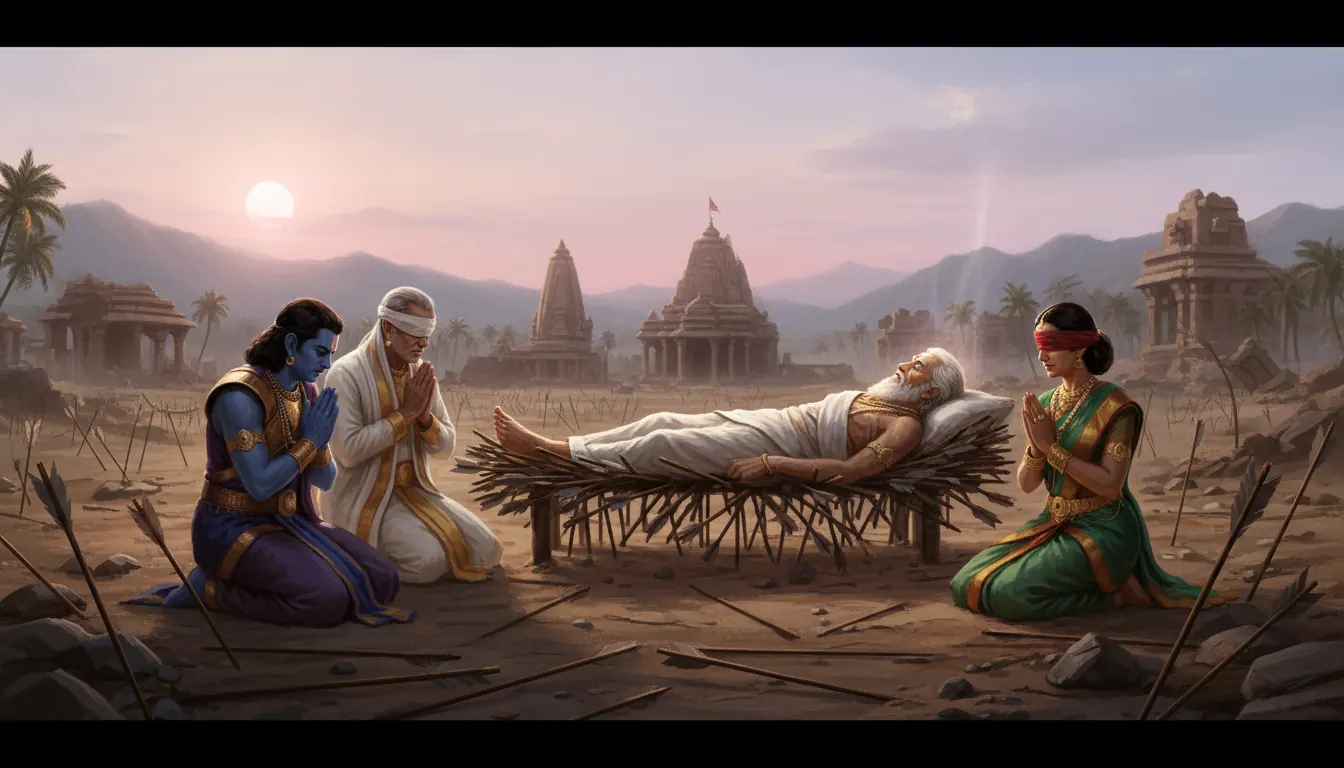
The Savitri Mantra of Salutations
Bhishma gives Yudhishthira the roll of names to be said at dawn
In short
After reciting the thousand names of Vishnu, Bhishma is asked for a shorter prayer, one that can be said on a journey, in a new house, or at the start of any undertaking. He gives the Savitri Mantra, declared by Vyasa and ordained by Savitri: salutations to Vasishtha and Parashara and the snake Ananta, then the eleven Rudras, the twelve Adityas, the eight Vasus and the two Ashvins, then the seven rishis of each quarter of the sky, and then six kings. He ends by telling the new king what the names protect, and from what.
Told in the Anushasana ParvaSet in Kurukshetra and Amaravati21 min read
The Question After the Thousand Names
The thousand names of Vishnu had just been recited from beginning to end, and there was a pause on that field while everybody took in what had been said.
Then Yudhishthira asked for something a man could carry.
"Grandsire, you who are so wise and learned in every branch of knowledge," he said, "what is the text for silent recitation which, if a man recites it every day, earns him the merit of righteousness in great measure?"
He was specific about the occasions he had in mind, and the list is the list of an ordinary life rather than of a sacrifice. "What is that Mantra for recitation which bestows success if recited on the occasion of setting out on a journey, or in entering a new building, or at the commencement of any undertaking, or on the occasion of sacrifices in honour of the deities or of the Pitris?"
And he named the conditions it had to meet. It must calm every evil influence. It must bring prosperity and growth. It must protect from evil, destroy enemies, drive away fear. And it must, at the same time, agree with the Vedas, which is to say that it could not be a charm picked up somewhere.
Bhishma lay on the arrows and answered him, and the first thing he did was name its authorship, because a mantra without a lineage is worth nothing.
"Listen closely, king, to the Mantra that Vyasa declared. It was laid down by Savitri and is of great excellence. It can cleanse a man of all his sins at once."
Savitri is the presiding power of the solar disc, and it is from her that these recitations take their name. They are the Savitri Mantras.
"One who recites this Mantra day and night is never stained by sin," Bhishma said. "Indeed, the man who hears it is granted long life, prince, and has all his wishes fulfilled, and lives in happiness both here and hereafter."
Then he said the thing that made it Yudhishthira's business in particular.
"This Mantra, king, was recited every day by the greatest of the royal sages, men devoted to the duties of kshatriyas and steadfast in the vow of truth. Indeed, tiger among kings, those kings who recite this Mantra every day, with their senses controlled and their souls at peace, win unrivalled prosperity."
It was a king's prayer. And the man he was handing it to had just been made a king.
Salutations to Vasishtha, and to the Snake
The mantra itself begins, and it does not begin with a god.
"Salutations to Vasishtha of the high vows," Bhishma said, "after bowing in reverence to Parashara, that Ocean of the Vedas!"
Two men, and the second of them saluted before the first. Vasishtha is among the oldest of the rishis and the sternest of them, a keeper of vows in a family that suffered for keeping them. Parashara is his grandson, the father of Vyasa, and the epithet given to him here is worth holding on to. Ocean of the Vedas. Not a student of them and not a teacher of them. The place where all of it collects.
So the prayer opens by bowing to a scholar and then to an ascetic, in that order, and only afterwards lifts its eyes.
"Salutations to the great snake Ananta, and salutations to all those who are crowned with success, and who are of unfading glory!"
Ananta is the endless one, the serpent on whose coils the earth is steadied and on whose hood the Lord sleeps between the dissolution of one world and the making of the next. He is saluted in the same breath as every ordinary person who ever finished what he set out to do, which is what "all those who are crowned with success" means, and there are a great many of them and they are not named.
"Salutations to the rishis, and to Him who is the Highest of the High, the god of gods, who grants boons to all who are foremost."
Now the ascent is complete. From two named men, to the snake that holds up the world, to the whole body of the rishis, to the one above all of it.
"Salutations to Him of the thousand heads, the most auspicious one, Him of the thousand names, Janardana!"
That is the hinge between this section and the one before it. The thousand names that Bhishma had spent the whole morning reciting are here folded up into a single bow and set down as one line of a longer prayer, and the prayer goes on.
Because after the salutations comes the roll. And the roll is the mantra.
The Eleven Rudras
What follows is a naming, and it has to be understood as a naming rather than as a list, because the reciter is not learning theology. He is standing in his own doorway at dawn saying the names of the powers that govern the place he lives in, one after another, until he has left none of them out.
Bhishma began with the fierce ones.
"Aja, Ekapada, Ahivradhna, the unconquered Pinakin, Rita, Pitrirupa, the three-eyed Maheshvara, Vrishakapi, Shambhu, Havana and Iswara. These are the famous Rudras, eleven in number, who are the lords of all the worlds."
Read the names slowly and the shape of the group comes out of them. Aja, the unborn. Ekapada, the one-footed. Ahivradhna, of the serpent depths. Pinakin, who carries the bow called Pinaka and has never been beaten with it. Rita, which is the order of things itself. Pitrirupa, who wears the form of the fathers. Maheshvara with three eyes, the great lord. Vrishakapi. Shambhu, the benign one, which is the name a man uses when he wants the fierce god to be kind. Havana, who is the offering. Iswara, the lord.
Eleven, and every one of them is the same terrible power looked at from a different side, which is why the prayer does not choose among them. It takes them all.
Then Bhishma added the line that tells you the count is not a limit.
"Even these eleven high-souled ones have been mentioned as a hundred in the Satarudra."
The Satarudriya of the Vedas gives a hundred where this gives eleven, and neither number is wrong, and neither number is the true number. Whether you say eleven or a hundred, you are pointing at the same thing and admitting that you have not finished pointing.
This is the pattern of the whole mantra, and it starts here. Count them. Know that the count is short. Say them anyway.
Twelve, Eight, and Two
Next came the bright ones, and Bhishma named the twelve.
"Ansa, Bhaga, Mitra, Varuna the lord of waters, Dhatri, Aryaman, Jayanta, Bhaskara, Tvashtri, Pushan, Indra and Vishnu make up a tally of twelve. These twelve are called the Adityas, and they are the sons of Kashyapa, as the Sruti declares."
Twelve, and the number is the year. One Aditya to a month, each of them a face the sun wears while it crosses a particular stretch of sky. Among them are Mitra who is friendship, Aryaman who is the guardian of contracts and marriages, Bhaga who is the portion a man is allotted, Tvashtri the artificer who shapes forms, Pushan the nourisher who keeps travellers on the road, and at the end of the tale, standing in the ranks like the rest, Indra and Vishnu.
Then the eight.
"Dhara, Dhruva, Soma, Savitra, Anila, Anala, Pratyusha, and Prabhava, are the eight Vasus named in the scriptures."
These are the Vasus, the good ones, the substance of the world set out under eight names. Dhara is the earth that holds. Dhruva is the pole star that does not move. Soma is the moon. Savitra is the impelling light. Anila is the wind and Anala is the fire. Pratyusha is the daybreak and Prabhava is the beginning. Anyone on that field who had heard the story of Shantanu and Ganga knew that eight brothers of that company had once come down and been born and gone back again, and that one of them had been made to stay, and was lying on the arrows saying their names.
Then the last two.
"Nasatya and Dasra are said to be the two Ashvins. They are the sons of Martanda born of his spouse Samjna, from whose nostrils they came out."
The physicians of the gods, the twin horsemen who come at dawn and at the end of every hopeless case, and even their birth is odd and is reported without apology.
Eleven and twelve and eight and two. Three and thirty deities, which is the old count of heaven, complete.
The Ones Who Watch and Are Not Seen
"Next," said Bhishma, "I will recite the names of those who witness every act in the worlds."
He was careful about what these ones do. "They take note of every sacrifice, every gift, every good deed. Those lords among the gods see everything, though they themselves are unseen. Indeed, they see all the good and bad deeds of every being."
Then the names. "They are Mrityu, Kala, the Viswedevas, the Pitris in bodily form, the great rishis rich in penances, the Munis, and others who have won perfection and are devoted to penance and liberation."
Death is on that list, and Time is on it, and the fathers are on it in bodily shape, and they are grouped not by what they can do to a man but by what they see. They are the audience. Every act performed anywhere is performed in front of them.
And then, having said that the witnesses of every bad deed are permanently present and invisible, Bhishma described their faces.
"These sweetly smiling ones grant many blessings to those who recite their names. Truly, by their heavenly energy they grant such men many blessed worlds created by the Grandsire. They live in all the worlds and watch every deed closely."
Then the prayer widens until it can hardly be held. The three and thirty deities are joined by Nandiswara of huge body, and by that pre-eminent one who has the bull for the device on his banner, and by the followers and associates of him called Ganeswara, and by those called Saumyas, and the Rudras, and the Yogas, and those known as the Bhutas.
And then it leaves the company of persons altogether. The lights of the sky. The Rivers. The sky. Garuda, prince of birds. All those on earth who have won perfection by their penances, whether they exist in a moving or an unmoving form. The Himavat. All the mountains. The four Oceans. The followers of Bhava, who are as strong as Bhava himself. The ever-victorious Vishnu, and Skanda, and Ambika.
"These are the great souls," said Bhishma, "by reciting whose name with restrained senses one becomes cleansed of all sins."
By the end of that sentence the man reciting has saluted the mountains and the sea.
The Rishis of the East and the South
Then Bhishma came to the rishis, and he did not give them as a crowd. He gave them by the compass.
"Next I will recite the names of those great rishis who are known as the Manavas. They are Yavakrita, and Raibhya, and Arvavasu, and Paravasu, and Aushija, and Kakshivat, and Vala the son of Angiras. Then comes Kanva the son of the rishi Medhatithi, and Varishada."
Some of those names carry stories the Pandavas had already heard in the forest. Yavakrita is the man who tried to get the Vedas without a teacher and paid for it. Raibhya was his father's friend and then his father's grief. Arvavasu and Paravasu are Raibhya's sons, and what happened between those four households is one of the hardest tales in the epic. Kanva is the sage who raised Shakuntala in his hermitage on the Malini and gave the line of Bharata its beginning.
"All of these have the energy of Brahma," Bhishma said, "and are spoken of as creators of the universe. They sprang from Rudra and Anala and the Vasus. People win great blessings by reciting their names. Indeed, by doing good deeds on earth, people rejoice in heaven with the gods."
Then the placement. "These rishis are the priests of Indra. They live in the east. The man who recites the names of these rishis with full attention rises to the worlds of Indra and wins great honour there."
Then he turned the reciter a quarter of the way round.
"Unmachu, Pramchu, Swastyatreya of great energy, Dridhavya, Urdhvavahu, Trinasoma, Angiras, and Agastya of great energy, the son of Mitravaruna. These seven are the Ritwiks of Yama, king of the dead, and they live in the southern quarter."
Agastya is the one everybody knows, the small sage who drank the ocean dry and made the Vindhya bow down and stay bowed. He is a priest of the lord of the dead, and he faces south, which is the direction of the dead, and nobody in the recitation finds that strange.
Every quarter of the horizon has its seven, and each seven serves a different lord.
West, North, and the Rishis of No Direction
"Dridheyu and Riteyu, and Pariyadha of great fame, and Ekata, and Dvita, and Trita, these last three shining like the sun, and Atri's righteous son, the rishi Saraswata. These seven, who served as Ritwiks at Varuna's great sacrifice, have made their homes in the western quarter."
Ekata, Dvita and Trita are the one, the two and the three, brothers whose names are numbers, and Trita is the one who was thrown into a well by the other two and performed a whole sacrifice down there out of nothing.
Then the north, and here the names need no gloss at all.
"Atri, the illustrious Vasishtha, the great rishi Kashyapa, Gotama, Bharadwaja, Vishvamitra the son of Kushika, and Richika's fierce son Jamadagni of great energy. These seven are the Ritwiks of the Lord of treasures and live in the northern quarter."
That is the constellation men look up at, the seven of the northern sky, and the mantra sets them to work as priests for Kubera.
"There are seven other rishis who live in every direction and are not bound to any one. It is they who bring fame and everything good to men, and they are praised in song as the creators of the worlds. Dharma, Kama, Kala, Vasu, Vasuki, Ananta and Kapila. These seven uphold the world. Rama, Vyasa, and Drona's son Ashwatthama are the other rishis held to be the foremost."
Ashwatthama's name is in the mantra. He was alive when Bhishma said it, wandering under Krishna's curse after the night he had already made in the sleeping camp. He is counted here among the foremost of the rishis.
Then Bhishma gave the practical instruction, which is the only piece of ritual technique in the whole section.
"If one wishes to worship one of these rishis, one should turn one's face toward the direction where he lives."
The prayer has a geography. You aim it.
"Samvarta, Merusavarna, the righteous Markandeya, and Sankhya and Yoga, and Narada and the great rishi Durvasa. These are men of severe penance and great self-control, famous throughout the three worlds. There are others who are equal to Rudra himself. They live in the world of Brahman."
And then, with no change of tone: "By naming them with reverence a man without a son gains a son, and a poor man gains wealth."
The Kings Who Are Named With the Gods
Then the mantra does something unusual. It takes six kings and puts them in with the rishis and the powers of the sky, and it names them by their deeds.
"One should also speak the name of that famous king who was Emperor of the whole earth and equal to a Prajapati, that greatest of kings, Prithu the son of Vena."
And the reason is given in one line that is worth the whole passage. "The earth became his daughter."
That is what a good reign looks like when it is put into a single phrase. Not that he conquered the earth or held it or taxed it. That she took him for her father.
"One should also name Pururavas of the Solar line, equal in prowess to Mahendra himself. He was the son of Ila and famous throughout the three worlds. One should indeed speak the name of that dear son of Vudha."
"One should also take the name of Bharata, that hero celebrated over the three worlds."
Bharata, after whom every man on that field was named, the son of Shakuntala who as a boy of six tied lions and tigers to the trees around Kanva's hermitage. Yudhishthira is called Bharata a dozen times a day by the man reciting this, and here is the origin of the address, set down as a name to be spoken at dawn.
"He too should be named who in the Krita age worshipped the gods with a grand Gomedha sacrifice, Rantideva of great splendour, who was equal to Mahadeva himself. Rich in penances, bearing every auspicious mark, the source of every kind of good to the world, he was the conqueror of the universes."
"One should also speak the name of the royal sage Shveta of illustrious fame. He had pleased the great Mahadeva, and it was for his sake that Andhaka was slain."
And last, the one whose work is still running past the door.
"One should also speak the name of the royal sage Bhagiratha of great fame, who by the grace of Mahadeva brought the sacred river down from heaven. It was Bhagiratha who made the holy waters of Ganga flow over the ashes of the sixty thousand sons of Sagara and so freed them from their sin."
Six kings, each remembered for one thing, and the one thing is never a battle.
What the Names Do
"Keeping one's senses under control, Bharata, one should speak the names of these, morning and evening."
Then Bhishma told the king what these names are, and he told it in short hammering clauses.
"It is these that protect. It is these that shower rain. It is these that shine and give light and heat. It is these that blow. It is these that create all things."
And then the promises, and they are not vague ones. They are the fears of an actual household, answered one at a time.
Whoever speaks their names is freed from the fear of fire and of thieves. No obstacle ever blocks such a man's way. He is freed from bad dreams of every kind. Cleansed of every sin, such men are born into auspicious families. If a man who is ill recites them, he is freed from his sin in the form of disease. Reciting them inside a house drives every evil away from those who live there. Reciting them in a field helps every kind of crop to grow. Reciting them when setting out on a journey, or while away from home, brings good fortune.
"These names lead to the protection of one's own self, of one's children and spouses, of one's wealth, and of one's seeds and plants."
Then the one clause aimed at the man he was speaking to. "The kshatriya who recites these names as he goes into battle sees destruction overtake his enemies and good fortune crown him and his side."
Then the fathers. The man who recites them at the rites in honour of the deities or the Pitris helps the deities and the Pitris eat the Havya and the Kavya that are set out for them, which is to say that the food does not arrive unless somebody speaks.
"By reciting these excellent Savitri Mantras on board a ship, or in a carriage, or in the courts of kings, one achieves great success. Wherever these Mantras are recited, fire does not burn wood. There children do not die, and snakes do not live. Indeed, in such places there can be no fear of the king, or of Pishachas and Rakshasas."
Fire does not burn wood. Children do not die. That is the whole of what anybody has ever wanted, put in five words and then four.
"The man who recites these Mantras among his cows sees his cows become fruitful. Whether setting out on a journey or coming home and entering the house, one should recite these Mantras on every occasion."
The Opinion of Parashara
"These Mantras are a great mystery of the rishis," Bhishma said, "and the very highest of the texts they recite in silence."
Then he gave up the authorship, having carried it for the length of the recitation.
"What I have told you is the excellent teaching of Parashara. It was recited long ago to Shakra himself. Since it embodies Truth, the Eternal Brahman, I have declared it to you in full. It is the heart of all creatures, and the highest Sruti."
And then the line that tells Yudhishthira he has not been given anything unusual. "All the princes of the lines of Soma and of Surya, the Raghavas and the Kauravas, recite these Mantras every day after purifying themselves."
His own house had been saying this every morning for as long as there had been a house. So had the house of Rama. It was not a secret and it was not new. He had simply never been told what it was for.
Bhishma named the men who had used it before him. Kashyapa and Gotama, Bhrigu and Angiras and Atri, Shukra and Agastya and Brihaspati, all of them twice-born rishis, have worshipped these Mantras. Approved by the son of Bharadwaja, they were obtained by the sons of Richika.
And one use of it is reported like a piece of military history. "Truly, after receiving them again from Vasishtha, Shakra and the Vasus went out to battle and conquered the Danavas."
Then, at the very end, four short lines, each one a single name and a single result, the mantra reduced to the size of a thing a man can actually hold in his mouth on a bad morning.
"Reciting the name of Bhrigu increases one's righteousness. Bowing to Vasishtha increases one's energy. Bowing to Raghu brings victory in battle. Praising the Ashvins frees one from disease."
"So, king, I have told you of the Savitri Mantras, which are one with the eternal Brahman."
And then, because the arrows were still under him and there was still time and he had decided long ago how he would spend it, the old man made his standing offer once more.
"If you wish to ask me about any other subject, you may. I will answer you, Bharata."
Dharma Lesson
The mantra never asks for anything. It only names: two sages, a serpent, eleven Rudras, twelve Adityas, eight Vasus, two physicians, seven rishis in each quarter of the sky, six kings remembered for what they gave rather than what they took. To say it every morning is to rehearse the fact that you did not make the world you woke up in and are not the first to stand in it. The protection it promises against fire and thieves and bad dreams follows from that, and not the other way round.