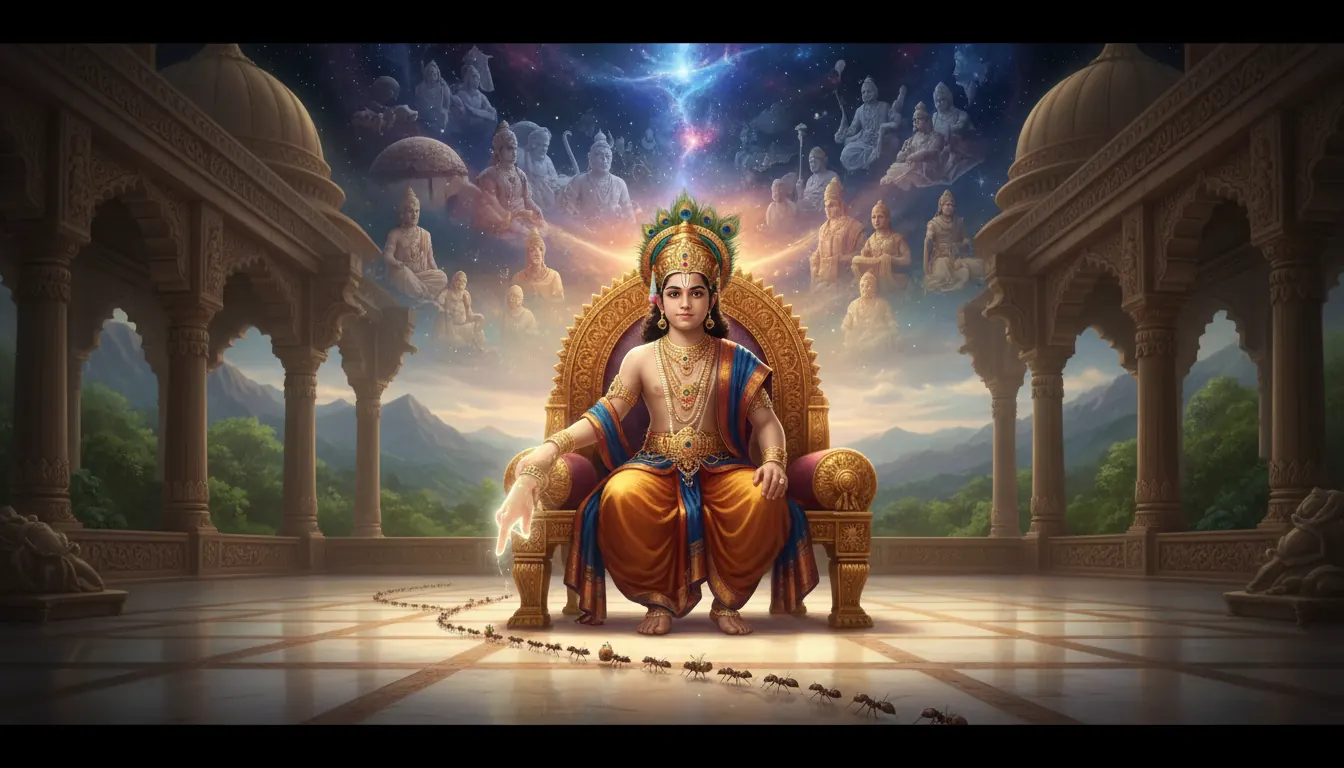
The Fowler's Cry
Brihaspati teaches Indra how to subdue an enemy without fighting him
In short
Yudhishthira asks how a king should deal with a mild foe, a fierce foe, and a foe with many allies, and Bhishma answers with the old discourse in which Indra came to Brihaspati with joined palms and asked how to subdue his enemies by contrivance rather than slaughter. The teacher of the gods gave him the covert arts entire: the concealed face, the feigned trust, the fowler who calls in the language of the birds he means to take, the long wait for the hour when the enemy expects nothing, the agent paid in private and disgraced in public. He ended with a plain domestic test for telling a friend from a wicked man, and Indra, following the instructions, reduced all his enemies to subjection without a battle.
Told in the Shanti ParvaSet in Amaravati and Kurukshetra16 min read
Three Kinds of Enemy
The old man on the arrows had been answering questions about war for days, and the last of them had been about omens: which birds, which winds, which way the deer run when an army sets out. Bhishma had finished that catalogue by telling Yudhishthira that the victory won by battle is the inferior kind, and that a king should first behave peacefully and fight only when peace has failed.
Yudhishthira, who now had a kingdom and every enemy in it already dead, asked the question that came next.
"Tell me, grandfather, how a king should behave towards a foe that is mild, towards one that is fierce, and towards one that has many allies and a large force."
Three enemies, and the king wanted three different answers. Bhishma did not give him a rule. He gave him a conversation that had happened before the world was as old as it is now.
"On this point the old story is told of the conversation between Brihaspati and Indra," he said.
Brihaspati is the teacher of the gods, the one who holds their sacrifices together and their policy as well, skilled in Virtue and Profit and Pleasure alike and learned in the duties of kings. Indra is his pupil, and Indra is also the ruler of the celestials, the slayer of Vala and Vritra, a king with a throne already won and a great many defeated beings living below it who remembered exactly how they had been defeated.
Once on a time, said Bhishma, that slayer of hostile heroes, the chief of the celestials, joined his palms and approached Brihaspati and saluted him. A king came to his teacher in the posture of a suppliant, and asked.
"How, twice-born one, should I behave towards my foes? How should I subdue them by stratagems, without wiping them out? In a collision between two armies, victory may be won by either side. In what way should I behave so that this blazing prosperity that I have won, and that scorches all my enemies, may not desert me?"
That is the whole of the question, and every clause of it matters. Not how to kill them. How to hold what is already held, by contrivance rather than by arms, in a world where a battle is a coin thrown into the air.
The Fowler's Cry
Brihaspati began where a teacher of the gods would be expected to begin, with what a king must not do.
"One should never wish to subdue one's foes by quarrel," he said. "Only boys, hot with anger and without forbearance, go looking for quarrels."
That is the first sentence of the whole science, and it is an insult. A man who picks a fight because he is angry has not entered upon policy at all. He is a child with a kingdom.
Then the rules for a face.
"One that desires the destruction of a foe should not put that foe on his guard. One should never exhibit one's ire or fear or joy. He should hide these in his own heart. Without trusting one's foe in reality, one should behave towards him as if one trusted him completely. One should always speak sweet words to one's foes and never do anything unpleasant to them. One should abstain from fruitless acts of hostility as also from insolence of speech."
Three feelings are named and all three are shut in: anger, fear, and gladness. The king may keep them. He may not wear them. And what he shows instead is not neutrality but warmth, an imitation of trust so complete that the man being deceived would swear to it.
Then the image that carries the rest of the discourse.
"As a fowler, carefully imitating the cries of the birds he wants to catch or kill, captures them and brings them under his power, so should a king, Purandara, bring his foes under subjection, and then slay them if he likes."
The fowler does not chase birds. He learns their language, and he says in it the one thing they want to hear, and they come down to him. The teacher of the gods put that in front of the king of the gods without softening it, and then added the clause that takes the last comfort out of it: and then slay them if he likes.
"Having overcome one's foes, one should not sleep at ease. A wicked foe raises his head again, like a fire carelessly put out that flares up again."
There is no moment in this teaching at which the work is finished. There is only a fire that has stopped smoking.
The Man Who Waits
"When victory may be won by either side," said Brihaspati, "an armed clash should be avoided. Once one has lulled a foe into a sense of safety, one should bring him under subjection and gain one's object."
Then he turned the lesson around, so that Indra could see it from the other side of the field, and this is the most alarming passage of the discourse, because the man being described is not the pupil.
A foe that is disregarded and neglected, being all along unsubdued at heart, consults with his ministers and with intelligent persons conversant with policy, and smites at the proper season, especially when the enemy makes a false step. By employing trusted agents of his own, such a foe would also render the other's forces inefficient by producing disunion.
That is what the beaten man in the corner of the hall is doing while the victor enjoys his prosperity. He is waiting for the false step. Brihaspati describes him in order to say: this is also you, and he is also this.
So the king must know his enemies the way a man knows a text, ascertaining the beginning, the middle and the end of them, and in secret cherish feelings of hostility towards them while showing none. He should corrupt the forces of his foe, ascertaining everything by positive proof, using the arts of producing disunion, of making gifts, and of applying poison. He should never live in companionship with his foes.
"A king should wait long, and then slay his foes," Brihaspati said. "He should wait for the opportunity, so that he can fall on his foe at a time when the foe least expects him."
Wait long. Not because delay is a virtue, but because the value of the blow is set entirely by the surprise in it, and surprise is a thing that ripens.
And then, against everything the passage has been building, a restraint.
"A king should never slay a large number of the troops of his foe, although he should certainly do that which would make his victory decisive."
The object is the decision, not the killing. A field full of bodies is not a proof of policy. It is usually a confession that policy failed and the king had to spend men instead.
The Wound That Rankles
"The king should never do his foe an injury that would rankle in his heart," Brihaspati said. "Nor should he wound him with wordy darts and shafts."
Here is the whole difference between this teaching and mere cruelty. A humiliation is not free. Every insult is a deposit left with the man insulted, and he keeps it, and it earns interest for as long as he lives. The prohibition covers speech as strictly as it covers the sword, and the phrase used for speech is the one used for arrows: wordy darts and shafts, which is what a taunt is, and which is why the wound it makes does not close.
"If the opportunity comes, he should strike at him, without letting it slip. Once an opportunity has passed the man who was waiting for it, he can never have it again, however much he wants to act."
So the waiting has an edge on both sides. The king who moves too early is a boy quarrelling. The king who lets the hour go by because he has grown comfortable with waiting has thrown away the only thing his patience was buying.
"Acting according to the opinions of the wise, a king should only break the strength of his foe. He should never try to achieve his aims when the moment is not favourable. Nor should he, when the opportunity is at hand, persecute his foe."
Then Brihaspati named what ruins kings, and the list is short, and not one of the four things on it is an enemy.
His own mildness. The severity of his punishments. His inactivity. His heedlessness.
Those are the four, and the fifth thing that ruins a foolish ruler is the deceitful contrivances of his foes, well applied. But the contrivances only work because the four are already there. A king is opened from within, and then entered.
"Giving up lust and wrath and pride, the king should act with care and keep watching for his foes' lapses. The king who can conquer these four faults and counter the deceitful contrivances of his enemies succeeds, without doubt, in striking them all down."
The first campaign in this science of enemies is fought against the king himself, and until it is won the rest of the instruction is worth nothing to him.
Consult One Man
Brihaspati came down from the general to the particular, and the first particular was the council chamber.
"When a single minister, with no help, can accomplish a secret purpose of the king, the king should consult that one minister alone about it. Many ministers, if consulted, try to push the burden of the task onto one another's shoulders, and even make public what should be kept secret. Only when consulting one is not proper should the king consult many."
Two failures of a large council, and the second is the one that kills. A crowd of advisers leaks. It also spreads the responsibility so thin that no man in the room believes the work is his.
Then the enemies themselves, sorted by whether they can be seen.
"When foes are unseen, divine punishment should be invoked on them. When they are seen, the army of four kinds of forces should be set in motion."
And the order of the means: the king should first use the arts of producing disunion, as also those of conciliation, and when the time for each particular means comes, that particular means should be applied. The tools are not ranked by dignity. They are ranked by the hour.
Then the passage that Indra, of all listeners, would have found hardest.
"At times, the king should even prostrate himself before a powerful foe. By prostrating one's self, by gift of tribute, by uttering sweet words, one should humble one's self before a more powerful king. And again, keeping careful watch himself, he should try to bring about the victor's destruction when the victor grows careless."
The chief of the celestials was being told how to lie on the ground in front of somebody stronger, pay him, praise him, and take care to do nothing that might awaken his suspicions, while waiting for him to relax. And the same lesson runs the other way, as it always does in this discourse: a victorious king should not trust his beaten foes, for those who are beaten always stay wakeful.
"If a king becomes mild, he is ignored. If he becomes fierce, he fills people with dread. So do not be fierce. And do not be mild. But be both fierce and mild. As a rapid current ceaselessly eats away the high bank and causes large landslips, even so heedlessness and error cause a kingdom to be ruined."
Ground One by One
"Never attack many foes at the same time," Brihaspati said. "By using the arts of conciliation, or gifts, or sowing discord, Purandara, they should be ground down one by one. As for the few who remain, the victor may deal peacefully with them. An intelligent king, even if he is able to, should not set out to crush all his foes at once."
Even if he can. That qualification makes it a doctrine and not merely prudence. The strength to do a thing all at once is not a reason to do it all at once.
Then the single case in the discourse where open war is approved, fenced about with conditions. When a king happens to have a large army of the sixfold forces, full of horse, elephants, chariots, foot and engines, all devoted to him, and when he thinks himself superior to his foe in many respects upon a fair comparison, then he should strike the foe openly without hesitation. Devoted to him, and upon a fair comparison. A king who cannot make an honest count of his own troops has no business at the head of them.
"If the foe is strong, a policy of conciliation towards him is not to be approved. Punishment by secret means is the policy to adopt instead."
Against the strong: nothing soft, no repeated expeditions, and no scorching of the country either. Loss of crops, the poisoning of wells and tanks, and suspicion in respect of the seven branches of administration are all to be avoided, which is to say that a king may deceive his enemy but should not wreck the land they are fighting over or the machinery he hopes one day to inherit.
What he may do instead is set out plainly. Diverse kinds of deception. Diverse contrivances for setting his foes against one another. Different kinds of hypocritical behaviour. Trusted agents ascertaining the doings of his foes in their cities.
And then a piece of stagecraft that deserves to be read slowly. Kings should send their agents into the cities and provinces of their foes, making them gifts of wealth in private, and confiscating their possessions publicly, without however injuring them materially, and proclaiming that these are all wicked men who have suffered for their own misdeeds.
The agent is paid in the dark and punished in the daylight, and the punishment is his cover, and the crowd that watches him ruined is the audience the whole performance was mounted for. Meanwhile, at home, men conversant with the scriptures and adorned with every accomplishment are set to work upon incantations and foe-killing rites.
How to Know a Wicked Man
Indra had listened to the whole of it, and the question he asked at the end was not about armies.
"What are the marks of a wicked person, best of the twice-born? Since I ask you, tell me how I am to know who is wicked."
It is the right question. Every contrivance in the discourse depends on knowing which man across the table is which, and Brihaspati answered with a portrait so domestic that it could be checked at any dinner.
A wicked person is he who proclaims the faults of others behind their backs, who is inspired with envy at the accomplishments of others, and who remains silent when the merits of other people are proclaimed in his presence, feeling a reluctance to join in the chorus.
Then the teacher stopped himself, because that last sign is not safe.
"Mere silence on such occasions is no indication of wickedness."
Quiet men are not villains. So he gave the signs that go with the silence and make it legible. At such times the wicked man breathes heavily. He bites his lips. He shakes his head. He always mixes in society and speaks irrelevantly.
He never does what he promises when the eye of the person to whom he gave the assurance is not upon him, and when that eye is on him, he does not even allude to the subject.
He eats by himself, and not with others on the same board, and finds fault with the food placed before him, saying, "All is not right today as on other days."
His disposition shows itself in the circumstances connected with his sitting, his lying and his riding.
And then the line that gives the test its opposite, and its use.
"Sorrowing at times of sorrow and rejoicing at times of joy are the marks of a friend. The opposite behaviour marks an enemy. Keep these sayings in your heart, ruler of the gods! The disposition of wicked men can never be concealed. Having listened to the truths laid down in the scriptures, follow them duly."
Bhishma let the old dialogue close there, and gave Yudhishthira the outcome in a single sentence.
"When he had heard these words of Brihaspati, Purandara, intent on subduing his foes, acted strictly according to them. Bent upon victory, that slayer of foes, when the opportunity came, obeyed these instructions and reduced all his enemies to subjection."
Every enemy. Not by a battle. By waiting, and by the fowler's cry, and by knowing which of the men at his own table breathed heavily when another man was praised.
Dharma Lesson
The epic does not hide this teaching or apologise for it. It puts the crooked arts in the mouth of the teacher of the gods, has the king of the gods practise them successfully, and then hedges them everywhere with restraints a merely ruthless man would never accept: do not kill in numbers, do not wound with words, do not poison the wells, do not crush every enemy at once even when you can. The line drawn here is not between honesty and deception but between the injury that ends a quarrel and the injury that keeps one alive in another man's heart. And the first enemy named in the whole discourse is the king's own mildness, severity, idleness and inattention, which is a way of saying that no amount of cunning will save a ruler who has not first been honest with himself.