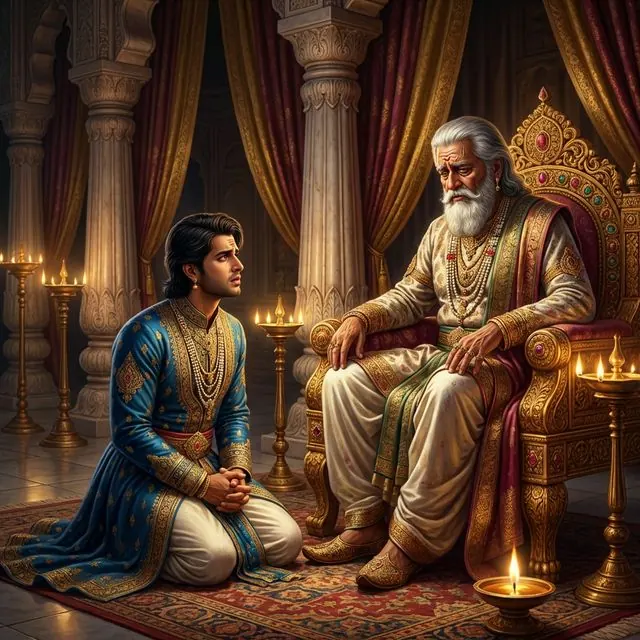
Krishna's Gift to the Dying Grandsire
The Boon That Took Away Pain, Hunger and Thirst So Bhishma Could Speak
In short
Riding out from the Kuru city, Krishna and Yudhishthira come to the bank of the Oghavati where Bhishma lies on his bed of arrows, looking like a fire about to die out. Krishna praises him, shows him his eternal form, and tells him that fifty-six days of life remain and that all Knowledge will expire with him. Bhishma answers that his limbs are weak, his vitals are burning and he cannot tell the sky from the earth, and asks to be excused from teaching. Krishna refuses the excuse and instead grants him freedom from pain, hunger and thirst, an unclouded memory, and the eye of knowledge that sees all created things like fishes in a limpid stream.
Told in the Shanti ParvaSet in Oghavati, Kurukshetra and Hastinapura18 min read
The Road Out of the City
Vaishampayana, telling the whole of it long afterwards to king Janamejaya, set the scene on a road.
The war was over. The eighteen days were spent, the fires had been lit for the dead, and Yudhishthira sat on a throne he did not want. Krishna had taken him up on his chariot that morning, and to fill the road he had told him the story of Rama of Bhrigu's race, the brahmana with the axe who in wrath had emptied the earth of kshatriyas thrice seven times over, and of how the boys of the royal order had been hidden from him among cows and bears and apes until the earth herself begged a sage for kings again.
Yudhishthira heard it out and was filled with wonder.
"Descendant of Vrishni," he said to Janardana, "the great-souled Rama, who in his wrath rid the earth of kshatriyas, had prowess like Shakra's own. The young kshatriyas, in fear of Rama, were hidden and raised by cows, by the Ocean, by leopards and bears and apes. This world of men deserves every praise, and those who live in it are fortunate, for in it a brahmana once again did a deed so righteous."
He was a man who had just killed his own house down to the last cousin, listening to a story in which the killing of kshatriyas came out righteous at the end. He said the pious thing and did not sound comforted by it.
The discourse ended there, and neither of them began another. The chariot went on across the field where the war had been fought, and its rattle was the only sound. The two illustrious men in it, Krishna of unfading glory and the son of Dharma, went on to the place where the mighty son of Ganga lay on his bed of arrows.
A Fire About to Die Out
They saw him from a long way off.
Bhishma lay stretched on his bed of arrows, and Vaishampayana says that he looked in splendour like the evening sun covered with his own rays. He had been there since the tenth day of the battle, held up off the ground on the shafts that Arjuna had driven through him, waiting by his own choice for the sun to turn north before he would consent to die. The spot was highly sacred, on the banks of the river Oghavati, and the Kuru hero lying on it was surrounded by many ascetics, as he of a hundred sacrifices is surrounded by the deities of heaven.
Krishna and Dharma's royal son and the four Pandavas and the others, headed by Kripa the son of Sharadvan, got down from their vehicles while they were still at a distance. They collected their restless minds. They concentrated all their senses. Then they went forward on foot, and saluted first the foremost of the rishis, Vyasa among them, before any of them went near the bed.
Govinda and Satyaki and the rest approached the son of Ganga last, and took their seats around him, the Yadu princes and the Kuru princes together on the ground, which had not happened in that field for eighteen days without arrows in the air.
Keshava looked at him.
Whatever the ascetics had been saying about the ninth of the Vasus and his mastery over death, what lay on the arrows was an old man at the end of a long life with a hundred wounds in him, and Vaishampayana chooses the plainest image in the section for what Krishna saw: he looked like a fire about to die out.
And Keshava, with a rather heavy heart, spoke to him.
Are Your Perceptions Clear
"Are your perceptions as clear now as they were before?" Krishna said. "I hope your understanding is not clouded, most eloquent of men. I hope your limbs are not tortured by the pain of the arrow wounds."
Then, having asked it, he answered it himself, and the answer is the strangest thing in the conversation.
"Grief of the mind weakens the body too. Because of the boon your father, the righteous Shantanu, granted you, your death, mighty hero, waits on your own will. I myself do not have the merit that won you this boon."
Shantanu had given his son that boon long ago, on the day the boy gave up a throne and a wife and every son he might have had, so that his father could marry a fisherman's daughter. The gift was that death would have to wait until Bhishma called it. It had been sitting unused for a lifetime. Now it was the only thing holding him above the ground, and Krishna, who was God walking about in the shape of a cousin, said in front of everybody that he did not possess the merit by which that boon had been won.
Then he said the other half.
"The smallest pin pushed into the body hurts. What then of the hundreds of arrows that have pierced you, king? Surely pain cannot be said to afflict you."
Both things are true at once and Krishna lets them stand side by side without reconciling them. A pin hurts. There are hundreds of arrows in this man. Therefore, he says, pain cannot be said to afflict you, and everyone sitting on that ground could see the shafts standing out of him in the evening light and could hear what the sentence was really doing, which was asking a question in the form of a compliment.
Bhishma did not answer it yet.
The Ninth of the Vasus
Krishna went on praising him, and the praise was a list of the things nobody else had done.
"You could teach the gods themselves, Bharata, how living creatures come to be and how they pass away. Your knowledge is great, and you know everything of the past, the future and the present. You are an ocean of virtue and duty.
"When you were enjoying great sovereignty I saw you give up the company of women, though you were sound of limb and in perfect health and surrounded by women. Apart from Shantanu's son Bhishma, we have never heard of anyone in the three worlds who, by ascetic power, while lying on a bed of arrows at the point of death, could master death so completely as to hold it off.
"We have never heard of anyone else so devoted to truth, to penances, to gifts, to sacrifices, to the science of arms, to the Vedas, and to protecting those who ask for protection. There is no one so harmless to all creatures, so pure in conduct, so self-controlled, so set on the good of all creatures, and at the same time so great a chariot warrior as you. There is no doubt that on a single chariot you could subdue the gods, Gandharvas, Asuras, Yakshas and Rakshasas.
"Mighty-armed Bhishma, the brahmanas always call you the ninth of the Vasus. But in virtue you have surpassed them all, and you are the equal of Vasava himself."
That last is not flattery but a fact about his birth. Eight Vasus once stole a sage's cow and were cursed to be born as men, and seven of them Ganga carried to the river as infants and gave back to the water at once. The eighth she was made to keep, and he grew up, and this was he, lying on the arrows beside the Oghavati.
"By your ascetic power you could create a whole universe of moving and unmoving creatures."
Dispel the Grief of the Son of Pandu
Then Krishna came to what he had actually driven out there to ask.
"Now dispel the grief of the eldest son of Pandu, who is burning with sorrow over the slaughter of his kinsmen."
Yudhishthira was sitting there while it was said. He had been crowned days before and had spent the days since unable to look at his own hands, and the man he was being brought to was the man his brother had shot down.
Krishna set out what Bhishma had that was needed, and he set it out as an inventory, because the point was that no one else held the whole of it.
"You know all the duties laid down for the four orders and the four stages of life. Everything taught in the four branches of knowledge and in the four Hotras. Those eternal duties laid down in Yoga and in Sankhya. The duties of the four orders, and those duties that are not inconsistent with their declared practices, all of these along with their interpretations. The duties laid down for those born of a mixture of the orders, and those laid down for particular countries and tribes and families. Those declared by the Vedas and those declared by men of wisdom. The subjects of the histories and the Puranas. All the scriptures on duty and conduct live in your mind.
"Apart from you, bull among men, there is no one who can clear away the doubts that arise about the branches of knowledge people study in this world. Use your intelligence, prince of men, to drive away the sorrow of the son of Pandu."
And then a line that says why such a man is permitted to exist at all.
"People of such great and varied knowledge live only to comfort men whose minds are bewildered."
Bhishma raised his head a little off the arrows, and joined his hands, and spoke.
What the Dying Man Saw
"I bow to you, divine Krishna. You are the origin of all the worlds and their dissolution. You are the Creator and the Destroyer. No one can defeat you, Hrishikesha. The universe is your handiwork. You are the soul of the universe and the universe has come from you. You are the end of all created things. You are above the five elements. I bow to you who are the three worlds and who are beyond the three worlds as well. Lord of yogis, I bow to you, the refuge of everything."
He had been listening to a long speech in praise of himself, and the first thing he did with his voice was turn every word of it around.
Then he said what was happening to him while he lay there.
"Foremost of beings, the words you have spoken about me have let me see your divine attributes as they show themselves in the three worlds. Govinda, I see your eternal form as well."
He described it the way a man describes something he is looking at.
"You stand there, boundless in energy, closing off the seven paths of the Wind. Your head fills the sky, and your feet the earth. The points of the compass are your two arms, the Sun is your eye, and Shakra is your prowess. Lord of unfading glory, your Person, dressed in yellow robes the colour of the Atasi flower, looks to us like a cloud charged with lightning."
Arjuna had been shown that form on the first morning of the war, between the armies, and had been terrified by it. Bhishma was shown it on his bed of arrows, and asked for nothing that a frightened man asks for.
"Best of gods, lotus-eyed one, think what would be good for me, your humble devotee, who seeks your protection and longs for a blessed end."
Fifty-Six Days
"Your devotion to me is very great, bull among men," said Vasudeva, "and that is why I have shown you my celestial form, prince. I do not show myself to anyone who is not devoted to me, or to a devotee who is not sincere, or to anyone whose soul is not restrained. Your own penances, Bhishma, have made you able to see me."
Then he told him two things that no one else on that field could have told him.
"The regions from which there is no return are ready for you, king. You have fifty-six days still to live, best of Kuru's race. Then you will cast off your body and receive the blessed reward of your acts."
Fifty-six days. Not a hope and not a blessing, a number, given to a man who had chosen to keep himself alive by will and had no way of knowing how much of that will he would need. And Krishna showed him what was waiting through all of it.
"Look: those gods and the Vasus, all in forms of fiery splendour, riding in their chariots, are waiting for you unseen until the moment the sun enters his northern course. When the divine Surya turns north, as universal time decrees, you, best of men, will go to the regions from which no man of knowledge ever comes back to this earth."
His seven brothers had come for him. They were standing over the arrows in the air, in their chariots, and they would go on standing there for eight more weeks, and nobody had been able to see them.
Then Krishna said the thing that put the whole burden on the old man's mouth.
"When you leave this world for that one, Bhishma, all knowledge will die with you, hero. That is why all these people have gathered and come to you. Speak words of truth, full of morality and Yoga, to Yudhishthira, whose learning grief has clouded, and take that grief from him quickly."
I Cannot Tell the Sky from the Earth
Bhishma had two answers and he gave both.
The first was courtesy. "Master of all the worlds, mighty-armed one, Shiva, Narayana, lord of unfading glory, your words have filled me with joy. But what can I teach in your presence, when your own speech has covered everything there is to speak of? Whatever in either world ought to be done, or is done, comes from your mind. Only a person able to lecture on heaven in front of the king of the gods himself could lecture on morality, pleasure, profit and salvation in front of you."
Even Brihaspati, he said, the very master of speech, would be overcome by hesitation if he spoke in your presence.
The second answer was not courtesy. It was the plain report of a body on a bed of arrows, and it is one of the few places where Bhishma says what the last days actually feel like from the inside.
"My mind, slayer of Madhu, is in turmoil from the pain of the arrow wounds. My limbs are weak. My understanding is not clear. These shafts torment me like poison or fire, so that I have no strength to say anything. My strength is abandoning me. My life-breaths are hastening to leave me. The very vitals of my body are burning. My understanding is clouded. From weakness my speech is becoming indistinct. How then can I venture to speak?
"I can no longer tell the points of the compass apart, or the sky from the earth. It is only through your energy, slayer of Madhu, that I am barely alive."
So he refused. He asked to be excused, and asked Krishna to teach the king himself.
"Speak yourself, then, for the good of king Yudhishthira the just, for you are the one who ordained every ordinance. When you, the eternal creator of the universe, are here, Krishna, how can someone like me speak, like a pupil in front of his teacher?"
Krishna did not accept the refusal. He removed the reason for it.
The Boon
"Your words are worthy of you," said Vasudeva, "best of Kuru's race, great in energy, great in soul, great in patience, and learned in every subject."
Then he gave him the gift, and it was made of exactly the complaints Bhishma had just listed, taken away one by one.
"As for what you have told me about the pain of your arrow wounds, Bhishma, take this boon that I grant you out of my grace.
"Discomfort and stupor and burning and pain and hunger and thirst will not overcome you, son of Ganga.
"Your perceptions and memory, sinless one, will be clear. Your understanding will not fail you. Your mind, Bhishma, freed from the qualities of passion and darkness, will always rest in the quality of goodness, like the moon come out from behind the clouds.
"Your understanding will see to the bottom of any question of duty, morality or profit you turn your thoughts to."
And then, past the removing of pain, an addition.
"Tiger among kings, you will gain celestial vision and see the four orders of created things. With the eye of knowledge you will see every created thing you try to call to mind, as clearly as fish in a clear stream."
That is what he was given for his fifty-six days. Not health, and not one hour of extra life. He would lie on the same arrows in the same body, and the shafts would stay where they were. What was lifted off him was everything that stood between his mind and his speech: the hunger, the thirst, the burning, the wandering, the indistinct speech of a weak man. In their place, a memory that could look down into the whole of what had ever been made the way a man looks down into clear water and sees the fish.
Everything that comes after this in the Shanti Parva and the Anushasana Parva, every duty of kings and every old story and every catalogue of gifts and sins, comes out of a mouth that could only work because of what was said on that riverbank.
Flowers Out of Season, and the Ride Home
The rishis were still sitting there, and they had heard the whole of it.
Then those great rishis, with Vyasa among them, praised Krishna with hymns from the Rik, the Yajus and the Saman. A celestial shower of flowers of every season fell on that spot where he of Vrishni's race sat with Ganga's son and the son of Pandu, blossoms of spring and of the rains and of the cold weather coming down together on the same patch of ground. Celestial instruments of every kind played in the sky and the tribes of Apsaras began to sing.
Vaishampayana is careful about what did not happen. Nothing evil and no evil portent of any kind was seen there. A pleasant, pure and auspicious breeze, carrying every kind of fragrance, began to blow. All the points of the compass became clear and quiet, and all the animals and birds began to roam in peace. On a field where for eighteen days the omens had been jackals and headless trunks and rain of blood, there was nothing wrong with the sky for one evening.
Soon after, like a fire at the edge of a great forest, the divine Surya of a thousand rays was seen sinking in the west. The rishis rose and saluted Janardana and Bhishma and king Yudhishthira, and Keshava and the sons of Pandu and Satyaki and Sanjaya and Kripa bowed in reverence to them, and they went away to their own abodes saying, "We will return tomorrow."
Then Keshava and the Pandavas saluted Bhishma, walked round him keeping him on their right, and climbed into their handsome chariots. The army went with them, chariots decked with golden Kuvaras and infuriated elephants like mountains and horses fleet as Garudas, moving in two divisions, one before the princes and one behind, so that the whole host in the dusk looked like the two currents of the great river Narmada where the Rikshavat mountains stand across it and divide the water.
The moon rose in front of them as they went, giving back moisture to the herbs and plants whose juice the sun had sucked up all day.
And that bull of Yadu's race and the sons of Pandu entered the Kuru city and went to their mansions like tired lions seeking their caves, leaving behind them on the riverbank an old man in no pain at all, wide awake, with fifty-six days to spend and the eye of knowledge open in his head.
Dharma Lesson
Bhishma does not ask to be spared his death, and Krishna does not offer to spare it. What is lifted from him is only what stood between his mind and his speech, so that the last fifty-six days of a dying man could be spent giving something away. The boon is shaped precisely to the complaint that preceded it, which is its own kind of answer to prayer: not the removal of the arrows, but the removal of everything that made the arrows an excuse. Grace here is not comfort but capacity, and it is granted to a man who had already refused to use his weakness as a reason to be silent for anything smaller than reverence.