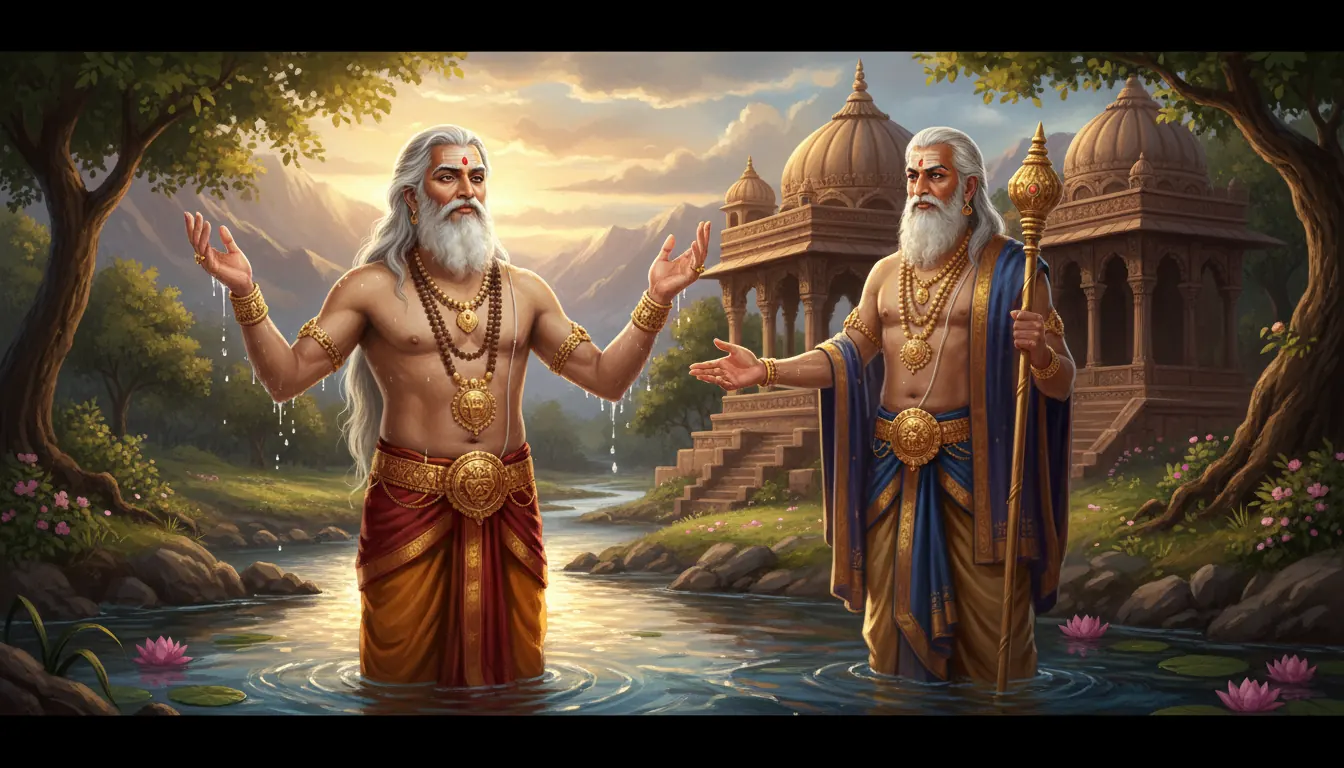
The King Who Was Left Alone
Vyasa tells Yudhishthira of Hayagriva, who fought robbers after his army was gone and won heaven at his post
In short
On the riverbank after the war, Vyasa tells Yudhishthira to rule before he retires, and sets out what a king is answerable for: the sixth part he takes, the protection he owes, and the counsellors whose practices resemble those of robbers. Then he recites the story of the ancient king Hayagriva, who had done everything a king should do and was still defeated and killed by robbers with no follower left beside him. Vyasa reads that last fight as a sacrifice, the bow its stake and the king's own breaths its final oblation, and says four times over that Hayagriva is now sporting in the regions of the gods. He never says the kingdom was saved.
Told in the Shanti ParvaSet in Ganga and Kurukshetra16 min read
The Sage Speaks Again
Arjuna had finished, and the king had not answered him. Vaishampayana, reciting the whole of it to Janamejaya generations afterwards, puts the moment down in a single line: thus addressed by Arjuna of curly hair, the Kuru king born of Kunti remained speechless.
They were still on the bank of the river, near the field, with the water rites for the dead behind them and the crown waiting for Yudhishthira in Hastinapura. He did not want it. His brothers had been taking turns for days telling him why he must keep it, and the arguing had reached the stage where a man stops replying.
Then the island-born spoke. Krishna-Dvaipayana Vyasa, who had fathered the fathers of both armies and had watched the whole ruin come on from a long way off, had answered the king first on the duties of the householder and the duties of kshatriyas, ending with the history of Sudyumna, the royal sage who cut off the hands of a brahmana who begged to be punished, and became famous for it. Now he began again. He addressed Yudhishthira as Ajatashatru, the man whose enemy has not been born.
"King," he said, "Yudhishthira, chief of the Bharatas, let these brothers of yours, these great chariot-warriors of tireless spirit, have the things they longed for while they lived in the woods."
That is a claim on the king made on behalf of four other men. Whatever they had promised themselves during those years of bark and roots, they had promised it against a future that only Yudhishthira could now unlock, and he was proposing to walk away from it.
"Rule the earth, son of Pritha, like a second Yayati, the son of Nahusha. Until now you have known only misery, living in the woods and keeping your ascetic vows. That misery is over, tiger among men. So be happy, for a while."
Notice what the sage did not say. He did not tell the king that his grief was unreasonable, or that the dead were well. He told him to be happy for a while, as though happiness were a duty with a term attached, and then he began to set out what the term contained.
The Debts, and the Two Sacrifices
"Earn and enjoy merit and wealth and pleasure with your brothers for some time, king, and after that you may withdraw into the woods."
The forest was not being refused him. It was being postponed, and put in its proper place at the end of a sequence, which is the whole of Vyasa's argument. Yudhishthira wanted to go into the woods immediately, out of horror at what the throne had cost. Vyasa was telling him that the woods are what a man goes to when he has finished paying, and that he had not begun to pay.
"First free yourself, Bharata, from the debts you owe: to those who come to you asking, to the Pitris, and to the gods. After that, son of Kunti, you may take up all the later stages of life."
Three creditors, and the order of them is worth holding. The men who come to a king's gate and ask. The ancestors, who are fed by the rites of a householder and by nobody else. The gods, who are fed by sacrifice. A man who walks into the forest with those three unpaid has not renounced anything. He has defaulted, and taken his peace of mind out of other people's mouths.
"Perform the Sarvamedha and Ashvamedha sacrifices, son of Kuru's line. Then, king, you will reach the highest goal hereafter. Set your brothers too at the head of great sacrifices with rich gifts to the brahmanas, and you will win great fame, son of Pandu."
So the programme was complete, and it was entirely a programme of work. Rule. Pay. Sacrifice, on the largest scale the books know. Put your brothers at the head of great rites of their own, and give away enough to make the gift memorable. Then, when there is nothing outstanding, go.
And having finished with what the king should do, the sage came to the part that concerns what a king is answerable for, and he introduced it the way such things are always introduced.
"There is a saying, tiger among men, best of the Kurus. Listen to it, king, for if you act on it you will not stray from virtue."
The saying, when it came, was about robbers.
Those Whose Practices Resemble Robbers
"Only men whose ways are the ways of robbers, Yudhishthira, will advise a king to take up a career of war and conquest."
It is a hard sentence to have read out to you on a riverbank within sight of the ground where eighteen armies went down. Vyasa is not saying that a king must never fight. He says a great deal in the other direction before he is done. He is saying something narrower and more uncomfortable: that when a king is talked into making conquest the business of his reign, the men doing the talking are of a particular kind, and the kind can be named. Their trade is taking what belongs to other people. They have simply found a way to do it with an army instead of with a knife on a road.
Yudhishthira had been counselled for years by men who wanted a war, and had been sitting for days being counselled by the same men that he must now enjoy what the war had bought. He was in a position to test the sentence against his own memory, which is presumably why it was said to him.
"A king who weighs the place and the time and is guided by an understanding grounded in the scriptures may pardon even a number of robbers and incur no sin."
That is the other side of it, and it is placed immediately after, so that neither half can be quoted alone. Robbers are the standing enemy of a kingdom, and the king may still pardon them, in numbers, without staining himself, provided he has weighed the place and the hour and has an understanding trained on the scriptures rather than on his own appetite. Mercy is not a lapse in a king. It is one of the things he is competent to do, exactly as punishment is.
"A king who collects his sixth part as tribute and does not protect his kingdom takes on a quarter of the sins of his kingdom."
Here is the arithmetic that runs under everything else. The sixth part of the harvest is the king's, and it is not a gift. It is the wage of protection. A king who draws the wage and does not do the work is not merely idle. A quarter of every wrong committed in his country is entered against his name, and he will be asked for it.
The Rules by Which a King Does Not Swerve
"Listen also to the rules that keep a king from straying from virtue."
What followed was a list, and Vyasa gave it plainly, without ornament, in order.
Going against the scriptures brings sin, while obeying them lets a man live without fear. That is the ground of it: the texts are not a burden laid on a king but the only thing that lets him sleep.
A king who is guided by an understanding grounded in the scriptures, who puts aside lust and anger and treats all his subjects alike, as a father would, never incurs sin. Two passions are named and no others. Wanting, and rage. Strike those out of the seat of judgment and what is left behaves like a father, which is to say it does not have favourites among its children and does not stop feeding the difficult one.
If a king, afflicted by destiny, fails to accomplish an act which he should, such failure would not be called a trespass.
The king should put down his enemies by force and by policy. He must not allow sin to be committed in his kingdom, but should see that virtue is practised.
Certain people are to be protected before others, and Vyasa named them: brave men; those whose conduct is respectable; those whose acts are virtuous; the learned; brahmanas versed in Vedic texts and rites; and men of wealth.
In deciding lawsuits and in carrying out religious acts, only men of great learning should be employed. And a prudent king will never put his whole trust in one man, however accomplished. However accomplished. The clause is put in to close the door that every king walks through.
Then the portrait of the other kind of ruler. That king who does not protect his subjects, whose passions are ungovernable, who is full of vanity, who is stained with haughtiness and malice, incurs sin and earns the reproach of tyranny. And if the subjects of a king waste away from want of protection and are afflicted by the gods and ground down by robbers, the sin of all this stains the king himself. The gods and the robbers are put in the same clause, and the king is charged with both.
Last, the mercy in the whole system. There is no sin in an act done with a whole heart, after full deliberation, and after taking counsel with men able to give good advice. Our tasks fail or succeed through destiny. But if effort has been made, sin will not touch the king.
Having said that a king is judged by his effort and not by his outcome, Vyasa gave him a king who was destroyed.
Without a Follower by His Side
"I will tell you, tiger among kings, son of Pandu, the story of what happened to an ancient king named Hayagriva."
Horse-necked, the name means, and that is nearly all the description the epic gives him. He belongs to no lineage the listener is expected to know. He has no capital that is named, no queen, no son, no counsellor. He is a king in the way a figure in a legal example is a man, and the story of him is four clauses long.
"It is the story of the heroic Hayagriva, whose deeds were without stain, who killed great numbers of his enemies in battle and was then himself defeated and killed, with not one follower at his side."
Everything is in the last phrase. He was not betrayed, and he was not taken asleep, and there is no traitor in this account because there is nobody in it at all except the king. He had an army at the start of that day and at the end of it he did not, and the epic does not say where it went, and the silence is the point. What is recorded is that when the field was empty he was still standing on it.
"He had done everything that must be done to keep enemies in check, and adopted all the best means by which men are protected. Hayagriva won great fame from the battles he fought and now enjoys great bliss in heaven."
He had done the work. He had checked his enemies as far as a king can check them, and taken up every one of the foremost means by which men are protected, which is the list Yudhishthira had just been given. He had drawn the sixth part and earned it. And it was not enough, because it is not always enough.
"Cut to pieces by the weapons of robbers while fighting them boldly, and giving up his life in battle, the great-souled Hayagriva, always devoted to his duties as king, achieved the purpose of his life."
Robbers. Not an emperor with a hundred thousand chariots, not a rival house with a claim, not a god in disguise testing him. The same dasyus who had been in the saying three breaths earlier, the standing enemy that a kingdom is organised against, and they cut him to pieces with their weapons while he fought them.
He died of exactly the thing a king exists to prevent, and the epic calls it the object of his life achieved.
The Bow Was the Stake
Then Vyasa did something to that little death on an empty field. He read it as a rite, and he read it part by part, matching every implement of the altar to something the man had in his hands.
The bow was his sacrificial stake, the post to which the victim is tied. The bowstring was the cord that binds the victims. His arrows were the smaller ladle, and the sword was the large one, the two spoons with which the offering is lifted and poured. Blood was the clarified butter that he poured. The chariot was the altar. The anger he felt in battle was the fire. And the four fine horses yoked to his chariot were the four Hotris, the priests who chant the invitation to the gods.
A man who has ever watched a sacrifice will recognise the whole apparatus, and will also recognise that every item of it has been made worse. The cord that ties the goat is a bowstring. The ghee is blood. The fire is a man's temper. The priests do not speak; they are horses. This is not a decoration laid over a battle to make it respectable. It is a battle described in the vocabulary of the altar so that both things are seen at once, and neither is let off.
"He poured his enemies into that sacrificial fire as offerings, and then, when the sacrifice was complete, his own life-breath, and so that vigorous lion among kings, Hayagriva, was freed from sin and now takes his pleasure in the worlds of the gods."
The foes went in first, one after another, as libations go in through the length of a long rite. That accounts for the large number of them he killed before the end. And then there is the final oblation, the one that closes the ceremony, and by then he had nothing left to lift with the ladle, so he poured in his own breaths.
This is the part no sacrificer ever does. The whole institution rests on the offerer standing outside the fire and handing things into it. A man who has run out of everything else and puts himself in has either destroyed the sacrifice or completed it, and the epic says completed, and says he came out of it freed from sin.
Taking His Pleasure in the Worlds of the Gods
After that the sage said the same thing over and over, and changed only the reason.
Hayagriva protected his kingdom with policy and intelligence. That great-souled king, self-controlled and strong of mind, devoted to sacrifice, filled all the worlds with his fame and now takes his pleasure in the worlds of the gods. He won the merit that sacrifice brings and every kind of merit belonging to human affairs, and he wielded the rod of punishment and ruled the Earth with vigour and without pride. That is why the virtuous and great-souled Hayagriva now takes his pleasure in the worlds of the gods.
Learned, practising renunciation, moved by faith, and full of gratitude, that king did many deeds, then left this world of men and won the worlds reserved for the intelligent and the wise, for those of approved conduct and behaviour, and for those ready to give up their lives in battle.
He studied the Vedas well and the other scriptures too, ruled his kingdom properly and kept all four orders to their own duties, and so the great-souled Hayagriva takes his joy in the worlds of the gods.
He won many battles and cherished his subjects, drank the Soma juice in sacrifices and pleased the foremost of brahmanas with gifts, wielded the rod of punishment wisely over those in his power, and at last gave up his life in battle; and that king now lives happily in heaven.
Four times the same destination, reached by four different roads, and the roads are the ordinary duties of an ordinary reign. Study. Revenue. Rites. Judgment, applied to the people under his hand. Care of subjects. Not one miracle in the list, and not one victory that lasted.
"His life deserves every praise. Learned and honest men applaud it, as it deserves. Having won heaven and gained the worlds reserved for heroes, that great-souled king of virtuous deeds was crowned with success."
And there the story stops, without ever saying that the kingdom was saved. It is not said that the robbers were driven off, or that anything at all survived the afternoon. Vyasa never claims the outcome. He claims the man.
The king listening was the one who had won. He had the earth and a crown he had spent days trying to refuse, and he had been shown a man who lost everything including his life and was now at play among the gods. Between the two of them the difference was not victory. It was that one of them was still at his post.
Dharma Lesson
Vyasa answers a king who wants to leave the throne by describing a king who stayed on it and was killed for nothing. Hayagriva took the sixth part and earned it, protected whom he was told to protect, and still lost the field, and the epic counts his exertion rather than his result. That is the mercy hidden in the rules: tasks fail or succeed through destiny, and what is asked of a ruler is that he keep working at the post while he is standing in it. Grief at an outcome is not the same thing as guilt for it.