Seven Bows Against One
Dhrishtadyumna rides at Drona in the night battle and answers seven champions with three arrows apiece
In short
At dead of night on the fourteenth day, Dhrishtadyumna drives at Drona and shoots a shaft that lights the whole army, and Karna cuts it out of the air. Seven of the greatest Kaurava chariot-warriors then shoot at the Panchala prince together, and he answers each of them with three arrows and beheads the warrior Drumasena in the middle of it. Satyaki reaches him before the ring closes, and Karna tells Duryodhana that the way to win is to surround these two as they once surrounded Abhimanyu.
Told in the Drona ParvaSet in Kurukshetra12 min read
Two Oceans in the Lamplight
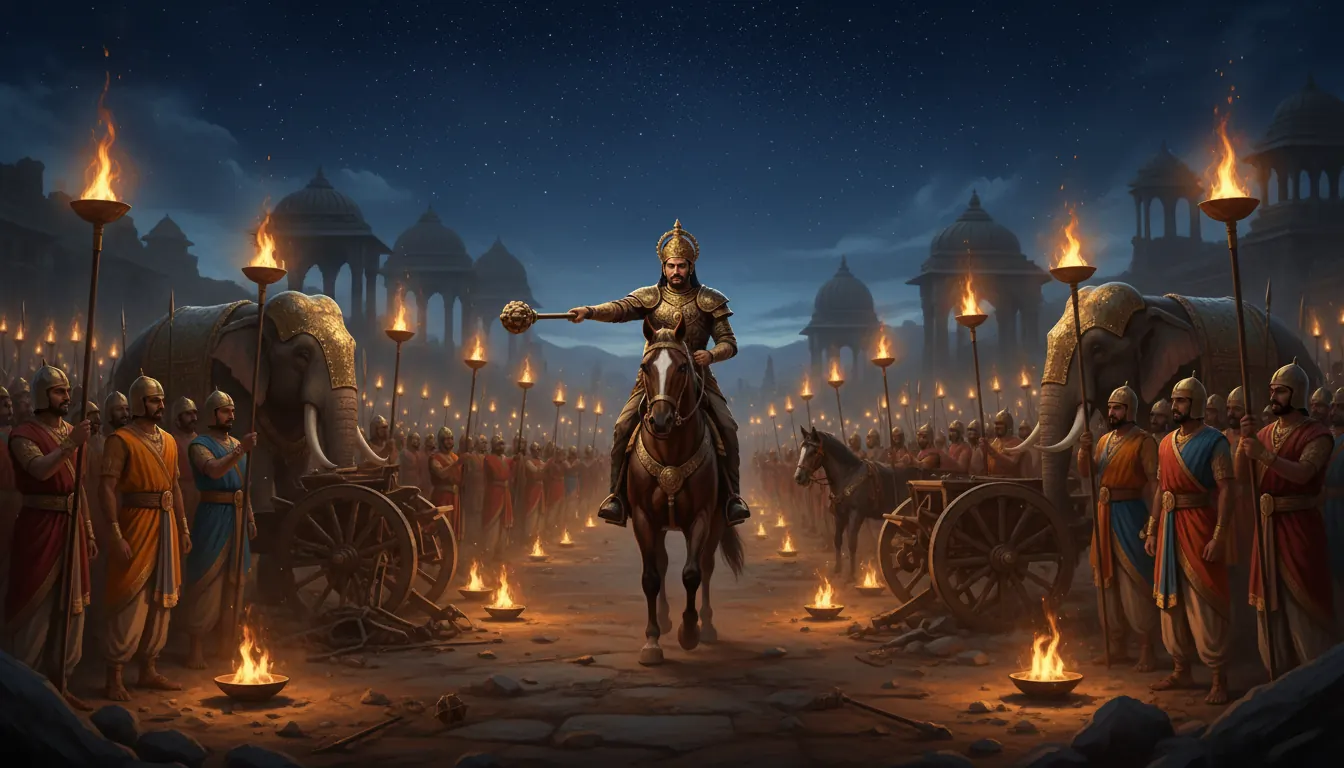
Sanjaya was describing the night. Not a night of rest, because there was none on the fourteenth day of that war, which had run past sunset and gone on burning in the dark by the light of lamps set on chariots and elephants and horses, so that the field looked like day and the men on it could not tell one side from the other.
"Father slew son," Sanjaya said, "and son, not knowing him, slew father, and friend slew friend. In that dreadful battle by night, king, all fought furiously, with no regard left for one another."
Into that, holding his formidable bow and stretching the string again and again as he came, went the prince of the Panchalas.
Dhrishtadyumna had been born out of a sacrificial fire for one purpose, which everybody on both sides of the field knew. His father Drupada had obtained him from the fire to kill Drona. He had been given the command of the whole Pandava host, and he had spent fourteen days doing a general's work, and now, at dead of night, he set his chariot straight at the one man he existed for.
Drona's chariot was decked with gold and easy to find in the lamplight.
The Panchalas and the Pandavas, seeing where their commander was going, came after him and surrounded him, because a man riding at Drona alone does not come back. And Duryodhana, seeing the teacher attacked, put himself and his men round Drona on all sides and fought resolutely to keep him.
So the two masses of troops came together on that night, and Sanjaya said they looked like two terrible oceans lashed into fury by a tempest, with every living creature inside them agitated.
Then the prince of the Panchalas pierced Drona in the chest with five arrows, and uttered a lion-like roar.
The Arrow That Lit the Army
Drona answered the roar with twenty-five arrows, and with one more, broad-headed, he cut off Dhrishtadyumna's bright bow at a stroke.
There is a thing that happens to a man who has been made for a single task and is stopped at the door of it. Dhrishtadyumna threw the useless bow aside and bit his lower lip. Sanjaya gives that detail and no other about his face.
Then he took up another formidable bow, for the accomplishing of the destruction of Drona.
He was, Sanjaya said, a warrior of great beauty, and he stretched that bow to his ear, and shot one terrible arrow that could take Drona's life.
It lit the whole army as it went. Men on both sides saw their own hands and their own dead by the light of it, as though the sun had risen at midnight over the field. And the gods, the gandharvas and men, watching from above the lamps and below them, said these words aloud: "Prosperity to Drona!"
It was Karna who answered them.
He was not fighting Dhrishtadyumna. He was somewhere along the line with his own work in front of him, and he saw the shaft go and read where it was going, and displaying that lightness of hand for which he was famous he cut it into a dozen fragments while it was still in the air, before it reached the teacher's chariot.
The pieces came down on the earth like a snake without poison.
Then Karna, having cut the arrow, went after the archer. He shot away Dhrishtadyumna's own shafts with his straight ones, and then pierced the prince himself with many sharp arrows, and the night closed round the Panchala's chariot.
Three Arrows Each
What followed is set down by Sanjaya as a list, because that is what it was.
Drona's son Ashwatthama pierced him with five. Drona himself with seven. Shalya, the king of the Madras, with nine. Dushasana with three. Duryodhana with twenty. Shakuni with five. And Karna, who had begun it, with ten.
Seven of the greatest chariot-warriors of the Kaurava side, all of them shooting at one man in the dark, and all of them exerting themselves for one purpose, which was the rescue of Drona.
Dhrishtadyumna pierced every one of the seven with three arrows.
That is the whole of his answer and it is worth pausing on. He did not withdraw, he did not call for the Panchalas who had come out with him, and he did not choose one of the seven and turn on him. He divided himself among all of them, three arrows apiece, and kept his chariot where it was, and went on afterwards to strike Drona again, and Karna, and Drona's son, and the king's son, singling out the four heaviest of them for a second time.
Thus pierced by that bowman, they fought together and pierced him again, roaring the while.
Anyone counting arrows in the lamplight would have said the thing was already decided. Seven bows against one, and every one of the seven a name that armies moved for. The Kaurava troops nearest the place had begun to look at the Panchala prince the way men look at something that is finished and does not yet know it.
They were still looking when a fresh voice came out of the press on his flank, calling him to stop.
Wait, Wait
"Wait! Wait!"
The man who said it was Drumasena, one of the warriors of Duryodhana's side, and he had come up excited with wrath and had already pierced the Panchala prince with a winged arrow and then quickly with three more. He wanted the prince to turn and give him the fight.
Dhrishtadyumna gave it to him in the time it takes to draw three times.
Three straight arrows first, equipped with wings of gold, steeped in oil, and capable of taking the life of the man at whom they are sped. Then a fourth, broad-headed, that cut the head from Drumasena's trunk while it was still wearing its bright ear-rings of gold.
Sanjaya, who watched a great many heads come off that fortnight and does not usually stop for one, stopped for this one. The head fell on the ground, he said, with its lower lip bit in rage, like a ripe palmyra fruit separated from the stalk by the action of a strong wind.
It had been alive and shouting a moment earlier. That is the reason the image is there. The man had time to be angry and no time at all to be afraid.
Then Dhrishtadyumna turned back to the seven as though nothing had interrupted him. He pierced all of them again with keen shafts, and with some broad-headed ones he cut off the bow of Radha's son, that warrior who knew every mode of warfare.
Karna could not brook the loss of it. Sanjaya says he took it as a fierce lion takes the cutting off of his tail. He caught up another bow with his eyes red, breathing hard, and covered the Panchala prince with clouds of arrows.
And the six others, seeing Karna in that state, closed in and encompassed Dhrishtadyumna from every side, wanting to kill him there.
Every soldier of the Kaurava army who could see the place regarded him as already within the jaws of the Destroyer.
The Grandson of Shini Arrives
He was not, because somebody was crossing the field toward him.
Satyaki of the Dasharha race, the grandson of Shini, had been fighting his own way through that army since the afternoon, and he came now scattering his shafts as he went, and reached the spot where Dhrishtadyumna was battling the six.
Karna saw him coming and pierced him with ten arrows before he had finished arriving.
Satyaki pierced Karna with ten in return, in the very sight of all those heroes, and said one line to him.
"Do not run away. Stand and face me."
The fight that followed, Sanjaya said, was like the one between Vali and Vasava long ago. Satyaki terrified the kshatriyas around him with the rattle of his chariot and pierced the lotus-eyed Karna again and again; Karna made the earth tremble with the twang of his bow and answered with hundreds of shafts, long and barbed and pointed and razor-headed and tall-toothed, and Yuyudhana shrouded him back with arrows, and for a time the battle between them went on evenly.
Then Karna's armoured son joined in and pierced Satyaki from every side with sharp arrows.
Satyaki resisted the weapons of all of them and of Karna also, and while he was doing it he sent one arrow into the centre of Vrishasena's chest.
Vrishasena was Karna's son. He was of great splendour and he was valiant and he fell down in his chariot, casting his bow away, and lay still.
Karna, looking at him, believed that mighty chariot-warrior slain.
What Sanjaya says next is that Karna was scorched with grief for the death of his son, and began to press Satyaki with great force. The boy was not dead. His father fought the rest of that engagement believing he was, and Satyaki, hard pressed by a man in that state, pierced him with many arrows and then cut off the leather guards and the bows of both father and son together, so that the two of them had to string fresh bows before they could go on.
What Karna Heard in the Dark
While the two of them were stringing those bows, another sound arrived over the whole field.
It was the twang of Gandiva, and it was louder than everything else in that darkness, and the rattle of the chariot under it was like thunder.
Karna heard it and turned to Duryodhana and spoke, and what he said is the clearest account anybody on the Kaurava side gave that night of what was happening to them.
"Arjuna is slaughtering our entire army, the best of our heroic warriors and many mighty bowmen among the Kauravas, and twanging his bow loudly. Clearly the son of Pandu is achieving feats worthy of himself. This son of Pritha will grind down our great host. Many of our troops are already breaking. No one stands in battle. Our army is being scattered like a mass of rising clouds scattered by the wind. Meeting Arjuna, our host breaks up like a boat on the ocean.
"Listen, tiger among chariot-warriors, to the sound of drums and cymbals near Arjuna's chariot at dead of night, like the deep roll of thunder in the sky. Listen too to the loud wails of stricken fighters, and the tremendous lion-like shouts, around his chariot.
"But here among us stands Satyaki, the greatest of the Satvatas. If we can strike down this target, we can defeat all our foes. And the son of the Panchala king is fighting Drona. He is surrounded on all sides by many heroic and great chariot-warriors. If we can slay Satyaki and Dhrishtadyumna, the son of Prishata, then without doubt, king, victory will be ours.
"Surrounding these two heroes, as we did the son of Subhadra, we will strive to slay them."
As we did the son of Subhadra. He said it plainly to the king, in the middle of a battle, as a method that had worked once and could be used again. Abhimanyu had been sixteen years old and had been surrounded by six chariot-warriors, Karna among them, only the day before.
Back Where It Began
Duryodhana took the advice, and turned to his uncle to give the order, and Sanjaya, telling it afterwards to a blind man in a hall, said that he addressed Shakuni the way the illustrious Indra addresses Vishnu.
"Go against Dhananjaya with ten thousand elephants that never retreat and ten thousand chariots as well. Dushasana and Durvishaha and Subahu and Dushpradharshana will follow you, with a great many foot-soldiers around them. Uncle, slay those great bowmen, the two Krishnas, and Yudhishthira, and Nakula, and Sahadeva, and Bhima, the son of Pandu. My hope of victory rests on you, as the gods' hope rests on their chief Indra. Uncle, slay the son of Kunti."
So Shakuni clad himself in mail and went off with a large force and the king's brothers to keep Arjuna away from the place, and the Suta's son went at Satyaki with hundreds of shafts and a great many men behind him, and the Kaurava warriors combined and encompassed the grandson of Shini.
Which left the thing where it had begun.
Bharadwaja's son brought his own chariot up against Dhrishtadyumna's chariot, and the two of them fought a wonderful and fierce battle at dead of night, the teacher and the Panchalas, exactly as they had been fighting when Karna cut the first arrow out of the air.
Nothing in the whole exchange had moved either of them a foot. Seven of the greatest bowmen in the world had shot at one man in turn and together; he had answered every one of them with three arrows apiece, taken a head off in the middle of it, cut Karna's bow, and stood where he was until help came. And Drona, who had been the target from the first line of it, was still on the field and still had his weapon in his hand, and the man born to kill him was in front of him again with a bow.
They had eight hours of darkness left, and then a morning, and Drona had one more day to live.
Dharma Lesson
Dhrishtadyumna was made for one man and rode at him with seven bows in the way, and what he did was not to break through and not to retreat, but to answer every one of the seven with the same three arrows and hold his ground until help arrived. Courage of that kind is not the will to win a thing quickly; it is the refusal to let being outnumbered decide what you attempt. Karna, meanwhile, proposed to win by surrounding two men the way six of them had surrounded a boy the day before, and said so to the king without embarrassment. The same night shows both: a man who would not change his purpose because the odds were against him, and men who had already changed theirs because the odds were with them.