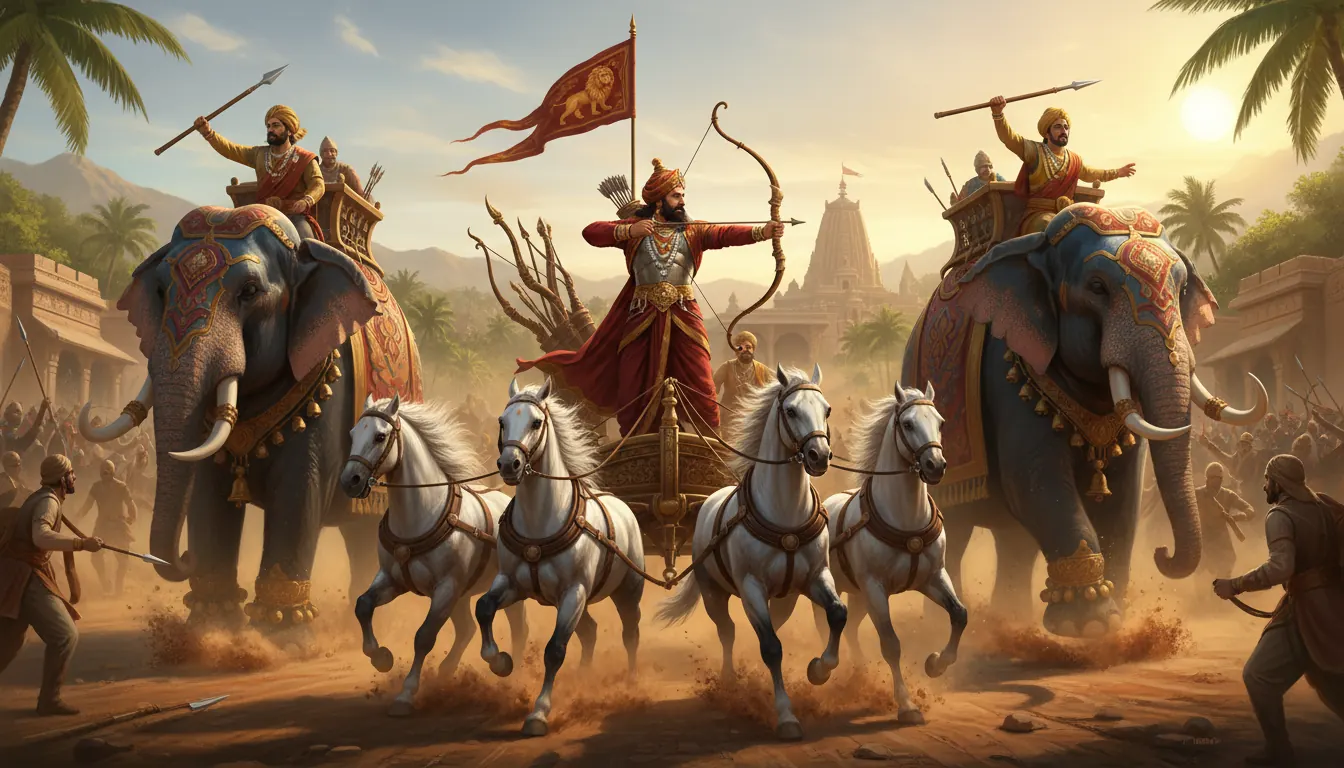
The King Put Off His Chariot
Satyaki kills Duryodhana's horses and driver, cuts his bow at the handle, and the king escapes on Kritavarma's chariot
In short
On the night of the fourteenth day the Kaurava kings surround Satyaki, and the noise of the slaughter brings Duryodhana himself. In a duel of a few exchanges Satyaki puts eighty shafts into the king's chest, kills his horses and his driver, cuts off the five hundred arrows Duryodhana shoots from the wrecked chariot, and finally cuts his bow through the handle. Deprived of both chariot and bow, Duryodhana mounts Kritavarma's chariot, and the same hour sees Shakuni put off his own chariot by Arjuna.
Told in the Drona ParvaSet in Kurukshetra13 min read
The Uproar at Dead of Night
Sanjaya said: "Then all those kings of your army, who were not easily beaten in battle, advanced in anger against Yuyudhana's chariot, unable to bear his feats."
It was still the fourteenth day, or what was left of it. The sun had gone down on Jayadratha's death hours before, and neither army had stopped. Duryodhana had ordered lamps carried onto the field, torches in the hands of foot-soldiers and cressets fixed to the chariots and the tusks of elephants, so that the fighting went on in a moving hall of light with darkness pressing at its edges.
Somewhere in that light was Satyaki.
He is called by many names in this part of the account and it is worth having them straight, because Sanjaya uses them all in the space of a page. Yuyudhana is his own name. He was the grandson of Shini, of the Satvata line, of the race of Madhu and of Vrishni, which is to say he was Krishna's kinsman, one of the Yadava chiefs who had come to Kurukshetra on the Pandava side. He was also Arjuna's pupil. Earlier that same day Yudhishthira had sent him alone through the whole Kaurava army to find Arjuna, and he had gone through it and reached him, and he had been fighting ever since without rest.
Now the kings came for him together. They mounted their well-equipped chariots, decked with gold and jewels, and brought cavalry and elephants with them, and they surrounded the Satvata hero on all sides. Hemming him in, those mighty chariot-warriors challenged him and roared like lions. They were not trying to drive him off. They wanted him dead, and there were enough of them to do it.
They poured their keen arrows on him from every quarter.
Seeing them rush towards him like this, the mighty-armed grandson of Shini took up his bow and shot.
Yak-Tails and White Umbrellas
What followed is described by a man who was watching it and who had no fondness for the Pandava side.
The heroic and great bowman Satyaki, invincible in battle, cut off many heads with his fierce and straight arrows. And the hero of Madhu's race also cut off, with razor-headed arrows, the trunks of many elephants, and the necks of many horses, and the arms of many warriors, arms decked with Angadas.
An Angada is an armlet worn above the elbow, gold, heavy, the ornament of a man rich enough to fight in his jewellery. Sanjaya notices them lying on the ground because they were the only thing about those arms that could still be recognised.
Then he gives the image that stays.
With the fallen yak-tails and white umbrellas, the field of battle became almost full, and resembled the firmament with stars.
The yak-tail whisk and the white umbrella are what a king travels under. Every one of those umbrellas had been held over the head of somebody who mattered, and every whisk had been waved by a servant whose whole office was to wave it, and now they were down in the dirt in such numbers that a man looking across the field in lamplight saw only pale round shapes scattered over a dark surface, like the night sky turned upside down and laid on the earth.
The wails of the host Yuyudhana was slaughtering grew as loud as the shrieks of ghosts. The earth was filled with that uproar, and the night grew fiercer and more terrible.
That is the sound that carried across the field to the place where the king of the Kauravas was fighting, and that is how this episode begins: not with a challenge or an insult or a formal approach between equals, but with a noise in the dark that had to be gone to and stopped.
Drive the Horses to That Place
Seeing his host broken and stricken by Yuyudhana's arrows, and hearing that tremendous, hair-raising uproar at dead of night, your son, that mighty chariot-warrior, spoke to his driver, and said one thing again and again.
"Drive the horses to that place the uproar is coming from."
Sanjaya says he repeated it, which is worth noticing. The order was given more than once, either because the driver hesitated or because Duryodhana could not stop saying it. Nothing in the line is boastful. He does not say find Satyaki, or bring me to the Vrishni. He says: go to the sound.
It should be said plainly what he was doing. Duryodhana was the king. He had a hundred brothers, many of them still alive that night, and Drona and Karna and Ashwatthama and Kritavarma and Shalya and his uncle Shakuni all fighting on the same field within reach of a horn. Any of them could have been sent.
He did not send anybody. He went himself, toward a noise that had already eaten a piece of his army.
Then king Duryodhana, that firm bowman, above all modes of warfare, rushed against Yuyudhana.
Madhava saw him coming and did not wait. He pierced Duryodhana with a dozen blood-drinking shafts, sped from a bow drawn to its fullest stretch, and the fight was joined before the king had said a word.
Struck by Yuyudhana's arrows first, Duryodhana flew into a rage, and pierced the grandson of Shini in return with ten arrows.
Around them the battle between the Panchalas and all the Kaurava troops went on, and Sanjaya, who had been describing carnage for hours, pauses to say that it presented an exceedingly wonderful sight. Then he goes back to the two men.
Eighty Shafts in the Chest
Ten arrows from a king is not a small answer. Duryodhana was not a poor bowman and never had been. He had been Drona's pupil alongside Arjuna and Balarama's pupil with the mace, and earlier that same day he had stood in front of Arjuna in armour of mantras and had not fallen. Sanjaya calls him a firm bowman and says he was above all modes of warfare, and that is the assessment of a man reporting to the king's father, but it is not flattery invented for the occasion. It is what the account says of him elsewhere too.
It made no difference at all.
Then the grandson of Shini, in a rage in that battle, pierced your son, that mighty chariot-warrior, with eighty shafts, in the chest.
Eighty. Not eighty over the course of the duel, but eighty in the exchange that followed ten, and all of them in the chest, which means every one of them found the same place on a moving man in a moving chariot by lamplight. That is the whole of what needs to be said about the difference between the two of them as archers, and Sanjaya says it with a number and moves on.
Then, with other shafts, he sent Duryodhana's horses to Yama's realm.
And then that slayer of foes quickly struck his enemy's driver down from the chariot.
It took three strokes of work, delivered in order, the way a man dismantles a machine. First the man himself, so that he is hurt and cannot press. Then the horses, so that the chariot cannot move. Then the driver, so that even if fresh horses were brought up there would be nobody to handle them.
The king of the Kauravas was left standing on a chariot that was not going anywhere, in the middle of a night battle, in front of a Vrishni who had been killing since morning and was not tired.
The Bow Cut at the Handle
What Duryodhana did next is the reason this episode is remembered kindly by people who do not otherwise think well of him.
Your son, king, standing on that horseless chariot, shot many sharp arrows at Satyaki's chariot.
He did not get down. He did not call for help, and there is no speech from him here at all. He stayed on the wreck with dead horses in the traces and his charioteer on the ground beside the wheel, and he went on shooting, and he shot five hundred arrows.
But the grandson of Shini, showing great lightness of hand, cut down all five hundred of the shafts your son shot in that battle.
Lightness of hand is the phrase Sanjaya keeps for the very best archers on the field, and it is the same phrase he used of Karna a few hours earlier. Five hundred arrows came at him and five hundred arrows were cut out of the air, and nothing reached the chariot.
Then Madhava, with a broad-headed shaft, suddenly cut through your son's formidable bow at the handle.
The handle is the grip, the thick middle of the stave where the hand closes on it. A bow cut at the tip can sometimes be restrung. A bow cut at the handle comes apart in two pieces in a man's fingers while he is holding it, and it is finished, and so is he.
Robbed of both his chariot and his bow, that mighty ruler of men quickly climbed onto Kritavarma's bright chariot.
Kritavarma was a Bhoja chief of the Vrishni house, one of Krishna's own kinsmen, who had brought his own army over to Duryodhana's side while Arjuna took Krishna. So the man who reached down and pulled the king of the Kauravas onto his chariot floor that night was of the same blood as the man who had just knocked him off his own.
When Duryodhana withdrew, the grandson of Shini harried and routed your army at dead of night.
Shakuni Loses a Chariot in the Same Hour
The same thing was happening on the other side of the field, and Sanjaya sets the two down one after the other without comment, which is its own kind of comment.
Karna had persuaded Duryodhana earlier that night that the war could be won by killing Satyaki and Dhrishtadyumna while Arjuna was kept away from them, and Duryodhana had sent his uncle Shakuni to keep Arjuna away. So Shakuni surrounded Arjuna on all sides with many thousands of chariots and several thousands of elephants and many thousands of horses, and began to fight desperately. Many of them hurled divine weapons of great power. Those kshatriyas fought Arjuna in the certainty of death, which is Sanjaya's way of saying that they knew.
Arjuna, in a rage, held back those thousands of chariots and elephants and horses and at last made those foes turn back. Then Subala's son, his eyes copper-red with rage, pierced him deeply with twenty shafts, and with a hundred more stopped the advance of Partha's great chariot.
Then the field is described as it looked afterwards. Strewn with lopped off arrows and with dead bodies by thousands, the earth looked as if covered with flowers. Indeed, strewn with the heads of kshatriyas, heads decked with diadems and handsome noses and beautiful ear-rings and lips bit in rage and wide open eyes, heads graced with collars and crowned with gems, heads which while life was in them spoke sweet words, the earth looked resplendent as if strewn with hillocks overspread with Champaka flowers.
Arjuna struck Uluka with an arrow in front of his father, and roared. Then the son of Indra cut Shakuni's bow in two. And then he sent his four horses to Yama's realm.
Then Subala's son jumped down from his chariot and quickly climbed onto Uluka's.
Within the same hour, on one field, the king and the king's uncle were both put off their chariots and both finished the night standing on somebody else's.
The River Between the Hosts
Father and son rode on the one chariot after that and showered their arrows on Partha like two risen clouds pouring torrents of rain on a mountain, and the son of Pandu pierced both of them and caused the Kaurava troops to fly away in hundreds and thousands.
Like a mighty mass of clouds dispersed on all sides by the wind, that army was dispersed. That host, slaughtered in the night, fled in all directions, stricken with fear, before the very eyes of their leaders. Many abandoned the animals they rode. Others drove their animals at full speed and turned back from the battle in terror, in that fierce hour of darkness.
When they had beaten those warriors, Vasudeva and Dhananjaya joyfully blew their conchs.
At the third place on the field, Dhrishtadyumna was still where he had been all night, in front of Drona, the man he had been born to kill. He pierced Drona with three arrows and cut the teacher's bowstring with a sharp one. Throwing that bow to the ground, heroic Drona, that grinder of kshatriyas, took up another that was exceedingly tough and strong, and pierced Dhrishtadyumna with seven arrows and his driver with five. Holding Drona back with his arrows, the Panchala prince began to destroy the Kaurava host like Maghavat destroying the army of the Asuras.
As your son's army was slaughtered, a terrible river with blood for its current began to flow. It ran between the two hosts, carrying away men and horses and elephants on its current. And it resembled the Vaitarani that flows towards the domains of Yama.
The Vaitarani is the river at the edge of the world of the dead, which the dead have to cross. Sanjaya does not say it looked like a river of the dead. He says it ran between the two armies, so that each host stood on its own bank and looked across at the other over water that was carrying their men away.
Then Dhrishtadyumna and Shikhandi blew their large conchs, and so did the twins, and Vrikodara, the son of Pandu.
So those fierce warriors defeated thousands of kings of your side, men of great energy, before the eyes of your son, and of Karna, and of the heroic Drona, and of Drona's son.
Dharma Lesson
Duryodhana comes off better in this passage than in almost any other, and it costs him everything anyway. He goes toward the screaming himself instead of sending a brother, and when the horses and the driver are gone he stays on the dead chariot and keeps shooting, and none of it matters against a better archer. Courage is not the same thing as competence, and a man who has been told all his life that he is the equal of the men fighting for him will only find out on a night like this one. The kindest reading of the scene is also the most damning: he was brave, and it changed nothing, because the war was never going to be decided by how much heart he had.