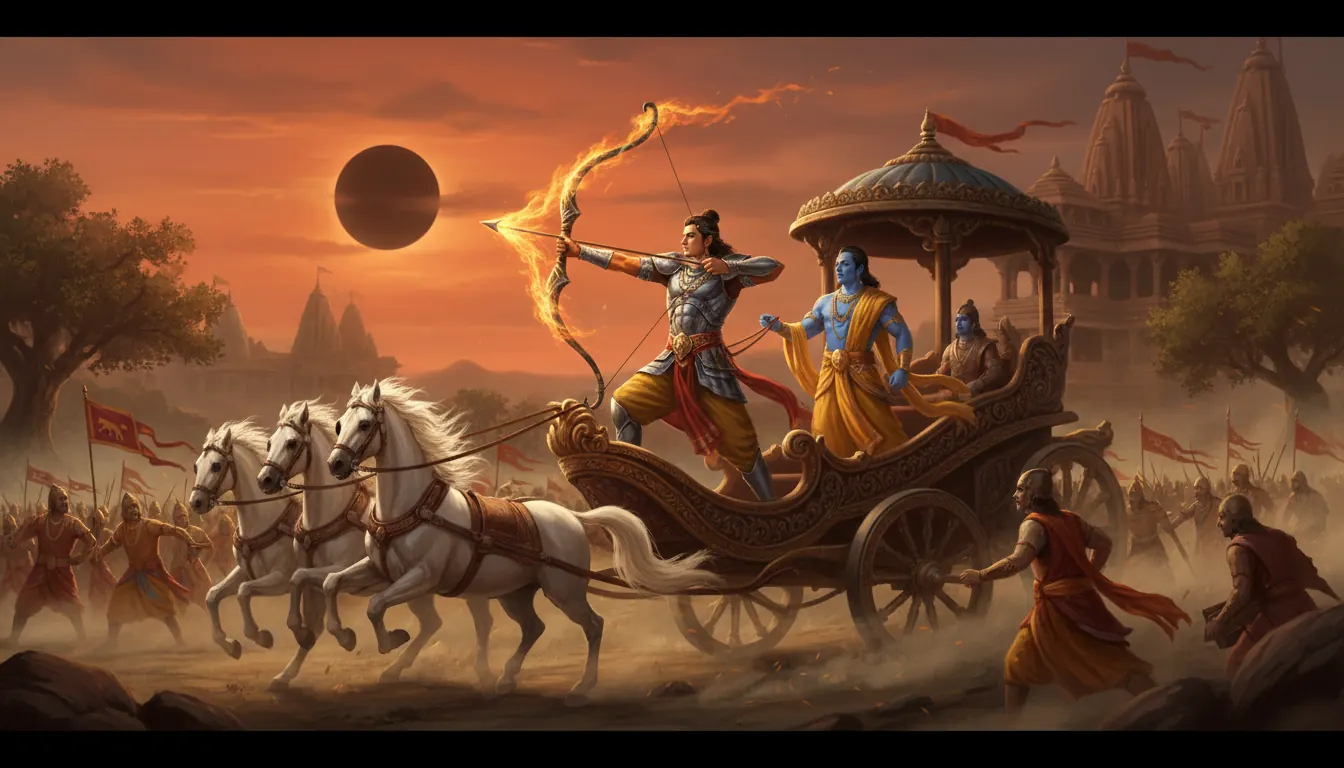
Duels by Torchlight
Six single combats fought by lamplight on the road to Drona's chariot
In short
On the night of the fourteenth day, every Pandava warrior trying to reach Drona is met by a Kaurava champion, and the battle breaks into single combats fought by lamplight. Shalya unhorses Virata and kills his brother Satanika when he comes to the rescue; Nakula's son Satanika strips Chitrasena of his armour; Vrishasena drives an arrow through Drupada's breast; Dushasana cuts Prativindhya's chariot into a thousand pieces; Nakula pierces Shakuni's thigh; and Kripa beats Shikhandi down onto the platform of his chariot. Then the lamps make the field bright enough for men to kill their own kin without knowing them.
Told in the Drona ParvaSet in Kurukshetra20 min read
Lamps on the Chariots
Sanjaya was telling the blind king what his sons had done after dark.
The fourteenth day had not stopped at sunset. Arjuna's vow had eaten the whole of it, and when the sun went down the two armies were still locked together, so lamps were called for and lamps were brought, and men set them burning on the platforms of the chariots, on the backs of the elephants, on the necks of the horses, and carried them in their hands where they fought on foot. The field of Kurukshetra became a hall lit for a festival, and the men in it went on killing each other by the light.
At the centre of that light stood Drona.
Everything Sanjaya had to report of that night was a variation on one sentence: somebody on the Pandava side was trying to reach the teacher's chariot, and somebody on the Kaurava side stepped across his road. That was the whole shape of it. The Panchalas wanted Drona dead. The commander's own troops had put themselves between him and every man who wanted it, and the wanting had to be spent one duel at a time before anyone came near him at all.
So the night broke into single combats, each with its own ring of lamplight around it, each fought by men who could see their enemy's face at twenty paces and nothing whatever beyond him.
"The ruler of the Madras," Sanjaya said, "covered Virata and his troops on all sides with clouds of arrows, as Virata was pressing quickly forward to get at Drona."
Shalya, king of Madra, was the uncle of Nakula and Sahadeva by their mother Madri, and he was fighting on the other side, having been tricked into a promise on the road to the war. Virata, king of the Matsyas, was the old man who had sheltered the five brothers for a year while they wore other men's names in his palace, and had given his daughter to Abhimanyu, who had been killed the day before.
The two of them came together in the dark, and Sanjaya, who had seen a great deal by then, said the battle was like the one between Vala and Vasava long ago.
The King of Madra and the King of the Matsyas
Shalya struck first, and struck like a man doing arithmetic. A hundred straight shafts into Virata, that commander of a large division, delivered with great activity.
Virata answered in the old style, counting aloud with his arrows. Nine keen arrows. Then three and seventy. Then a hundred more.
It was an even exchange while it lasted, and it did not last. Shalya stopped shooting at the man and shot at the chariot instead. The four horses yoked to Virata's chariot went down together. Two shafts after that took the umbrella and the standard, which are the things by which a king is known on a field at night, so that in the space of three breaths the king of the Matsyas had lost his horses, his shade and his name.
He did not wait to be dragged out of the wreck. Jumping quickly down from that horseless chariot, the old man stood on the ground, drawing his bow and shooting sharp arrows, on foot, in front of the Madra king's horses.
That is the picture to hold, because it is the one his brother saw.
Satanika, Virata's brother and a Matsya prince of the same house, was fighting elsewhere in the lamplight. Seeing his brother robbed of his horses, he turned his chariot and came, before the eyes of all the troops, driving straight at the gap between Virata and the man who had made him a foot-soldier.
There was nothing wrong with what he did. It is what a brother does, and it is what a rescue looks like, and every man watching would have done the same.
The ruler of the Madras pierced the advancing Satanika with many arrows and sent him to the abode of Yama before he had crossed half the distance.
He was still coming forward when he died. The chariot came on without its master, garlanded, its standard swaying, and drew up in the lamplight beside the king it had been sent to save.
The Chariot He Climbed Into
When the heroic Satanika fell, Virata, the commander of a large division, climbed into the fallen hero's chariot, decked with its standard and garlands.
He had no other. The chariot his brother had died bringing him was the nearest vehicle on the field, and it was empty, and he got up onto it with his brother's blood on the terrace and his brother's garlands still swinging from the pole. Sanjaya does not say that he wept, or that he spoke. He says only what happened to his eyes.
With his eyes wide open, and his prowess doubled by rage, Virata quickly covered the chariot of the ruler of the Madras with winged arrows.
For a little while the old man was the better warrior of the two. He put the whole of what he had left into it, and the arrows went over Shalya's chariot in a roof, and the Madra king was driven back on his own axle by an enemy shooting from a dead man's footboard.
Then Shalya, excited with rage, steadied, and shot for the chest.
A hundred straight arrows, driven deep, into the breast of a man who had held nothing back and had nothing in reserve. That great chariot warrior, Virata, sat down on the platform of his chariot and fainted, and his driver, seeing him torn by arrows in that encounter, did the only useful thing left and carried him out of the fight.
With him went the courage of his troops. That vast force fled away on that night, oppressed by hundreds of arrows of Shalya, that ornament of battle.
So the first of the night's accounts closed. The king who had hidden the Pandavas for a year, and given them his daughter's marriage and his kingdom's army, was carried off the field senseless, and his brother lay behind him in the lamplight, and the man who had done both was their own nephews' uncle.
Seeing the troops running, Vasudeva and Dhananjaya quickly advanced to the place where Shalya stood.
The Rakshasa With the Vulture on His Pole
They did not reach Shalya, because something came out of the dark to meet them.
Alambusha was a prince of the rakshasas fighting in Duryodhana's pay, and his equipage was worth the description Sanjaya gave it, because on a night lit by lamps it was designed to be seen. A splendid chariot with an eight-horse harness. Terrible-looking pisachas with horses' faces yoked to it in place of horses. Blood-red banners. Floral garlands made of black iron. Bear-skins over the sides. And a tall standard on which perched a fierce-looking vulture, of spotted wings and wide-open eyes, shrieking without stopping.
The rakshasa himself, said Sanjaya, looked beautiful like a loose heap of antimony, and he withstood the advancing Arjuna the way Meru withstands a tempest, scattering showers of arrows on Arjuna's head.
The battle that commenced between the rakshasa and that human warrior was exceedingly fierce, and it filled all the spectators with wonder, and it conduced also to the joy of vultures and crows, of ravens and owls and kanakas and jackals, who had learned by the fourteenth day where to wait.
It did not take long. Arjuna struck Alambusha with six arrows and then cut down the shrieking standard with ten sharp arrows. With a few others he cut down the driver, with some more the trivenu, with one the bow, with four the four horses. Alambusha strung another bow and Arjuna cut that in two as well, and then put four sharp arrows into the prince of the rakshasas himself.
Thus pierced, the rakshasa fled away in fear, leaving the iron garlands and the bear-skins and the vulture on the ground behind him.
When he had defeated him, Arjuna went on toward the place where Drona was, shooting many arrows as he went at men, elephants and horses. Slaughtered by the illustrious son of Pandu, the fighters fell to the ground like trees laid low by a storm, and all the rest fled like a frightened herd of deer.
The lamps went with them, so that the flight could be watched from a long way off, a slow tide of small lights going backward across the field.
The Snake That Cast Its Slough
Elsewhere in the same darkness there was a young man scorching the Kaurava host with keen shafts, and he was also called Satanika. This one was Nakula's son by Draupadi, one of the five brothers the Pandavas had fathered on her, and he was making enough trouble that a son of Dhritarashtra turned aside to stop him.
Chitrasena, the king's son, resisted him, and what followed was a young men's duel, quick and showy and very nearly fatal to both.
Nakula's son pierced Chitrasena with five arrows. Chitrasena pierced him in return with ten whetted shafts, and then with nine more into the chest.
Then Satanika did the thing that made the watchers look twice. With many straight shafts he cut Chitrasena's armour off his body, plate from plate, without touching the man inside it. This feat of his seemed exceedingly wonderful. Divested of his armour, said Sanjaya, that son of yours looked exceedingly beautiful, like a snake having cast off its slough at the proper season.
He was also, of course, naked to the next arrow.
Satanika cut the standard next, and then the bow. Bowless, armourless, Chitrasena took up another bow capable of piercing every foe and went straight back at him with many straight arrows, which is the only answer available to a man in that position.
Then Satanika, in a rage, killed the four horses and then the driver.
Chitrasena jumped down from the useless chariot and stood on the ground and struck the son of Nakula with twenty-five arrows from there, still fighting, still shooting, with nothing under him and nothing on him.
And Nakula's son, with one crescent-shaped arrow, cut the gold-decked bow out of his hands while he was in the act of shooting.
Without bow or chariot or horses or driver, Chitrasena turned and climbed up into the chariot of the son of Hridika, and the duel ended there, with the boy who had begun it still standing and the man who had come to stop him borne away in another man's chariot.
Two Porcupines in the Lamplight
Drupada, king of the Panchalas, whose other name is Yajnasena, was advancing at the head of his troops against Drona. He had been advancing against Drona in one way or another for most of his life. The two of them had been boys together in a teacher's house, and the friendship had broken, and the whole war had a thread of that quarrel running through it.
He did not get there either. Vrishasena rushed at him with great speed, scattering shafts in hundreds.
Vrishasena was Karna's son, a young man of his father's quality with none of his father's history to slow him down, and he took sixty arrows in the arms and the chest from the old king before he had properly begun. Then, excited with rage, he put many shafts into the centre of Drupada's chest in return.
Those two warriors, mangled by arrows, with shafts sticking to their bodies, looked beautiful like a couple of porcupines with their quills erect. Bathed in blood from the wounds of those straight arrows of keen points and golden wings, they looked, Sanjaya said, like a couple of radiant kalpa trees, or a couple of kinsukas rich with their flowery burthens.
Then Vrishasena pierced Drupada with nine arrows, and once more with seventy, and then again with three, and shooting thousands of arrows he looked in that battle like a cloud pouring torrents of rain.
Drupada, inflamed with wrath, cut Vrishasena's bow into two fragments with a broad-headed arrow, sharp and well-tempered.
Sanjaya slows down for what Karna's son did next, because he did it slowly. He took another gold-decked bow, new and strong. He drew out of his quiver one strong, whetted, well-tempered, sharp, broad-headed arrow. He fixed it on the string. He aimed it carefully at Drupada, and every Somaka watching that deliberate business was afraid, and then he let it off with great force.
That arrow, piercing through the breast of Drupada, fell on the surface of the earth beyond him.
The king of the Panchalas swooned. His driver, recollecting his own duty, bore him away from the field.
The Ground Made Beautiful
After that mighty chariot warrior of the Panchalas had retreated, the Kaurava army rushed furiously at Drupada's troops, whose armour had been cut away by the enemy's arrows.
What Sanjaya describes then is a rout, and he describes it as scenery, which is the strangest habit of this whole night's telling.
In consequence of the blazing lamps dropped by the combatants all around, the earth looked beautiful like the cloudless firmament bespangled with planets and stars. Men running had let their lamps fall, and the lamps had gone on burning where they lay, so that the field under the fighting was made of scattered lights. With the fallen angadas of the combatants, the armlets struck off arms and left lying, the earth looked resplendent like a mass of clouds in the rainy season with flashes of lightning in them.
Gripped by fear of Karna's son, the Panchalas fled on all sides, like the danavas in fear of Indra in the great battle long ago between the gods and the asuras. Driven like that in battle by Vrishasena, the Panchalas and the Somakas, lit up by lamps, looked exceedingly beautiful.
That is the sentence to sit with. They were the losing side, running, lit from below by the lamps they had dropped, and they were beautiful.
Having vanquished them, Karna's son looked beautiful like the sun when he reaches the meridian. Amongst all those thousands of kings on both sides, said Sanjaya, the valiant Vrishasena then seemed to be the only resplendent luminary on the field.
When he had defeated many heroes and all the mighty chariot warriors among the Somakas, he did not stop to be admired. He turned his horses and proceeded quickly to the spot where king Yudhishthira was stationed.
So in the space of one hour of that night the Matsya king and the Panchala king, the two old men who had given the Pandavas their army and their shelter and their marriages, had both been carried senseless off the field, one by Shalya and one by Karna's son.
Mercury and Venus
Prativindhya was Yudhishthira's son by Draupadi, and he was advancing against Drona, scorching his foes in battle, when Dushasana came out to meet him.
The encounter that took place between them, said Sanjaya, looked beautiful, like that of Mercury and Venus in the cloudless firmament: two bright things closing on each other with a great deal of dark around them.
Dushasana pierced Prativindhya with three arrows on the forehead. Deeply pierced by that mighty bowman, Prativindhya looked beautiful like a crested hill, with the three shafts standing out of his brow like a ridge. He answered with three arrows, and then with seven.
And then Dushasana, of whom very little good is recorded anywhere in the epic, achieved there an exceedingly difficult feat, and Sanjaya says so plainly.
He brought down Prativindhya's horses with many arrows. With another broad-headed arrow he brought down the driver, and then the standard. Then he cut the chariot itself into a thousand pieces, and, in a rage, cut the banner, the quivers, the strings and the traces into countless pieces as well, so that there was nothing left of the young man's equipage larger than a hand.
Robbed of his chariot, the virtuous Prativindhya stood on the ground, bow in hand, and fought him, scattering countless arrows.
Then Dushasana, displaying great lightness of hand, cut off his bow, and afflicted his bowless antagonist with ten shafts.
He had him. On any other night of that war he would have had him, and the arithmetic of the fifteenth day would have been different by one prince.
But Prativindhya had brothers on that field, the other sons of Draupadi, all mighty chariot warriors, and seeing their brother in that state they rushed headlong to the spot with a large force. He climbed into the shining chariot of Sutasoma, took up another bow, and continued to pierce the king's son from his brother's footboard.
Then many warriors on the Kaurava side rushed up with a large force and surrounded Dushasana to rescue him, and the single combat was swallowed. Then commenced a fierce battle between the two hosts at that dreadful hour of midnight, increasing the population of Yama's kingdom.
Wait, Wait
Nakula was smiting the Kaurava host when Shakuni saw him and came at him with great impetuosity, calling out as he came.
"Wait! Wait!"
They knew each other. Shakuni was the man whose dice had taken the kingdom, and Nakula was one of the five who had walked out of that hall in deer-skins, and Sanjaya says of them, without softening it, that each was enraged with the other and each desirous of slaying the other.
They struck each other with shafts sped from bows drawn to their fullest stretch. Subala's son displayed the same measure of skill that Nakula displayed in shooting showers of arrows, which is not a thing said of Shakuni often. Both pierced with arrows, they looked beautiful like a couple of porcupines with quills erect on their bodies. The armour of each was cut off by shafts with straight points and golden wings, and each bathed in blood, and they looked resplendent like two brilliant kalpa trees, or two flowering kinsukas, or a couple of salmali trees with prickly thorns on them.
Then they stopped shooting for a moment and looked at each other. Casting oblique glances, with eyes expanded in rage whose corners had become red, they seemed to scorch each other by those glances.
Shakuni, in a rage and smiling all the while, pierced Madri's son in the chest with a sharp barbed arrow. Nakula sat down on the platform of his chariot and fainted. Seeing his proud enemy, his mortal foe, in that state, Shakuni let out a roar as loud as the clouds at the end of summer.
Nakula recovered consciousness and came back at him like the Destroyer himself of wide-open mouth.
Sixty arrows. A hundred long arrows into the centre of the chest. Then he cut Shakuni's bow in two at the handle with the arrow still fixed on the string, and in an instant cut the standard down. Then he pierced Shakuni's thigh with keen, sharp, well-tempered arrows, and the gambler fell forward on the platform of his chariot, clasping his flagstaff, like an amorous man clasping his mistress.
His driver carried him away senseless. The Parthas and all their followers let out a loud roar, and Nakula said to his own driver only this: "Take me to the army Drona commands."
The Night That Was Its Own Death-Night
The last of them to try for Drona that hour was Shikhandi, and the man who advanced resolutely and with great impetuosity to stop him was Kripa, son of Gotama, who had taught both sides their first lesson in arms and had never once been on the side he would have chosen.
Shikhandi, smiling the while, pierced him with nine arrows as he came. Kripa pierced him first with five, then with twenty. The combat that took place between them was exceedingly dreadful, like that between Shambara and the chief of the celestials in the battle between the gods and the asuras. Those two, both invincible, covered the heavens with their arrows, like clouds covering the sky at the end of summer.
Terrible of itself, said Sanjaya, that night became more terrible still to the combatants engaged in it. Of terrible aspect, inspiring all sorts of fear, it became as it were the death-night of all creatures.
Shikhandi cut off the large bow of Gotama's son with a crescent-shaped arrow and shot many whetted shafts at him. Kripa, inflamed, sped at him a fierce dart equipped with a golden shaft and a keen point, polished by the hands of the smith, and Shikhandi cut it with ten arrows as it came, and the gold-decked thing fell on the earth.
Then Kripa took up another bow and covered him with a great many whetted arrows, and Shikhandi, that great chariot warrior, sank down on the platform of his chariot. Seeing him weakened, the old teacher struck him with many more arrows, meaning to kill him, and Shikhandi was carried away by his driver.
The Panchalas and Somakas surrounded their man to save him. The Kauravas surrounded Kripa. And after that there were no more single combats to describe, because the field closed over all of them.
The earth trembled under the running infantry like a woman shaking with fear. Chariot warriors attacked their equals by the thousand, like crows seizing winged insects in the air. The lamps on chariots and elephants and horses looked like great meteors falling out of the sky, and by their light the night looked like day.
And in that light, said Sanjaya, none of the combatants could know the warriors of his own side. Sire slew son, and son, from ignorance, slew sire. Friend slew friend, relatives slew relatives, maternal uncles slew sisters' sons. Warriors slew warriors of their own party, and foes slew their own men, and all fought furiously, ceasing to have any regard for one another.
Dharma Lesson
Nothing in this night is decided by the merits of the men fighting. Virata's brother dies because he did the right thing at the wrong speed; Dushasana, who is nowhere else called admirable, performs a feat Sanjaya calls exceedingly difficult; the two old kings who sheltered the Pandavas and married their daughters into the Pandava house are both carried off senseless within an hour. War does not sort people. It only sorts positions, and the lamps that were lit to make the field visible ended by making sires kill sons who were standing in the wrong place.