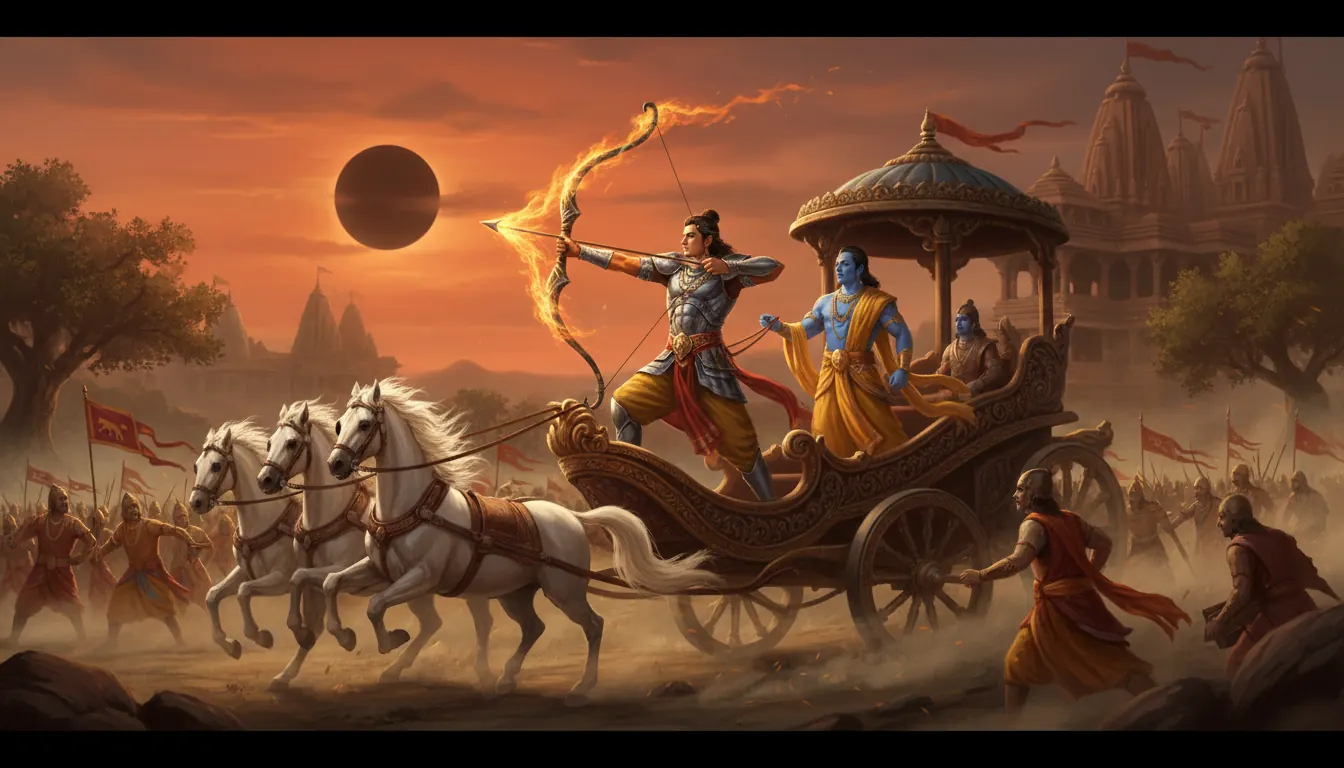
The Guard at Drona's Right Wheel
Yudhishthira orders his whole army against Drona, and never gets past Kritavarma
In short
On the lamp-lit night of the fourteenth day, Duryodhana posts his brothers behind Drona's chariot and Kritavarma at its right wheel, telling them that the teacher is merciful and the Pandavas are not. Yudhishthira answers with one order to his entire army: go against Drona only, and kill him. Every Pandava who starts for Drona finds a man standing in his road, and the king finds Kritavarma. Bow, sword, shield, lance and armour are taken off Yudhishthira one after another, and the Vrishni goes back to his post without a word.
Told in the Drona ParvaSet in Kurukshetra15 min read
The Field Given Back Its Faces
For most of that night the fourteenth day had been fought blind. Sanjaya had already told the blind king how it was: the world enveloped in darkness and dust, the combatants standing on the field unable to see one another, the best of the kshatriyas striking at guesses, guided by conjecture and by the names men shouted as they came on. Thousands of chariot-warriors had slaughtered one another that way. Whole divisions had broken and run in all directions with hearts utterly cheerless, and been cut down as they ran.
Then Duryodhana had ordered lamps, and the foot-soldiers had laid aside their great weapons and taken up burning lights instead, five to a chariot, three to each maddened elephant, one large lamp on every horse, and the Pandavas had answered with ten to a chariot and seven to an elephant, until both hosts stood illuminated on the same plain.
"When the field of battle, which had been wrapped in darkness and dust, was lit up in this way," said Sanjaya, "heroic warriors met one another, each eager to take the other's life."
That was the change. Not that the killing began. The killing had never stopped. What the lamps did was give every man back the face of the man he was about to kill.
Armed with lances and swords, they gazed at one another under the influence of rage, and now the rage had somewhere to fasten. With thousands of lamps blazing all around, and the more blazing lamps of the gods and the Gandharvas on golden stands decked with jewels and fed with fragrant oil, the field looked resplendent like the firmament bespangled with stars. With hundreds upon hundreds of blazing brands the earth seemed to be in a conflagration, as at the universal destruction. All the points of the compass looked like trees covered by fire-flies at an evening in the season of rains.
Elephant went against elephant, horseman against horseman, chariot-warrior against chariot-warrior, filled with joy, on that fierce night, at the command of Dhritarashtra's son.
And then Arjuna, with great speed, began to destroy the Kaurava ranks, weakening all the kings.
Who Guarded the Wheels
The old king in the hall could not see the lamps either. What he had was Sanjaya's voice, and at the word Arjuna he interrupted, and the interruption came out of him in a rush of questions that were really one question asked eleven ways.
"When the invincible Arjuna, roused to fury and unable to bear the feats of the Kurus, broke into my son's army, what did you all feel? When that scorcher of foes came into their midst, what did the soldiers think? And what steps did Duryodhana think fit to take then? Who were the scourges of foes who went against that hero in that battle?"
Then he came to the thing he actually wanted.
"When Arjuna of the white horses entered our army, who protected Drona? Who guarded the right wheel and who the left wheel of Drona's chariot? Who were the heroes who protected the rear of that fighting hero? When Bharadwaja's son went forward, killing the foe along his way, who went ahead of him?"
Dhritarashtra knew already how the story ended. He had been told, long since, that Drona would not come back from this field, and every night he made Sanjaya walk him up to that fact again by a slightly different road.
"That mighty and invincible bowman who penetrated into the midst of the Panchalas," he said, "that tiger among men of great valour, who went along the track of his chariot as if dancing, and burned up great throngs of Panchala chariots with his shafts like a raging fire. Alas, how did that Drona meet his death?"
And then, because grief in that hall always turned at the last moment into a complaint about the reporting, he turned on the reporter.
"You always speak of my enemies as cool and unbeaten and cheerful and swelling with might in battle. But you never speak of mine in such words. Instead you describe them as slain, pale and routed, and you speak of my chariot-warriors as men stripped of their chariots in every battle they fight."
Sanjaya did not answer the accusation. He answered the question about the wheels.
Vikarna at the Rear, Kritavarma at the Right
Duryodhana had seen what his commander intended. Drona was bent on battle and would not be persuaded to stand off and be safe, and a king who cannot move a man can at least build a wall around him. So on that night, understanding the wishes of Drona, Duryodhana called his obedient brothers to him and named them one by one.
Vikarna, who had once stood up in a full assembly hall and said aloud that Draupadi had not been fairly won. Chitrasena. Suparsva. Durdharsha. Dirghavahu. And all those that followed them.
"You heroes of great valour, fight with resolution, and all of you protect Drona from the rear. The son of Hridika will protect his right and Sala his left."
The son of Hridika was Kritavarma, a Vrishni, a warrior of Krishna's own clan and of Krishna's own city, who had come to this war on the other side of it. When Duryodhana went gathering armies before the war, Kritavarma gave him an akshauhini of his own, the Bhojas, the Andhakas and the Kukuras, and came with it. He was one of the three men of the Kaurava side who would still be alive at the end of everything. Tonight he was a name in a list, posted to a chariot wheel like a door-guard.
Having named the rear and the two flanks, Duryodhana sent forward to the front what was left of the brave and mighty chariot-warriors of Trigarta, the sworn men whose whole remaining purpose in the war was to die somewhere useful.
Then he gave them the reason, which was not a reason about tactics.
"The teacher is merciful," said Duryodhana. "The Pandavas are fighting with great resolution. While he is slaughtering the foe in battle, stand together and protect him well."
It is worth stopping on that sentence, because it is Duryodhana's own estimate of the man he had made commander after Bhishma fell. Not that Drona was old. Not that Drona was slow. That Drona was merciful, and that the enemy was not, and that the arithmetic of the thing therefore did not work in Drona's favour, and would have to be corrected by other men standing where the arrows came.
Apart From Dhrishtadyumna, I Do Not See the Man
Duryodhana went on, and what came out of him was not an order but a whole war laid out end to end, as a man lays out a plan at night when he badly needs it to be true.
"Drona is mighty in battle, with great lightness of hand and great valour. He can defeat the gods themselves in battle. What, then, of the Pandavas and the Somakas? But all of you, standing together and fighting with great resolution in this terrible battle, protect the invincible Drona from that mighty chariot-warrior, Dhrishtadyumna. Apart from Dhrishtadyumna, I do not see the man among all the Pandava warriors who can defeat Drona in battle."
He was right. That was the whole horror of it. Dhrishtadyumna had come out of a sacrificial fire for exactly this, born of his father's old grudge with a bow already in his hands, made for the death of Drona the way a weapon is made for a purpose, and everyone on that field including Drona knew it. Duryodhana had identified the one man who mattered, and his answer to him was a hedge of bodies.
"So I think we should protect the son of Bharadwaja with our whole soul. With us protecting him, he is sure to kill the Somakas and the Srinjayas, one after another. Once all the Srinjayas at the head of the Pandava army are slain, Drona's son will without doubt kill Dhrishtadyumna in battle. In the same way, the mighty chariot-warrior Karna will vanquish Arjuna in battle. As for Bhimasena and the others in armour, I will subdue them all in the fight. The rest of the Pandavas, their energy gone, will be easily defeated by our warriors. Clearly my success will then last for ever."
Every link in that chain broke. Ashwatthama did not kill Dhrishtadyumna in battle, but in his sleep, on the last night of the war, and paid for it for the rest of a very long life. Karna did not vanquish Arjuna. Duryodhana did not subdue Bhimasena. Only the first clause held: protected, Drona did slay the Srinjayas, one after another, for another day.
"For these reasons, protect the mighty chariot-warrior Drona in battle."
Having said these words, Duryodhana urged his troops forward on that night of terrible darkness. Ashwatthama covered the ruler of the Panchalas with straight shafts, and Drona covered the Srinjayas, and a furious uproar went up.
Sanjaya said afterwards that the battle fought on that night was so terrible and so fierce that its like had never been witnessed by themselves or by those gone before them.
Go Against Drona Only
On the other side of the lamps, Yudhishthira had come to the same conclusion by the opposite road.
In the course of that terrible night battle, full of indiscriminate carnage, Dharma's son called out to the Pandavas, the Panchalas and the Somakas, and what he ordered was not a manoeuvre. For the destruction of men and chariots and elephants, king Yudhishthira commanded his own troops in a single sentence.
"Go against Drona only, and kill him."
This is the eldest Pandava, the man who within another day would be asked to tell the one lie of his life, ordering his entire army to converge on one old brahmana who had taught him archery as a boy. The night had got that far into him. At the command of the king, the Panchalas and the Somakas rushed against Drona alone, uttering terrible shouts, and the Kauravas, excited with rage and loudly roaring in return, rushed to meet them to the best of their prowess and courage and might.
What happened then was that Duryodhana's hedge did its work. Every road to Drona had a man standing in it.
Kritavarma, the son of Hridika, rushed against Yudhishthira as the king was advancing against Drona, like a maddened elephant against a maddened rival. Against Satyaki, grandson of Shini, advancing and scattering showers of arrows all around, rushed the Kuru warrior Bhuri. Karna resisted Sahadeva as he came on for Drona. Duryodhana himself rushed against Bhimasena, who was advancing on his chariot like the Destroyer. Shakuni went to meet Nakula, who knew every kind of battle. Kripa resisted Shikhandi. Dushasana, contending vigorously, took Prativindhya, the eldest of Draupadi's five sons, whose horses looked like peacocks. Ashwatthama resisted Bhima's son Ghatotkacha, who knew a hundred kinds of illusion. Vrishasena, Karna's son, resisted the aged Drupada with his troops and followers. Shalya, ruler of the Madras, in a fury, resisted Virata. Chitrasena resisted Nakula's son Satanika. The prince of the Rakshasas, Alambusha, resisted Arjuna.
And Dhrishtadyumna, the one man Duryodhana had named, cheerfully resisted Drona himself.
Below the chariots the rest of it went on without names. Elephant riders encountered elephant riders and ground each other by thousands. At dead of night the horses rushed against one another so hard that they looked like winged hills. Horsemen met horsemen with lances and darts and swords and loud shouts, and large numbers of men slaughtered one another in heaps with maces and short clubs.
Like Continents Holding Back the Sea
Kritavarma, the son of Hridika, in a fury, held back Dharma's son, Yudhishthira, as continents hold back the swelling sea.
Sanjaya chose that image and it is worth keeping, because it says which of the two men was moving. Yudhishthira was the water. He had a direction and a weight behind him and a whole army coming the same way. Kritavarma had one job, which was to be the coast.
The king opened by piercing Hridika's son with five arrows, and then with twenty more, and called out to him.
"Wait. Wait."
It is the standard challenge of that field, the two syllables men shout when they mean stand and fight me and do not go elsewhere, and it is also, from Yudhishthira on that particular night, an order to a man who was already refusing to move.
Kritavarma, in a fury, cut through the bow of Yudhishthira the just with a broad-headed shaft, and pierced him with seven arrows. The king took up another bow at once and put ten arrows into the son of Hridika's arms and chest. Pierced like this, the warrior of Madhu's race trembled with rage and struck Yudhishthira with seven shafts in return.
Then Pritha's son found the seam. He cut off his enemy's bow, and with it the leathern fence that cased Kritavarma's hands, and while the man stood there disarmed and unguarded he sped five keen shafts whetted on stone. Those fierce arrows pierced through the costly armour decked with gold and went on through and entered the earth like snakes going into an ant-hill.
That was Yudhishthira's best moment of the encounter, and it lasted about as long as it takes to describe. Within the twinkling of an eye Kritavarma had another bow up and had put sixty arrows into the son of Pandu, and then ten more.
So the king laid his large bow down on the floor of his chariot and took up a dart instead, gold-decked, and sped it at Kritavarma like a snake going through the air, and it pierced clean through Kritavarma's right arm and entered the ground behind him.
A man with a dart through his bow arm ought to be finished. Meanwhile, Pritha's son took up his formidable bow again and shrouded the son of Hridika with showers of straight shafts, and for one moment on that lamp-lit field it must have looked to the Panchalas coming up behind their king as though the road to Drona had opened.
The Armour That Fell Like Stars
Then brave Kritavarma, that great chariot-warrior among the Vrishnis, in less than the twinkling of an eye, left Yudhishthira without horses, without driver and without chariot.
Sanjaya gives it in one breath, in that order, and the order is the whole of it. The horses, the man holding the reins, the chariot itself. A king who had been advancing on Drona at the head of an army was standing on the ground.
Then the eldest son of Pandu took up a sword and a shield. The warrior of Madhu's race cut through both those weapons.
Yudhishthira then took up a fierce lance equipped with a gold-decked staff and sped it, quickly, at the illustrious son of Hridika. And here the text puts in the detail that turns a defeat into a humiliation. Hridika's son, smiling all the while and showing great lightness of hand, cut in two the lance Yudhishthira had hurled, as it rushed towards him.
Smiling the while. With a dart-wound through his right arm.
Then he covered the son of Dharma with a hundred arrows. In a fury, he cut away the king's coat of mail with showers of shafts, and Yudhishthira's armour, decked with gold, cut loose from his body by Hridika's son, dropped down off him, said Sanjaya, like a cluster of stars dropping down from the sky.
His armour gone, his chariot gone, his weapons gone one after another, wounded by Kritavarma's shafts, Dharma's son quickly retreated from battle.
That is the sentence. The commander of the Pandava army, who had ordered every man he had to go for Drona and nothing else, got no closer to Drona than one Vrishni posted at the right wheel, and left the field on foot with his gold lying behind him in the dirt.
And Kritavarma did not pursue him. There is no boast recorded, no speech over the wreck of the chariot, nothing thrown after the retreating king. The mighty chariot-warrior Kritavarma, having defeated Yudhishthira, the son of Dharma, went back to protecting the wheel of Drona's chariot.
He went back to his post. The lamps went on burning on the elephants and the horses, and the Panchalas came on again behind their broken king, and somewhere ahead in that lit darkness Drona was still killing Srinjayas one after another, exactly as Duryodhana had promised, with his right wheel guarded.
Dharma Lesson
Yudhishthira gave the simplest order of his war, that every man go for Drona and nothing else, and it failed for the dullest of reasons: Duryodhana had already put a name at each wheel. Wars are not usually decided by the man everyone is looking at but by the ones assigned to stand in the way, who win nothing by it and are not sung. Kritavarma stripped a king of his chariot and his armour and did not stay to enjoy it; he went back to the wheel he had been given. That is the discipline of a good soldier, and the epic will show, on a later night, that a good soldier who never asks what his post is for can be walked all the way into an atrocity.