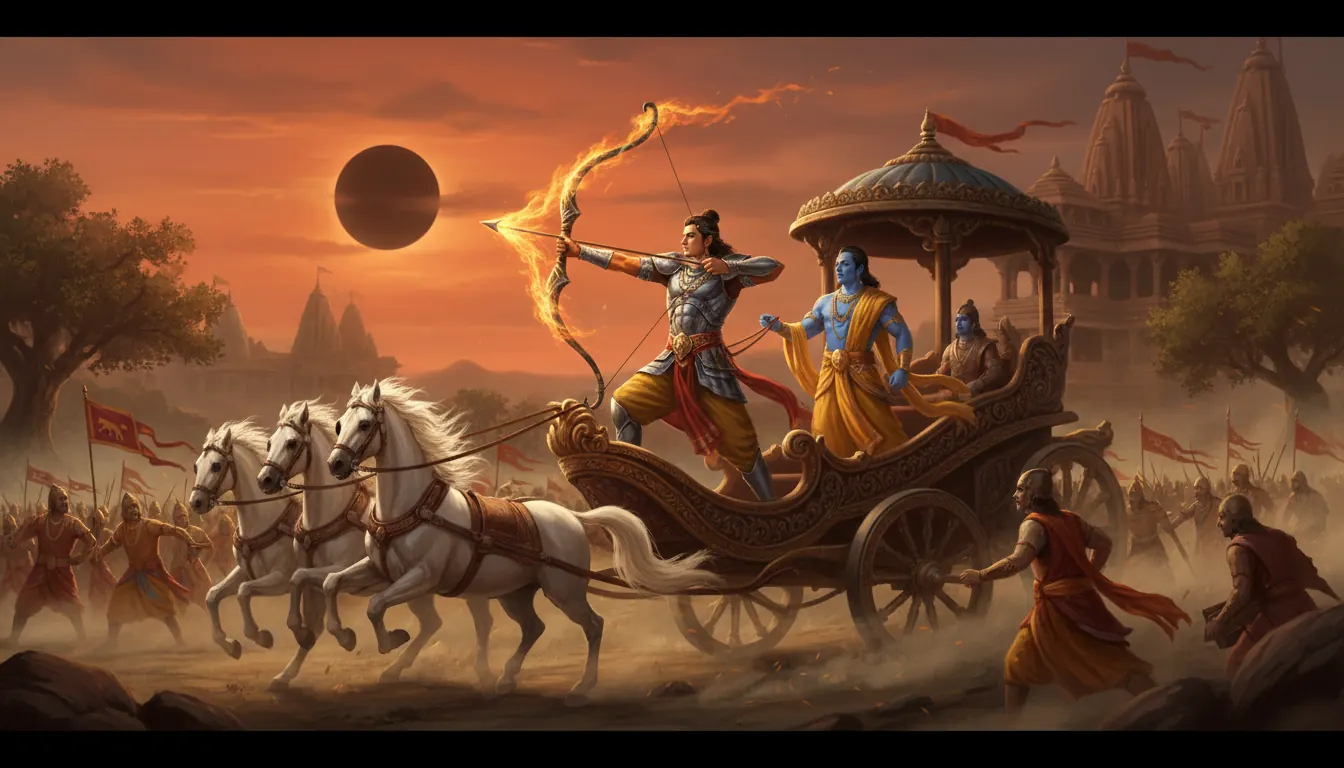
Karna by Night Against the Panchalas
The armies throw down their torches, and the Suta's son scatters Dhrishtadyumna and all of Panchala in the dark
In short
Late on the fourteenth night, Duryodhana goads Drona and Karna back into the battle, and the two of them break the Panchala host so badly that it flees throwing away its own torches. Krishna, cheerless for once, rallies Arjuna and Bhima and turns the army round, and the two sides fight on in total darkness, recognising each other only by the names they shout. Then Karna strips Dhrishtadyumna of chariot, bow and driver, drives the Panchalas and Srinjayas before him until they mistake a blowing straw for him, and Yudhishthira asks Arjuna to end it. Krishna refuses to spend Arjuna against a man still holding Indra's dart, and sends Ghatotkacha instead.
Told in the Drona ParvaSet in Kurukshetra17 min read
The Goad of Speech
It was still the fourteenth day, in the sense that nobody had called it over. The sun had gone down long before on Jayadratha's death, and the armies had not stopped. Duryodhana had ordered lamps carried onto the field, and men fought with torches lashed to their chariots and held up by servants who had no other work that night, and in a hall at Hastinapura, Sanjaya went on telling it to a blind king who could not see any of it.
What he had to tell just then was a rout, and it was Duryodhana's own army that was being routed. Satyaki, the grandson of Shini, had taken the king's chariot and bow away from him in the dark and left him to climb up beside Kritavarma. Arjuna had broken Shakuni's thousands. Dhrishtadyumna, the fire-born prince of Panchala who commanded the Pandava army, had cut Drona's bowstring and was grinding the Kaurava troops between himself and his brother Shikhandi, and the conchs of the Pandavas were being blown one after another in the sight of Drona and Karna and Drona's son.
So Duryodhana, who knew well how to use words, drove to where his two great bowmen stood, and used them.
"You two started this battle in a rage when you saw Savyasachin kill the ruler of the Sindhus. You stand by and watch the Pandava forces slaughter my army, though you are well able to defeat those forces. If you meant to abandon me, you should have told me so at the start. We two will defeat the sons of Pandu in battle: those, you givers of honour, were the very words you said to me then. It was because I heard you say them that I let all this go forward. Otherwise I would never have started this war with the Parthas, a war that destroys so many brave fighters. If I do not deserve to be abandoned by you, bulls among men, then fight with all the prowess you truly have."
Sanjaya used one image for what that speech did to them. Pierced by the goad of his words, those two heroes went back into battle like two snakes provoked with sticks.
The Wall Around the Grandson of Shini
The two of them went forward together, and the Parthas, seeing them come, gathered their troops and went to meet them, and the noise both sides made was the noise of men who wanted to be found in the dark.
They found Satyaki first. He was the one who had done the damage, and every bow on that side of the field turned on him at once. Drona pierced him with ten arrows. Karna pierced him with ten. Duryodhana put in seven. Vrishasena, Karna's eldest son, a boy fighting his father's war beside him, put in ten more, and Shakuni added seven, and then they did not scatter again. They stood where they were and closed around him, and Sanjaya called what they made a wall of Kauravas that nothing could get through.
That left Drona free of Satyaki, and the Somakas came at him instead. They were Drupada's own clan among the Panchalas, and they poured arrows on the old teacher from every side at once because there was no other way to reach him.
He began to take the lives of kshatriyas, Sanjaya said, the way the sun destroys the darkness around it with its rays, which is a strange thing to say about a man fighting at midnight, and is exactly right about what he was doing.
And then, out of the dark on the Panchala side, there came a sound the Kauravas had not heard from that army before. It was men calling to one another by name while they were being killed.
"Then, king, we heard a great uproar among the Panchalas, calling out to one another as Drona slaughtered them."
Some of them abandoned sons. Some abandoned fathers. Some left brothers, or uncles, or their sisters' sons, or whatever kinsman was nearest, and ran as fast as they could to save their own lives. Others, out of their minds altogether, turned and ran straight at Drona, which came to the same end.
Many of the Pandava army, Sanjaya told the blind king, were sent to the other world in that hour.
The Torches Thrown Down
The army broke.
It broke in the sight of Bhimasena and Arjuna and Krishna and the twins and Yudhishthira and the son of Prishata, which is to say that every man the Pandavas had who was worth anything was standing there watching it happen and could not stop it. Their soldiers ran, and as they ran they threw down the blazing torches they had been carrying, all around them, because a man running in the dark does not want to be the brightest thing on the field.
So the light went out of that half of the battle. The world was wrapped in darkness and nothing could be seen.
And here is the detail that decided the next hour. The Kaurava troops still had their lamps. By the light they had among them, they could see the enemy running. The Pandava army had made itself invisible and had also made itself blind, and the men hunting it could see, and see by their own light, which the fugitives were running away from into the black.
Drona and Karna went after them, mighty chariot warriors both, scattering arrows into ground where they could hear feet.
Janardana watched it and his face fell. He had driven Arjuna through everything the fourteenth day had put in front of them, and he did not often let his face change, and Sanjaya says plainly that it changed then. He said to Phalguna:
"Dhrishtadyumna and Satyaki went with the Panchalas against those great bowmen Drona and Karna, shooting arrow after arrow. This great army of ours has been broken and routed by showers of arrows. They are told to stop running, son of Kunti, and still they cannot be rallied. Pandava warriors, you see the army running in fear: put away your fears. The two of us, with all our forces drawn up in good order and our weapons raised, are going this moment against Drona and the Suta's son to hold them back."
Then he saw Vrikodara coming up out of the dark with the Somakas behind him, and he said it again, differently, the way a man says a thing to put heart into another man.
"There is Bhima, who loves battle, coming against those mighty chariot warriors Drona and Karna, with the Somakas and the Pandavas around him. With him behind you, and the many mighty chariot warriors among the Pandavas, fight now, son of Pandu, and give all your troops courage."
And those two tigers among men went and took their place at the head of the battle, in front of Drona and Karna, where the army could see them.
Fighting by the Names They Called
The army came back. That is the plain fact of it, and it is not a small one. An army that has thrown away its lights and run turned round in the dark and went again to the place where Drona and Karna were grinding down their enemies, because two men had gone and stood there first.
At dead of night a fierce battle broke out, and Sanjaya reached for the sea to describe it: it was like the meeting of two oceans swelling at moonrise.
Then the Kaurava soldiers did the thing their enemies had done an hour before. They threw the blazing lamps out of their hands and fought fearlessly and madly without them, and with that the last of the light on that field went out. The world was wrapped in gloom and dust together. There was nothing to aim at and nothing to recognise.
So the fighters fought one another guided only by the names they shouted.
A man called his own name into the dark to find out whether the man beside him was a friend, and the answer he got told him whether to strike. Sanjaya, who had been at enough courts to know, said the names of the kings fighting there were heard the way names are heard at a swayamvara, where a herald stands beside a girl with a garland and reads out the lineage of each suitor as she passes down the line. That is the comparison he chose for it. The same roll of famous houses, called out in the same order, in a field where nobody could see his hand.
Then, suddenly, silence spread over the whole battle, and lasted for a moment.
Nobody has ever explained that moment. It is simply set down: that in the middle of the worst night of the war, every man on that field stopped making noise at once, and the ground where two armies stood mixed together went quiet.
Then the uproar came back, made by angry men, victors and defeated together.
And wherever a lamp was still burning, wherever some servant had kept his nerve or some chariot still carried a torch, the heroes rushed towards it. They went at the light like insects flying into a fire, because it was the only place where a man could be seen, and therefore the only place where a man could be killed. And as the Pandavas and the Kauravas fought each other, the darkness of night thickened around them.
The Mace of Prishata's Son
Karna found Dhrishtadyumna in that dark, and struck him in the chest with ten arrows made to go into the vitals.
The son of Prishata answered with five, and with two words. "Wait! Wait!" That is all the speech he gets in this passage, and it is the speech of a man who does not intend the other to go anywhere.
They covered each other in showers of arrows, drew their bows to the full and pierced each other again, and then Karna's aim began to tell. He sent the four horses of the Panchalas' greatest warrior to Yama's realm. He cut his enemy's bow with keen arrows. With one broad-headed arrow he knocked the driver out of his seat on the chariot.
Dhrishtadyumna had commanded the whole Pandava army since the first morning of the war, and he now had no bow, no horses, no driver and no chariot. He jumped down onto the field and picked up a mace.
Then he walked at Karna on foot.
He was struck the whole way with straight arrows and he kept walking, and he reached the chariot, and he killed the four horses standing in its traces. Having done that, the destroyer of armies turned back at great speed toward Yudhishthira's army, and climbed up onto Sahadeva's chariot.
Standing on it, he wanted to go back at Karna at once, and would have.
Dharma's son told him to stop.
That is how Yudhishthira comes into this hour, saying no to his own commander in the middle of a rescue, and there is no argument recorded, and Dhrishtadyumna stayed where he was put.
Behind them, Karna mixed his lion-like shouts with the twang of his bowstring and blew his conch with great force, so that the whole field would know what had happened to the Panchala prince. His driver was already yoking fresh horses to the chariot, horses white as conchs, of the Sindhu breed, well broken and very fast.
And the Panchalas and the Somakas, hearing that conch and knowing what it meant, took up every kind of weapon and came for him, with death itself as their goal.
A Straw Mistaken for Karna
They came, and he stood on the new chariot with the white horses and lashed them with his arrows like a cloud pouring torrents of rain on a mountain, and the Panchala army fled in fear like a doe frightened by a lion.
After that it was not a battle. Horsemen fell from their horses, elephant riders from their elephants, chariot warriors from their chariots, all around. With razor-headed arrows Karna cut off the arms of men who were running from him, and their heads with the earrings still on them, and the thighs of others, whether they were on elephants or on horseback or on the ground. Many great chariot warriors, as they fled, did not feel that they had lost a limb.
Sanjaya measured their fear with one line that the blind king would have understood better than any tally of the dead. Slaughtered by those terrible arrows, the Panchalas and the Srinjayas took the stirring of a straw for Karna. Men out of their minds saw their own friends running beside them and thought they were seeing Karna, and fled from them.
He followed the broken army, shooting on every side. Others fled without being shot at all, merely because Drona looked at them.
Yudhishthira watched his army going and decided that retreat was wise, and said so to Arjuna.
"Look at that mighty bowman Karna standing there like Rudra himself with his bow. See how he scorches everything around him like the blazing sun, at this fierce hour, in the dead of night. You can hear the endless wailing, Partha, of your helpless friends torn by Karna's arrows. Karna aims and looses his arrows so fast that no gap can be seen between the one and the other. He will wipe out all our friends. Dhananjaya, do now about killing Karna whatever you judge should be done next, if its time has come."
Arjuna turned to Krishna and did not pretend that his brother was calm.
"The royal son of Dharma is frightened today by Karna's prowess. Our army is running, slayer of Madhu. Our troops are broken and torn by Drona's arrows and terrified of Karna, and they cannot make a stand. I see Karna ranging fearlessly. Our greatest chariot warriors are running. Like a snake that cannot bear a man's foot treading on it, I cannot bear to watch him ranging at the head of the battle before my eyes. So drive to where Karna is. Either I will kill him, or he will kill me."
The Raft for a Sinking Army
Krishna said no, and gave his reasons in order, and the first of them was praise.
"I see Karna, that tiger among men, that warrior of superhuman prowess, ranging over the battle like the king of the gods himself. Dhananjaya, no one but you and the rakshasa Ghatotkacha can go up against him in battle. But I do not think the time has come for you to meet the Suta's son. He still has the blazing dart Vasava gave him, like a mighty meteor, and he has kept it carefully for you. He keeps that dart by him, and he has taken on a terrible form."
That was the whole calculation. Indra's dart would kill any single man it was thrown at, Karna was saving it for Arjuna, and Krishna did not intend to let Arjuna be the man standing in front of him when it went.
So he sent for somebody else. Ghatotkacha was Bhima's son by the rakshasa woman Hidimbi, born in a forest after the Pandavas escaped the house of lac, and he came at once, in mail, armed with sword and arrow and bow, saluted Krishna and Arjuna and said, "Here I am. Command me."
The Dasharha spoke to that rakshasa with the blazing mouth, the fiery eyes and the body the colour of clouds.
"Listen, Ghatotkacha. The time has come to show your prowess, yours and nobody else's. Be the raft for the Pandavas, who are sinking in this battle. You have all kinds of weapons, and many kinds of rakshasa illusion. Look: Karna is driving the Pandava army like a herdsman beating a herd of cows. Tormented in the dead of night by the Suta's son and his showers of arrows, the Panchalas are running like a herd of deer before a lion. Except for you, there is no one who can stand against him. It is for exactly this, son of Hidimbi, that men want children: to be rescued from trouble. Now rescue your kinsmen. At night, rakshasas have boundless prowess. Kill Karna in battle in this dead of night, with the help of your illusions. The Parthas, with Dhrishtadyumna, will deal with Drona."
Tonight I Will Fight Such a Battle
It was a strange thing to say to a son of the house, and Krishna had said the hardest part of it plainly. Fathers want sons to gain their own ends. Children, those sources of good, are expected to rescue their fathers both in this world and the next. Ghatotkacha was being told, in front of his father's brothers, exactly what he was for.
Arjuna added his own judgment, which was a soldier's.
"Ghatotkacha, in my judgment three of all our warriors stand above the rest: you, the long-armed Satyaki, and Bhimasena. Go and meet Karna in single combat tonight. The mighty chariot warrior Satyaki will guard your rear."
And Ghatotkacha answered them both, and there was no modesty anywhere in it.
"I am a match for Karna, and for Drona too, or for any famous kshatriya skilled in weapons. Tonight I will fight such a battle with the Suta's son that men will talk of it as long as the world lasts. Tonight I will spare neither the brave nor the timid, nor those who join their hands and beg for mercy. I will kill them all, as rakshasas do."
Then he went, and the Kaurava troops were frightened at the sight of him coming, and Karna, that tiger among men, met the warrior with the blazing mouth and blazing hair with a smile. Sanjaya, who had to find a comparison for what began then, went outside the world of men for it. The battle between Karna and that rakshasa, both roaring at each other, was like the battle between Indra and Prahlada.
Dharma Lesson
Duryodhana gets his two greatest bowmen to fight properly by reminding them of a promise they made him, and within an hour that promise has cost the Panchalas more men than any charge of the day. The night shows what happens when skill is finally used without restraint: soldiers throw away their own light rather than be seen, and men kill each other by the sound of a name. Krishna's answer is not courage but arithmetic, holding Arjuna back from the one weapon that would end him and spending a son instead. Even the side that is in the right wins this hour by deciding, coldly, whose life it can afford to lose.