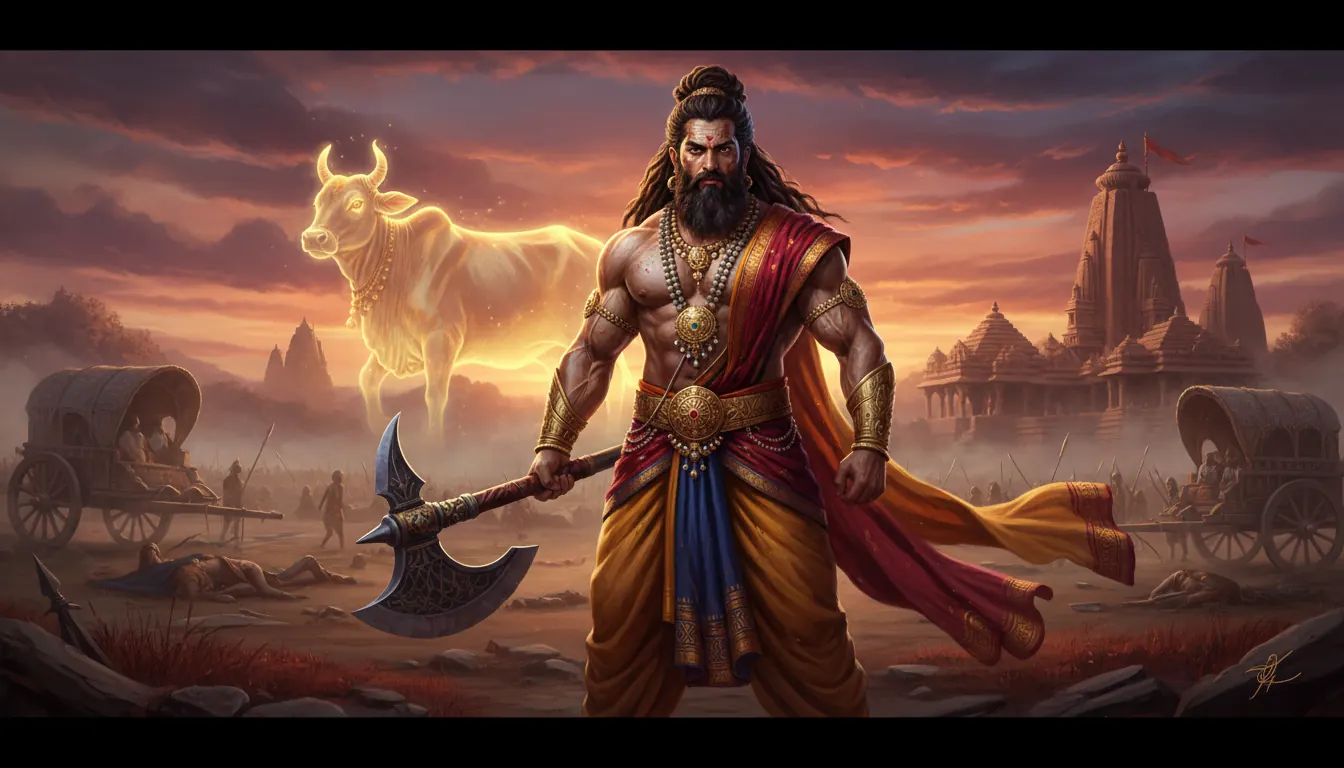
How Parashurama Won Shiva's Weapons
Years of penance, a war fought with empty hands, and the arsenal that reached Karna
In short
On the second morning of Karna's command, Duryodhana told Shalya a second old story to persuade him to hold the reins. Rama of the Bhrigus had asked Mahadeva for the celestial weapons and was told to make himself pure first, since those weapons burn a man who does not deserve them. After years of vows he was sent unarmed against the Daityas whom the massed gods could not beat, and came back cut to pieces, and the god healed him with a touch and gave him the astras he had earned. Those were the weapons the Bhargava later gave whole to Karna.
Told in the Karna ParvaSet in Kurukshetra and Forest Hermitage17 min read
Another Story Before the Fighting Began
Sanjaya, telling the whole of it afterwards to a blind king in a hall at Hastinapura, came to the morning when the Kaurava army had Karna for its commander and no driver good enough to stand in front of him.
Duryodhana had spent that morning arguing with Shalya, the ruler of the Madras, a crowned king with an army of his own, asking him to take up the reins of another man's chariot. He had already told him one long story to get him to agree, the story of the three cities of the Asuras and the shaft that burned them, and he had ended it with the point he wanted made.
"As the glorious Brahman, the Creator of the worlds, the Grandsire, drove for Rudra, so you should guide the horses of the great-souled son of Radha, as the Grandsire guided Rudra's. There is not the slightest doubt, tiger among kings, that you are greater than Krishna, than Karna, and than Phalguna. In battle Karna is like Rudra, and in policy you are like Brahman. So together you two can defeat my foes, who are like the Asuras."
Then, because Shalya had still not said yes, he said it plainly.
"Karna, ourselves, our kingdom and our victory in battle all depend on you. So take the reins of those fine horses."
And then, since one story had not been enough, he began another.
"There is another story I will tell you. Listen once more. A virtuous brahmana recited it in my father's presence. When you have heard these delightful words, full of the reasons and purposes of deeds, do whatever you decide, Shalya, without any scruples."
It is worth noticing what he chose. The first tale had been about a driver. This one was about the man who taught Karna everything he knew, and about the price that man had paid for it, and Duryodhana told it to a king he was trying to hire.
In the Race of the Bhrigus
"In the race of the Bhrigus," said Duryodhana, "was Jamadagni, a man of stern penances. He had a son full of energy and every virtue, who became famous under the name of Rama."
The Bhrigus are the oldest and the most dangerous of the brahmana lines in the epic, a family whose anger is spoken of as a thing with a temperature. Jamadagni was the head of that house in his generation, and his son Rama is the one the world came to call Parashurama, Rama of the axe, the brahmana who fought like a kshatriya and made a legend out of the contradiction. The site tells that story elsewhere: the father's terrible command, the mother restored, the thousand-armed king who stole the calf, the twenty-one clearings of the earth. None of that is in this tale. This is the story of where the arms came from.
"Practising the severest penances, cheerful of soul, bound to observances and vows, his senses under control, he won the favour of the god Bhava in order to obtain weapons."
Every clause in that sentence is a discipline, and the last clause is the purpose. He was not seeking release, or knowledge, or the sight of the god for its own sake. He wanted astras, the celestial weapons that answer to mantras rather than to strength, and he went about getting them the way a brahmana gets anything, by penance, and he addressed himself to Bhava, which is one of the names of Mahadeva, the god who wears the ashes and carries the trident and gives what nobody else can give.
He did not go to Indra, who trades. He went to the god who burns.
And for a long time nothing happened at all, which is how such requests are usually answered, and Rama went on with the penances, cheerful, as the account is careful to say, and kept his senses in hand, and waited.
The God Comes Before He Is Asked
"Because of his devotion and his calm of heart, Mahadeva was pleased with him."
Not because of the severity alone. The account puts two things together, the devotion and the calm, and the second is the rarer of them in a Bhargava. Men had wasted themselves to skeletons for less and got nothing. What moved the god was that this one had kept a quiet heart while doing it.
"Shankara understood the desire Rama cherished in his heart, and showed himself to him."
Rama had not asked out loud. That is the point of the line. The god read the wish where it was kept and came and stood in front of him without waiting to be petitioned, and then said something that was half a gift and half a warning.
"Rama, I am pleased with you. Blessings on you; I know your desire. Make your soul pure. Then you will have all you desire. I will give you every weapon when you have become pure. Those weapons, son of Bhrigu, burn a man who is unfit for them and does not deserve them."
Read the last sentence again, because it is the whole doctrine of the astras in a single clause and the epic never afterwards contradicts it. The weapons are not tools that a bad man may pick up and misuse. They are fire, and they discriminate. Given to a man who cannot hold them, they do not fail him or serve his enemies; they consume him. Every later catastrophe with a celestial weapon in this epic is a footnote to that warning, and so, in the end, is the fate of the man Rama would one day teach.
So the answer to the request was not no, and it was not yet. It was a condition, and the condition was not skill, and it was not birth, and it was not years of service. It was purity, which is the one qualification a man cannot demonstrate to anybody, including himself.
When You Think Me Fit
"When the trident-bearing god of gods had spoken, the son of Jamadagni bowed his head to that mighty, great-souled one and said, 'God of gods, I am always devoted to your service. Please give those weapons to me when you think me fit to hold them.'"
That is the answer of a man who has understood exactly what was said to him. He does not argue that he is already pure. He does not ask how long it will take, or what test he must pass, or what the marks of fitness are. He puts the judgment entirely into the hands of the one who is to give, and asks only that when the giver considers him fit, the giving should happen.
A whole temperament is visible in that sentence, and it is not the temperament the world remembers about Parashurama. The axe and the twenty-one campaigns have no place in this tale. Here he is an ascetic with his head bent, agreeing to be assessed.
Then Duryodhana went on, and the account of what followed is one long line of nouns.
"Then with penances, with restraint of the senses, with vows kept, with worship and offerings, with sacrifices and with Homa performed with mantras, Rama worshipped Sarva for many long years."
Seven disciplines named in a row, and then the phrase that swallows them all, for many long years. Nobody counts them. There is no episode in that stretch of time, no visitor, no temptation, no test, nothing that a storyteller could make a scene out of. There is a man in a forest feeding a fire and saying the words correctly, morning after morning, for a period the text does not bother to measure, on the strength of a promise that named no date.
That is the part of the story that Duryodhana, who wanted a favour before noon, chose to include.
Spoken Of in the Presence of the Goddess
"At last Mahadeva, pleased with the great-souled son of Bhrigu's race, spoke of his many virtues in the presence of his divine wife."
The first sign that the years had counted for something did not reach Rama at all. It happened somewhere else entirely, in a domestic moment among the gods, when Mahadeva turned to Uma and mentioned a man.
"This Rama, firm in his vows, is always devoted to me."
That is all. One sentence of praise, said to his wife about somebody who was not there to hear it.
"Pleased with him, the Lord Shankara proclaimed his virtues again and again before the gods and the rishis, slayer of foes."
Then it widened. What had been said once in private got said again in company, and again, until the assembly of the gods and the great rishis knew the name of the ascetic in the forest and knew what the three-eyed god thought of him. A reputation was being built for a man who was not participating in it, who had not been told, and who was still getting up before dawn to lay the fire.
There is a quiet piece of instruction buried in the order of events here, and it is easy to read past. Rama's fitness was established before he was ever asked to do anything. The god declared him worthy in the hearing of heaven while he was still weaponless, still unproven, still doing nothing but the vows. The tests that follow do not create the verdict. They publish it.
And the account, having praised him in the assembly of the gods, turns without pause to the other side of the universe, where the enemies of heaven were doing well.
"Meanwhile, the Daityas became very mighty."
The Gods Come Back Beaten
"Blinded by pride and folly, they oppressed the dwellers of heaven."
The Daityas are the older children of the same fathers as the gods, and their quarrel with heaven is the oldest quarrel there is. This time they were winning. The account gives them the two failings it always gives them, pride and folly, and then gives them the victory anyway, which is the epic's usual honesty about how these things go.
"Then the gods joined together, firmly resolved to slay them, and strove earnestly to destroy those foes. But they failed to defeat them."
United, resolved, earnest, and beaten. Three qualities that ought to have been enough, and were not.
So they went where they always go.
"Then the gods went to Maheshvara, the Lord of Uma, and began to win his favour with devotion, saying, 'Slay our foes.'"
They asked the god to do it himself. That is what they had come for and that is what they said, and it was a reasonable request, since he had done exactly that for them before against the three cities, which was the story Duryodhana had just finished telling.
"That god promised the gods the destruction of their foes, and summoned Rama the descendant of Bhrigu."
He promised the gods their victory. Then he sent for a man.
"Descendant of Bhrigu, slay all the assembled foes of the gods, for the good of all the worlds and also to satisfy me."
After the long silence, the summons had come, and it was not what the ascetic had been waiting for. He had asked for weapons and had been told to become pure. Now he was being told to go to war, and nothing had been said about the weapons at all.
Go at My Command
Rama said the obvious thing, and he said it to the face of the god who had promised him an arsenal.
"Chief of the gods, I have no weapons. What strength have I to slay in battle the assembled Danavas, who are skilled in weapons and invincible in fight?"
It is not a refusal. It is an inventory. He is a brahmana with vows and mantras and nothing in his hands, and he is being sent against an enemy that has just defeated the massed gods, an enemy the account itself calls skilled in weapons and invincible in fight. He points this out. Any soldier would.
"Maheshvara said, 'Go at my command. You will slay those foes. And when you have defeated all those enemies, you will gain many merits.'"
That is the whole of the answer. No arms are issued. No boon is granted first. No explanation is offered of how an unarmed ascetic is to accomplish what heaven in arms could not. He is given a command and a promise and sent out, and the order of those two things is the test.
"Rama heard these words and accepted them all. He had rites performed to win favour for his success, and went against the Danavas."
He accepted them all. Then he did the one thing left to a man in his position, which was to have the rites performed properly, and went.
And he announced himself when he arrived, to enemies who were full of might and possessed by folly and pride.
"Daityas, fierce in battle, fight me. The God of gods has sent me to defeat you."
"At these words of the descendant of Bhrigu the Daityas began to fight. But the delight of the Bhargavas slew the Daityas in battle with strokes that struck like Indra's thunder, and came back to Mahadeva."
The battle gets one sentence. What the sentence contains is a man with no weapons killing them with strokes that felt like the thunderbolt, which is to say with his hands and his penances, and then turning round and walking back to the god who had sent him.
The Wounds Were the Evidence
"Jamadagni's son, that foremost of brahmanas, came back with many wounds on his body that the Danavas had dealt him."
He had won and he was cut to pieces. The enemy had been skilled in weapons, exactly as he had said, and every one of those weapons had found him, because he had gone in with nothing to keep them off. He walked back into the presence of the god carrying the whole record of the fight on his skin.
"Touched, however, by Sthanu, his wounds were immediately healed."
One touch. The god did not send for herbs or utter a charm. He put a hand on the man, and the injuries were gone, and what had been an ordeal an hour earlier was over and could not be shown to anybody.
"Pleased too with that feat of his, the glorious god gave the great-souled son of Bhrigu many kinds of boons. With satisfaction in his heart, the trident-bearing God of gods said, 'The pain you have suffered from the weapons that fell on your body is the evidence of the superhuman feat you have achieved, delight of the Bhrigus. Accept from me these celestial weapons, as you desired.'"
The god names his reason, and the reason is the pain. Not the number of Daityas killed. Not the victory, which the gods had wanted and got. The proof that the thing done was superhuman is that it cost him his body to do it, and a man who will go unarmed into that because he was told to is a man who will not be burned by what he is now being handed.
"When he had received all the celestial weapons and the boons he had desired, Rama bowed his head to Shiva. Then, taking leave of the gods as well, that great ascetic went away."
He bowed, he took his leave of the assembly, and he walked out of heaven with the arsenal, and the account does not say a word about what he felt. Years of vows, one battle fought without arms, a healed body, and then the plain sentence: he went away.
"This is the old story that the rishi had recited," said Duryodhana.
What Duryodhana Wanted It to Prove
Then he came to the reason he had told it.
"The descendant of Bhrigu gave the whole science of weapons to the great-souled Karna, tiger among kings, with a delighted heart."
That is the join between the two halves of the tale. What Rama had bought with years of penance and one unarmed war, he handed on entire to a young man who came to him as a pupil, and the phrase used of the handing over is with a delighted heart.
Out of that Duryodhana built his argument, on a battlefield, about the man he was asking Shalya to drive.
"If Karna had any fault, lord of the Earth, the delight of Bhrigu's race would never have given him his celestial weapons."
It is a real argument, and it rests on the warning Mahadeva had given in the forest. Those weapons burn a person who is unfit and undeserving. The Bhargava had been made to wait years on that exact condition, and knew it better than anybody. If he judged Karna fit to receive them, then a god's standard had been applied to Karna and Karna had met it.
Having got that far, Duryodhana went further than he needed to.
"I do not believe Karna could have been born in the Suta order. I think he is the son of a god, born in the kshatriya order. I think he was abandoned as an infant so that the race he was born in might be known from his features and his feats. There is no way, Shalya, that this Karna was born in the Suta order. With his natural earring and natural coat of mail, this long-armed mighty chariot-warrior, like Surya himself, could no more be born of a common woman than a tiger could be born of a doe. His arms are massive, each like the trunk of a prince of elephants. Look at his chest, so broad, able to withstand any foe. Karna, also called Vaikartana, cannot be an ordinary man, king. This disciple of Rama, full of great valour, is a great-souled man, king of kings."
He had guessed the truth. The son of a god, born of no common woman, set adrift as an infant so that his birth might be read later off his own body: every clause was correct, and Kunti and Krishna had each already said so to Karna's face, and Duryodhana knew none of that. He had arrived at his friend's parentage by looking at his shoulders, and he offered it to Shalya as a compliment, and stood waiting to hear whether the king of the Madras would take the reins.
Dharma Lesson
Mahadeva does not ask Rama for strength or skill or birth, but for purity, and then refuses to say when it will be reached. The test he sets is not the battle; it is the willingness to walk into the battle unarmed on nothing but an order and a promise. The weapons come afterwards, and the god names the wounds, not the victory, as the evidence that the man can hold them. What is earned that way can be given away entire, which is what the Bhargava did when a pupil came to him and asked.