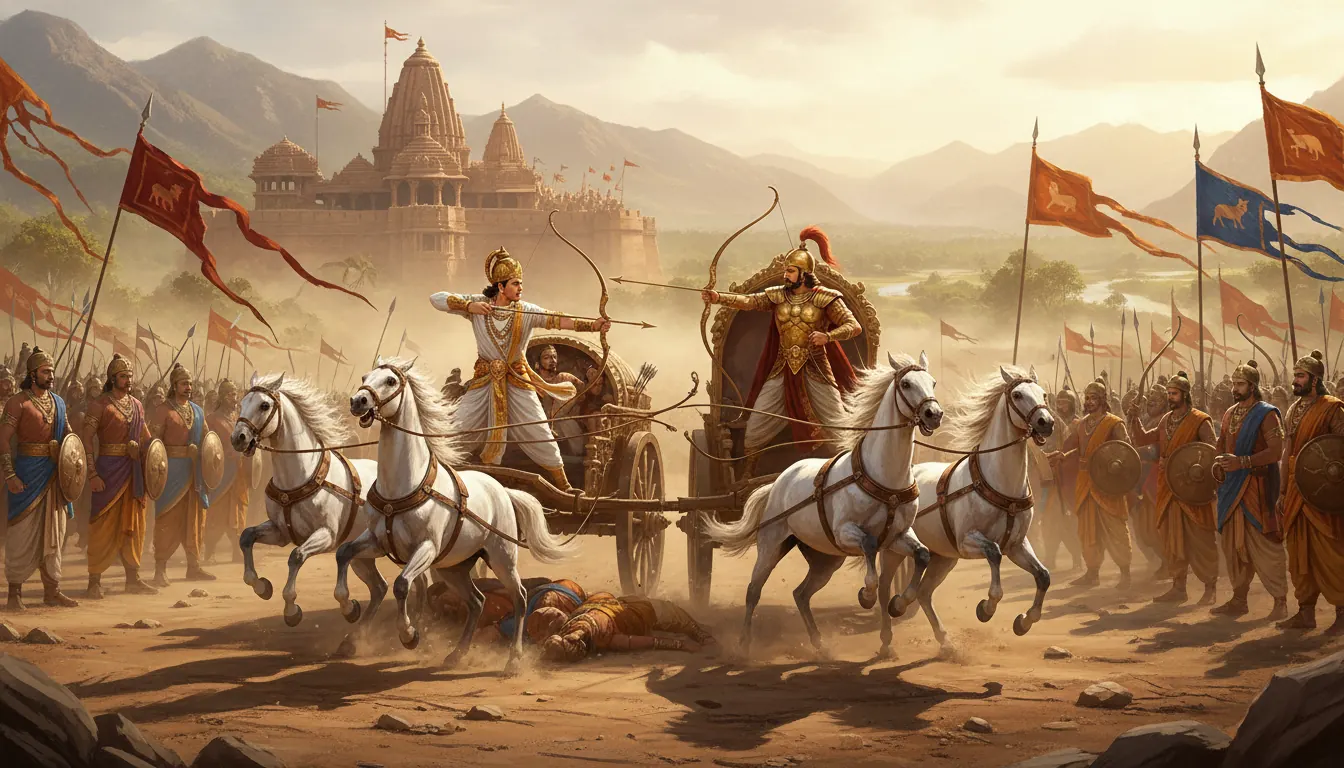
Ashwatthama at Dhrishtadyumna's Throat
The vow he very nearly kept on the seventeenth day
In short
On the afternoon of the seventeenth day, Dhrishtadyumna leads the Pandava host against Karna and is intercepted by Ashwatthama, who has sworn to kill him for Drona's death. Ashwatthama strips him of bow, chariot, horses, driver, sword and shield, and then, finding that arrows will not finish him, throws down his own bow and goes at him with his hands. Krishna sees it from across the field, Arjuna's arrows drive Ashwatthama off, and Sahadeva carries the wounded commander away.
Told in the Karna ParvaSet in Kurukshetra16 min read
The Hosts Close Again
Sanjaya, who sat in a hall in Hastinapura and told a blind king what his sons were doing on the field, had reached the afternoon of the seventeenth day.
"Then the Kurus and the Srinjayas fearlessly met each other in battle once more," he said, "the Parthas led by Yudhishthira, and ourselves led by the Suta's son."
The samsaptakas were nearly finished. Those were the sworn men, the ones who had taken an oath to kill Arjuna or die in the attempt, and only a remnant of them were left unslaughtered somewhere at the edge of the field with Arjuna working through them. Everywhere else the battle had narrowed to one man.
Dhrishtadyumna saw it and took the chance. He was the commander of the Pandava host, the son of Drupada who had been born out of a sacrificial fire for one purpose, and the purpose had already been accomplished two days earlier when he took Drona's head. He gathered the kings on his side, and the mighty chariot-warriors, and the Pandavas themselves, and every one of them rushed against Karna only.
Karna was unaided by anyone.
Sanjaya described what followed with an image he must have turned over for some time afterwards. Like a mountain receiving a vast body of water, Karna received in that battle all those advancing warriors, filled with joy and longing for victory. And those mighty chariot-warriors, meeting him, were beaten off and broken like a mass of water beaten back on all sides when it strikes a mountain.
The battle that took place between them and that one man made the hair stand on end.
It is worth marking what the Pandava commander was doing when the day turned on him. He had not come looking for Drona's son. He had come for Karna, at the head of an army, in the ordinary business of a war he was winning.
The son of Drona was elsewhere on the field, and coming.
Wait, Wait
Dhrishtadyumna assailed the son of Radha with a straight shaft, and called out to him across the noise.
"Wait, Wait."
Karna, filled with rage, shook Vijaya, which was the foremost of his bows, and answered the summons in the shortest way available to him. He cut off Dhrishtadyumna's bow. He cut off the arrows in the prince's hand as well, shafts that Sanjaya said were like snakes of deadly poison, and then he put nine arrows into the man himself.
Those nine went through the gold-decked armour of the high-souled son of Prishata and came out bathed in blood, and Sanjaya, telling it, could not help noticing how they looked. Beautiful, he said, like so many cochineal.
That is the habit of the whole account. Men are being opened up and the language keeps finding them handsome.
Dhrishtadyumna cast aside the broken bow. He took up another, and a number of shafts of the same poisonous kind, and with seven of those straight arrows he pierced Karna in return. Karna covered Prishata's son with as many again, and for a while the two of them stood in a cloud of their own making.
Then the slayer of Drona, a great bowman by any reckoning, retaliated by piercing Karna with many keen shafts.
The name matters. Sanjaya rarely calls Dhrishtadyumna by his own name in this hour without also calling him what he had made himself: the slayer of Drona. Everyone on that field had one word for him now, and it was not commander, and it was not son of Drupada. It was the thing he had done to an old brahmana who sat in yoga on the terrace of a chariot with his weapons laid down.
Karna, filled with rage, reached for something heavier.
The Shaft That Was Cut Into Seven
What Karna sped at his antagonist was a gold-decked shaft that resembled a second rod of death.
It went for Prishata's son impetuously, and it did not arrive. The grandson of Shini cut it into seven fragments in the air.
Satyaki was Krishna's kinsman and the best archer of the Vrishnis, and he had spent two days making himself a nuisance to the Kaurava line, and the lightness of hand he showed in that one instant, taking a death-shaft apart into seven pieces while it was still travelling, turned Karna's attention off Dhrishtadyumna and onto himself.
Seeing his shaft foiled by Satyaki's arrows, Karna resisted Satyaki with showers of arrows from every side, and pierced him with seven clothyard shafts. The grandson of Shini pierced him in return with many arrows decked with gold.
The battle that took place then between those two, Sanjaya said, was such as to fill both spectators and listeners with fear. Though awful, soon it became beautiful, and a deserving object of sight. The hair of all the creatures present seemed to stand on end.
So the field arranged itself the way a field does when two famous men begin. Karna and Satyaki had the crowd. Everyone was watching them, which meant that for a space of time nobody was watching the commander of the Pandava army, who was still on his chariot in the middle of it with a fresh bow, bleeding through his gold armour, and no particular protection near him.
Meanwhile the mighty son of Drona rushed against Prishata's son.
Sanjaya introduces him with the whole of his reputation. Ashwatthama was that chastiser of foes and queller of the prowess of all enemies, the son of the teacher, the one man in that army whom weapons were not able to kill. He had spent two days looking for exactly this.
Slayer of a Brahmana
"Wait, wait, slayer of a brahmana," said Drona's son. "You will not escape me alive today."
Having said it, he began. He was a chariot-warrior of great lightness of hand and he fought with resolve, and though the brave son of Prishata fought back with all his prowess, he pierced him with many keen, terrible and forceful shafts.
The charge in that opening word is simply the fact of the case. Drona was a brahmana. He had taught arms for a living because there was no other living to be had, but the order he was born into is the one that is not to be killed, and on the fifteenth day Dhrishtadyumna had climbed onto his chariot while the old man sat with his weapons put down and his eyes closed, and had taken his head off with a sword, in front of an army that was shouting at him to stop.
Ashwatthama had been elsewhere on the field when it happened. His father had been undone by a lie about Ashwatthama's own death, and the son came back to find his father slain and his father's killer alive.
Sanjaya sets the two men against each other with a symmetry he clearly enjoyed. Drona's son looked at Prishata's son, and Prishata's son looked back. Ashwatthama was glad to see him, and yet not wholly glad, for the man who had been his father's death might, he thought, be his own.
The father had looked at this man and seen his own end. Now the son looked at the same man and wondered whether he was seeing his.
That is what a vow does to a battlefield. It converts two ordinary combatants into a fixed appointment that both of them can see coming, and that neither can decline without becoming somebody else.
Dhrishtadyumna did not decline it.
The Destroyer Running Against the Destroyer
What steadied him was a piece of knowledge that everybody on that field possessed and nobody could do anything with.
Remembering that Ashwatthama was unslayable in battle by means of weapons, Dhrishtadyumna rushed with great speed against him.
Read it slowly, because it is not the reasoning of a hopeful man. He was not remembering that he could win. He was remembering that arrows would not settle this, that the thing in front of him was not going to be killed by anything he had on the chariot. Having remembered it, he went straight at him, and Sanjaya reached for the largest comparison he had. Like the Destroyer running against the Destroyer at the time of the universal dissolution.
Drona's heroic son, seeing Dhrishtadyumna standing before him, drew deep breaths in wrath and rushed at him. Both of them were filled with great rage at the sight of each other.
Then Ashwatthama, staying not far off, said the rest of what he had to say.
"Wretch of the Panchalas, today I will send you to Yama. The sin you committed when you slew Drona will fill you with regret today, to your great harm, if you stay in battle without Partha to protect you, or if you do not run away, fool. I tell you truly."
Dhrishtadyumna answered him.
"The same sword of mine that answered your father, while he fought with resolve, will answer this speech of yours today. If I could slay Drona, you who are a brahmana in name only, why should I not put forth my prowess and slay you too in battle today?"
It is a cruel reply and an exact one. He was throwing the sword back in the son's face, and he was returning the insult in its own coin, because Ashwatthama had called him a slayer of brahmanas and he called Ashwatthama a brahmana in name only, a priest's son who had chosen the bow.
Having said it, the commander of the Pandava forces pierced Drona's son with a keen arrow.
Arrows Enough to Put Out the Sky
Drona's son, filled with great rage, shrouded every side of Dhrishtadyumna with straight arrows.
Shrouded with thousands of them, neither the sky, nor the points of the compass, nor the combatants all around could any longer be seen. Dhrishtadyumna did the same to him, and did it in the very sight of Karna, which is the detail Sanjaya thought worth adding, because Karna was the man everyone had come to watch and here were two others putting out the sky beside him.
Karna, for his part, was doing something no other man on the field could have done at all. Singly he resisted the Panchalas and the Pandavas and the five sons of Draupadi and Yudhamanyu and the mighty chariot-warrior Satyaki, all of them at once, and because of that feat, Sanjaya said, every eye was on him.
So the whole army was looking one way. Which is how the thing that mattered most that afternoon came to happen almost privately, off to the side, between two men inside a cloud of arrows.
Inside the cloud, Dhrishtadyumna was winning.
He cut off the very tough and formidable bow of Drona's son, and all his arrows with it.
That was the last good moment he had. Because Ashwatthama, bowless for a heartbeat, took up another, and within the twinkling of an eye destroyed the bow, the dart, the mace, the standard, the horses, the driver and the chariot of Prishata's son.
Seven things, and Sanjaya lists them in the order they went, and the whole list occupies less time than a man takes to breathe. The commander of the Pandava army had been standing on a chariot at the head of a host. Now the chariot was wreckage under him, the horses were down in their traces, and the man who drove him was dead at his feet.
He was still standing. He reached for what was left.
The Scimitar and the Hundred Moons
Without bow or chariot, horses or driver, the son of Prishata took up a huge scimitar and a blazing shield decked with a hundred moons.
He had that much left, and it was the right choice. A sword and a shield are the weapons of a man who means to come down off a ruined chariot and finish the argument on foot, and a sword was the thing he had used on this man's father.
He never got down.
With great lightness of hand, Ashwatthama quickly cut off those weapons too, with many broad-headed arrows, before the prince could come down from his chariot. All this, Sanjaya said, seemed truly wonderful.
Consider what the shooting required. A shield is a moving disc and a scimitar is a moving edge, both of them in the hands of an experienced man who is bracing to jump, and Drona's son took them both off him with broad-headed arrows in the space of that jump, from a chariot, at speed, in a battle. Nobody there had seen better archery. Everybody there could see what it was for.
And then the thing neither of them expected.
The mighty chariot-warrior Ashwatthama, though he strove hard, could not slay Dhrishtadyumna, who had no chariot, no horses and no bow, although the prince was pierced and badly mangled by many arrows.
He had stripped him of everything a warrior has, and he still could not kill him with arrows. Sanjaya does not explain it. He records only that the shafts would not finish the work, and that after a while the son of Drona understood what he was being told.
When he found that he could not slay his enemy with arrows, he laid aside his bow and went quickly towards the son of Prishata.
The best archer alive put his bow down in the middle of a battle and went to do it with his hands.
The impetuosity of that high-souled one, as he rushed towards his foe, resembled that of Garuda swooping down to seize a large snake.
Within the Jaws of Death
Some distance off, Krishna was driving Arjuna through the wreck of the field, and he saw it.
"Look, Partha, how the son of Drona is rushing at great speed towards the chariot of Prishata's son. Without doubt he will slay the prince. Mighty-armed crusher of foes, rescue the son of Prishata, who is now within the jaws of Drona's son as if within the jaws of Death himself."
With these words, Vasudeva urged the horses towards that spot. They were horses as bright as the moon, and, urged on by Keshava, they made for the chariot of Drona's son devouring the very sky.
Ashwatthama looked up and saw them coming: Krishna and Dhananjaya together, in the one chariot the whole war had learned to be afraid of, driving straight at him.
He did not turn to meet them. Seeing those two of great energy coming towards him, the mighty Ashwatthama strove hard to slay Dhrishtadyumna quickly.
That is the coldest sentence in the section. He had one chance and less time than he needed, and he spent it on the vow instead of on his own safety. He had the man off the chariot now, and he was dragging him.
Seeing Dhrishtadyumna dragged by his enemy, Partha sent many arrows at the son of Drona. Those arrows, decked with gold and shot from Gandiva, reached him and pierced him deeply, like snakes going into an ant-hill.
Pierced by those terrible arrows, the valiant son of Drona let go of the Panchala prince of immeasurable energy.
He let go. He had been perhaps a breath away from the thing he had sworn, twice over, in front of witnesses, and Gandiva took it out of his hands. Stung by Dhananjaya's shafts, he mounted his chariot, took up his own excellent bow, and began to pierce Partha with many shafts, which is to say he went back to being an archer in a battle.
Behind him, on the churned ground, the commander of the Pandava army lay where he had been dropped.
Sahadeva's Chariot
Meanwhile the heroic Sahadeva carried the son of Prishata away on his chariot.
He is given one line and no speech. The quiet brother, the youngest of the five, the one remembered for knowing things rather than for killing them, came in under the fighting, got the wrecked and bleeding commander of his army up onto his own chariot, and took him out. That is the whole of Sahadeva's part in the hour, and without it the vow would have been kept.
Arjuna then pierced Drona's son with many arrows. Filled with rage, Drona's son struck Arjuna in the arms and the chest. Provoked, Partha sent at him a long shaft that resembled a second rod of Death, or rather Death himself.
That arrow of great splendour fell upon the shoulder of the brahmana hero. Badly shaken by the force of the blow, he sat down on the terrace of his chariot and fainted.
Karna, watching from wherever he stood in that press, shook his bow Vijaya and, filled with rage, repeatedly eyed Arjuna, desiring a single combat with him. Those two had one appointment left, and it would not be kept for another hour yet.
The driver of Drona's son, seeing his master senseless, quickly carried him away from the battlefield on his chariot. The same rescue, run twice within a few minutes, in opposite directions.
Seeing Prishata's son rescued and Drona's son struck down, the Panchalas, expecting victory, began to shout aloud. Thousands of sweet instruments were sounded. Seeing such wonderful feats in battle, the warriors roared like lions.
When he had done that, Partha spoke to Vasudeva.
"Go now, Krishna, towards the samsaptakas, for that is what I greatly desire."
Hearing those words of Pandu's son, Krishna of Dasharha's race drove off in that banner-hung chariot, as fast as the wind or the mind. The two of them went off to finish the sworn men, and left the field.
The vow was not cancelled. It was postponed. Ashwatthama would come back for Dhrishtadyumna on a night when there was no Gandiva anywhere near him and no Sahadeva awake, and would do with his hands what he had not been permitted to do that afternoon.
Dharma Lesson
Ashwatthama's vow was made out of grief for a father killed while his weapons were down, and the epic does not pretend that grief was unjust. What it shows is what such a vow becomes once it outlives the hour that made it. It stops being a demand for justice and becomes a debt to be collected in whatever hour it can be collected, by whatever hand is free, and it will wait years if it has to. Arjuna's arrows bought Dhrishtadyumna a little more than a day. They did not buy him anything else.