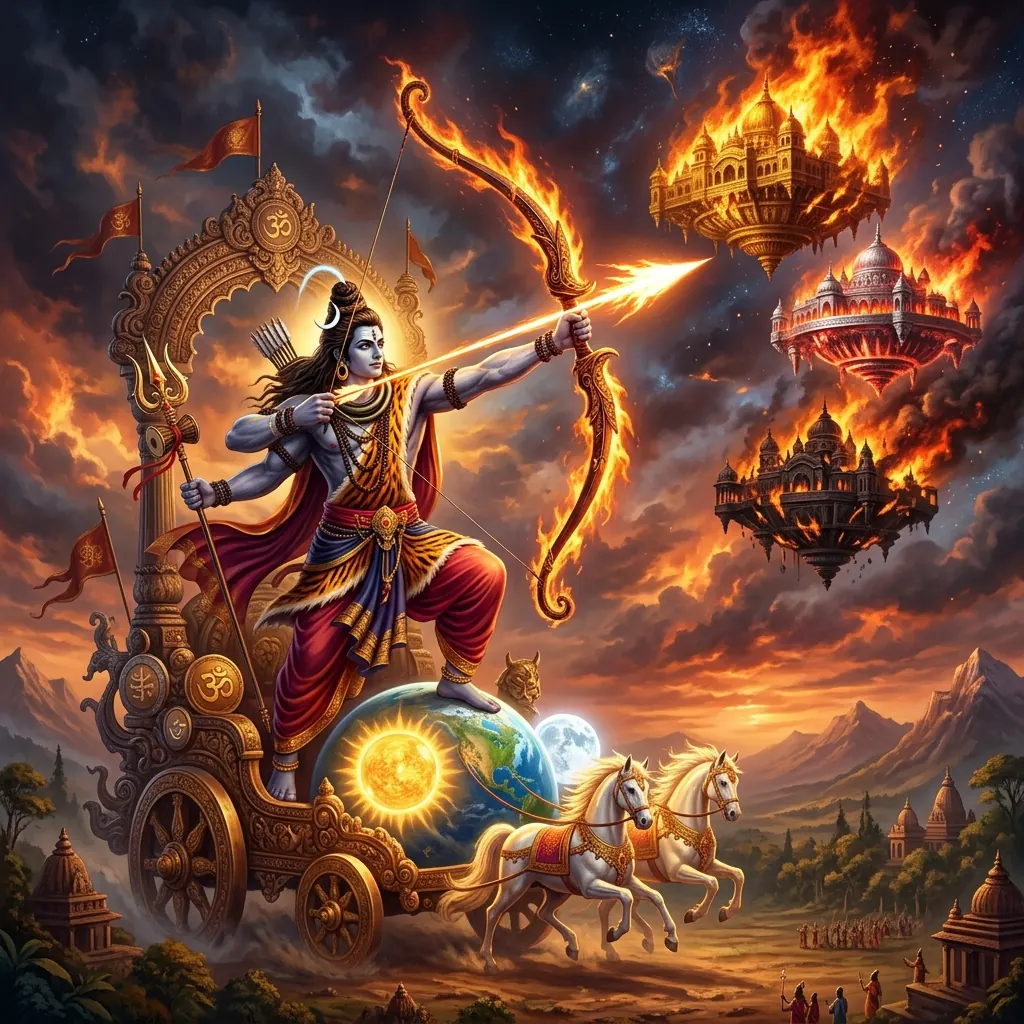
How Vishnu Got the Discus
Upamanyu tells Krishna where Sudarshana came from, and Krishna climbs Himavat to ask Mahadeva for a son
In short
Yudhishthira asks Bhishma for the names of Mahadeva, and Bhishma hands the question to Krishna, who tells how his wife Jambavati once asked him for a son and how he went to Himavat to earn one. In the asylum of the rishi Upamanyu he learns that the discus he carries was made by Mahadeva and given away, that it was named Sudarshana because no one but Shiva could look at it, and that it could not scratch the Daitya Mandara, who fought Indra for a billion years on a boon from the same god. Then Krishna takes the Diksha, stands five months on one foot, and sees Mahadeva in a cloud like a mass of blue hills.
Told in the Anushasana ParvaSet in Himavat, Kurukshetra and Dwaraka22 min read
The Names Bhishma Would Not Recite
"Son of the River Ganga," Yudhishthira said, "you have heard all the names of Maheshvara, the Lord of the universe. Now tell us all the names given to Him who is called Isa and Shambhu, and Vabhru, the vast one; to Him whose form is the universe; to the illustrious teacher of all the gods and the Asuras, who is called Swayambhu, and who makes the universe and dissolves it. Tell us also of Mahadeva's power."
It was the sort of request the grandsire had been answering all season from the bed of arrows. A list was wanted. Bhishma refused it.
"I am not able to recite the virtues of Mahadeva, whose intelligence is the highest," he said. "He pervades everything in the universe and yet is seen nowhere. All the gods, from Brahma down to the Pishachas, adore and worship him. He is beyond both Prakriti and Purusha. He stirred them both with His energy, and out of them He created Brahma himself, the lord of all creatures. A man is conceived in his mother's womb, is born, grows old and dies. How could a man like me understand Bhava? Only Narayana, who carries the discus and the mace, can comprehend Mahadeva."
Then he gave his reason, and the reason was sitting in the assembly.
"It is through his devotion to the illustrious Rudra, whom he pleased with penances in the retreat of Badari, that the great-souled Krishna has come to pervade the entire universe. For a full thousand years this Madhava performed the severest penances, until at last he pleased Shiva, the giver of boons. In every new Yuga Krishna has pleased Mahadeva, and in every Yuga Mahadeva has been pleased with his devotion. Hari saw with his own eyes how great Mahadeva's power is, when he performed penances to obtain a son. I know of no one greater than Mahadeva. Only Krishna is able to explain the names of that god of gods."
The king had asked for a thousand names. His grandsire had handed the question across the field to a man who had a memory instead.
A Wife Who Wanted a Son Like the Others
Vaishampayana, telling all this afterwards to Janamejaya, said that Bhishma turned to Vasudeva where he sat and spoke to him directly.
"You are the Master of all the gods and the Asuras. You are Vishnu, because you pervade the whole universe. Long ago the rishi Tandin, who sprang from Brahma, recited the thousand names of Mahadeva in Brahma's own region, before Brahma himself. Recite those names to this assembly, so that these rishis of high vows may hear them from you."
Krishna began by refusing as flatly as Bhishma had.
"The gods themselves, Indra among them, and the Grandsire Brahma, and the great rishis too, cannot truly understand the course of Mahadeva's acts in all their detail. Even the Adityas, whose sight is subtle, cannot see where he dwells. How then can a mere man hope to comprehend Him? So I will tell you only some of the attributes of that illustrious Lord of all sacrifices and vows."
He purified himself by touching water. Then, instead of opening with the names, he opened with a domestic quarrel.
"Hear how, long ago, I won the sight of that great god, which is so hard to win, and for whose sake. Twelve years had passed since Pradyumna, the son of Rukmini, killed the Asura Shambara. My wife Jambavati, the daughter of the prince of apes, had been watching Pradyumna and Charudeshna and the other sons Rukmini had borne me, and she came to me and said this.
"'Lord of unfading glory, give me a son who is a hero, the greatest of mighty men, handsome, sinless in conduct, and like you. And do not delay. There is nothing in the three worlds you cannot do, upholder of Yadu's race. You could create other worlds if you only wished it. You kept a vow for twelve years, purified yourself and worshipped the Lord of all creatures, and then you fathered on Rukmini the sons she has had by you: Charudeshna and Sucharu and Charuvesa and Yasodhana and Charusravas and Charuyasas and Pradyumna and Shambhu. Slayer of Madhu, give me a son like them.'"
She had counted them. She knew what the price had been, and she was asking her husband to pay it a second time.
Garuda Sets Him Down on Himavat
"Give me leave to go away from you for a while," Krishna answered her. "I will certainly do as you ask."
What she gave him back was not a farewell but a shield made out of the whole world. Go, she said, and may success and prosperity always be with you. Let Brahma and Shiva and Kashyapa protect you, and the Rivers, and the deities that preside over the mind and the soil and all herbs that die each year, and the rishis, and Earth, and the Oceans, and the sacrificial presents, and the Pitris and the Planets and the celestial mothers, and cows, and Agni, and the knowledge of the Vedas, and the seasons and the year and all the divisions of time, the Kshanas and the Labas and the Muhurtas and the Nimeshas and the Yugas in their succession. Let no danger meet you on your way, and may you never be careless.
He went then to his father and his mother, to the king and to Ahuka, and told them what the daughter of the prince of the Vidyadharas had said to him in her distress. He took leave of them with a sorrowful heart. He went to Gada and to mighty Rama, and those two were cheerful about it. "May your penances grow without any obstruction," they said, which is the blessing a man gets when he is going away to suffer on purpose.
Then he thought of Garuda, and the bird came at once and carried him to Himavat, and was sent away there.
On that greatest of mountains he found the retreat of the great-souled Upamanyu, a descendant of Vyaghrapada. The gods and the Gandharvas praised and revered it, and it seemed clothed in the beauty of the Vedas. It was adorned with Dhavas and Kakubhas and Kadamvas, with Ketakas and Jamvus and Patalas, with banians and Vilwas and Salas and palmyras, with Asokas and Amras and Champakas and Panasas, and with heaps of ashes from the sacrificial fires thrown in their proper places all around. It was full of apes and tigers and lions and leopards, of deer and peacocks and snakes, of buffaloes and bears. The clear and sacred Ganga ran through it, for the daughter of Jahnu always stayed there. The mongoose played with the snake, and the tiger with the deer, like friends who had forgotten their natural enmity, because of the energy of those ascetics whose penances blazed.
"No one could even imagine a retreat as delightful as the one I saw," Krishna said. "It lay in all its beauty on the breast of Himavat, like the moon in the sky."
A Young Man With Matted Locks
The ascetics in that place were the strangest catalogue of all, because every item in it is a man. Some lived on air and some on water, some on smoke only, some on fire, some on milk. Some had taken the vow of eating and drinking like cows, which is to say they had given up the use of their hands altogether. Some used two pieces of stone for husking their grain and some used their teeth. Some drank only the rays of the moon, and some only froth. Some had vowed to live like deer. Some dressed in rags, some in animal skins, some in the bark of trees.
As soon as he entered, Krishna saw a mighty rishi with matted locks and dressed in rags, who seemed to blaze like fire with his penances. His disciples waited on him, and his soul was at peace. And he was young in appearance, which in a man who has been standing in that place since the Krita age is the most alarming thing about him.
His name was Upamanyu.
Krishna bowed with a nod of the head, and the rishi got in first.
"Welcome, lotus-eyed one. Your visit today shows us that our penances have borne fruit. We should be worshipping you, and yet you worship us. You are the one worth seeing, and yet it is you who have come to see me."
Krishna joined his hands and made the ordinary enquiries a guest makes at a hermitage, after the animals and birds that lived there, after the progress of the ascetic's righteousness, and after his disciples. Then Upamanyu answered the question that had not been asked.
"You will certainly have a son like yourself, Krishna. Take up severe penances and please Isana, the Lord of all creatures. That divine Master, Adhokshaja, takes his pleasure here with his wife at his side. It was here, Janardana, that long ago the gods and all the rishis pleased him with their penances, their truth and their self-restraint, and won many high desires. That inconceivable Deity you seek, who brings all things, good and evil, into being and draws them back into himself, lives here with his wife."
He had answered the errand before it was stated, and named the god, the place and the method in one breath.
Then, because there was one thing on Krishna's person that had come from this very god, Upamanyu began to talk about what Mahadeva had given away over the years, and to whom.
The Son of Hiranyakashipu
"The one who was born as the Danava Hiranyakashipu," Upamanyu said, "whose strength was so great that he could shake the mountains of Meru themselves, won from Mahadeva the power of all the gods, and enjoyed it for a billion years."
That is the opening entry of the ledger, and it is worth pausing on the arithmetic. A billion years of holding, by grant, the combined power of every god there is. Not stolen. Given. And it was not the most dangerous thing that came out of that family.
"The greatest of all his sons, the famous Mandara, was able, through the boon he had won from Mahadeva, to fight Shakra for a billion years."
A billion years of war against the king of the gods, unbroken, without a decision. Indra had the thunderbolt. Vishnu had the discus. Upamanyu, standing in front of the man who carries the second of those two weapons, said what those weapons were worth against Mandara.
"In those days, Keshava, neither the terrible discus of Vishnu nor the thunderbolt of Indra could make the slightest mark on the body of that great scourge of the universe."
He did not soften it afterwards. He repeated it, and then he raised the number.
"Even that weapon could not make the slightest mark on the body of Hiranyakashipu's son Mandara, who rose like an evil planet over the three worlds. Hundreds of discuses like yours, and hundreds of thunderbolts like Shakra's, could not scratch the body of that mighty evil planet, because he had a boon from Mahadeva."
And because a boon is a thing that can be given to more than one, Mandara did not stand alone. Afflicted by him, the deities fought hard against him and against his associates, and every one of those associates had also obtained boons from Mahadeva. That is the shape of the war Upamanyu was describing. Heaven, in arms, against a company of invulnerable men, each of whom was invulnerable by the gift of the same god the gods themselves worship.
The great deity had armed both sides of the battle and had then declined to take one.
Why It Is Called Sudarshana
Then Upamanyu told Krishna where the thing on his own hand had come from.
"The discus you carry, sinless one, was given to you by Mahadeva, after he had killed a Daitya who was proud of his strength and lived under the waters. That discus, blazing with energy like fire, was made by the great god whose emblem is the bull. Wonderful and irresistible in its energy, it was given to you by that illustrious god."
So the weapon that the worlds know as Vishnu's was made by the god with the bull on his banner, and handed over after a killing done in the water. It was not won and it was not forged by its bearer. It was a gift, and it came with a name attached, and the name has a reason.
"Its energy blazed so that no one could look at it except Shiva, the wielder of Pinaka. That is why Bhava named it Sudarshana. Ever since, it has been known by that name in all the worlds."
Sudarshana means the thing that is good to look at, and it was called that because there was exactly one being in creation who could look at it. The name is not a compliment paid to the discus. It is a statement about the eyes of the one who made it.
And Upamanyu said, before and after telling it, that this weapon could not scratch Mandara.
That is the whole of the teaching he had put into Krishna's hands, and he had done it without a word of instruction. The discus is Mahadeva's. The son of Hiranyakashipu who could not be cut by it was also Mahadeva's. The bearer of the discus had come up the mountain to ask for a son, and the first thing he had been shown was that the greatest weapon he owned was somebody else's grant, and that the same hand had signed a warrant against it.
There was no arguing with a man in rags who was in possession of that particular fact.
The Rest of the Ledger
Upamanyu went on down the list, and it is long, because he was not making a case for Mahadeva's power but for Mahadeva's habit.
Pleased with a Danava named Vidyutprabha, Mahadeva granted him the sovereignty of the three worlds, and that Danava held it for a hundred thousand years. "You will be one of my attendants," the god told him, and gave him a million sons as well, and the region called Kusadwipa for his kingdom.
Another great Asura, Satamukha, was created by Brahma, and for a hundred years he poured upon the sacrificial fire, as offerings to Mahadeva, the flesh of his own body. "What can I do for you?" said Shankara. "Grant me extraordinary Yoga," said Satamukha, "so that I may have eternal power." "So be it," said the lord.
The Self-born Brahma, concentrating his mind in Yoga, made a sacrifice for three hundred years to obtain children, and Mahadeva granted him a thousand sons, as the merit of that sacrifice deserved. The rishi Yajnavalkya acquired great fame by adoring Mahadeva, and Vyasa, the son of Parashara, became greatly renowned by adoring Shankara.
The Valikhilyas, those ascetics no bigger than a thumb, were once disregarded by Maghavat. Filled with wrath, they pleased Rudra, and Rudra said to them, "You will succeed by your penances in creating a bird that will rob Indra of the Amrita." When through Mahadeva's wrath all the waters disappeared, it was the deities who had to please him with a sacrifice called Saptakapala, and only then did water appear again.
The wife of Atri left her husband in a huff, saying she would no longer live in subjection to that ascetic, and sought the protection of Mahadeva instead. For three hundred years she abstained from all food and slept on wooden clubs, and the great deity appeared and smiled and told her she would have a son without the need of a husband, and that he would be famous in a lineage named after him.
Sakalya adored Bhava in a mental sacrifice of nine hundred years and was told he would become a great author whose race would never end. Savarni, in this very asylum, underwent penances for six thousand years and was granted freedom from old age and death. Shakra himself, in Baranasi, adored Mahadeva, who has empty space alone for his garments and ashes for his unguent, and by it obtained the sovereignty of the celestials. And Narada was told that none should be his equal in energy and penances, and that he should always attend on the god with his songs and his music.
Every name on that list had asked, and every name had been answered.
Five Months, Standing on One Foot
Upamanyu had told his own story too, of the thousand years of penance and of the day Mahadeva came to him disguised as Indra on a white elephant to find out whether he would take a boon from anyone else. Krishna listened to all of it, and when it was done he asked the only question a guest in that asylum could ask.
"You deserve great praise, best of learned brahmanas, for what other righteous man has a retreat honoured by the presence of that God of gods? Will mighty Shiva, the great Shankara, show himself to me as well, and show me his favour?"
"You will certainly see Mahadeva very soon, lotus-eyed one," Upamanyu said. "With my spiritual eyes I see that you will see him in the sixth month from now. You will receive twenty-four boons from Maheshvara and his wife. What I tell you is true, for by that Deity's grace I know the past, the future and the present. The great Hara has favoured these rishis, thousands of them, and as many others besides. Why would he not favour you, who are devoted to the brahmanas, full of compassion and full of faith? I will give you certain mantras. Recite them without stopping, and you are sure to see Shankara."
Eight days passed there like an hour, all of them occupied with talk of Mahadeva. On the eighth day Krishna underwent the Diksha at the hands of that brahmana according to due rites, and received the staff from his hands.
What followed he reported to the assembly as a plain schedule, in the manner of a man reading out an account.
He underwent the prescribed shave. He took up a quantity of Kusa blades in his hand. He wore rags for his clothes. He rubbed his body with ghee. He tied a cord of Munja grass round his loins. For one month he lived on fruits. The second month he lived on water. The third, fourth and fifth months he lived on air alone. All that while he stood on one foot, his arms raised above him, and did not sleep at all.
The lord of Dwaraka, who could create other worlds if only he wished it, stood on one leg on a mountain for five months in a borrowed cord of grass, because his wife had asked him for a boy.
A Cloud Like a Mass of Blue Hills
Then he saw in the sky a radiance as dazzling as a thousand Suns together. Toward the centre of it he saw a cloud like a mass of blue hills, hung with rows of cranes and many great rainbows, with flashes of lightning and the fire of the thunder set in it like eyes. Inside that cloud was Mahadeva himself, with his wife Uma beside him, like the Sun among driving clouds with the Moon at his side.
The hair on Krishna's body stood on end and his eyes opened wide with wonder. The god was adorned with a diadem. He was armed with his Sula, clad in a tiger-skin, with matted locks on his head, carrying the staff of the Sannyasin in one hand, armed besides with the Pinaka and the thunderbolt. His teeth were sharp-pointed. His sacred thread was a snake. He wore a garland of many colours that hung down to his toes, and surrounded by his hosts of spirits and ghosts he looked like the autumn Sun, too bright to look at.
Eleven Rudras stood about him, singing his praises. The Adityas, the Vasus, the Sadhyas, the Viswedevas and the twin Ashvins praised him with the hymns of the scriptures. Indra and his brother Upendra and the Grandsire Brahma chanted the Rathantara Saman in his presence. The Earth was there, and the Sky, and the Constellations and the Planets, the Months, the Fortnights, the Seasons, Night, the Years, and the Yugas one after another, all bowing. The Gandharvas and the Apsaras sang. The Vidyadharas, the Danavas, the Guhyakas, the Rakshasas and every created being, moving and unmoving, worshipped that Lord in thought and word and deed.
The whole universe, with the Grandsire and Indra among them, turned and looked at Krishna.
And Krishna, who had stood on one foot for five months to come to this, did not have the power to look at Mahadeva.
Then the great Deity spoke.
"Look, Krishna, and speak to me. You have worshipped me hundreds and thousands of times. No one in the three worlds is dearer to me than you."
He bowed, and Uma also became pleased with him.
Ask For Eight Boons
"I bow to you, eternal origin of all things," Krishna said. "The rishis say that you are the Lord of the Vedas. The righteous say that you are Penance. You are Sattwa, you are Rajas, you are Tamas, and you are Truth. You are Brahman, you are Rudra, you are Varuna, you are Agni, you are Manu, you are Bhava, you are Dhatri and Tvashtri and Vidhatri, and you are everywhere. All beings, moving and unmoving, have come from you."
He went on, and the part of it that is hardest to hear is the part he did not flinch from saying to the god's face.
"You, illustrious one, are the Vedas, the Sacrifices, Soma, Dakshina, Pavaka, Havi, and all the other requisites of sacrifice. The merit won by sacrifices, gifts to others, study of the Vedas, vows, restraint, Modesty, Fame, Prosperity, Splendour, Contentment and Success all exist to lead to you. And Desire, Wrath, Fear, Greed, Pride, Delusion and Malice, and Pains and Diseases, are your children, illustrious one. You are every act that creatures do. You are the joy and the sorrow that flow from those acts, and you are the absence of joy and sorrow. You are that Ignorance which is the indestructible seed of Desire."
"Your arms and feet reach everywhere, and your eyes and head and face are everywhere. You hear everything in the universe, and you abide, pervading all things. You dwell in the heart of every creature, and the rishis worship you as Kshetrajna. Those who know you as the Immutable, or as the one who dwells in all hearts, or as the ancient Purusha, or as pure Knowledge, are people of great intelligence indeed. Truly, such people abide beyond intelligence itself."
When he had finished, the universe, moving and unmoving, sent up a lion-like shout. The brahmanas present, the deities and the Asuras, the Nagas, the Pitris, the birds, the Rakshasas, the ghosts and spirits, and all the great rishis bowed down to Mahadeva. Showers of celestial flowers of great fragrance fell on Krishna's head and delicious winds blew on the spot.
Then Shankara, devoted to the good of the universe, looked at the goddess Uma, and at the lord of the celestials, and at Krishna, and spoke.
"We know, Krishna, how deeply devoted you are to us. Do what is for your own good. My love and affection for you are very great. Ask for eight boons, and I will certainly give them to you. Name what you want. However hard they may be to win, you will have them."
Dharma Lesson
The story is told by the man who owns the most famous weapon in the world, and what he is made to say about it is that he did not make it, did not win it, and cannot look at it without help. Upamanyu names Mandara in the same breath: the discus could not scratch him, because the god who forged the one had also armoured the other. Power that comes as a gift is never proof of standing, only of somebody else's kindness. Krishna answers that knowledge in the only way it can be answered, by taking off his weapons, taking a grass cord and a beggar's staff, and standing on one foot for five months like any other petitioner.