In short
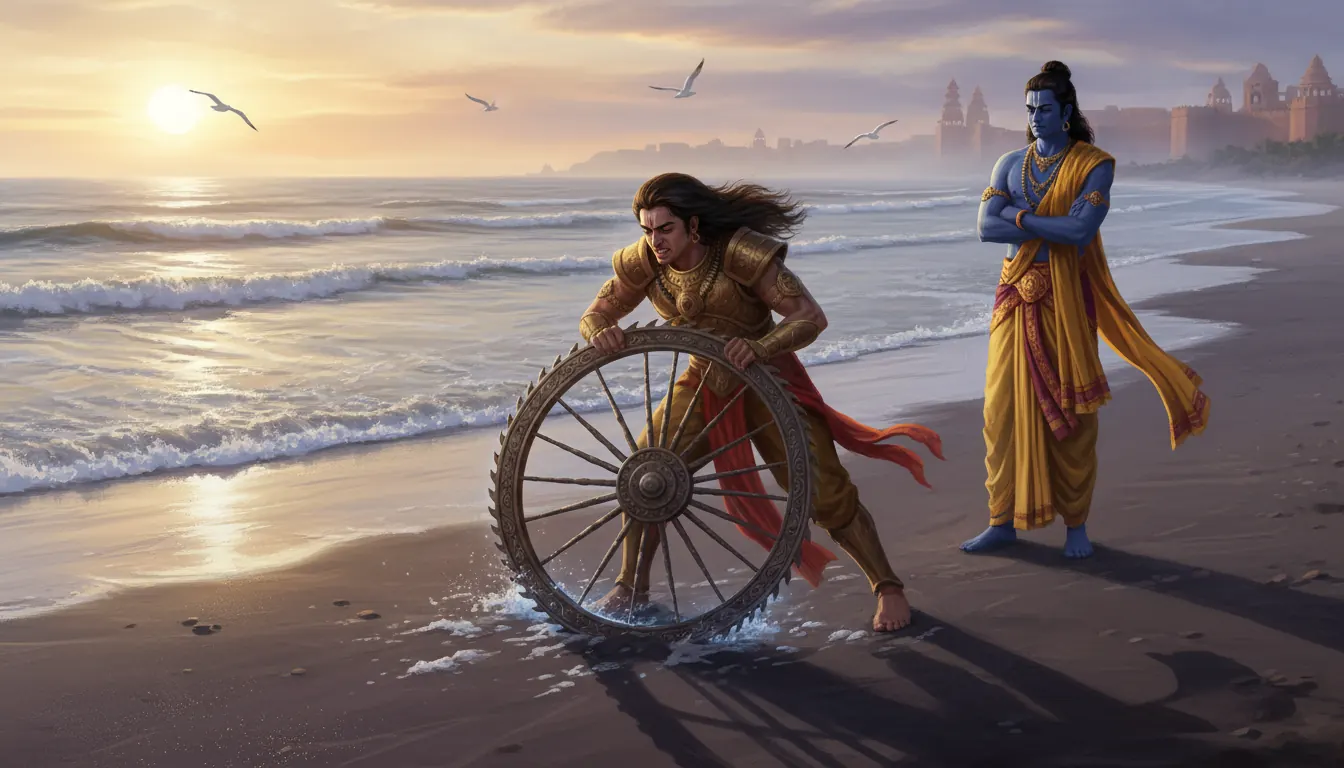
Krishna tells Yudhishthira why Bhima must not ride alone against Ashwatthama, and the reason is a private meeting years earlier. During the exile Ashwatthama lived at Dwaraka, and one morning found Krishna alone on the seacoast and offered to trade the Brahmashira for the Sudarshana discus. Krishna told him to take whichever weapon he could lift.
Told in the Sauptika ParvaSet in Dwaraka, Kurukshetra and Himavat16 min read
After Bhima Had Set Out
Vaishampayana said, "Draupadi had come from Upaplavya to the field where her five sons lay. Nakula had brought her, on his chariot that shone like the sun, and she had arrived trembling like a plantain tree shaken by the wind, and had fallen down before Yudhishthira.
'By good luck, king, you have won the whole earth, and you will enjoy her now that your brave sons have been slaughtered,' she said. 'By good luck your thoughts do not dwell on Subhadra's son, who walked like an enraged elephant. Since I heard that Drona's son, that doer of sin, has slaughtered those heroes in their sleep, grief has burned me as if I stood in the middle of a fire. If Drona's son is not made to reap the fruit of that sinful deed, then listen to me, Pandavas: I will sit here in praya.'
And she sat down beside the eldest son of Pandu and would not rise.
'Blessed lady, you who know what is right,' Yudhishthira said, 'all your sons and brothers have met a noble death, righteously. You should not grieve for them. As for Drona's son, he has gone to a distant forest, beautiful princess. How will you be sure that he has fallen in battle?'
She had her answer ready, and it was a price. 'I have heard that Drona's son has a gem on his head that was born with him. I will see that gem brought to me once that wretch has been killed in battle. When I have placed that gem on your head, king, I will bear to go on living.'
Then she had turned to the one man who would not argue with her. 'Remember the duties of a kshatriya, Bhima, and come to my rescue. At Varanavata you were the refuge of all the Parthas. When Hidimba saw us, you were our refuge in the same way. In Virata's city you rescued me in my distress from a great calamity. Kill the son of Drona now, and be happy.'
Bhimasena heard these and other piteous laments and could not bear them. He climbed onto his great chariot adorned with gold, took up his beautiful bow with the arrow already on the string, made Nakula his charioteer, and had the horses driven without delay along the track of Ashwatthama's wheels.
When he had gone, the lotus-eyed bull of Yadu's race spoke to Kuru's son Yudhishthira.
'Son of Pandu, this brother of yours, overwhelmed with grief at the slaughter of his sons, is going alone into battle to kill the son of Drona. Of all your brothers, Bhima is your dearest. You see him walking into great danger, so why do you not stir yourself?'
Yudhishthira looked at him, and Krishna went on, and what he said next was not about tonight at all. It was about a conversation on a beach, years ago, that nobody else had heard."
The Weapon Drona Did Not Want to Give
"'The weapon called Brahmashira,' said Krishna, 'which Drona, conqueror of hostile cities, passed on to his son, can burn up the whole world. Understand where it came from and how it passed.
That glorious and greatly blessed teacher, the first of all who bear bows, won it from Agastya by the severest penances. And because he was delighted with Dhananjaya, he gave that very weapon to him. Arjuna had it first, and had it as a gift, freely, because his teacher was pleased with him.
Drona's only son could not bear that, and begged it from him. He begged, king; he was not offered it. Unwillingly Drona taught Ashwatthama the knowledge of that weapon. Mark the word, king. Unwillingly. The father who had given it gladly to a pupil gave it grudgingly to his own child, and everyone standing there understood the difference and nobody said anything about it.
There is hardly any defence against the Brahmashira, and only a man of cleansed soul who has kept the vows of a brahmachari can call it back once it is loosed. But loosing it answers to the syllables, and the syllables can be spoken by anyone who has been taught them, in any temper, on any night. Drona understood that difficulty perfectly, which is why he never once made the mistake of thinking that teaching a weapon and trusting a man were the same act.
The glorious Drona knew how restless his son was. So the teacher, who knew every duty, laid this command on him. He said, "Child, even if the greatest danger overtakes you in the middle of battle, you must never use this weapon, and above all not against human beings."
That is what the teacher Drona said to his son. And a little while after, he spoke again, and said a second thing, which was worse.'"
You Will Not Walk in the Path of the Righteous
"'He said, "Bull among men, it seems you will not walk in the path of the righteous."
That is what a father said to a son on the day he handed him the most terrible weapon in the world. Not a curse. Not a prohibition. A prediction, spoken in the ordinary voice of a man who has watched a boy grow up and has finally admitted to himself what he has been watching.
When he heard those bitter words from his father, the wicked-souled Ashwatthama gave up hope of ever winning prosperity of any kind, and began to wander the earth in grief. He did not stay in his father's house. He had the weapon and he had the sentence that came with it, and he carried both of them about with him from country to country like a man carrying two vessels he cannot set down. Understand that this was said long before the war, king, before his father's head was taken while it sat in meditation in a chariot. Whatever Ashwatthama did afterwards, he did with that sentence already spoken over him, and there is a question in that which I do not propose to settle for you: whether a father who says such a thing to a son is describing him, or making him.
Then, chief of the Kurus, while you were living in the woods, Bharata, he came to Dwaraka and made his home there, and the Vrishnis honoured him. He was the son of the teacher of the Bharatas. All the Yadavas held him in high respect. He was given a house and honour and the freedom of the city, and nobody in Dwaraka asked him why he had left home. He lived among the Vrishnis for a long while, and he was pleasant to them, and they thought well of him.'"
Alone on the Seacoast
"'One day, after he had settled in Dwaraka, he came to me. He came without a companion, and he came at a time when I myself was without anybody by my side, on the seacoast. I have thought since that he must have waited some while for such a time, because in that city it does not often happen. There is always a kinsman, an errand, a child, a petitioner. That morning there was the water and the sand and the two of us.
And there he spoke to me with a smile:
"Krishna, that weapon called Brahmashira, worshipped by gods and gandharvas, which my father, the teacher of the Bharatas, whose prowess could never be thwarted, won from Agastya by the severest penances, is now mine, Dasharha, as much as it is my father's. First of Yadu's race, give me your discus, which can slay every foe in battle, in exchange for that celestial weapon."
He stood there on the sand with his palms joined, begging me for it, as a man asks a favour of a friend he has come a long way to see. And he was offering, in trade, the one thing his father had been unwilling to give him and had told him never to use. He described it accurately and at length. He named Agastya. He named the penances. He was careful to say that the weapon was as much his as it was his father's, which was the very point his father had doubted. A man selling something always tells you the parts of the story that flatter him.'"
Take Whichever You Can Lift
"'While he begged me for my discus like this, with joined palms and great insistence, I wanted to make him glad, and so I said to him:
"Gods, danavas, gandharvas, men, birds and snakes, all gathered together, are not equal to a hundredth part of my energy. I have this bow, this dart, this discus, and this mace. I will give you whichever of these you want. You need not give me the weapon you are offering. Take whichever of my weapons you are able to wield and use in battle."
Understand the terms, son of Pandu, for I meant them exactly as I said them. I did not ask him for the Brahmashira. I told him to keep it. I told him to take whatever of mine he could carry, and I named four things and set them in front of him, and I laid no condition on the choosing except the one condition that cannot be argued with.
At that, the glorious son of Drona, as if challenging me, asked me for my discus with its fine hub, hard as thunder, with a thousand spokes, made of iron. He did not take the bow. He did not take the mace. He looked at the four and asked for the one that was mine above all the others.
"Take it," I said.
And notice, king, that I did not refuse him. Men will tell this story afterwards as though I set a trap on that beach. I did not. The discus lay on the sand between us and I told him to take it, and I meant it. Had he lifted it he would have carried it away with my blessing, and my kinsmen would have stood in the road and watched him go.'"
The Left Hand, Then the Right
"'At that he sprang up and seized the discus with his left hand.
But he could not even move the weapon from where it lay. Not raise it. Move it. It did not shift on the sand.
Then he got ready to seize it with his right hand. He gripped it very firmly and put out all his strength, and still he could neither wield it nor move it. He set his feet. He bent his back over it. He was a great warrior, the son of the greatest teacher of arms in the world, and he stood on a beach in front of me sweating over a wheel of iron that would not come off the ground.
At this, Drona's son was filled with sorrow. When he was worn out with the effort, he stopped, Bharata. He let go of it and stood up and would not look at me for a while.
I have seen men fail at things, son of Pandu. What was in his face was not the failure. It was the arithmetic he was doing behind the failure, and I could watch him do it: if it will not come up for me, then it will never come up for me, and therefore this thing that I planned is finished, and therefore I must plan another thing. There was no moment in it at which he considered that the wheel had answered him.
And when he had drawn his heart back from that purpose, I spoke to him, and I spoke gently, though by then I had understood what the request had been.'"
Nobody Ever Asked Me for It
"'I said to him:
"Think of the one whom everyone counts the first of all human beings: the bearer of Gandiva, the warrior whose chariot is drawn by white horses, the hero with the prince of apes on his banner, the hero who once wrestled the god of gods, the blue-throated lord of Uma, hoping to defeat him, and so won the favour of the great Shankara himself. That Phalguna, the dearest friend I have on earth, the friend to whom there is nothing I would not give, not even my wives and children, that dear friend Partha of spotless deeds, never once said to me, brahmana, words like these you have spoken.
I won my son through penance, by keeping a stern vow of brahmacarya for twelve years on the breast of Himavat, where I had gone for that purpose. That son of mine, of great energy, born to my wife Rukmini, who kept vows as stern as mine, never asked me for this best of things, this matchless discus, which you, with your little understanding, have asked for.
Rama of great might never said such words to me. Nor have my son Samba, or Gada, ever asked me for what you have asked. No one among the other great chariot-warriors of the Vrishni and Andhaka races who live in Dwaraka has ever asked me for what you have asked.
You are the son of the teacher of the Bharatas. All the Yadavas hold you in high respect. So let me ask you, best of chariot-warriors: whom would you fight with this weapon?"
I asked it plainly, king, and I waited, standing on the sand with the sea behind me, to hear what he would say. I had given him every road out of the question. He might have said that he wanted it for the honour of holding it, or to defend the Kurus, or because a young man wants what he sees. He had lived in my house. He knew what answer would have cost him nothing.'"
The Answer He Gave
"'When I had said this, Drona's son answered me:
"Krishna, I meant to worship you first and then fight you, you of unfading glory. That is why, Krishna, I asked you for your discus, which gods and danavas adore. If I had got it, I would have become invincible in the world. I have failed, Keshava, to win my all but unattainable wish, and now I am going to leave you, Govinda. Speak kindly to me now. This terrible weapon is held by you, the most terrible of all. No one is your rival for it. There is no one else in this world who could possess it."
There it is, son of Pandu. He had lived in my city and eaten at my table and been honoured by my kinsmen, and what he wanted from me, when the two of us were alone and no one was listening, was the means to kill me. He said it without shame and without much heat, as one states an ordinary intention that has merely gone wrong. Then he asked me to speak kindly to him, and I did, because he was my guest and the son of a teacher, and because there is nothing to be gained by anger with a man who has just told you the truth.
When he had said this to me, the son of Drona took many pairs of horses and much wealth and many kinds of gems, and left Dwaraka.'"
Why Bhima Must Not Ride Alone
"'He is quick to anger, wicked at heart, restless, and very cruel,' said Krishna. 'He knows the weapon called Brahmashira. Vrikodara must be protected from him.'
And there was the whole of the argument, Janamejaya, laid out in front of the eldest son of Pandu on the evening of the worst day of his life. Bhima had gone out alone after a man who had once tried to buy the means of killing Krishna, and who carried in his memory a weapon that could consume the whole world, and who had been told by his own father, on the day he received it, that he was not the kind of man who would keep such a promise.
Draupadi wanted a gem off that man's head. Bhima had gone to fetch it. And Krishna, who had stood on a beach in Dwaraka years before and watched Ashwatthama's hands go white on a wheel of iron that would not move, knew better than any of them what Bhima was riding toward.
With these words, that first of all who bear weapons, the delight of all the Yadavas, climbed onto his fine chariot, which was equipped with every kind of powerful weapon. Two pairs of the best horses of the Kamboja breed were yoked to it, adorned with garlands of gold. On the right was the horse called Shaibya; on the left was Sugriva; the Parshni positions were held by two others called Meghapushpa and Balahaka. On the standard sat Vinata's son, the enemy of snakes, shining with great splendour.
Then Hrishikesha mounted that chariot, and after him Arjuna of irresistible feats and Yudhishthira, the king of the Kurus, climbed onto the same vehicle, and he urged on those splendid horses, and they flew."
Dharma Lesson
What a man asks for when he thinks nobody is listening is the truest account of him, and a weapon refuses the hand that wants it for the wrong reason. Krishna set no trap on that beach; he offered four weapons and one condition, and the condition simply told the truth about the man in front of him.