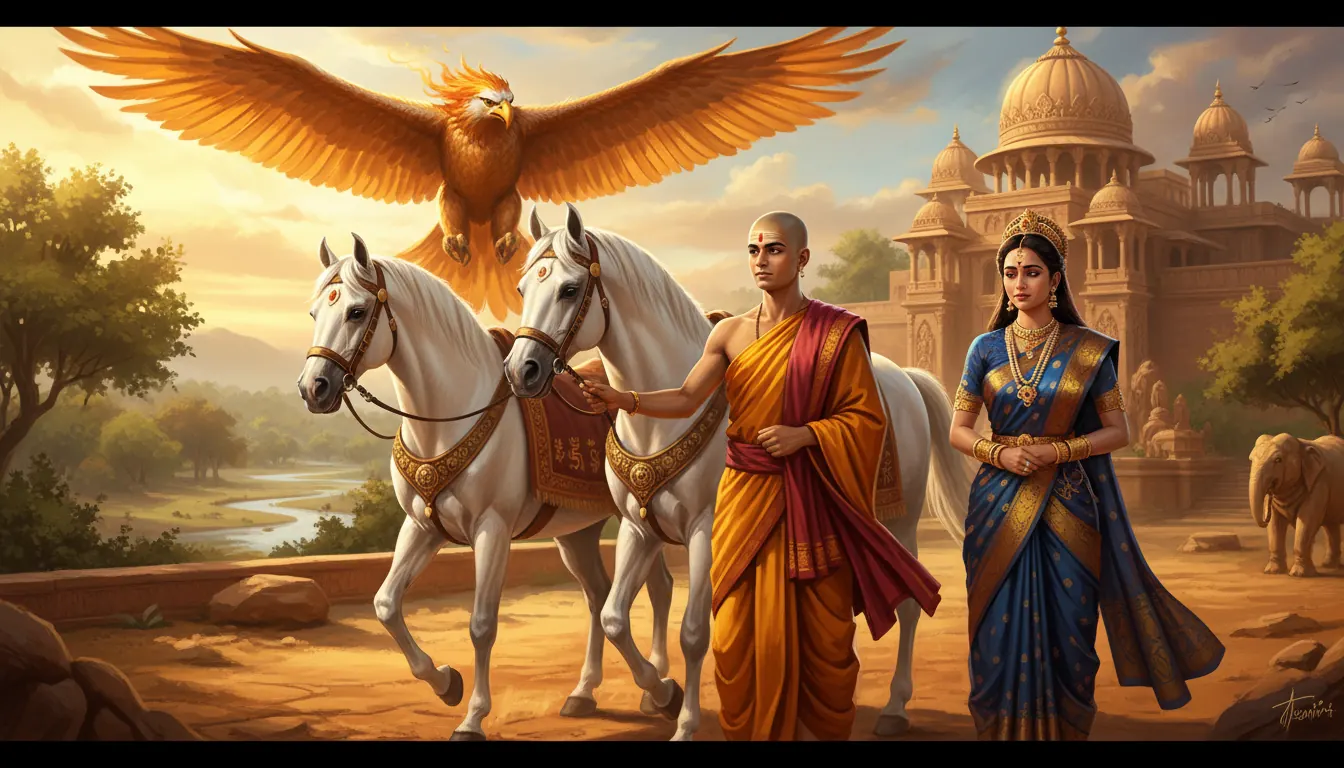
The Devotees of Mahadeva
Kapila, Valmiki, Gritsamada and others tell Yudhishthira what a lifetime's devotion to Mahadeva bought them.
In short
Beside Bhishma's bed of arrows, after Krishna has recited the thousand and eight names of Mahadeva to Yudhishthira, Vyasa and a series of rishis rise to tell what that same devotion had already won them. Kapila is given the Sankhya and freedom from rebirth, Charusirsha a hundred sons for a century of penance, and Valmiki is cleared of a brahmanicide he never committed. Gritsamada, cursed mid-sacrifice into a deer, is made free of grief and death, his friendship with Indra intact. Jamadagni's son is cleansed and armed, Vishvamitra is made a brahmana, Asita-Devala's ruined merit is restored with interest, Garga is given the science of time and a thousand sons, and Galava, who feared he would never see his father again, is sent straight home to him.
Told in the Anushasana ParvaSet in Kurukshetra17 min read
The Hymn Finished, and What Came After
Bhishma lay where he had lain since the tenth day of the war, on a bed that Arjuna's arrows had made for him, and around him the conclave had just heard Krishna recite the thousand and eight names of Mahadeva, whom even the gods could not sound to the beginning, middle, or end.
What followed was told afterwards by Vaishampayana to Janamejaya.
The hymn had come down through a long chain of teachers, from Brahma and through Tandi, until Upamanyu gave it to Krishna, and Krishna had now recited it for Yudhishthira in full, every name of it. When he had finished, the Island-born Krishna Dvaipayana spoke. Long before, on the breast of Mount Meru, he had practised the sternest penances a man can practise, wanting a son, and this was the hymn he had recited through all of it.
"Recite this hymn yourself, my son," he said, "and win the favour of Maheshvara. It is through this hymn that all my wishes were fulfilled, and so will yours be."
And in that same gathering, seated near enough to be heard, were rishis who did not need to be told what the hymn could do, because each of them had already been given something by the God it praised. One after another, they rose and told Yudhishthira in their own words what Mahadeva had done for them.
There is no better proof of what devotion buys than the men who have already spent it and been paid.
The Knowledge That Ends Rebirth, and a Hundred Sons
The first to speak was Kapila, the rishi who had given the world the Sankhya, the philosophy that sets out to know the soul by first learning to tell it apart from everything it is not. He was honoured by the gods themselves for it, and he did not dress his testimony up.
"For many lives together I worshipped Bhava with great devotion," he said. "At last the illustrious God was pleased with me, and he gave me the knowledge that helps whoever gains it to pass beyond rebirth."
That was the whole of it. No battle, no curse, no long ordeal to narrate, only lifetimes of unwavering worship set against a single gift so large it needed no embellishment: the science by which a man learns to separate his self from his body, his mind, his senses, and the world those senses report to him, until nothing is left in the reckoning that death can touch.
After him came Charusirsha, a rishi known also as the son of Alamvana, a dear friend of Shakra's and a man filled, the record says, with compassion. His penance had been plainer to describe.
"Long ago I went to the mountains of Gokarna," he said, "and sat there practising severe penances for a hundred years."
For a hundred years of stillness on that mountain, Mahadeva gave him a hundred sons. Not born of a woman, none of them, but given whole, each one already self-restrained, versed in righteousness, splendid, free of disease and sorrow, and granted a hundred thousand years of life apiece. Where Kapila had asked to be freed from the wheel of birth and death altogether, Charusirsha had been given a wheel of his own, a hundred lives running in parallel for a hundred thousand years each, none of them touched by grief. Two men, on two mountains, and two entirely different ideas of what a great gift looks like.
The Sin That Came From an Argument
Then Valmiki spoke, and what he had to confess was not a penance chosen but a sin that had descended on him out of nowhere.
"Once, in the course of a philosophical debate," he said, "some ascetics who kept the sacred homa fire accused me of having killed a brahmana. The moment they said it, the sin of killing a brahmana took hold of me."
It is worth sitting with how strange that sentence is. He had not killed a brahmana. He had argued with a circle of ascetics, and lost or won the argument in some way the record does not preserve, and been called a murderer of brahmanas by men who had the standing to make the charge stick, and the charge itself, spoken aloud by men of that authority, was enough to fasten the sin onto him as though he had actually done the thing. Reputation and reality had briefly become the same substance.
"To cleanse myself, I sought refuge with Isana, the sinless one, whose power no one can resist," Valmiki said. "And I was cleansed of all my sins."
Isana is one more name for the Deity whose thousand and eight names had just been recited in full, the destroyer of the triple city of the Asuras, and it was that Deity who answered him, not with a ritual to perform or a period of austerity to complete, but with a single sentence.
"Your fame will be great in the world."
Valmiki did not explain what he understood by that promise, and the assembly did not ask him to. He had come to Mahadeva carrying a name that other men had ruined for him in an afternoon, and he had gone away carrying a different name, one that the Deity himself had set a value on. He left it at that.
Two Kinds of Rebirth
Two more spoke in quick succession after Valmiki, and between them they showed how far the God's mercy could be made to stretch.
Jamadagni's son rose first, shining, the record says, like the sun in the midst of that gathering of rishis. His crime was heavier than Valmiki's, and he did not soften it.
"Eldest son of Pandu, I was weighed down by the sin of killing brahmanas, for I had slain brahmanas who were like my own father," he said. "To purify myself I sought refuge with Mahadeva, and I sang the great God's praises by reciting his names."
Bhava was pleased. He gave the man a battle-axe and other celestial weapons, and he told him plainly what the gift meant. "You will be freed from sin, and no one will defeat you in battle. Death himself will not overcome you, for you will be free from disease." A killer of brahmanas walked away armed and unkillable, because he had asked to be forgiven, and had asked correctly.
Vishvamitra's confession was smaller and stranger for being smaller. He had not sinned at all.
"I was born a kshatriya," he said. "I worshipped Bhava because I wished to become a brahmana, and by the grace of that great God I won the rank of a brahmana, which is so hard to win."
No curse had touched him and no crime weighed on him. He had simply wanted to be born again into a different order of men without waiting for another birth to do it, and Mahadeva had let him. Between the two of them, slayer of brahmanas and king, the assembly had just heard the God erase the two hardest lines a man can be asked to cross in that world: the line a murderer cannot walk back across, and the line a birth is supposed to fix forever. Neither line had held.
What a Curse from Heaven Could Not Keep
The rishi Asita-Devala spoke next, and his history was the shortest of all, though what it implied was not small.
"Son of Kunti, long ago a curse from Shakra destroyed all the merit I had earned by my righteous deeds," he said.
Shakra is Indra, king of the gods, and a curse from Indra was not a thing an ordinary ascetic could expect to survive intact. Merit in that world is not a reputation or a feeling. It is a substance, accumulated act by act across years of discipline, the one possession a rishi carries out of this life and into the next, and Indra had reached into Asita-Devala's store of it and burned it down to nothing, for a reason the rishi did not name and perhaps did not need to.
"It was mighty Mahadeva who kindly gave that merit back to me," Asita-Devala said, "and with it great fame and a long life."
Notice what did not happen. Mahadeva did not quarrel with Indra over the curse, did not declare it unjust, did not undo the act of cursing itself. He simply restored what the curse had taken, as if the years Asita-Devala had spent earning it were an account that could be recopied from memory once the ledger was burned. And he added interest: fame the rishi had not had before, and years beyond what the merit alone would have bought him. A god had taken everything a man owned in the unseen world, and another God had made good the loss and paid him besides.
The assembly around Bhishma's bed took note of that, for it meant that even the highest of the gods could be answered by a devotion greater than his anger.
The Sacrifice That Was Recited Wrong
Then the illustrious Gritsamada spoke, a rishi who resembled Brihaspati himself in splendour and who counted Shakra among his dear friends, and his history was the longest of all of them, because it had a villain in it.
"Long ago the inconceivable Shakra performed a sacrifice that lasted a thousand years," he said. "While it went on, Shakra had me chant the Samans."
A thousand-year sacrifice needs a thousand years of correct chanting, and somewhere inside that enormous span, Gritsamada made a mistake. Varishtha, the son of the Manu who had sprung from Brahma's own eyes, was present at the rite, and he heard the error and did not let it pass.
"Best of the twice-born, you are not chanting the Rathantara properly," Varishtha said. "Foremost of brahmanas, stop piling up demerit with such faulty recitation."
That alone would have been correction enough. But Varishtha was wrathful, and wrath, once it has an opening, does not stop at the first sentence.
"Become an animal without understanding," he said, "full of grief and always afraid, living in pathless forests where there is neither wind nor water, forests the other animals have abandoned. Live like that for ten thousand years and eighteen hundred more. The forest where you spend those years will have no sacred trees, and it will be the haunt of Rurus and lions. Yes, you will become a cruel deer, sunk in grief."
He said it, and it happened. Gritsamada, who had been trusted with the recitation of that sacrifice, was reborn at his death as a deer.
The Deer Who Sought Maheshvara
"Because of his words, son of Pritha," Gritsamada told the gathering, "when I died I was born as a deer."
There is no description of what came next, no years counted out in the forest that Varishtha had promised him, no lions named. Gritsamada does not dwell on the sentence itself. What he tells Yudhishthira instead is the single thing he did about it.
"I then sought the protection of Maheshvara."
An animal without intelligence, by the terms of the curse, should not have been capable of that. A creature stripped of understanding cannot form the thought of seeking a god's protection, cannot direct devotion anywhere at all. But Gritsamada's devotion had not been stripped away along with the rest of him, or Mahadeva reached past the curse to find what was still there. However it happened, the great Deity answered him, not by lifting the curse, but by making the curse survivable, and then some.
"You will be free from every kind of disease," Maheshvara told him, "and you will be immortal as well. Grief will never touch you. Your friendship with Indra will stay as it was, and may the sacrifices of both Indra and yourself flourish."
Read that last clause again. The friend who had presided over the sacrifice where Gritsamada was cursed, whose own guest Varishtha had been, lost nothing from the arrangement. Their friendship was to remain unchanged, as though the deer standing in a lion-haunted forest bore his old friend no grudge for what had happened under his roof.
"I know of none who is his equal in learning," Gritsamada said of the god, closing his account, and no one in that gathering disputed it. He had gone into a curse meant to strip him of intelligence, and the god had answered it with freedom from grief and death.
A Thousand Sons and the Reckoning of Years
Garga spoke after him, and his account was gratitude without complaint, a man naming a debt paid rather than a wound healed.
"Son of Pandu," he said, "the great God was pleased with a mental sacrifice I had performed, and on the banks of the sacred Saraswati he gave me that wonderful science, the knowledge of Time with its sixty-four branches."
A mental sacrifice, offered without fire or fee, on the banks of a river that itself does not flow visibly through most of the land it waters. In return, the God gave him the science by which the movements of the sky are read against the doings of the earth: the reckoning of years and seasons, the counting of when a rite should begin and when it must end, the branch of learning that tells a king or a priest that this hour is auspicious and that one is not. It was the discipline every other rishi in that gathering had leaned on without ever having to master it themselves, because Garga's science already told them when their own sacrifices should be lit.
He was given more besides. "He also gave me a thousand sons," Garga said, "all equal in merit and all thoroughly versed in the Vedas." And their years, his own included, were stretched to a million, so that a science built on the counting of time was given to a family that time itself would take an unusually long while to catch.
Where Charusirsha had asked for a hundred sons across a hundred years of penance, Garga had been given a thousand for a sacrifice that cost him nothing but the discipline of his own mind, and it was hard, hearing the two accounts back to back, to say which rishi's devotion Mahadeva had weighed the more precious.
The Boy Who Was Afraid to Go Home
The last to speak was the youngest history in that assembly, and it belonged to Galava, who had been, not long before by the reckoning of such lives, simply a student.
"I once studied under my teacher Vishvamitra," Galava said. "With his permission I set out for home, to see my father."
It should have been a happy errand. It was not, because his mother had fallen into grief in his absence, and that grief had reached him before he could reach her with the truth of his return.
"My mother was full of sorrow and weeping bitterly," Galava said, "and she told me, Alas, your father will never see his son come home, learned in the Vedas and sent home by his teacher."
A young man walking home with everything he had earned at his teacher's feet, told before he arrived that the one person he most wanted to show it to was already gone. Galava does not describe the walk after that. He describes only what he did with the despair it left him.
"Then I worshipped Maheshvara with my whole soul," he said, "and he was pleased with me. He appeared to me and said, Your father, your mother and you yourself, my son, will all be freed from death. Go home quickly; you will find your father there."
He went. And there, coming out from his own homa fire with kusha grass and fallen fruits still in his hands, having already washed and eaten, was his father, alive, unhurried, exactly where a father should be found.
"He embraced me and smelt the crown of my head," Galava said, "and said, By good luck I see you again, my son. You have come back with the knowledge your teacher gave you."
Of everything spoken in that gathering, it was the smallest miracle, and to the men listening, perhaps the one that needed no explaining at all.
What the Gathering Had Proven
"When he heard the ascetics tell these marvellous and wonderful deeds of the illustrious Mahadeva," the story goes, "the son of Pandu was amazed."
He had reason to be. In the space of one gathering he had heard a philosopher freed from rebirth, a hermit given a hundred sons without a wife, a poet cleared of a murder he never committed, a slayer of brahmanas armed and made deathless, a king remade into a brahmana, a rishi's stolen merit restored with interest, a man cursed into a deer who was made free of grief and death, an astronomer given a thousand sons and a million years, and a frightened student who arrived home to find his father exactly where he had been told he would be. Different men, different faults, different mountains and rivers and forests, and one God answering every one of them out of the same well.
Krishna spoke once more before it closed, repeating words Upamanyu had said to him. "Sinful men stained with unrighteous deeds never reach Isana," he said. "Only the twice-born whose souls are cleansed reach the Supreme Deity. Even a man who lives amid every pleasure and luxury, if he is devoted to the Supreme Deity, comes to be counted the equal of forest hermits whose souls are cleansed. This is my settled conviction: those who give themselves to Mahadeva are certainly set free from rebirth."
The words rested a while over the bed of arrows.
It was the whole of what those rishis had proved without meaning to prove anything: that the size of the sin, or the size of the sorrow, makes no difference to the size of the mercy. Kapila asked for the end of rebirth and got it. Galava asked only to see his father's face again, and got that too. Mahadeva did not weigh one request as larger than the other.
Dharma Lesson
None of these rishis bargained with Mahadeva in the ordinary sense; they arrive with wildly unequal claims on his attention, from a philosopher's request to be released from birth altogether to a frightened student's request to see his own father's face, and the catalogue treats both as answered in full. The god who cannot be measured, so Upamanyu had just finished saying, turns out here to be measured only by the width of his answers, never by the size of what was asked. A rishi who wanted a hundred sons is heard exactly as fully as one who wanted only to stop being reborn, and a curse from Indra himself proves no match for it.