Where the Kingdom Ends
A sentence of exile that its author could not locate
In short
Krishna, asked to repeat the Gita and refusing, tells Arjuna an older story instead. King Janaka sentences an offending brahmana to leave his dominions, and the man politely asks to be told where those dominions stop so that he may obey. The question eclipses the king's understanding like Rahu swallowing the sun, and the answer he gives when it clears turns a banishment into a welcome.
Told in the Ashvamedhika ParvaSet in Mithila and Hastinapura18 min read
I Have Forgotten What You Told Me
"Then Arjuna asked for it a second time," said Vaishampayana, "and was refused, and was given something better. Listen to it, Janamejaya, as it was given."
The war was over and the mansion was full of light, and Arjuna, walking through it beside Krishna with his relatives and attendants around him, was happier than he had been in many years. He surveyed the rooms he had won back. Then he said the thing he had been carrying since Kurukshetra.
"Mighty-armed one, your greatness became known to me when the battle was about to begin. Son of Devaki, your form also, as the Lord of the universe, became known to me then. But all that your holy self said to me at that time, Keshava, out of affection, I have forgotten, chief of men, through the fickleness of my mind. And I have been curious about those truths again and again. And you will go back to Dwaraka soon."
Krishna embraced him, and then answered him, and the answer was not gentle.
"I made you listen to truths that are regarded as mysteries. I taught you truths that are eternal. I spoke to you of religion in its true form and of all the eternal regions. It displeases me greatly to learn that, out of folly, you did not take in what I taught. I cannot now recall all that I told you then. Without doubt, son of Pandu, you lack faith, and your understanding is not good. It is impossible for me to repeat in detail all that I said then. I spoke to you of Supreme Brahma when I was concentrated in Yoga. I cannot speak of it again in that way."
Arjuna said nothing. He had asked for the same song twice and been told the singer does not remember it either.
"I will, however, tell you an old story on the same subject," Krishna said. "Listen to everything I now say, without giving way to any doubts, so that with an understanding shaped to my teaching you may reach the highest end."
So the second teaching began, and it was not a revelation this time but a chain of remembered voices, each one quoting somebody older, going back and back until it reached a king of Mithila and a brahmana he had thrown out of the country.
The Wife's Question
"On this subject the ancient story is told," Krishna said, "of a conversation between a married couple."
A certain brahmana's wife came upon her husband sitting in seclusion. He was a complete master of every kind of knowledge and wisdom, and he had put down all his religious acts, every one of them, and no longer performed anything at all. She had watched this for some time and had made up her mind about it.
"To what region will I go," she said, "relying on you as my husband? On you, who sit here having cast off all acts, who are harsh toward me, and who see so little? We have heard that a wife reaches the regions her husband wins. What, then, is the goal I will reach, with you for a husband?"
It was a hard question and it was a fair one. She was not asking about doctrine. She was asking what happens to a woman whose husband has stopped earning merit on behalf of the household, since by every rule she had been taught, she would go wherever his account took her, and his account had been closed.
The brahmana of tranquil soul answered her smiling.
"Blessed lady, I am not offended by these words of yours, sinless one. Freedom from acts cannot be attained in this world for even a moment. From birth until a new form is taken, action, good or bad, done by mind or speech or body, exists in all beings. Those who lack knowledge only store up delusion by their acts."
And then, because she was not satisfied and did not pretend to be, he began to explain what a man does with himself when he has stopped doing things, and the explanation ran on at length, and it is the reason this old conversation between two people in a house was still being repeated, generations later, by Krishna to Arjuna in a palace at Hastinapura.
The Only Sovereignty There Is
"There are three foes in the world," the brahmana told his wife. "They are said to be ninefold, according to their qualities. Exultation, satisfaction and joy belong to Goodness. Greed, anger and hatred belong to Passion. Weariness, procrastination and delusion belong to Darkness. Cutting these down with showers of arrows, the man of intelligence, free from procrastination, of tranquil soul and with his senses under control, sets out to conquer others."
He was speaking to a woman who had asked about the next world, and he was answering with a war. That was deliberate. He then produced a king to prove it, as such teachers always do.
"Those who know the ancient cycles recite some verses sung long ago by king Ambarisha, who had won a tranquil soul. When faults of many kinds were in the ascendant and the righteous were suffering, Ambarisha of great fame put forth his strength to take up sovereignty. He subdued his own faults and honoured the righteous, reached great success, and sang these verses.
"'I have subdued many faults. I have killed all foes. But there is one, the greatest vice, which deserves to be destroyed and which has not been destroyed by me. Driven by that fault this creature fails to reach freedom from desire. Tormented by desire, one runs into ditches without knowing it. Cut off, cut off that greed with sharp-edged swords. From greed arise desires. From desire flows anxiety.'"
The brahmana let the verse finish and gave it its point.
"Understanding this, and subduing greed by intelligence, one should seek sovereignty in one's own soul. This is true sovereignty. There is no other sovereignty here. The soul, properly understood, is the king."
His wife, who had been listening with attention and without agreement, would have been within her rights to say that this was a very convenient doctrine for a man who owned nothing and had a wife to feed him. What she got instead, before she could say it, was the story of a king who did own something, and who was asked about it in public.
Get Out of My Dominions
"On this subject the old story is told," said the brahmana, "of the conversation between a brahmana and king Janaka."
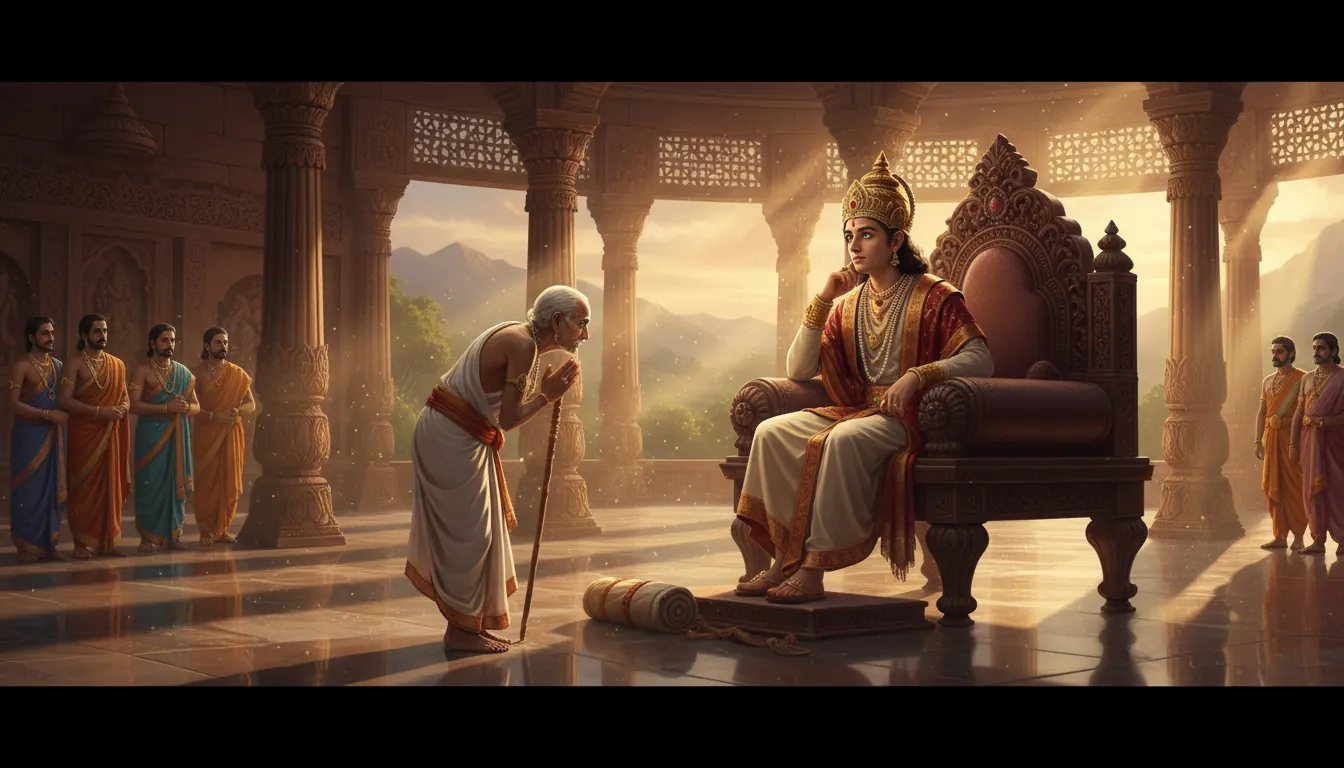
There was a brahmana in Mithila who had become guilty of some offence. The chronicle does not say what it was, which is its way of saying that it does not matter. It was an offence a king could not overlook, and Janaka, who was celebrated over the whole earth for his understanding, was on that occasion desirous of punishing him.
He could not order him killed. He could not order him fined into ruin. There was one sentence available against such a man, and Janaka delivered it from his seat, in the ordinary language of kings.
"You shall not dwell within my dominions."
It is the most natural sentence a ruler ever speaks. It rests on a single unexamined word, and it had been spoken by kings in that hall for as long as the hall had stood, and no one in it had ever had occasion to look at the word closely.
The brahmana did not protest. He did not deny the offence, or beg, or invoke his birth, or curse. He bowed, and he asked one question, in the tone of a man who wishes only to comply exactly.
"Tell me, king, what the limits are of the territories subject to you. I wish, lord, to live within the dominions of another king. Truly, I want to obey your command, lord of Earth, as the scriptures require."
He was not being insolent. That is the whole force of it. He was accepting the sentence and asking for the one piece of information he needed in order to carry it out: where does your kingdom stop, so that I may walk past that line and stand on the other side of it and trouble you no more.
Like Rahu Swallowing the Sun
When that celebrated brahmana had spoken, the king said not a word in reply.
The court waited. It was an easy question. Any minister in the room could have answered it, and several of them had the survey rolls to prove the answer: the kingdom ran to such a river on the east, and to such a range on the north, and the tribute lists went with it. It is the sort of thing kings know before they know their own children's names.
Janaka sat and drew breath, and the men nearest the throne could hear him. He was heaving repeated and hot sighs, and still he said nothing.
Then, like the planet Rahu overwhelming the Sun, a cloudedness of understanding suddenly overwhelmed that king of immeasurable energy as he sat plunged in thought.
This is the strangest moment in the story and the chronicle does not soften it. The most famous intelligence of the age was asked to name the edge of his own kingdom, and his mind went dark. Not confused: eclipsed. The light was still there and something had passed in front of it. He was looking for the boundary, and the search itself was undoing the thing being searched for, the way a man who begins to examine how he walks discovers that he cannot walk.
Nobody moved. You do not prompt a king in that condition, and you certainly do not repeat the question. The brahmana who had asked it stood where he was and waited with the rest of them.
When that cloudedness of understanding passed away and the king became comforted, he spoke, after a short while, these words to that brahmana.
I Searched, and I Did Not Find It
"Although a large inhabited tract is subject to me within this ancestral kingdom of mine," Janaka said, "yet I fail to find my dominion, searching through the whole Earth."
He described the search, and he described it as a journey, because that is what it had been, done sitting still while the court watched him sigh.
"When I failed to find it on the Earth, I then searched Mithila for it." The whole earth was too large a claim to defend, so he had come inward to the city he could see from his own window, the walls his fathers built. It was not there either. A city is a name laid over people who were there before the name and will be there after it.
"When I failed to find it in Mithila, I then searched for it among my own children." This is the last hiding place of ownership and everybody in that hall knew it. If a man owns nothing else he believes he owns his sons. It was not there. They were not his. They had come through him.
"When I failed to find it even there, a cloudedness of understanding came over me. After that cloudedness passed away, intelligence came back to me. Then I thought that I have no dominion, or that everything is my dominion. Even this body is not mine, or the whole Earth is mine. At the same time, best of the twice-born, I think that it is as much mine as it is anyone else's."
And then, having failed to find any ground on which to stand while sending the man away, the king finished the sentence he had begun as a banishment.
"Live here as long as you choose, and enjoy it as long as you please."
That is the reversal, and it is done in one line without apology or embarrassment. He did not pardon the offence. He simply discovered, in front of everyone, that he had never possessed the thing he had been proposing to throw the man out of.
On What Understanding
The brahmana was not finished. He had come for the reasoning, not the verdict, and he pressed the king the way a man presses a witness.
"When there is a large inhabited tract in your ancestral kingdom, tell me, on what understanding have you got rid of the idea of mine? And on what understanding have you concluded that everything is your dominion? What, indeed, is the notion by which you have no dominion, or everything is your dominion?"
Janaka answered the first half briefly.
"I have understood that every condition here, in all affairs, comes to an end. So I could not find anything that should be called mine. Considering whose is this, I thought of the Vedic text about anybody's property, and I could not therefore find, by my understanding, what should be called mine. Depending upon this notion, I got rid of the idea of mineness."
Then he came to the second half, and here the argument stops being about land and becomes about the six doors of a man.
"Hear now the notion on which I concluded that I have dominion everywhere. I do not want for myself even the smells that are in my nose. So the earth, which I have conquered, is always subject to me. I do not want for myself even the tastes that touch my tongue. So water, which I have conquered, is always subject to me. I do not want for myself the colour or light that belongs to my eye. So light, which I have conquered, is always subject to me. I do not want for myself even the sensations of touch that are on my skin. So the wind, which I have conquered, is always subject to me. I do not want for myself even the sounds that reach my ear. So sounds, which I have conquered, are always subject to me. I do not want for myself the mind that is always in my mind. So the mind, which I have conquered, is subject to me."
It is an inventory taken in the opposite direction from every other royal inventory ever made. The tax rolls list what comes in. This one lists what is refused at the door, sense by sense, and calls the refusal a conquest. The earth is his because he does not want the smell of it.
"All these acts of mine," the king finished, "are for the sake of the deities, the Pitris, the Bhutas, together with guests."
Know That I Am Dharma
The brahmana then smiled, and once more said to Janaka, and the whole hall heard it.
"Know that I am Dharma, and I have come here today to test you."
There had been no offence. There had never been an offending brahmana in Mithila. Righteousness itself had walked into the court in the shape of a man who could be thrown out of a country, had earned a sentence of exile on purpose, and had then asked the one question that made the sentence impossible to carry out. The test was not whether Janaka would be merciful. Mercy would have proved nothing. The test was whether, standing at the top of the world with the survey rolls in his own treasury, he could be asked to name the edge of what was his and answer honestly.
And Dharma gave him the image he had earned, which is a wheel.
"You truly are the one person to set this wheel in motion, this wheel that has the quality of Goodness for its circumference, Brahman for its nave, and the understanding for its spokes, and which never turns back."
Every king in the world claims a wheel. That is what a sovereign is, the man whose wheel rolls unobstructed to the sea in all directions, and Yudhishthira was even then resolving on a horse sacrifice to establish exactly such a claim. The wheel Dharma handed Janaka has no rim of territory on it at all. Goodness runs around the outside of it. The absolute is the hole at the centre where the axle goes, holding it to nothing that can be lost. Understanding is what keeps the rim off the axle. And its single distinction from every other wheel is that it never turns back, having no border to reach and no march to return from.
A wheel of that construction cannot be inherited, and cannot be seized, and cannot be resigned, and cannot be surveyed. It only turns for as long as the man in the middle of it is still willing to be asked where his kingdom stops.
What the Brahmana Told His Wife
The story ended and the brahmana in the house turned back to his wife, who had asked him a question about the next world and had been given a king instead.
Her complaint had been that he had cast off all acts and was therefore earning nothing for either of them. His answer, now that Janaka had made it for him, was that she had misread what he was doing.
"Timid one, I do not move in this world in the way that you, by your own understanding, find fault with. I am a brahmana with Vedic knowledge. I am emancipated. I am a forest recluse. I am an observer of the duties of a householder. I observe vows. I am not what you see me in good and bad acts. I pervade everything that exists in this universe. With numerous unconfused symbols, only one knowledge is worshipped. Those who, whatever the symbols and modes of life to which they adhere, have acquired an understanding having tranquillity for its essence, attain to that one entity, even as numerous rivers all meeting the Ocean."
And he gave her the reassurance she had actually come for, which was about where she was going.
"The path can be travelled with the understanding, and not with this body. So, blessed lady, you need have no fear about the world hereafter. With your heart intent upon the real entity, it is my soul into which you will come."
At Hastinapura, Krishna stopped there and let Arjuna sit with it.
Arjuna had spent thirteen years being told what was rightfully his, and had fought a war over five villages that were refused, and had come out of it holding everything and feeling almost nothing. Krishna had refused to repeat the great song to him, and had given him instead an old king in a small city, eclipsed like the sun in front of his own court by one polite question, who came out of the darkness able to say that he had no dominion, or that everything was his dominion, and that it was as much his as it was of others.
It is the same teaching. It has simply been put where a man who forgets things can find it again: not in a vision on a chariot, but in a question anyone can ask a king. Tell me where your kingdom stops.
Dharma Lesson
Ownership is a claim that cannot survive being asked for its boundary, and a ruler who searches the earth, then his city, then his own children, will not find one thing he can honestly call his. The man who stops keeping the world's smells and tastes and sounds for himself is the only one to whom the whole of it can safely belong.