The Fires Inside the Body
A wife asks what her husband's stillness is worth
In short
A wife demands to know what region she can hope for, having married a man who has cast off every rite. Her husband answers by showing her the sacrifice he performs without altar or fire, in which the senses are the priests and the body is the ground, counting them down from ten to seven to five. Arjuna then asks where that couple may be found.
Told in the Ashvamedhika ParvaSet in Indraprastha and Forest Hermitage20 min read
What Region Shall I Go To
Arjuna had asked to be told the Gita again and had been refused, and what he was given instead was other people's conversation. This was one of them.
"On this," said Krishna, "there is an old story, son of Pritha, of a conversation between a husband and his wife."
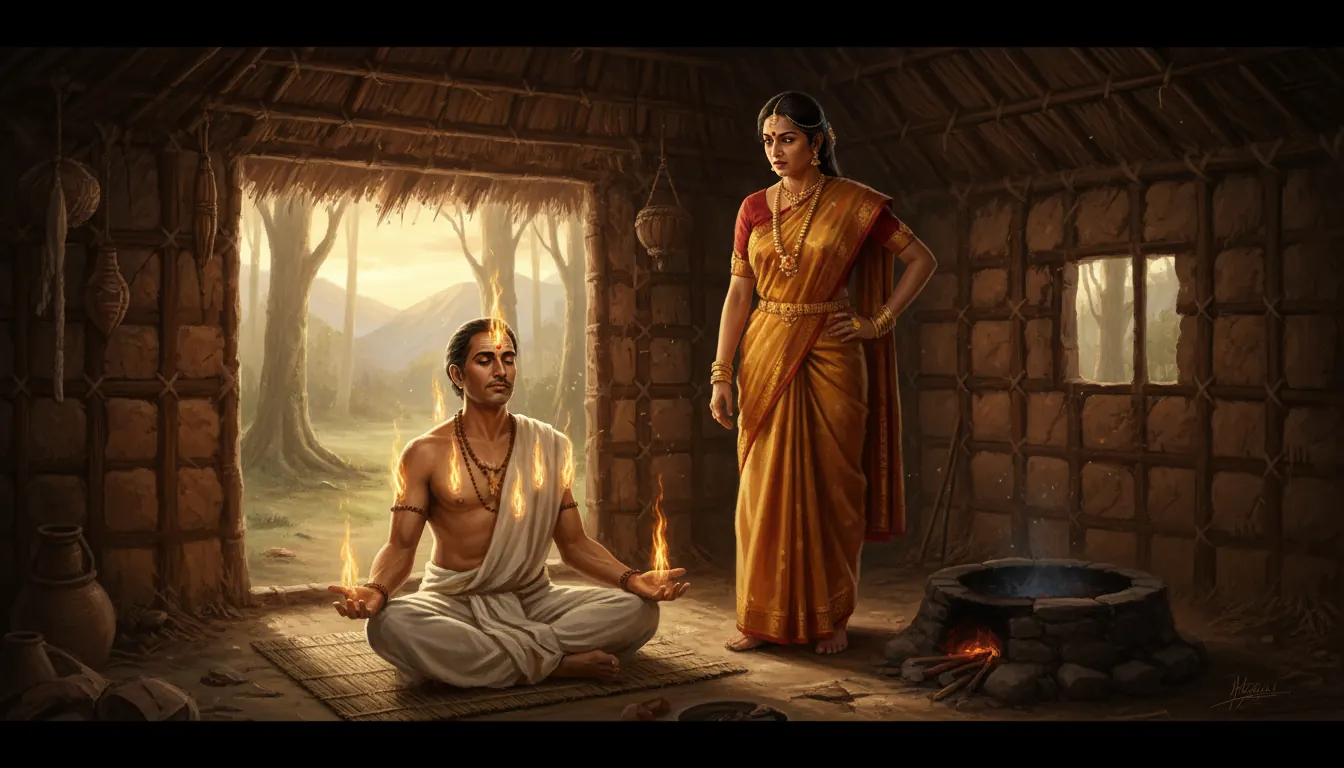
There was a brahmana, he said, a complete master of every kind of knowledge and wisdom, who had taken to sitting in seclusion. He had cast off all religious acts. He kept no fire. He poured no butter. So far as anybody could tell from the outside, he was not doing anything at all.
His wife stood in front of him and asked a question with a hard edge on it, because it was a question about her own future and he had made himself its obstacle.
"What region will I go to, with you for my husband to depend on? You sit there having cast off every act, harsh toward me and so undiscerning. We have heard that a wife reaches the regions her husband wins. What goal, then, will I reach, with you for a husband?"
He did not take offence, which is the first thing recorded of him.
"Blessed lady, I am not offended by what you say, sinless one," the brahmana said, and he smiled as he said it.
"Those without knowledge only pile up delusion by their acts. And yet no one in this world can be free of acts even for a moment. From birth until a new form is taken, action, good or bad, done by deed or by mind or by speech, is present in every being.
"The paths of action marked by visible things, such as the Soma juice and the ghee for the libations, have been destroyed by Rakshasas. I have turned away from them and have seen the seat of the soul within the body."
The Fire With Seven Tongues
"There dwells Brahma, beyond all pairs of opposites," he said. "There is Soma with Agni, and there the urger of the understanding, who is Vayu, always moves, upholding all creatures. It is for that seat that the Grandsire and others, absorbed in Yoga, worship the Indestructible.
"It cannot be smelt by the nose, or tasted by the tongue, or touched by the organs of touch. The eye cannot master it. It is beyond hearing. It is reached by the mind. It is the source of the well-ordered universe, and the universe rests on it.
"The life-breaths called Prana and Apana and Samana and Vyana and Udana flow from it, and they flow back into it. Udana lives between Apana and Prana, pervading everything. That is why Prana and Apana do not leave a sleeping person.
"And in the middle of all those life-breaths that move within the body and swallow one another up, the fire called Vaiswanara blazes with its seven flames."
Then he counted the fire out for her, because a woman who has asked about the fruit of sacrifices is entitled to be shown the whole apparatus.
"The nose, the tongue, the eye, the skin, the ear which is the fifth, the mind, and the understanding: these are the seven tongues of that Vaiswanara's flame.
"That which is smelt, that which is seen, that which is drunk, that which is touched, that which is heard, that which is thought of, and that which is understood: these are the seven sorts of fuel.
"That which smells, that which eats, that which sees, that which touches, that which hears, that which thinks, and that which understands: these are the seven great officiating priests.
"See, blessed one, how learned sacrificers pour seven libations in seven ways into seven fires. Earth, Wind, Ether, Water, and Light which is the fifth, Mind, and Understanding, these seven are called the wombs of all things."
There was no altar in the room. There was a man sitting still, and by his account the rite had not stopped since he was born.
The Ten Priests
"There is an old story on this as well," the brahmana said. "Learn how the ten Hotris are ordered.
"The ear, the skin, the two eyes, the tongue, the nose, the two feet, the two hands, the organ of generation, the lower duct, and speech: these are the ten sacrificing priests.
"Sound and touch, colour and taste, scent, speech, action, motion, and the discharge of the vital seed, of urine and of excreta: these are the ten libations."
He did not lower his voice at the unlovely part of the list, and she did not look away from it, and that is the argument. Nothing a body does is too low to be an offering, because there is no second body in which to offer the higher things separately.
"The points of the compass, the Quarters, Wind, Sun, Moon, Earth, Fire, Vishnu, Indra, Prajapati, and Mitra: these, beautiful one, are the ten sacrificial fires. The objects of the senses are the fuel cast into them. The mind is the ladle, and the wealth of the sacrificer is his good and his bad acts. What remains, when all of it has been poured, is the pure and highest knowledge.
"The knower, wrapped in a subtle form, lives inside the gross body that the vital seed produces. The bearer of the body is the Garhapatya fire. Mind is the Ahavaniya fire, and the oblation is poured into it. From that the Word was born."
His wife had been listening with more attention than he perhaps expected, and she stopped him there, on a point of order.
Word and Mind Go to Be Judged
"Why did Word arise first, and why did Mind arise afterwards," the brahmana's wife said, "when Word only comes into being after Mind has thought it? And why, in dreamless sleep, does Prana not perceive objects, though it is separated from Mind? What holds it back then?"
"The Apana breath becomes the lord of Prana and makes it one with itself," the brahmana said. "That restrained motion of the Prana breath is called the motion of the mind. So the mind depends on Prana, not Prana on the mind. That is why, in dreamless sleep, when the mind disappears, Prana does not.
"But since you ask me about Word and Mind, I will tell you a conversation between them.
"Word and Mind went together to the Soul of matter and asked him, Tell us which of us is greater. And the holy one answered: The mind, without a doubt. And Word said to him: I yield to you the fulfilment of all your desires."
He went on before she could ask what a defeated goddess does afterwards.
"Understand that I have two minds, the unmoving and the moving. The unmoving one is truly with me. The moving one is in your realm. The mind called moving is the one that belongs to your realm, in the form of mantra, or letter, or voice.
"The goddess Word always used to live between Prana and Apana. But she sank into Apana, though she was urged upward, and because she had been parted from Prana she ran to Prajapati and said, Be gracious to me, holy one. Then Prana appeared and nourished Word once more. That is why Word, when it meets deep exhalation, never utters anything.
"Word flows both with utterance and without it, and of the two, Word without utterance is the higher. Like a cow with excellent milk, she gives many kinds of meaning. This one always gives the Eternal, speaking of Brahman."
Seven Who Cannot See One Another
"There is also an old story of how the seven sacrificing priests are ordered," said the brahmana. "The nose, the eye, the tongue, the skin, the ear which is the fifth, the mind, and the understanding. These seven stand apart from one another. Living in subtle space, they do not perceive one another."
"How can they live in subtle space and not perceive one another?" she said. "What is the nature of each, holy one? Tell me this, my lord."
"Not knowing an object's qualities is ignorance of that object, and knowing the qualities is knowing the object that has them. These seven can never grasp one another's qualities. Smells are apprehended by the nose alone, and sounds by the ear alone, and doubt by the mind alone, and determination, which is certainty in knowledge, by the understanding alone. Not one of them has ever met another.
"There is an old story too of a debate between the senses and the mind."
The Mind spoke first.
"Without me the nose does not smell. Without me the eye does not take in colour, the skin does not feel touch, the ear does not catch sound. I am the eternal one, the first of all the elements. Without me the senses never shine; they are like empty houses, or fires whose flames have gone out."
The Senses answered together, and they were not respectful.
"That would be true, as you think, if you really could enjoy pleasures without us or our objects, and if, once we were gone, there were still satisfaction, and life went on being supported, and your enjoyments continued.
"If you think your power over our objects is always complete, then take in colour through the nose, and taste through the eye. Take in smell through the ear, and sound through the skin.
"The powerful obey no rules. Rules exist only for the weak. Take pleasures no one has enjoyed before. It is beneath you to enjoy what others have already tasted.
"It is true that each of us is bound to his own attributes. It is true that we know nothing of one another's attributes. But without us you can perceive nothing. Without us no happiness can come to you."
The Five Winds Go Into Extinction
"There are five sacrificing priests also," the brahmana said. "Prana and Apana and Udana and Samana and Vyana. The learned know this to be a great principle."
"I used to believe there were seven sacrificing priests by nature," said his wife. "Tell me how the number can really be five."
"The wind nursed by Prana is then born in Apana. Nursed in Apana it becomes Vyana; nursed by Vyana it develops into Udana; and nursed in Udana it comes into being as Samana.
"Long ago those good beings asked the first-born Grandsire, Tell us which of us is the greatest. And Brahma said: The one whose going out makes all the life-breaths go out in the bodies of living creatures, and whose moving makes them move, is truly the greatest among you."
So they held the trial, and each of the five submitted to it in turn, and the manner of the trial was that the claimant stopped.
"When I go out, all the life-breaths go out in the bodies of living creatures," said Prana. "When I move, they move again. So I am the greatest. Watch: I am going out."
And Prana went into extinction, and the body went on moving without him, and then he moved again. But Samana and Udana said to him: You do not live here pervading all this, as we do. You are not the greatest among us. Only Apana is under your rule.
Then Apana said the same words and went out, and everything stopped, and Vyana and Udana told him that only Prana was under his rule. Then Vyana, then Samana, then Udana, and each time the body went on without the one who had gone out, and each time the others told the claimant whose master he was not.
Not one of them had proved his case. Each had gone out, the body had gone on without him, and not one had thereby become chief.
So the Lord of creatures spoke to them where they stood.
"None of you is greater than the others. Each of you has his own attributes. All are foremost in their own spheres, and all have special attributes. There is one that is unmoving and one that is moving. Because of their special attributes there are five life-winds. My own self is one. That one gathers into many forms. Be friends to one another, please one another, and go in peace. Blessings on you. Uphold one another."
One Syllable, Four Kinds of Hearing
"There is one Ruler," the brahmana said. "There is no second beside him. He lives in the heart. Driven by him I move as he directs, like water running down a slope.
"There is one Teacher, and no second beside him, and he lives in the heart. There is one kinsman, and taught by him kinsmen come to have kinsmen, and the seven rishis shine in the sky. There is one dispeller, and by living with that teacher in the proper way Shakra won sovereignty over all the worlds.
"And there is one enemy. There is no second beside him. He lives in the heart. Taught by that same teacher, all the snakes in the world are always full of hatred."
Then he told the story that proves it.
"The gods and the rishis, the snakes and the Asuras, sitting around the Lord of all creatures, asked him: Tell us what is best for us. And when they asked what was best, the holy one spoke only the word Om, which is Brahman in one syllable.
"When they heard it they ran off in every direction. As they ran, each wishing to teach itself, the urge to bite arose first in the snakes. In the Asuras arose showy pride, born of their nature. The gods turned to gifts, and the great rishis to self-restraint."
One syllable had been spoken. Four kinds of creature had heard four different instructions in it, and each had heard exactly what it already was.
"It is that one who hears himself when he speaks, and grasps it rightly," the brahmana said. "There is no second teacher. It is he who becomes a man of sinful deeds by acting sinfully in the world, and he who becomes a man of good deeds by acting well, and he who becomes a brahmacharin by devoting himself always to subduing his senses. Brahman is his fuel, Brahman is his fire, Brahman is his origin, Brahman is his water, Brahman is his teacher, and he is rapt in Brahman."
The Goat at the Stake
"There is an old story of a debate between an Adhwaryu and a Yati," the brahmana said. "Listen to it, glorious lady."
A Yati stood watching while an animal was sprinkled with water at a sacrifice, and said in reproach to the Adhwaryu sitting there: "This is the destruction of life."
"This goat will not be destroyed," the Adhwaryu said. "The animal that is sacrificed meets with great good, if what the Vedas declare is true. That part of him which is of earth will go to earth. That part which is born of water will enter into water. His eye will enter the sun, his ear the points of the horizon, his life-winds the sky. I keep to the scriptures, and I incur no fault by assisting at this killing."
"If you see so much good for the goat in being parted from his life-winds," the Yati said, "then this sacrifice is for the goat's sake. What do you need it for?
"Let this goat's brother, father, mother and friend give you their approval. Take him to them and ask them. This goat is especially dependent on others. Once you have heard them consent, the matter will be worth considering.
"Refraining from cruelty is the greatest of all gods. That is what the elders teach."
The Adhwaryu had an answer, and it was a good one.
"You enjoy smells, which belong to the earth. You drink tastes, which belong to water. You see colours, which belong to bodies of light. You hear sounds, which come from space. All these things, you hold, have life. So you do not refrain from taking life either. In fact you are engaged in slaughter yourself. There can be no movement without slaughter. Or what do you think, twice-born one?"
"The Indestructible and the Destructible are the soul's two forms," the Yati said. "Of these the Indestructible is what truly exists. But one who is free of these existing things, who is beyond all pairs of opposites, who expects nothing, who is the same to all creatures, who is free of the idea of mine, who has subdued himself and is released from everything around him, has nothing to fear from any quarter."
"One should live among the good," said the Adhwaryu. "Hearing your view, my understanding is full of light. I come to you believing you to be a god."
With that conclusion the Yati remained silent, and the Adhwaryu went on with the great sacrifice, freed from delusion. Neither of them had been beaten, and the goat is not said to have been spared.
The Forest He Says He Lives In
"I have crossed that impassable wilderness that has purposes for its gadflies and mosquitoes," the brahmana said, "grief and joy for its cold and heat, heedlessness for its blinding darkness, greed and diseases for its reptiles, wealth for its one danger on the road, and lust and wrath for its robbers, and I have entered the vast forest of Brahman."
His wife had by now stopped arguing about regions and had begun to want the thing itself.
"Where is that forest, wise one? What are its trees? What are its rivers? What are its mountains and hills? How far away is it?"
"Nothing is separate from it. Nothing is more delightful than it. Nothing is more painful than it. Nothing is smaller than it, and nothing vaster. The twice-born who enter it pass at once beyond both joy and sorrow. They never fear any creature, and no creature fears them.
"In that forest are seven large trees, seven fruits, and seven guests. There are seven hermitages, seven forms of Yoga concentration, and seven forms of initiation. There is one fire here, with a good mind. The five senses are the fuel. The qualities are the fruits, and the guests eat them.
"And when they have been worshipped and are wiped out, another forest shines out. In that forest Intelligence is the tree. Emancipation is the fruit. Tranquillity is its shade. It has knowledge for its resting house, contentment for its water, and the Kshetrajna for its sun. No end to it can be found above, below or on any side.
"Seven females always live there, faces turned downward, full of brightness and holding the cause of all generations. They draw up every taste from every creature, as inconstancy sucks up truth. In it live, and from it come out, the seven rishis crowned with ascetic success, with Vasishtha at their head. Glory, brightness, greatness, enlightenment, victory, perfection and energy, these seven always follow it, like rays following the sun.
"There are hills and mountains there too, and rivers whose waters are born of Brahma, and a meeting of streams in the secluded place of sacrifice. From there those who are content in their own souls go on to the Grandsire."
Two Sticks and a Fire
"Timid one, I do not live in this world in the way your understanding finds fault with," the brahmana said, and this was the answer to the question she had asked him at the beginning, held back until she was able to hear it.
"I am a brahmana with Vedic knowledge. I am emancipated. I am a forest recluse. I keep the duties of a householder. I am not what you see me as, in good acts and bad. Everything that exists in this universe is pervaded by me.
"Through many distinct symbols, one knowledge alone is worshipped. Those who, whatever way of life they follow, have gained an understanding whose essence is tranquillity, reach that one entity, as many rivers all meet the Ocean.
"So, blessed lady, you need have no fear about the world hereafter. With your heart set on the real entity, it is into my soul that you will come."
"Someone of little intelligence cannot understand this," said the brahmana's wife. "My intelligence is very small, and narrow, and confused. Tell me how this knowledge can be gained. I want to learn from you where it flows from."
"Understand that intelligence devoted to Brahman is the lower Arani," he said. "The teacher is the upper Arani. Penances and study of the scriptures make the friction. From this the fire of knowledge is born."
"And this symbol of Brahman called Kshetrajna: where is it described, so that it can be grasped?"
"He has no symbols and no qualities. Nothing exists that could be called his cause. But a good means can be found, through hearing and the other senses, as bees find flowers. That means is an understanding cleansed by action. One should grasp as many of his parts, unmanifest and manifest, by hundreds and by thousands, as one can here. Then, with practice, will come that above which nothing exists."
And the mind of that brahmana's wife, upon the destruction of the Kshetrajna, became that which is beyond Kshetrajna, because of the knowledge of Kshetra.
Krishna stopped there, and Arjuna, who had been listening to a married quarrel for a long time, asked the question of a man who wants an address.
"Where is that brahmana's wife now, Krishna, and where is that greatest of brahmanas, the two who won such success?"
"My mind is the brahmana," said the holy one, "and my understanding is the brahmana's wife. The one spoken of as Kshetrajna is I myself, Dhananjaya."
Dharma Lesson
A rite performed with fire and butter ends when the fire goes out, but the sacrifice a living body offers into its own senses never ceases. And the questioner who presses hardest is often the questioner's own understanding, so that the argument a man thinks he is winning against another is the argument he is having with himself.