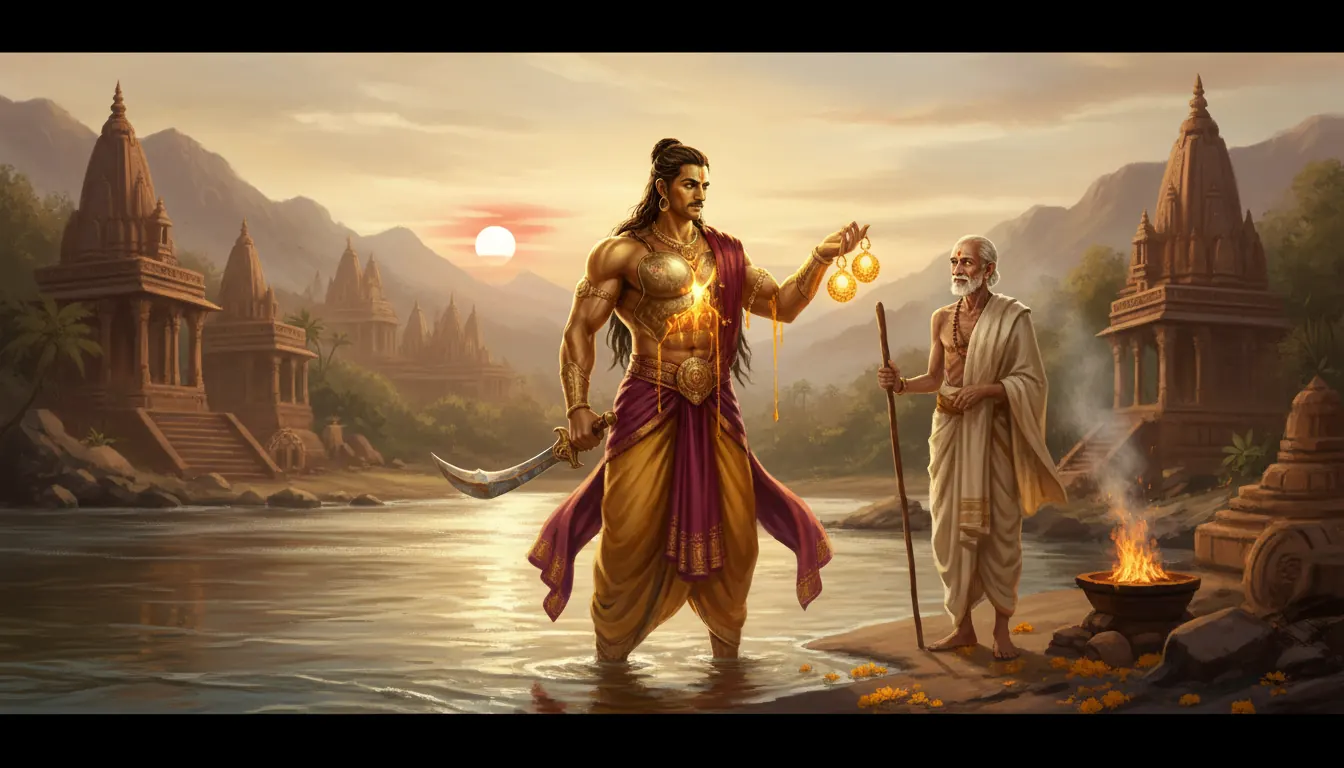
The Warning in the Dream
A father begs his son to live, and the son chooses to be remembered
In short
In the thirteenth year of the exile, Surya enters his sleeping son's dream as a brahmana and warns him that Indra is coming to beg the armour and earrings he was born in, and that giving them means death. Karna answers, courteously and at length, that a life saved by a blameworthy refusal is worth less than a name. Then he cuts them off.
Told in the Vana ParvaSet in Hastinapura, Ganga and Kamyaka Forest17 min read
The Fear He Never Named
"Stop there," said Janamejaya, "and tell me one thing before you go on. When Lomasa came down into the forest with a message from Indra for the son of Pandu, he said to him, 'That intense fear of yours, which you never express to anyone, I will remove after Dhananjaya leaves this place.' What fear was that? What was there in Karna that frightened Yudhishthira? And why, being frightened, did he never once say so aloud?"
Vaishampayana said, "That is a good question, tiger among kings, and I will tell you the whole of it.
"Yudhishthira was afraid of two ornaments. Karna had come into the world already wearing them: a coat of mail grown into his skin, close as a second body, and a pair of earrings that had risen long ago out of the nectar of immortality. While he wore them there was no weapon in the three worlds that could open him. Arjuna was gone up to heaven to learn the arts of the gods and would be a long time coming back, and every season some new report came in of what the son of Radha had done in the east or the south, and the eldest Pandava listened to each of them and said nothing. A king who names his fear aloud has not put it down; he has only handed it to his brothers to carry as well.
"Twelve years of the exile had worn away and the thirteenth had set in. In that year Shakra, who was always a friend to the sons of Pandu, settled on a thing he had been turning over for a long while. He would go to Karna himself, in the dress of a beggar, and ask him for the earrings.
"And Surya, whose whole wealth is his brightness, came to know what the chief of the celestials intended, and went at once to his son."
The Brahmana in the Dream
Karna lay that night at his ease on a rich bed spread with a costly sheet, a man devoted to the brahmanas and truthful in his speech, sleeping as such men sleep. And the god, filled with tenderness for his son, took by ascetic power the form of a handsome brahmana learned in the Vedas, and walked into his dream, and spoke to him gently.
"Listen to me, my son, most truthful of men. I have come out of love for you, to tell you today something for your great good. Shakra is coming. He wants your earrings, and he wants to help the sons of Pandu, so he will come to you disguised as a brahmana. He knows your nature, as the whole world knows it: when good people ask you for something, you give, and you never take. You give a brahmana wealth or whatever else he asks of you, and you refuse nobody anything. Knowing this, the subduer of Paka himself will come to beg you for your earrings and your coat of mail.
"When he begs for them, do not give them away. Please him instead with kind words, as best you can. Refuse him. Refuse him again and again, with one reason after another, and offer him other wealth instead: gems, and women, and cows, and quote him the old precedents as you do it. This is for your own highest good. If you give away those beautiful earrings that were born with you, your life will be cut short and you will die. In your mail and your earrings no enemy can kill you in battle. Take my words to heart. Both those jewelled ornaments came out of the Amrita. Keep them, my son, if your life is dear to you at all."
I Am He of a Thousand Rays
In his sleep Karna sat up and looked at the stranger. "Who are you, to tell me this and show me such kindness?" he said. "If you are willing, illustrious one, tell me who you are, you who come dressed as a brahmana."
"My son, I am he of a thousand rays," the brahmana said. "It is out of love that I am showing you the way. Do as I say, for it is for your great good."
"Then that alone is great good fortune for me," said Karna, "that the god of splendour himself should come and speak to me tonight, out of care for me. But hear what I have to say, and do not be offended, for I say it only out of love. If I am dear to you, you should not be the one to turn me from my vow. The whole world knows what my vow is: that I am ready to give even my life to the best of brahmanas. If Shakra comes to me disguised as a brahmana, begging for the sake of the sons of Pandu, I will give him the earrings and the excellent mail, so that my fame, which has spread through the three worlds, may not grow any less.
"Men like us must not save our lives by a shameful act. It is right for us to meet death with the world's approval, in a way that brings fame. So I will give the earrings to Indra, and the mail with them. Think what he is doing. If the slayer of Vala and Vritra comes in a beggar's cloth to ask a mortal for the ornaments he was born in, and asks for them on behalf of five men he favours, that will add to my fame and bring him disgrace. The shame in that transaction is not mine to carry."
What Fame Is For
"I want fame in this world," Karna went on, "even if I must pay for it with my life. Those who have fame enjoy the heavenly regions, and those without it are lost. Fame keeps people alive in this world, like a mother. Infamy kills men even while they walk about with their bodies whole. That fame is the life of men is shown by an ancient sloka sung by the Creator himself: in the next world fame is a person's chief support, and in this world pure fame lengthens life.
"So by giving away my earrings and my mail, both of which I was born with, I will win eternal fame. And by giving to brahmanas duly, according to the ordinance; and by offering up my body as a gift to the gods in the sacrifice of war; and by doing feats that are hard to do; and by conquering my enemies in battle, I will win nothing but renown. And by taking away, on the battlefield, the fear of the terrified who beg me for their lives, and by freeing old men and boys and brahmanas from terror and anxiety, I will win excellent fame and the highest heaven.
"My fame must be protected even at the cost of my life. That too is my vow. And by giving so precious a gift to Maghavan while he stands before me in the dress of a brahmana, I will reach in this world the most exalted state open to a man."
He said it without heat and without hurry, the way a man reads out a reckoning he has already made and checked. The god in the brahmana's body heard his son price his own life and find it cheap.
A Garland Round the Neck of a Corpse
"Never do anything, Karna, that harms yourself and your friends," said Surya, "your sons, your wives, your father and your mother. Men want renown in this world and lasting fame in heaven without having to give up their bodies for it. But you want undying fame at the price of your life, and she will certainly take your life.
"In this world father, mother, son and every other relative are of use only to someone who is alive. For kings too, prowess is of use only while they live. Do you understand this? Fame does good only to the living. What use is fame to the dead, whose bodies have been burned to ashes? One who is dead cannot enjoy renown. The fame of one who is dead is like a garland of flowers around the neck of a corpse.
"I tell you this because you revere me, and I always protect those who worship me. And there is more. There is a deep mystery in all this, ordained by fate, and that is as much my reason for speaking as any other. Do as I say without any mistrust. It is not right for you to know the thing itself, for it is a secret even from the gods, and so I do not reveal it. You will understand it in time.
"I say again what I have said. When the wielder of the thunderbolt asks you for them, do not give him your earrings. With those earrings on, you look beautiful, like the Moon in a clear sky between the stars of Visakha. And remember this: while you wear them, Arjuna will never defeat you in battle, even if Indra himself comes down to help him. You are always challenging the man who draws the bow with his left hand, and he will surely meet you. If you want to defeat Arjuna in battle, you must never give these earrings up to Shakra."
Death Is Not So Terrible to Me as Untruth
"You know me for your worshipper, lord of splendour," Karna said, "and so you also know that there is nothing I would not give away in charity. Not my wives, not my sons, not my own self, not my friends are as dear to me as you are, so deeply do I revere you. Great-hearted people love those who love them, and you have told me tonight what is for my good because Karna reveres you and knows no other god in heaven.
"Yet I bow my head and beg you again, and again I put myself in your hands, and I give you the same answer as before. Forgive me. Death itself is not as terrible to me as untruth. And for the brahmanas above all, I would not hesitate to give up my life.
"As for what you have said about Phalguna, the son of Pandu, put your grief away, for I will surely conquer Arjuna in battle. You know how strong I am in weapons, which I learned from Jamadagnya and from the great-souled Drona. Let me keep my vow now, so that when the wielder of the thunderbolt comes to beg from me, I may give him even my life."
There was a silence in the dream. The god had come down through the whole height of the sky to save one man, and had been answered courteously, at length, and without a single opening left in the argument. He had told his son that his life was at stake and his son had thanked him for the news.
Then Name Your Price
"If you will give away your earrings to the wielder of the thunderbolt," said Surya at last, "then at least do this, to make sure of victory. Say to him, 'Lord of a hundred sacrifices, I will give you the earrings on one condition.' Understand why he is coming. While you wear those ornaments no being can kill you, and the destroyer of the Danavas wants to strip you of them because he wants to see you killed in battle by Arjuna. So honour him with truthful words, that lord of the gods whose weapons never fail, and then ask him in turn: 'Give me an infallible dart that can kill any enemy, and I will give you the earrings with the excellent coat of mail.' Give them up on that condition and no other. With that dart you will kill your enemies in battle, for the dart of the king of the gods never goes back to the hand that throws it until it has killed enemies by hundreds and by thousands."
With that the thousand-rayed god suddenly vanished, and Karna was awake in an empty room with the taste of the words still in his mouth.
The next day, when he had said his prayers standing in the water with his hands raised, he told the dream to the Sun itself: the brahmana, the warning, the argument, and every word that had passed between them in the night. And Surya, the radiant god and the enemy of Swarbhanu, heard him out and said with a smile, "It is just so."
So Radha's son knew the whole of the matter. Knowing it, and now set on winning the dart, he stayed where he was and waited for Vasava to come.
Welcome, Brahmana
The king of the celestials presented himself in the guise of a brahmana, and Karna, seeing him, said, "Welcome!" and gave him the honours owed to a guest. Then, as though he knew nothing at all of what was coming, Adhiratha's son said, "A necklace of gold, beautiful maidens, villages rich in cows: which of these shall I give you?"
"I am not asking you for a necklace of gold," the brahmana said, "nor for fair maidens, nor for anything else that pleases. Give those to people who ask for them. If you mean your vow, then cut this coat of mail that was born with you off your body, and these earrings, and give them to me. Give them to me quickly, for I will count this one gain above every other."
"Brahmana," said Karna, "I will give you land to live on, and fair maidens, and cows, and fields. My mail and my earrings I cannot give you."
The brahmana said nothing and asked for nothing else. Karna urged him with one thing after another; he worshipped him duly and did everything he could to win him over, and still that best of brahmanas would not name another boon.
At last Karna smiled and tried once more. "My mail was born with my body, twice-born one, and this pair of earrings rose out of the Amrita. It is because of them that nothing in the worlds can kill me. So I cannot part with them. Take the whole kingdom of the earth from me instead, cleared of its enemies and full of prosperity; with one word from me it is yours. But if I am stripped of my earrings and of the mail I was born with, my enemies will be able to defeat me."
The brahmana stood in the sun with his hand out and did not move.
I Knew You Before You Came
Then Karna laughed outright and named him.
"God of gods, I knew you even before this. Shakra, it is not right for me to grant you a boon that profits me nothing, for you are the lord of the gods himself. You are the Creator and lord of all beings, and it is you who should be granting boons to me. If I give you this coat of mail and these earrings I am sure to be destroyed, and you for your part will be laughed at. So take my earrings and my excellent mail in exchange for something you give me. Otherwise I will not give them to you."
"Even before I came to you, Surya had known my purpose," said Shakra, "and it is certainly he who has told you everything. Let it be as you wish, my son. Apart from the thunderbolt, tell me what you want."
Karna came close to him, his purpose within reach at last. "In exchange for my coat of mail and my earrings, give me a dart that cannot be turned aside, one that can destroy whole hosts of enemies drawn up for battle."
Vasava fixed his mind a moment upon the dart to bring it there, and then he set out the terms. "Take it on these conditions. When I fight the Daityas, this dart thrown by my hand kills enemies by hundreds and comes back to my hand when its work is done. In your hand, son of a Suta, it will kill one powerful enemy only, and then it will come back to me, roaring and blazing."
"One enemy is all I want to kill in fierce battle," said Karna, "one who roars fiercely and burns like fire, and whom I fear."
"You will kill such a roaring and powerful enemy," said Indra. "But understand that the one you want to kill has an illustrious protector. The one whom men versed in the Vedas call the invincible Boar and the incomprehensible Narayana, Krishna himself, is protecting him."
The Cutting
"Even so," Karna said, "give me the weapon that will destroy one powerful enemy. For my part I will cut my mail and my earrings off my body and give them to you. Grant me only this: that my body, wounded like that, will not be disfigured."
"Since you hold so firmly to the truth," said Indra, "your body will not be disfigured, and no scar will remain on it. You will have the complexion and the energy of your father himself. But hear the condition on the dart. If you throw it in a mad rage while you still have other weapons left, and when your life is not in immediate danger, it will fall on you."
"As you tell me, Shakra, I will throw this Vasavi dart only when I am in immediate danger," Karna said. "I tell you truly."
Then, taking the blazing dart in one hand, he began with the other to peel the natural mail off his body. The whole host of the celestials and of men and of Danavas that had gathered unseen to watch set up a lion's roar. His face did not twist once while he peeled it. He was smiling now and again as he worked, as at some private joke, and celestial kettledrums began to sound over him and celestial flowers came down. He cut the excellent mail off his body and handed it to Vasava still dripping. Then he cut the earrings from his ears and gave them to Indra also. It is from this deed that he came to be called Vaikartana, the one who cut.
Shakra, who had beguiled the man and made him famous by the asking, thought with a smile that the business of the sons of Pandu was already done, and went back up to heaven. When the news went round, the sons of Dhritarashtra were distressed and shorn of their pride, and the sons of Pritha, learning what plight had befallen the son of the charioteer, were filled with joy. And so the fear Yudhishthira had never spoken of to anybody was taken away from him without his having once had to ask.
Dharma Lesson
A vow is only tested when keeping it costs more than breaking it would, and the man who has already priced his own life can be argued with but not bought. Karna hears every reason to live and answers each one, because what he is defending is not the ornaments but the single fact that he has never refused a beggar.