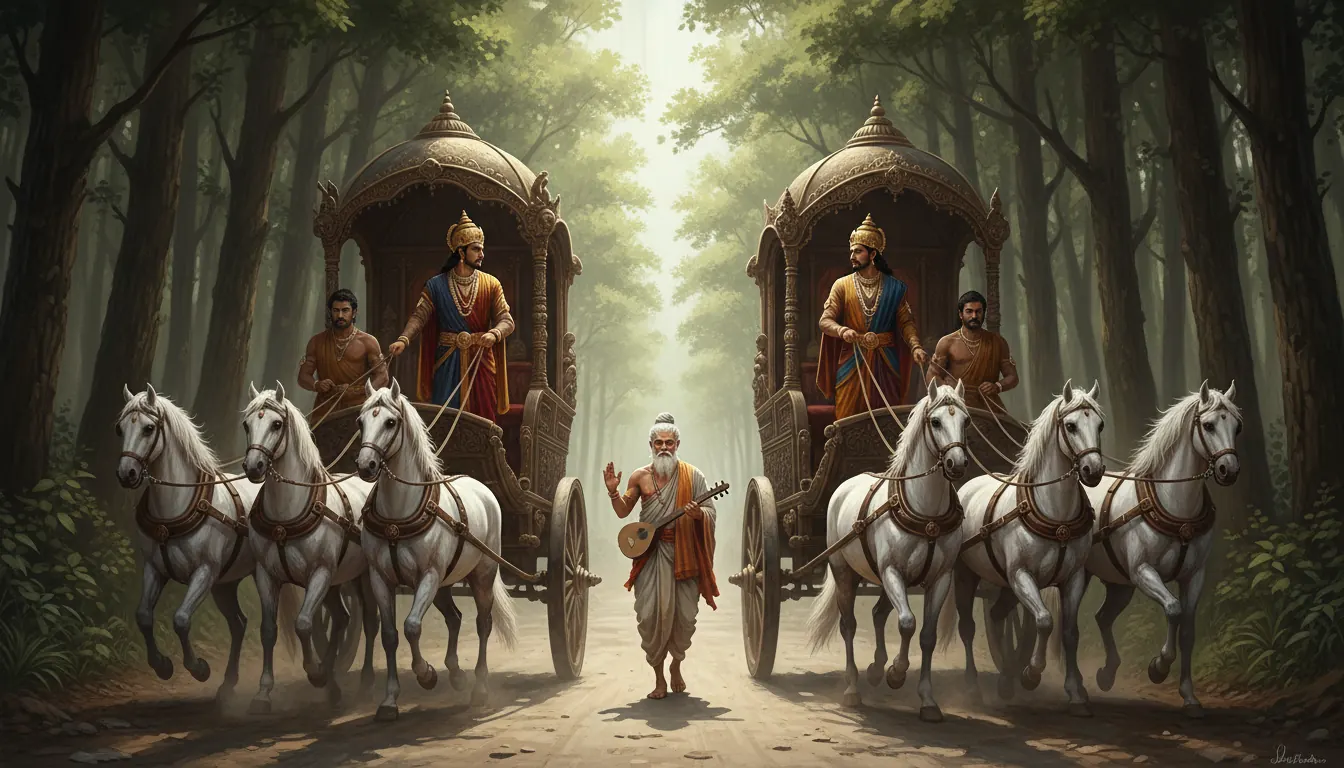
The Mole and the Charioteer
How Damayanti Was Found in Chedi and Nala in Ayodhya
In short
King Bhima of Vidarbha sends brahmanas across the earth for his lost daughter and her husband. In the palace of the Chedis a brahmana named Sudeva knows Damayanti by the lotus-shaped mole between her eyebrows, and she is carried home to her children. She then sends out a lament built as a trap, and when Parnada brings back the words a short-armed groom in Ayodhya wept while saying, she knows Nala is alive and lays her plan to reach him.
Told in the Vana ParvaSet in Chedi, Kundinapura and Kosala18 min read
Ten Thousand Cows for a Rumour
Yudhishthira had lost a kingdom at dice, and the sage Brihadashva was telling him about a king who had lost one the same way, so that a man sunk in self-reproach might hear his own case argued under another man's name.
The tale had reached its darkest turn. Nala, ruler of the Nishadhas, beaten at the dice by his own brother and stripped of everything, had cut his sleeping wife's garment in half in the forest and walked away from her. He had come at last to the city of Ayodhya and taken service with king Rituparna under the name of Bahuka, a man of unsightly appearance and short arms who could drive horses faster than anyone alive and cook better than anyone in the household. Damayanti, princess of Vidarbha, had come out of the same forest by another road and was living in the palace of the king of the Chedis, taken for a sairindhri, a well-born serving-woman fallen out of her station. Neither of them knew that the other was still breathing.
Vaishampayana, who set down the whole of it long afterwards, put the next part without ornament.
After Nala, despoiled of his kingdom, had with his wife become a bondsman, king Bhima of Vidarbha, who was Damayanti's father, sent out brahmanas to search for him.
He did not send them out empty. He gave them generous wealth first, and then he named his price.
"Search for Nala, and for my daughter Damayanti too. Whoever does this, whoever finds out where the ruler of the Nishadhas is and brings him and my daughter back here, will have from me a thousand cows, and fields, and a village as big as a town. And even if he cannot bring Damayanti and Nala here, whoever finds out where they are will have from me wealth worth ten thousand cows."
Ten thousand cattle's worth for a rumour. A thousand cattle and a village for the pair of them brought home alive. The brahmanas went out cheerfully in all directions, into cities and provinces, and for a long while they found nothing at all.
The Lotus Stalk Covered in Mire
Then one of them came to the beautiful city of the Chedis.
His name was Sudeva. He entered the palace during the hour of the king's prayers, when the household was quiet and the women were at their own business, and he saw a woman sitting beside the princess Sunanda, and he stopped where he stood.
Her beauty could only just be seen, like the glow of a fire wrapped in curls of smoke. She was soiled and she was emaciated. Sudeva looked at her large eyes and began, silently and carefully, to reason his way to a conclusion, and the reasoning came out of him in the shape of a lament.
"She is just as I saw her before. How blessed I am to set eyes on this lovely woman, who delights the worlds like Sree herself. She is like the full moon, ever young, lighting everything around her with her splendour, with large eyes like beautiful lotuses, and she looks like a lotus stalk that ill fortune has pulled from the Vidarbha lake and covered with mud along the way.
"Weighed down with grief for her husband, she looks like a full-moon night when Rahu has swallowed the moon, or like a stream that has run dry. She is like a ravaged lake whose lotus leaves have been crushed by the trunks of elephants and whose birds have been scattered in fright. This delicate girl, who ought to live in a palace adorned with gems, is like an uprooted lotus stalk scorched by the sun. She deserves ornaments and wears none, and she looks like the new crescent moon in the sky hidden by black clouds.
"A husband is a woman's finest ornament, however few other ornaments she has. Without her husband beside her, this lady, beautiful as she is, does not shine. It is a hard thing Nala is doing, to live on without being destroyed by grief when he is parted from such a wife.
"When will this girl cross her ocean of sorrow and be with her husband again, as Rohini is with the Moon again? Surely the king of the Nishadhas will feel, when he wins her back, the joy a king feels when he wins back the kingdom he has lost."
He had talked himself all the way to certainty. Then he crossed the floor.
I Am the Friend of Your Brother
"Princess of Vidarbha," he said, "I am Sudeva, your brother's dear friend. King Bhima sent me here to look for you."
She did not answer that at once, and he did not wait for her to. He gave her the news first, in the order in which a person starves for it.
"Your father is well, and so are your mother and your brothers. Your son and daughter, may they live long, are safe and at peace. Your family are alive, but they are almost dead for your sake, and hundreds of brahmanas are roaming the world looking for you."
Damayanti knew him then. She began to ask after her relatives and her kinsmen, one after another, every name in its turn, the way a person does who has had no word of any of them for a very long time and cannot bear to leave one out. And then, oppressed with grief at the unexpected sight of this brahmana who was her brother's friend, she wept bitterly.
Sunanda saw the two of them talking apart, and saw the weeping, and was distressed, and went to her mother.
"The sairindhri is weeping bitterly in front of a brahmana. Come and see for yourself, if you like."
So the mother of the king of the Chedis came out of the inner apartments to the place where the girl was standing with the stranger. She had taken this woman into her house out of pity, knowing only the little the girl had chosen to tell her of herself. She called Sudeva over and asked now.
"Whose wife is this lovely woman, and whose daughter? How has a lady with such beautiful eyes come to be parted from her relatives and from her husband? And how do you come to know her, fallen so low as she is? I want to hear it all from you in full. Tell me the truth about this young woman of heavenly beauty, since I am asking you."
Sudeva sat down where he was, at his ease, like a man who has carried something heavy a long way and has just been told to set it down, and began to tell the true history of Damayanti.
The Mole Between the Eyebrows
"There is a virtuous and famous ruler of the Vidarbhas named Bhima. This blessed lady is his daughter, known far and wide as Damayanti. And there is a king of the Nishadhas named Nala, the son of Virasena. This blessed lady is the wife of that wise and righteous king. His brother beat him at dice and stripped him of his kingdom, and he went away with Damayanti without anyone knowing. We have been searching the whole earth for Damayanti, and here at last she is, found in your son's house."
Then he gave them his proof, and the proof was small enough to be washed off.
"No woman alive can rival her beauty. Between the eyebrows of this ever-youthful woman there is a fine birthmark shaped like a lotus. We have seen it before, but it seems to have vanished, because her forehead is coated with dust, like the moon hidden in clouds. The Creator himself put it there as a sign of prosperity and wealth, and it can be faintly seen, like the cloud-covered crescent moon on the first day of the bright fortnight. Her body is covered with dust, but her beauty has not gone. Little as she cares for her looks, it still shows, and shines like gold. By this form of hers and that mole she can be known, and I have found her the way one finds a hidden fire, by its heat."
Sunanda went to her and washed the dust from between her eyebrows.
The mole came out from under it like the moon in the sky just emerged from the clouds. Sunanda saw it and the queen-mother saw it, and both of them began to weep, and they put their arms round Damayanti and stood there holding her without saying anything for a while.
Then the queen-mother spoke, still shedding tears, in gentle accents.
"By this mole I know that you are my sister's daughter. Your mother and I, my lovely girl, are both daughters of the great-souled Sudama, ruler of the Dasharnas. She was given in marriage to King Bhima, and I to Viravahu. I was there when you were born, in our father's palace in the Dasharna country. This house is as much yours as your father's, my dear, and this wealth, Damayanti, is as much yours as mine."
The nameless woman who had been living quietly in that palace was her sister's child, and she had been sheltering in her own family's house the whole time without either of them knowing it.
The Litter Out of Chedi
Damayanti bowed down to her mother's sister with a glad heart, and then asked to leave.
"Even though you did not know who I was, I have lived happily with you, with every need met and every care taken of me. Happy as my stay has been, it would no doubt be happier still. But, mother, I have been an exile a long time, so please give me leave to go. My son and daughter were sent to my father's palace and are living there. Without their father, and without their mother too, how are they getting through their days in their grief? If you want to please me, have a carriage made ready at once, for I want to go to the Vidarbhas."
Her aunt said, with a glad heart, "So be it."
She got her son's permission, and then she sent Damayanti out of Chedi the way a king's daughter travels. A handsome litter carried by men. A large escort. Food and drink and garments of the first quality. The woman who had walked into that city in half a garment went out of it in a covered chair with an armed guard on both sides of the road.
Soon enough she reached the country of the Vidarbhas, and her relatives came out rejoicing and received her with respect. She found her father and her mother well, her children well, all her maids well, and having found them so she worshipped the gods and the brahmanas according to the superior method, which is to say she did it thoroughly, as a person does who is paying off a debt carried a long time in silence.
King Bhima, rejoicing at the sight of his daughter, gave Sudeva a thousand cows and much wealth and a village. The price cried at the outset had been honestly earned by the one man who could remember a mole.
She spent that night in her father's mansion and recovered from the fatigue of the road. In the morning she went to her mother.
"Mother, if you want me to live, I tell you truly: do all you can to bring Nala back, that hero among men."
The venerable queen was filled with sorrow and could not answer. She stood there bathed in tears with nothing to say, and the women of the inner apartments, seeing her like that, broke out into exclamations of "Oh" and "Alas" and began to cry bitterly. Half that household understood at once what the other half had not dared to say aloud: the girl had come home, and she was not going to stay.
Beloved Gambler
The queen went to Bhima.
"Your daughter Damayanti is grieving for her husband. She has put all shyness aside, king, and told me her mind herself. Let your men do their utmost to find Nala the righteous."
So the brahmanas were sent out a second time, in all directions, with the same instruction: exert yourselves to discover Nala. Before they went they came to Damayanti to tell her they were leaving. She had something ready for them, and it was not a description of her husband. It was a speech, to be cried aloud in every realm and every assembly, whether anybody appeared to be listening or not.
"Beloved gambler, where have you gone, after cutting away half my garment and leaving your dear and devoted wife asleep in the forest? That girl is still waiting for you as you told her to, wrapped in half a cloth and burning with grief. King, hero, soften towards her, and answer her as she weeps on and on in that grief.
"With the wind to help it, fire consumes the forest. A husband must always protect and keep his wife. Then why, good as you are and knowing every duty, have you neglected both those duties? You have fame and wisdom and noble birth and kindness, so why have you been unkind? I fear it is because my good luck has left me. So have pity on me, tiger among men. I have heard you say yourself, bull among men, that kindness is the highest virtue."
Then she told them what to do if an answer ever came, and this is the part that shows what kind of mind she had.
"When you have said this, if anyone answers you, you must find out at all costs who he is and where he lives. Bring me the words of whoever hears this speech of yours and answers it. And take great care that no one knows you are speaking at my command, or that you will be coming back to me. Find out too whether the man who answers is rich, or poor, or powerless, in fact everything about him."
She was not sending out a lament. She was setting a snare, baited with the one accusation on earth that only one man could answer to, and she had built into it the instruction that the snare must never look like a snare.
The brahmanas went out into cities and kingdoms and villages, into the retreats of ascetics and the camps of cowherds, and everywhere they went they recited what she had given them.
The Charioteer Who Answered
A long time passed. Then a brahmana named Parnada came back to the city of the Vidarbhas and stood before Bhima's daughter.
"Damayanti, in my search for Nala, king of the Nishadhas, I came to the city of Ayodhya and went before the son of Bhangasura. There, best of women, I repeated your words in front of the blessed Rituparna. But neither that ruler of men nor his courtiers made any answer, though I said them again and again."
He had cried the speech in that hall until it would have been discourteous to cry it again, and the whole court had let it go past like weather.
"Then, after the king had dismissed me, a man in Rituparna's service named Bahuka came up to me. Bahuka is that king's charioteer, an ugly man with short arms. He is skilled at driving fast and knows a great deal about cooking. Sighing often and weeping again and again, he asked how I was, and then he said this.
"Chaste women, even when they fall into distress, guard themselves, and so they surely win heaven. Even if their husbands desert them, they do not become angry over it, for chaste women live their lives inside the armour of good conduct. She should not be angry, for the man who deserted her was overwhelmed with calamity and robbed of all happiness. A beautiful and virtuous woman should not be angry with a man whose garment was carried off by birds while he was trying to get food, and who is being eaten away by grief. Whether he treated her well or badly, such a wife should never give way to anger when she sees her husband in that state, stripped of his kingdom and his fortune, tormented by hunger and overwhelmed with calamity."
Parnada stopped there, because that was all of it.
"When I heard this, I came here as fast as I could. Now you have heard everything. Do what you think best, and tell the king."
He did not know what he had brought back. He had gone to Ayodhya looking for a king and returned with a stableman's opinion about the tempers of wives. But the answer had been made in the terms of the question. Nobody had told him about the birds that carried off a garment. Nobody in that hall knew that half a cloth had been cut from a sleeping woman. The man who defended the deserter to the deserted wife, weeping while he did it, had answered the one charge in her speech that no other man alive could have been accused of.
Tomorrow, After the Sun Has Risen
Damayanti heard him out with tears in her eyes. Then she took her mother aside, and the first thing she said was not about Nala.
"Mother, King Bhima must not on any account learn what I mean to do. I will give the task to Sudeva, that best of brahmanas, here in front of you. If you care for my happiness, make sure King Bhima does not find out what I intend. Let Sudeva leave at once for the city of Ayodhya to bring Nala back, mother, after performing the same auspicious rites that let him bring me back so quickly among my friends."
Her father was to be kept out of it. A king cannot help doing things in the manner of a king, and what she intended would not survive being done officially.
She waited until Parnada had recovered from his journey, and then she worshipped him with generous wealth and told him what he had done.
"When Nala comes here, brahmana, I will reward you richly again. You have done me a great service that no one else could have done, for because of it I will soon have my lost husband back."
Parnada comforted her with words of blessing and good omen, and went home believing his mission to have been successful, which it had been, in a way he never entirely understood.
After he had gone, Damayanti, oppressed with grief and distress, called Sudeva to her in her mother's presence. The man who had found her by a mole was to be sent for the thing the mole had proved.
"Sudeva, go to the city of Ayodhya as straight as a bird flies, and give King Rituparna there this message. Bhima's daughter Damayanti is to hold another swayamvara. All the kings and princes are on their way. By my reckoning, the ceremony will take place tomorrow. If you can manage it, conqueror of enemies, go there without delay. Tomorrow, after the sun has risen, she will choose a second husband, since she does not know whether the heroic Nala is alive or dead."
There was no swayamvara. There were no kings on the roads. There was a distance between Ayodhya and Vidarbha that no team of horses on earth could cover between one sunrise and the next, and there was exactly one man alive who would be asked to try.
Sudeva set out, and said to Rituparna all that he had been directed to say.
Dharma Lesson
Recognition in this episode is never a matter of proclamation. Damayanti is found by a birthmark under a coat of dust, and Nala is found because a stranger's speech about the patience of wives contains a detail about stolen garments that only one man could have known. What survives ruin is not rank or beauty or name, but the small unremovable marks of who a person is. Damayanti's cleverness lies in trusting those marks, and in building a search that lets them speak without being asked.