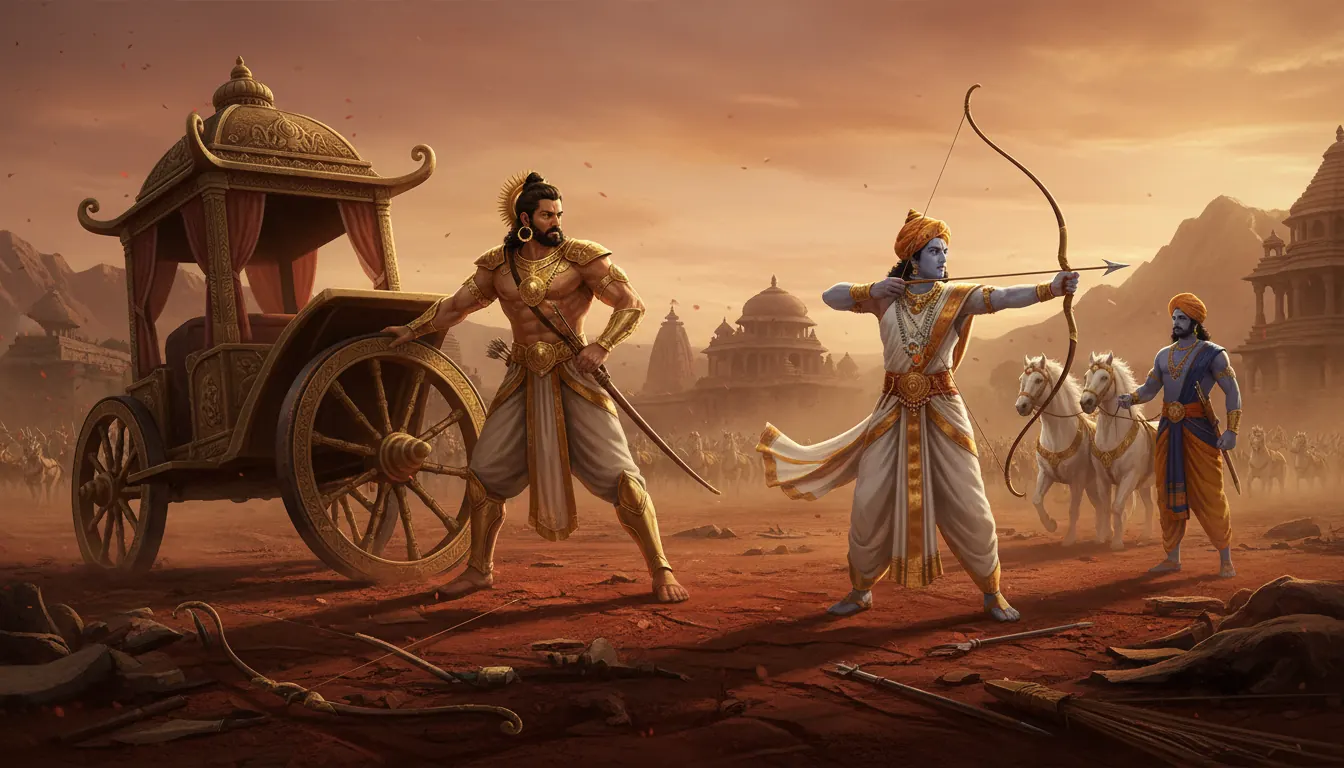
Karna's Tales of the Madrakas
The abducted woman's curse, the rakshasa's ranking of dirt, and a driver who cannot get off the chariot
In short
On the seventeenth morning of the war, tied to the same chariot as the king who is driving him, Karna answers Shalya's taunts by reciting everything the brahmanas of Dhritarashtra's court had ever said against the Vahikas and the Madrakas. He tells of the chaste woman abducted by robbers of Aratta whose curse made their sisters' sons their heirs, and of the rakshasa Kalmashapada, pulled out of a tank by a king, who repaid the rescue with a ranking of the impure peoples of the earth. Shalya answers in a minute, with one word repeated: everywhere.
Told in the Karna ParvaSet in Kurukshetra, Madra and Panchanada20 min read
The King Who Held the Reins
On the seventeenth morning of the war the man driving Karna's chariot was a king in his own right, and that was the whole trouble.
Sanjaya told it that way in the hall at Hastinapura, to a blind man who wanted to hear how his side had spent its last great captain. Shalya, ruler of the Madras, had agreed to take the reins only on the condition that he might say whatever came into his head while he held them, and Duryodhana, who wanted Karna to have a driver as good as Krishna, had agreed to the condition without thinking about it very hard.
So Shalya drove, and Shalya talked. All that morning he had praised Arjuna in the hearing of the troops and had told the son of Radha what would happen to him when the two chariots finally met.
"What you are saying about the enemy is raving, Karna," he said at last. "As for me, I can defeat the enemy in battle without a thousand Karnas."
The ruler of the Madras, a man of harsh features, was saying such unpleasant things that Karna answered him once more with words twice as bitter.
He had already begun the thing he was going to do to Shalya that day. He was not going to argue about Arjuna. He was going to take the country Shalya came from, the land of the five rivers and the Madrakas and the Vahikas who lived along them, and he was going to lay it open in front of the whole army out of the mouths of brahmanas who had said these things in Dhritarashtra's own court, where Karna had sat and listened and remembered every word.
"You ought to know all this, Shalya," he said. "But I will tell you again. Listen carefully to what I say."
Behind them the two arrays were still forming. The horses moved. The man with the whip had nowhere to go, and no way to stop his ears, and the man he was carrying had all day.
The Guest Who Had Seen Every Country
"Once," Karna said, "a brahmana came to our house as a guest."
He meant the house of Adhiratha the charioteer, where he had been raised, and he said it deliberately, because Shalya had been sneering at that house since sunrise. The guest, Karna said, watched how they lived and was very pleased, and being pleased he talked, as travellers do.
"I lived alone for a long time on a peak of the Himavat," the man had said. "Since then I have seen many countries following many religions."
That was the credential, and the next sentence was the finding.
"Never, however, have I seen all the people of a country act unrighteously."
It is worth stopping on, because it is the most generous sentence in the whole of Karna's speech, and Karna quoted it only in order to produce an exception to it. All the races the man had met, he said, accept as true religion what those who know the Vedas have declared. Every country he had walked through kept some floor under itself. Then, travelling through many lands with many religions, he came at last among the Vahikas.
And there, he said, the order of the world ran backwards and in a circle.
There he heard that a man is first a brahmana, and then he becomes a kshatriya. After that a Vahika will become a vaishya, and then a shudra, and then a barber. Once a barber, he will become a brahmana again. And once he is a brahmana again, he will become a slave.
"One person in a family becomes a brahmana," the traveller said. "All the others fall away from virtue and do as they please. That is how the Gandharas, the Madrakas and the dull-witted Vahikas are. I have travelled the whole world, and I heard of these practices, which destroy virtue, of these sinful disorders among the Vahikas."
Karna let the last three syllables of that sit where the driver could feel them.
"You ought to know all this, Shalya."
The Woman the Robbers Took
"But I will tell you again," Karna said, "about the ugly things someone else said to me about the Vahikas."
And then he told the only story in the whole tirade that has a woman in it who is allowed to speak.
Long ago, he said, a chaste woman was carried off by robbers from Aratta. Nothing is given of her name or her house or where they took her from. She was carried off by men of that country, and they sinfully violated her, and there was nobody to prevent it and nobody afterwards to whom she could complain.
So she cursed them. That was the one thing she had left, and she used it with terrible precision. She did not curse the men who had held her. She did not ask for their deaths, which would have ended in a generation. She reached past them into their houses and cursed the thing they had used against her.
"Since you have sinfully violated a helpless girl, and I am not without a husband," she said, "the women of your families will all become unchaste. You lowest of men, you will never escape the consequences of this dreadful sin."
She had a husband. She names it in the curse. It is the only fact about her life that survives, and she put it in because it was the measure of what had been taken.
"That is why, Shalya," Karna said, "the Arattas' heirs are their sisters' sons, and not their own sons."
That is the point at which the story stops being a story and becomes an explanation. A whole custom of inheritance, a whole arrangement about which child gets the land when a man dies, is being read backwards as the mark left on a people by one woman on one night, because after such a curse no man among them can be certain that his son is his.
Karna had found the sentence he wanted, and he was not done with it.
The Countries That Know
"The Kauravas with the Panchalas," Karna said, "the Shalvas, the Matsyas, the Naimishas, the Kosalas, the Kasapaundras, the Kalingas, the Magadhas, and the Cedis, who are all highly blessed, know what the eternal religion is."
He was naming, deliberately and slowly, half the kings on both sides of the field. Men whose sons were at that moment sitting in chariots a bowshot away waiting for the signal. He was inviting the entire war to agree with him about one thing before it resumed killing itself over everything else.
"The wicked even of these various countries know what religion is," he went on, and that clause is the sharp one. He was not claiming that the Kurus and the Panchalas and the Magadhas were good. He was claiming something narrower and harder to answer, that even their criminals could tell you what the rule was that they were breaking.
"The Vahikas, however, live without righteousness."
Then he said it again the other way round, in case anyone driving a chariot had missed it. Starting with the Matsyas, the people of the Kuru and Panchala countries, the Naimishas too and the other respectable peoples, the pious of every race know the eternal truths of religion.
"That cannot be said of the Madrakas, or of the crooked-hearted race that lives in the country of the five rivers."
The five rivers were Shalya's rivers. The Madrakas were Shalya's people, and their king was holding the horses.
"You know all this, king," Karna said, "so hold your tongue, Shalya, as if you had lost the power of speech, in every matter of religion and virtue."
There was a whole day of fighting still to come, and the two of them were tied to the same floor of the same chariot for the whole of it, and Karna had just told the man at the reins to be silent about dharma for the rest of his life.
Shalya, for the moment, said nothing at all, which was not the same as obeying.
A Sixth Part of the Demerit
What Karna went to next was the arithmetic of kingship, and it is the cruellest passage in the speech because it is the only one that is about Shalya personally.
"You are the protector and king of that people," he said, "and so you share a sixth part of their merits and their sins."
That is the old reckoning, and every king in the hearing of that chariot knew it. A sixth of the harvest goes to the crown, and a sixth of the invisible harvest goes with it. The good a protected people does is credited to the man who protects them. So is the evil. It is the price of the throne and it is also the dignity of the throne, because it means a king is genuinely joined to his subjects and not merely seated above them.
Karna took the second half of it away from him.
"Or perhaps you share a sixth part of their sins only, since you never protect them. A king who protects shares in the merits of his subjects. You do not share in their merits."
He was telling the ruler of the Madras that he carried the whole weight of his country and owned none of its worth. That he was liable and not entitled. That whatever his people had done wrong was on his head by law, and whatever they had done right had gone somewhere else, because he had never done the one thing that would have earned him a share of it.
Then he reached back past all living memory for a witness.
"Long ago, when the eternal religion was honoured in every country, the Grandsire saw the practices of the country of the five rivers and cried shame on them. If even in the krita age Brahman condemned the practices of those fallen people of evil deeds, born to shudras by other men's wives, what would you say now to men in the world?"
The krita age is the first age, when the world was new and dharma stood on four legs and nothing anywhere had begun to rot. Karna's argument was that even then, when everyone kept the duties of his own order, the Grandsire had to find fault with these men.
"You ought to know all this, Shalya. But I will tell you again."
The Rakshasa in the Tank
"A Rakshasa named Kalmashapada," Karna said, "said this while he was sinking in a tank."
The scene is given in half a line and it is one of the strangest in the epic. A rakshasa is going down in water. Not fighting, not devouring anyone, not haunting a road at night. Sinking, in a still tank, and reciting as he sinks.
"Begging alms is a kshatriya's dirt, and failing to keep his vows is a brahmana's dirt. The Vahikas are the dirt of the Earth, and the Madra women are the dirt of the whole female sex."
Four judgements, and the first two are not about anybody's country. They are about how each order fails in its own particular way. A kshatriya's dirt is begging, the taking of alms, because a man born to protect and to give should never be found with his hand out. A brahmana's dirt is the vow he did not keep, because a brahmana is nothing except his observances. Each order is measured by the thing it was made for, and the stain named is the shadow of its own duty.
Then the two clauses that Karna had actually come for. The Vahikas are the dirt of the Earth. The Madra women are the dirt of the whole female sex.
Shalya was a Madra. His sister Madri had been the wife of Pandu and the mother of Nakula and Sahadeva, and both of those young men were somewhere out on the field that morning in the Pandava array. Karna was standing in a chariot driven by their uncle and quoting a drowning rakshasa on the subject of Madra women.
While sinking in the stream, Karna said, a king rescued the rakshasa.
That is all the king gets. No name, no kingdom, no account of how he came to be at the water. He saw a thing going under and he put his hand in and pulled it out, and the thing he pulled out was a man-eater, and then he asked it a question.
"Asked by the former," said Karna, "the latter gave this answer. I will recite it to you. Listen to me."
The Order of the Dirt
The rescued rakshasa answered by building a ladder, and every rung of it was underneath the one before.
"The mlecchas are the dirt of mankind," he said. "The oilmen are the dirt of the mlecchas. Eunuchs are the dirt of the oilmen. Those who employ kshatriyas as priests at their sacrifices are the dirt of eunuchs."
Four steps down. Mankind at the top, and the barbarians who live outside the pale are the sediment mankind leaves. Below them the oil-pressers, whose trade crushes living seed in a mill. Below them men who cannot father children. And at the bottom of the four, not a people at all but a practice, a household that hires a kshatriya to do a brahmana's office at its fire and so puts the wrong hand on the ladle.
Then the rakshasa, who was standing dripping on a bank with the man who had just saved his life, delivered the price.
"And the sin of those who have these last for their priests, and the sin of the Madrakas too, will be yours if you do not let me go."
That is what the ladder had been for. Every rung of it was loaded onto the shoulders of the king who had reached into the water, and the only way out from under it was to let go of the creature he had rescued. The rakshasa was telling his rescuer, in careful order, exactly how much filth he had picked up along with him, and offering him the chance to put it down again.
And then the sting in the tail, which Karna delivered flatly, because it makes the whole recitation into something a person might actually use.
"The rakshasa declared that this is the formula to be used to cure a person possessed by a rakshasa, or one killed by the power of a poison."
The list is a charm. Said over a man who is raving with a spirit in him, or over a man dying of venom, that catalogue of dirt is supposed to drive the thing out. Karna was reciting a medicine at his driver, word for word, and the Madrakas were one of the ingredients.
"The words that follow," he said, "are all very true."
Who Guards Which Quarter
What followed was a survey of the whole world done in single clauses, and Karna went through it like a man reading out a ledger.
"The Panchalas keep the duties laid down in the Vedas. The Kauravas keep to truth. The Matsyas and the Surasenas perform sacrifices. The Easterners follow the practices of the shudras. The Southerners are fallen. The Vahikas are thieves. The Saurashtras are bastards."
Then the roll of what a man is defiled by, which is not aimed at any nation and is the plainest thing in the speech. Ingratitude. Theft. Drunkenness. Adultery with the wives of one's teachers. Harsh speech. Killing cows. Wandering out of the house at night in search of lust. Wearing other people's ornaments.
"What sin is there," Karna said, "that they do not incur? Shame on the Arattas and the people of the country of the five rivers."
Starting with the Panchalas, the Kauravas, the Naimishas, the Matsyas, all these know what religion is. The old men among the Northerners, the Angas and the Magadhas, follow the practices of the pious even without themselves knowing what virtue is, which is its own sort of compliment.
And then he named the guardians, and for a moment the quarrel opened out into something larger than a chariot.
Many gods, led by Agni, live in the East. The pitris live in the South, which is ruled by Yama of righteous deeds. The West is guarded by the mighty Varuna, who watches over the other gods there. The North is guarded by the divine Soma together with the brahmanas. Rakshasas and Pishachas guard the Himavat, best of mountains. The Guhyakas guard the mountains of Gandhamadana. And beyond doubt Vishnu, who is also called Janardana, protects all creatures everywhere.
Every direction of the world has somebody standing over it. Every mountain has its watchers, and above the lot of them is the god who guards all creatures without exception.
Karna finished the list and left one hole in it.
And yet, he said, the Vahikas have no particular protectors among the gods.
That was the cruelty of the whole passage. Not that the five rivers were wicked. That the map had been drawn out in full, quarter by quarter and peak by peak, so that the driver could look at it and see that his own country was the one square of it with nothing standing over it at all.
The Ones Who Cannot Take a Hint
The last catalogue was about understanding, and Karna arranged it as a descent.
"The Magadhas understand a sign," he said. "The Kosalas understand from what they see. The Kurus and the Panchalas understand from half a sentence. The Shalvas cannot understand until the whole sentence has been spoken. The Mountaineers, like the Sivis, are very stupid. The Yavanas, king, know everything, and the Suras especially so. The mlecchas are wedded to the creations of their own fancy, and other peoples cannot understand at all."
A ladder again, from the people who need only a gesture down to the people who need every word said out loud, and then off the bottom of it entirely.
"The Vahikas resent good advice," Karna said. "As for the Madrakas, they are not among those named at all."
Not slow. Not stupid. Not on the list. A whole people filed under nothing, in a scheme that had found room even for men wedded to their own inventions.
"And you, Shalya, are one of them. You should not reply to me."
Then he went back over the ground once more, because he wanted the ending to be the same words he had started with. The Madrakas are held on Earth to be the dirt of every nation. So the Madra woman is called the dirt of the whole female sex. People whose ways are drinking spirits, violating their teachers' beds, destroying the unborn by causing miscarriage, and robbing other people's wealth: there is no sin they lack.
"Shame on the Arattas and the people of the country of the five rivers. Knowing this, be silent."
And then, at last, what the whole hour had been for.
"Do not try to oppose me. Do not make me kill you first, and then Keshava and Arjuna."
That is the sentence under all of it. Karna had spent the morning of the day he was going to die proving that his own charioteer came from the one country on earth that the gods had left unguarded, and the reason he had done it was that he needed the man to shut up and drive, and could not think of any other way to make him.
Everywhere
Shalya heard him out and answered in about a minute, and his answer is the shortest speech in the quarrel.
"Abandoning the suffering and selling wives and children, Karna, are common among the Angas, whose king you are."
One clause, in the same coin, to show that the game could be played back. Then he dropped it, because he had something better.
"Remember the faults of yours that Bhishma listed when he told of the Rathas and Atirathas, and put away your anger. Do not be angry."
And then he took the whole enormous structure Karna had built, the brahmana on the Himavat, the cursed woman, the sinking rakshasa, the four dirts, the unguarded quarter, and he pulled the floor out from under it with one word repeated.
"Brahmanas are found everywhere. Kshatriyas are found everywhere. So are vaishyas and shudras, Karna. Chaste women of excellent vows are found everywhere too. Everywhere men enjoy mocking other men and wounding one another. And lustful men are found everywhere."
Everywhere. Not that the Madras were clean. That nobody was, and that the dirt was distributed evenly over the earth, and so was the virtue, and a map that puts all of one thing in one country and all of the other thing in another is a map of somebody's temper and not of the world.
"Anyone, at any time, can speak skilfully about the faults of others. But no one knows his own faults, or if he knows them, feels any shame. Everywhere there are kings devoted to their own religions and busy punishing the wicked. Virtuous men are found everywhere. It cannot be, Karna, that all the people of a country are sinful. In many countries there are men whose conduct surpasses the very gods."
It was the traveller's sentence from the beginning of the whole speech, the one Karna had quoted himself and then spent an hour trying to break: never have I seen all the people of a country act unrighteously.
Then Duryodhana came up and stopped the two of them from carrying on their war of words, speaking to the son of Radha as a friend and pleading with Shalya with joined hands. Karna was calmed by him and said nothing more. Shalya faced the enemy.
And Radha's son, smiling, once more urged the king of the Madras.
"Go on."
Dharma Lesson
Karna's speech is the most learned thing he ever says and the least true. He has read and remembered and can quote brahmanas, rakshasas and the Grandsire himself, and he uses all of it to prove that wickedness lives in one country and not in his own, because he needs his driver silent and has no better way to silence him. Shalya answers with the only correction that ever works on such a map: everywhere. The epic gives the last word not to the man with the catalogue but to the man who says that virtue and filth are distributed evenly over the earth, and that no one who is fluent about the faults of others has yet looked at his own.