The Vows Before the Final Duel
Karna, Shalya, Krishna and Arjuna each say what they will do when the other man dies
In short
On the seventeenth day, with his son Vrishasena just killed in front of him, Karna brings his chariot up against Arjuna's and the whole universe comes to watch, taking sides so openly that Brahman has to settle the outcome in advance. Before an arrow is loosed, Karna asks Shalya what he will do if Arjuna kills him, Arjuna asks Krishna the same question, and Shalya, Krishna and Arjuna answer with death-vows. Ashwatthama begs Duryodhana to end the war while there is still a kingdom to share, and is refused. Then the astras start, and when Karna baffles them Bhima and Krishna turn on Arjuna and tell him to stop being patient.
Told in the Karna ParvaSet in Kurukshetra23 min read
Two Chariots Like Two Suns
It was the seventeenth day of the war, and Sanjaya, who watched that field with the sight Vyasa had given him and carried it back every evening to a blind king in a hall, had come to the thing his master had been dreading since the war began.
Karna had just lost his son. Vrishasena, the heir of Anga, had been cut down in front of him by Arjuna a little while before, and Karna, filled with grief and rage, shed tears for the death of that boy. Then he stopped weeping. With eyes red as copper, he turned his chariot into the face of his enemy and summoned Dhananjaya to battle.
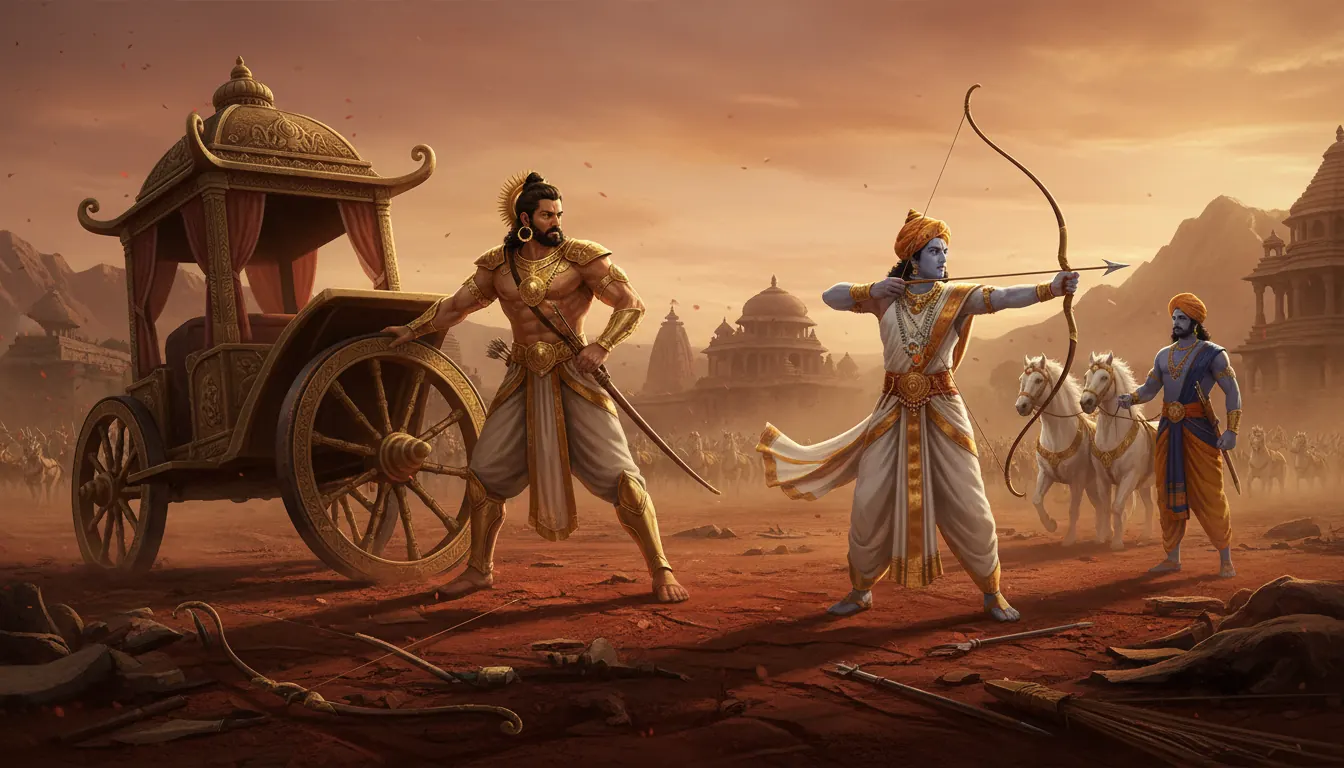
The two chariots came together. Both had the brightness of the sun on them and both were covered with tiger-skins, and when they closed they looked like two suns brought near to each other. Both had white horses. On one stood Karna with Shalya, the king of the Madras and the finest driver alive, holding the reins at the front of the chariot. On the other stood Arjuna with Krishna. High over Karna waved the standard with the elephant's rope, made of jewels and strung with rows of little bells, hard as iron, like the noose in the hands of Yama. Over Arjuna waved the ape, its jaws wide open, terrible, as hard to look at as the sun.
Both were clad in mail, both had scimitars at their belts, both had white umbrellas and yak-tails to fan them, and the limbs of both were smeared with red sandal-paste. They rushed at each other like two bulls in a cow-pen, like two angry mountains, like two all-destroying Yamas, and filled with wrath they looked like two mighty planets risen for the destruction of the world at the end of the yuga.
The armies did not stand back. The sons of Dhritarashtra closed round Karna without losing a moment, and the Pandavas, headed by Dhrishtadyumna who commanded them, closed round Partha, and the field arranged itself into a ring. Thousands of men slapped their armpits and waved their garments in the air, and in all that noise a doubt entered the heart of every man there as to which of the two would live until evening.
Sanjaya described what he was watching in the only language that fitted it. Karna, he said, became the stake of your army in that battle, and Partha became the stake of the Pandavas. The soldiers of both sides were members of that assembly and had come to be the spectators of the game. For the two players, either victory or defeat was certain.
The Worlds Take Sides
In the sky, said Sanjaya, the creatures there fell to quarrelling and trading insults over Karna and Arjuna. All the inhabitants of the world could be heard taking sides against one another. The gods, the danavas, the gandharvas, the pishacas, the snakes and the rakshasas took opposite sides.
He gave the roll as he heard it called.
The sky with all its stars became anxious on Karna's account, while the wide earth became anxious on Partha's account, like a mother for her son. The rivers and the seas and the mountains, the trees, the plants that shed their leaves, and the herbs took the side of the diadem-decked Arjuna. The asuras, the yatudhanas, the guhyakas, and the ravens and the other creatures that roam the sky sided with Karna.
All the gems and precious jewels went with Arjuna, and the four Vedas with the histories as the fifth, and the Upavedas, and the Upanishads with all their mysteries. Vasuki went with him, and Takshaka, and all the great venomous snakes, and the nagas, and Airavata with his children, and the offspring of Surabhi. The smaller snakes all sided with Karna. Wolves and wild stags and every auspicious animal and bird wanted victory for Partha.
The Vasus, the Maruts, the Sadhyas, the Rudras, the Vishvedevas and the Ashvins, and Agni and Indra and Soma and Pavana, and the ten points of the compass, took Dhananjaya's side, while all the Adityas sided with Karna. The vaishyas, the shudras, the Sutas, and those castes that were of mixed origin, all took the side of Radha's son. The brahmanas, the kshatriyas, the sacrifices and the gifts called dakshinas were for Arjuna. The pretas and the pishacas, the flesh-eating birds, the rakshasas with all the monsters of the sea, the dogs and the jackals were for Karna. The celestial and twice-born and royal rishis were for the son of Pandu, and Yama and Vaishravana and Varuna stood with him.
It is the plainest statement the epic ever makes about what those two men were to the people who watched them. Everything that had been given a place in the world was for Arjuna. Everything that had been left out of it, and the castes that had been ranked at the bottom of it, and the men without kernel and without name, were for the charioteer's son.
Then Shakra said, "Let Arjuna defeat Karna." And Surya said, "Let my son Karna kill Arjuna and win the victory in this battle."
What Brahman Said About the Ending
With the father of one man and the father of the other quarrelling openly in the sky, the gods became frightened. Brahman himself had come, with the twice-born rishis and the Lords of creation, and Bhava had driven up on his chariot, and the celestials went to the Self-born with a request.
"Let these two lions among men be equally successful," they said. "Do not let the vast universe be destroyed by this clash between Karna and Arjuna. Self-born one, only say the word, and let the two of them succeed equally."
It was a plea for a draw, and it was refused.
Maghavat bowed to the Grandsire and reminded him of an older word. "You yourself once said, holy one, that the two Krishnas are always sure to win. Let it be now as you said then."
Brahman and Isana answered him together. Victory is certain, they said, for the great-souled Vijaya, that Savyasachin who pleased the eater of sacrificial libations in the forest of Khandava, and who came to heaven and helped you. Karna is on the side of the danavas, so it is right that he should be defeated. Phalguna is devoted to truth and to morality, and he has for the driver of his chariot that Lord of the universe, Vishnu himself. These two are Nara and Narayana, the two ancient rishis. No one rules over them. In heaven or among human beings there is no one equal to either of them.
And then, having settled the outcome of the duel before a single arrow had been shot in it, the two gods said the other thing.
"Let Karna, that bull among men, win the highest regions of bliss here. Let him become one with the Vasus or the Maruts. Let him be worshipped in heaven with Drona and Bhishma, for Vikartana's son is brave and a hero. But let the victory belong to the two Krishnas."
The deity of a thousand eyes honoured those words, saluted all creatures, and told the assembled sky what it had just heard. "You have heard what the two gods have said for the good of the universe. It will be so and not otherwise. So stay, and be of good cheer."
They stayed. The celestials showered fragrant flowers and blew their trumpets, and the gods and the danavas and the gandharvas settled themselves to watch a contest whose end they had all just been told.
The Standards Fight First
On the ground, the first thing to attack was not a man.
The impetuous ape on the standard of the wielder of Gandiva grew eager for battle, leapt from his place and fell on Karna's standard. Darting forward, he struck the elephant's rope with his nails and his teeth, like Garuda falling on a snake. The rope, hung with rows of little bells and hard as iron, closed with the ape in a fury. So in that fierce single combat between two heroes, which was the result of what had been settled at the time of the match at dice, their standards battled with each other before their masters did. The throw made over a board in a hall at Hastinapura, in front of an old king who would not stop it, was being paid out here, and the counters on the table this time were the two men themselves.
Under them the horses of the one neighed at the horses of the other.
Then the drivers looked at each other. The lotus-eyed Keshava pierced Shalya with his keen glances, and Shalya cast the same kind of glances back at him, and Sanjaya, who watched it, said plainly that Vasudeva defeated Shalya with those glances of his, and that Dhananjaya at the same moment defeated Karna with his.
It was then, with everything settled above him and nothing yet decided below, that Karna turned and smiled at the man holding his reins.
"If Partha somehow kills me in battle today," he said, "tell me truly, friend, what you will do then."
Shalya was the king of the Madras and the uncle of Nakula and Sahadeva, tricked into this army on the road to the war and given to Karna as a driver only that morning, and the two of them had spent the day insulting each other on the same chariot floor. He did not hesitate.
"If you are killed, I myself will kill both Krishna and Dhananjaya."
Then he said it a second time, in case Karna had not believed him the first time.
"If the white-horsed Arjuna kills you in battle today, Karna, I myself, on a single chariot, will kill both Madhava and Phalguna."
That is the vow of a man who has been abusing his own warrior since sunrise and who intends, if his warrior falls, to go alone against the two people nobody on earth can go against. Shalya never got the chance to try it. But he had been asked, and he answered, and Karna took the answer and turned back to the front.
The Sun May Fall Down From Its Place
On the other chariot the same question was being asked, because Arjuna had thought of it too.
Krishna smiled at him and gave an answer of great weight.
"The Sun himself may fall from his place, the Earth may split into a thousand pieces, fire itself may turn cold. Still Karna will not be able to kill you, Dhananjaya! But if any such thing does happen, then know that the end of the universe is at hand. As for me, I will kill both Karna and Shalya in battle with my bare arms."
Arjuna laughed at that, and answered his driver in the same style.
"Shalya and Karna together are no match for me alone, Janardana! Today, Krishna, you will see Karna cut to pieces by my arrows in battle, with his standard and banners, with Shalya and his chariot and horses, with his umbrella and armour and darts and shafts and bow. Today you will see him ground to dust like a forest tree crushed by a tusker. Today the wives of Radha's son will become widows. They must surely have seen the signs of coming evil in last night's dreams."
Then the boasting stopped and the old wound opened, as it always did with this man and this enemy.
"I cannot hold back my wrath at what this short-sighted fool did when he saw Krishna dragged into the assembly, and laughed at us, and abused us again and again in vile words. Today, Govinda, you will see me crush Karna as a maddened elephant crushes a tree laden with flowers."
And then, before a single arrow had been loosed, Arjuna described the evening.
"Today, slayer of Madhu, when Karna has fallen, you will hear those sweet words, 'By good luck, descendant of Vrishni, the victory is yours!' Today you will comfort the mother of Abhimanyu with a lighter heart, having paid off your debt to the enemy. Today, full of joy, you will comfort your aunt Kunti, your father's sister. Today, Madhava, you will comfort tearful Krishna, and king Yudhishthira the just, with words sweet as nectar."
Three vows had now been spoken over that narrow strip of ground, and every one of them was about what would happen after one of these two men was dead.
A Darkness Made of Arrows
The sky by now had filled with gods and nagas and asuras and siddhas and yakshas, with large bands of gandharvas and rakshasas, with twice-born rishis and royal sages and birds of excellent feathers, and it resounded with musical instruments and song and hymns and laughter and dance. Men on the ground looked up and saw them standing in the air.
Then the two armies, filled with joy, made the earth and the ten points of the compass ring with drums and conchs and lion-like roars, and began to slaughter each other again. The field, teeming with men and horses and elephants and chariots, crowded with dead bodies and red with blood, looked wonderfully splendid.
In the middle of it the two archers covered the ten points of the compass with keen straight arrows until a darkness was caused there, and neither side could see anything at all. From fear, every warrior on that field sought the protection of either Karna or Arjuna, the way rays of light spread out in the sky converge toward either the sun or the moon. Each man stopped the other's weapons with his own, like the east wind and the west wind meeting. Each had urged his troops, "Do not run away!" and the two hosts stood their ground in a circle round them like the gods and the asuras standing round Vasava and Shambara.
Five great chariot warriors decided that this could not be left to Arjuna alone. Duryodhana came, and Kritavarma the chief of the Bhojas, and Shakuni the son of Subala, and Kripa, and Ashwatthama who was the son of Sharadvata's daughter, and they attacked Dhananjaya and Keshava with shafts that caused great pain.
Arjuna cut off, all at the same time, their bows, their quivers, their horses, their elephants and their chariots with the drivers on them, mangled every one of the five, and then pierced Karna with a dozen arrows while he was about it.
So a hundred chariots and a hundred elephants came, and Saka and Tukhara and Yavana horsemen with the foremost of the Kambojas among them, riding at him from every side to kill him. Cutting off with razor-headed arrows their weapons and their heads and their horses, Dhananjaya felled them on the field.
Then the trumpets of the excellent gods were blown in the sky, mingled with the praises of Arjuna, and gentle breezes brought down showers of fragrant flowers on his head. Gods and men alike saw it and were filled with wonder.
Two people on that field felt neither pain nor wonder: Duryodhana, and the Suta's son, who were of the same opinion about everything.
Ashwatthama Takes the King by the Hand
Drona's son had seen enough. He took Duryodhana's hand and, in a soothing voice, said the thing that nobody in that army had wanted to hear for seventeen days.
"Be content, Duryodhana. Make peace with the Pandavas. There is no need to quarrel. Shame on war! The teacher, who knew the mightiest weapons and was like Brahma himself, has been killed. Other bulls among men, Bhishma first among them, have been killed too. As for me, no one can kill me, nor my maternal uncle either. Rule the kingdom for ever, and share it with the sons of Pandu."
He was offering to do the work himself. If I dissuade Dhananjaya, he said, he will stop. Janardana does not want hostilities. Yudhishthira is always engaged in the good of all creatures, Vrikodara is obedient to him, and so are the twins. Let the kings who are still alive go back to their homes. Let the troops stop. If you do not listen to me, king, struck by your enemies in battle, you will burn with grief.
Then he set out the old teaching about friends, and applied it to the man in front of him. Wise people say there are four kinds of friends: friends by nature, friends won by conciliation, friends made through wealth, and those brought under by force. You have all of these with the sons of Pandu. The Pandavas are your friends by nature, hero. Win them back as friends by conciliation. I will dissuade Karna too, if you are willing to make peace.
Duryodhana thought for some time. He drew deep breaths, and answered with a heavy heart.
"It is as you say, friend. But listen to what I have to say to you. The wicked-hearted Vrikodara killed Dushasana like a tiger and spoke words that still live in my heart. You heard them too. How can there be peace now? And the sons of Pritha will never trust me in the least, when they think of all the violent wrongs I have done them."
That was the honest part. What followed was the hope.
"Nor is it right for you, son of my teacher, of unfading glory, to tell Karna now, 'Stop fighting!' Phalguna is very tired today. Karna will soon kill him."
When he had said this humbly, and more than once, to the man who had just offered him peace, Duryodhana turned to his troops and gave his orders.
"Take up your arrows, charge these enemies and kill them. Why are you standing idle?"
Fire, Water, Wind
When the conchs grew loud again, those two closed like two Himalayan elephants of full-grown tusk fighting over a she-elephant in her season, and both armies shouted advice.
The Somakas called to Partha, "Quickly, Arjuna, go and pierce Karna. Cut off his head, and with it the hope of Dhritarashtra's son for the kingdom." Our own men, said Sanjaya, called to Karna, "Go on, go on, Karna, kill Arjuna with your sharp arrows. Let the sons of Pritha go back to the woods for good."
Karna pierced Partha first with ten mighty shafts, and Arjuna answered with ten in the centre of the chest. Then Arjuna rubbed his arms and the string of Gandiva and sped showers of cloth-yard shafts and nalikas and razors and anjalikas and crescent-headed arrows. They spread over the sky and went down into Karna's chariot like birds coming with their heads bent into a tree at evening to roost for the night, and Karna cut every shower of them out of the air with arrows of his own.
So the son of Indra sped a fiery weapon at him. It covered the earth and the sky and the very course of the sun with its light and set Arjuna's own body blazing. The robes of the warriors round about took fire and they fled, and there was a sound like a bamboo forest burning in a wilderness.
Karna, seeing that fire working on every side, shot the varunastra to quench it. A mass of clouds came up whose edges looked like mountains and flooded the earth with water, and the fire went out in a moment, and nothing could be seen at all under that darkness.
Arjuna dispelled them with the vayavyastra.
Then, charging Gandiva and its string with mantras, he invoked the favourite weapon of the chief of the celestials. Arrows issued from it in thousands with the force of the thunderbolt, piercing Karna's limbs, his horses, his bow, his yoke and his standard, entering them like snakes frightened by Garuda entering the earth.
Pierced all over and bathed in blood, his eyes rolling in wrath, Karna bent his bow until the twang of it was as loud as the roar of the sea, and invoked the Bhargava weapon that Rama had taught him. It cut Arjuna's shower to pieces at the mouth and went on into the Pandava army, destroying chariots and elephants and foot-soldiers, and Karna, laughing at the two Krishnas, turned it on the foremost of the Panchala warriors and killed them where they stood, so that they fell like elephants slain by an angry lion.
Your troops, said Sanjaya, thought Karna had won, and clapped, and roared.
Slay Him Today
Bhima, watching his brother's weapon beaten in front of the whole army, squeezed his hands together, drew deep breaths, and shouted across at Arjuna with his eyes blazing.
"How, Jishnu, could this wretch who has fallen from virtue, this Suta's son, kill so many of the best Panchala warriors before your eyes? The gods themselves could not conquer you before now. You have felt the touch of Sthanu's own arms. How then could the Suta's son pierce you first with ten long shafts? Remember Krishna's sufferings, and the cutting words this wicked son of a Suta used against us: 'Sesame seeds without kernel!' Remember all this, Savyasachin, and kill the wretched Karna quickly today. This is no time for indifference. With the same patience with which you defeated all creatures and fed Agni at Khandava, kill the Suta's son. I will crush him with my mace as well."
Krishna said the same thing from the driver's seat, more quietly.
"What is this, diadem-decked Arjuna? How can Karna be crushing your weapons today? Why are you losing your wits? Do you not see that the Kauravas are shouting for joy even now? Yuga after yuga you have killed terrible kshatriyas and asuras born of pride; kill Karna today with that same patience. Then give king Yudhishthira the earth with her belt of seas, cleared of every enemy."
Urged by his brother and by his friend, calling to mind the object for which he had come into this world, Arjuna asked leave of Keshava and of Brahman and of Bhava, bowed, and invoked the brahmastra, the weapon that is applied by the mind alone.
Karna stopped it, and went on shooting like a cloud pouring rain.
"People say you are a master of the high brahmastra," said Bhima, blazing. "Then use another weapon of the same kind, Savyasachin."
He did. Arrows of golden wing, in hundreds upon hundreds, with the brightness of the yuga fire, covered Karna's chariot in a moment, and out of that cloud came long darts and battle-axes and discs. A head fell from its trunk. A man who saw his comrade fall died of fear beside him. A right arm massive as an elephant's trunk came down with the sword still in the grasp. Arjuna pierced Karna's standard, struck Shalya with four shafts, and killed the Kaurava prince Sabhapati in his golden mail, who fell from his chariot like a sala tree cut with an axe.
The Field Empties Around Him
Karna answered with thousands of arrows, pierced Bhima and Janardana and Arjuna with three apiece, and roared, and Arjuna, struck by those shafts and looking at his brother and at his friend, could not endure it, and shot again.
Yudhishthira came up at that moment to watch. His wounds had been dressed and his arrows drawn out by the foremost of surgeons, he was made sound with mantras and drugs, and he arrived on that spot clad in golden mail like the full moon freed from the jaws of Rahu and risen in the firmament, and all creatures were filled with delight at the sight of him. The spectators, celestial and earthly, reined in the animals they rode and stood motionless.
Then Arjuna's bowstring broke with a loud noise, and in that interval Karna put a hundred small arrows steeped in oil into him, sixty into Vasudeva, and thousands upon thousands into Bhima. Later, five of his shafts, snakes that had taken the side of Ashvasena the son of Takshaka, went through Krishna's armour and out of his body and into the earth, and bathed there, and came coursing back toward Karna, and Arjuna cut each of the five into three fragments in the air.
Seeing Krishna's limbs mangled by snakes turned into arrows, Arjuna blazed up with wrath like a fire burning a heap of dry grass. He pierced Karna in every vital limb with blazing shafts shot from a string drawn back to his ear, and Karna trembled in pain and kept his feet only with the greatest difficulty, summoning all his patience.
After that, nothing round Karna could be seen at all: the points of the compass, the splendour of the sun, and his own chariot all vanished under the shower Arjuna was pouring, and the sky over them looked like a thick forest. In that darkness Savyasachin killed two thousand of the picked chariot warriors of Duryodhana's host, the men who guarded Karna's wheels and his wings and his van and his rear, with their chariots and horses and drivers.
Then the Kauravas who were still alive fled. They deserted Karna where he stood and left behind them their dying and their wounded and their wailing sons and fathers.
Karna looked round at the empty ground where his army had been. Sanjaya, telling it afterwards, was careful about this one detail, because it was the last thing about the man that could still be told without grief. Seeing himself abandoned by the terrified Kurus, and seeing the space around him empty, Karna felt no agitation.
He turned his chariot and rushed at Arjuna with a cheerful heart.
Dharma Lesson
Everyone in this episode knows how it ends. Brahman announces the verdict aloud before the first arrow, and the gods are told to sit down and watch anyway. What the men do with that is the whole of the story: Shalya promises to avenge a warrior he has spent the day insulting, Ashwatthama offers to talk both sides out of a war that has already killed his father, Duryodhana admits his many acts of hostility in one breath and refuses peace in the next. A settled ending does not excuse anybody from choosing. It only means the choosing is the part that belongs to them.