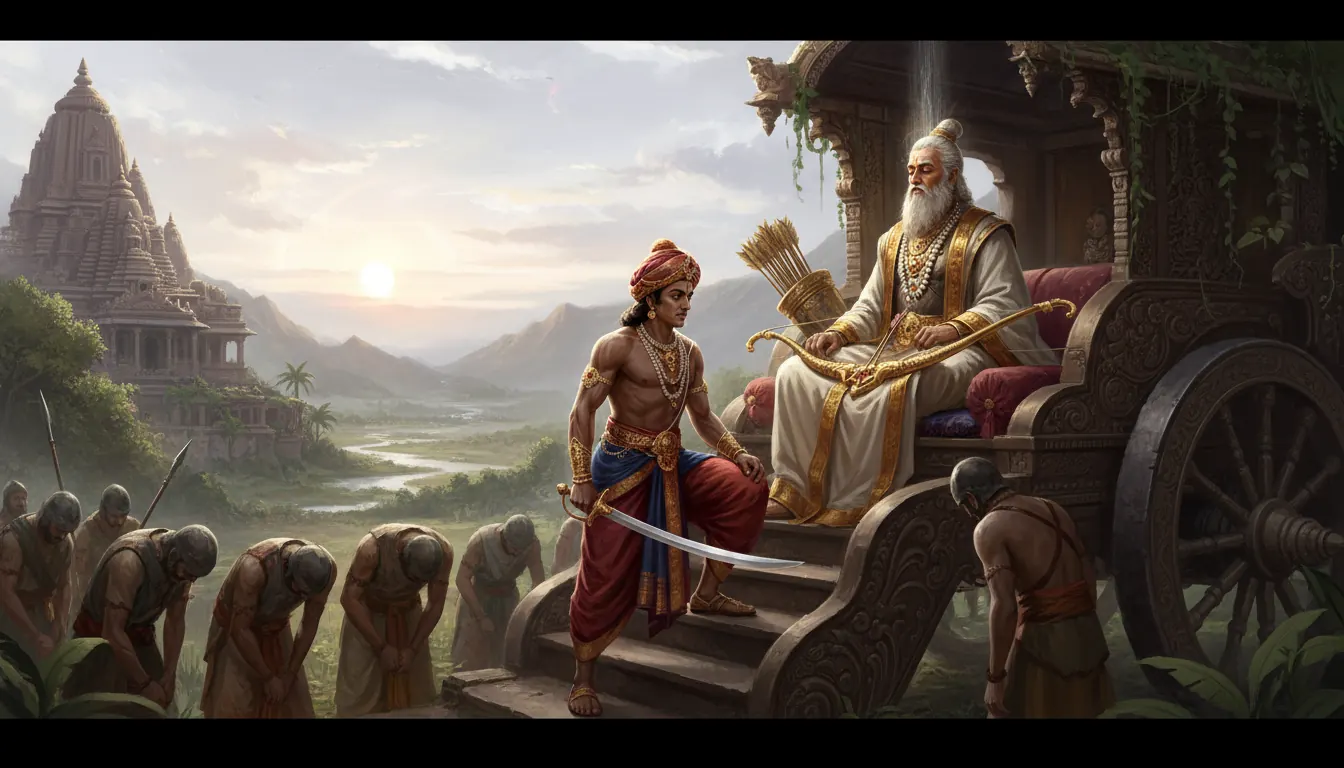
Kurukshetra Day 15: The Day the Teacher Died
From the Dawn Prayers to the Half-Truth at Noon
In short
Goaded by Duryodhana in the night, Drona swears to kill all the Panchalas and then take off his armour. At sunrise both exhausted armies get down from their chariots and say the twilight prayers together before resuming. Drona kills Drupada and Virata, hears Yudhishthira's half-truth about Ashwatthama, finds his arrows exhausted, sets down his bow and leaves his body. The day ends with the Narayanastra, the Agneya, and two revelations from Vyasa.
Told in the Drona ParvaSet in Kurukshetra21 min read
I Will Take Off My Armour
The quarrel that decided the fifteenth day happened in the dark, some hours before it, with both armies lying on the field where they had dropped.
Duryodhana had gone to his commander and said, more sharply than ever, the thing he had been saying to him for days.
"Neither the Pandavas, nor we, nor any other bowmen in the world are a match for you when you are fighting. You know every weapon. With your celestial weapons you could certainly destroy the three worlds with the gods and the Asuras and the Gandharvas. The Pandavas are all afraid of you." And then: "But you spare them, remembering that they were your pupils. Or perhaps it is my bad luck."
Drona did not answer that quickly.
"Old as I am," he said, "I am still fighting in battle with all my might. All these men know nothing of weapons. I am well versed in them. If, out of a desire for victory, I kill these men, there can be no act more ignoble for me.
"But whatever is in your mind, good or bad, I will carry out at your command. It will not be otherwise.
"I will show my prowess in battle, kill all the Panchalas, and then take off my armour, king. I swear this to you truly."
And then, because the insult was still in him, he told his king exactly what he thought of him. He recited Arjuna's deeds at Khandava and against the Gandharvas and the Nivatakavachas, and asked what kshatriya was going to kill that man. He said, 'You are sinful and cruel and suspicious of everybody. You rebuke even those who work for your good in this way. You are the root of this hostility. Why do you have all these innocent kshatriyas killed? Go yourself against the son of Kunti. To be killed by Jaya would be a death worthy of every praise. You have given in charity. You have eaten. You have had all the wealth you wished for. You have no debts. Do not be afraid. Fight the son of Pandu now.'
Those words being said, king, the battle recommenced.
The Prayers Both Armies Said
When three-fourths of that night had worn away, they were still at it, and both sides were somehow elated with it.
Then Aruna, the charioteer of Surya, came up and weakened the splendour of the moon and made the whole sky coppery, and the east reddened with rays like a circular plate of gold.
And this is the moment, king, and there is nothing else like it in the eighteen days.
All the warriors of the Kuru host and all the warriors of the Pandava host got down. They came down from the chariots and off the horses and out of the litters carried by men, on both sides, at the same time, in a field they had been killing each other in since the previous sunrise, with only a short sleep in the dark between. They stood facing the sun with their hands joined. And they uttered the prayers of the twilight of dawn.
Together. In hearing of one another. The same words.
Then they got back on and Drona divided the Kuru army into two bodies and came on with Duryodhana in front of him against the Somakas and the Panchalas, and Madhava said to Arjuna, 'Keeping your foes to your left, place this division to your right,' and Arjuna moved to the left of Drona and Karna both.
And Bhima, seeing it, said to his brother the only thing anybody said that morning that was not a prayer.
"Bibhatsu, listen to what I say. The hour for which kshatriya women bear sons has come. If at such a time you do not strive to win prosperity, you will be acting meanly, like a true wretch. Pay the debt you owe to Truth, to Prosperity, to Virtue and to Fame. Break through this division."
Drupada and Virata
Drona moved away from the fighting toward the north and took up his station there, and stood like a smokeless fire, and the Pandava troops looking at him began to tremble.
Some of them became perfectly cheerless. Some grew angry instead. Some were simply filled with wonder. Some of the kings squeezed their hands together, and some, deprived of their senses by rage, bit their lips, and some whirled their weapons and some rubbed their arms. And then they went at him.
The three grandsons of Drupada came first. He killed them with three sharp arrows, one each, and they fell lifeless from their chariots. Then he defeated the Chedis, and the Kaikeyas, and the Srinjayas, and all the Matsyas.
Then the two old men came, the two who had every reason to.
Drupada, king of the Panchalas, who had been Drona's friend when they were boys studying together, and had told him at the gate of his palace years later that friendship between a king and a beggar was impossible, and had been made to pay for it, and had then obtained a son out of a fire for the express purpose of this. Virata, king of the Matsyas, in whose kitchens and cattle-sheds the Pandavas had hidden for their thirteenth year, whose son had been killed on the first day, whose daughter was a widow in a tent behind the lines.
They came together and shot showers of shafts at him.
Drona checked the shower and covered them both. Then, in his anger, he cut through both their bows with two broad-headed arrows. Virata sent ten lances and ten arrows at him to kill him. Drupada hurled a terrible dart of iron, decked with gold and with stones of lapis lazuli, that looked like a large snake.
He cut the ten lances out of the air with broad-headed arrows and the dart with another. And then, with a couple of well-tempered broad-headed shafts, he sent Drupada and Virata both to the abode of Yama.
Dhrishtadyumna saw his father go down, and Drupada's three grandsons, and swore aloud in the middle of all the chariot warriors:
"Let me lose the merit of all my religious acts, and my kshatriya energy, and my Brahma energy, if Drona escapes me alive today, or if he defeats me."
Stand There and Watch
But swearing was one thing and doing was another. Duryodhana and Karna and Shakuni and the brothers born of one mother took their places around Drona in order of rank and protected him, and the Panchalas, for all their struggling, could not even look at him.
And Bhimasena became highly angry with Dhrishtadyumna and pierced him with words instead of arrows.
"What man who is counted a kshatriya, born in the race of Drupada, the greatest master of weapons there is, would only stand and look at the enemy in front of him?
"What man, who has seen his father and his son killed and has sworn such an oath in the presence of the king, would stand idle before his enemy?
"There stands Drona like a fire swelling with its own energy. With bow and arrows for fuel he is consuming all the kshatriyas. Soon he will wipe out the Pandava army.
"Stand there and watch, and see what I do. I will go against Drona myself."
And Vrikodara went into that array and began to rout it, and Prishata's son came in after him, and the two of them got in among the red horses of Drona's chariot; and such a fierce encounter took place at sunrise of that day, king, as we had never seen or heard of before.
A Dust That Everyone Took for Night
By full morning nobody could see anything.
The dust went up off that field and was not laid, and thick showers of arrows fell into it, and the noise, growing every minute, reached the heavens. Many of the men had fought all night and were weak with hunger and thirst and had gone past their senses. Horses of the noblest breed, as big as elephants, trembled with the effort of dragging vehicles whose wheels had sunk into the earth. There was no path for a chariot anywhere on that ground because of the carnivorous animals and the dead and the dying.
And the dust made a night out of the morning. Neither Karna, nor Drona, nor Arjuna, nor Yudhishthira, nor Bhimasena, nor the twins, nor the Panchala prince, nor Satyaki, nor Dushasana, nor Drona's son, nor Duryodhana, nor Subala's son, nor Kripa, nor the ruler of the Madras, nor Kritavarma, nor I myself, king, nor the earth, nor the points of the compass, could be seen. All of us were shrouded.
Warriors, desirous of victory, killed friends and foes alike, whoever they could reach with the touch of their hands.
Then the wind came and took the dust away, and the blood that had been shed laid the rest of it, and everything was suddenly visible again and drenched. Elephants and horses and chariot warriors and foot soldiers, bathed in blood, looked like a forest of Parijata trees in flower.
And in the clear, four pairs found each other. Duryodhana and his brothers took the twins. Nakula placed the king on his right and shot hundreds of shafts and was cheered for it, and Duryodhana turned on him from that very side and drove him back, and Nakula, recollecting every one of his woes, said only, 'Wait. Wait.' Radha's son engaged with Vrikodara. And Arjuna engaged with the son of Bharadwaja, and both armies stopped to watch that one.
The Rishis Standing at His Wheel
Then Drona set about keeping the oath he had sworn in the night, and did it with nothing held back. I tell it here in one piece, king, though the worst of it came after the lie I will come to next, when he had shaken that lie off.
He turned to the Brahma weapon to wipe out the kshatriya race. Twenty thousand Panchala chariot warriors covered him with arrows and he scattered all of them. He killed twenty thousand of them. He killed five hundred Matsyas and six thousand Srinjayas and ten thousand elephants and ten thousand horses. He killed twenty thousand kshatriyas and then sent ten times ten thousand more to their deaths with sharp-pointed arrows. Dark-skinned, with his grey locks hanging down to his ears, that man of eighty-five careered over that field, for your son's sake alone, with the energy of a youth of sixteen.
And then, king, the sky above his chariot filled up.
Vishvamitra came, and Jamadagni, and Bharadwaja who was his own father, and Gautama, and Vasishtha, and Kashyapa, and Atri; and the Srikatas and the Prisnis, and Garga, and the Valakhilyas, and the Marichis, and the descendants of Bhrigu and of Angiras, and diverse other sages of subtle form, with the Bearer of sacrificial libations at their head. They had come to take him to the region of Brahman and they told him so.
"You are fighting unrighteously. The hour of your death has come. Lay down your weapons in battle, Drona, and look at us standing here.
"From now on you must not do such very cruel deeds. You are versed in the Vedas and their branches. You are devoted to the duties that truth lays down. Above all, you are a brahmana. Such acts are not worthy of you.
"Lay down your weapons. Drive away the film of error that clouds you. Keep now to the eternal path. Your time in the world of men is complete. With the Brahma weapon you have burnt men on earth who knew nothing of weapons. That act is not righteous. Do not stay on earth any longer."
He heard them. He did not stop.
But something else was coming. He had been shooting ceaselessly for four days and one night without ever coming to the end of his arrows, and before the third part of that fifth day was out, his arrows would be exhausted, and the celestial weapons, when he called them, would no longer come at his bidding.
Falsehood Is Better Than Truth
By then the Pandavas had stopped talking about winning.
"Is it not plain," they were saying to each other, "that Drona will consume us all like a raging fire consuming a heap of straw in the spring? No one can even look at him. And Arjuna, who alone is a match for him, knows the ways of morality and will not fight him."
So Keshava said what he said.
"This greatest of all bowmen can never be defeated by force in battle, not even by the gods led by Vasava. But when he lays down his weapons, he can be killed on the field even by human beings.
"Cast virtue aside, sons of Pandu, and find some trick to win the victory, so that Drona of the golden chariot does not kill us all in battle.
"If his son Ashwatthama falls, he will stop fighting, I think. So let someone tell him that Ashwatthama has been killed in battle."
Dhananjaya did not approve of it. The others did. Yudhishthira accepted it with great difficulty.
Then Bhima went and found a mighty elephant belonging to Indravarman, the chief of the Malavas, standing in his own army: a huge foe-crushing beast, terrible, like the elephant of Shakra himself. Its name was Ashwatthama. He killed it with his mace.
And then he went to Drona with some embarrassment on his face and called out aloud, "Ashwatthama has been killed."
When Drona heard those terrible words and thought about them, his limbs seemed to dissolve like sand in water. And then he remembered his son's prowess, and came to think the news false, and was not unmanned by it, and recovered, and rushed at Prishata's son with a thousand arrows.
But he had heard it. And there was one person on that field whose word he would take.
Four Fingers' Breadth
He asked Yudhishthira. Not anybody else. He asked Yudhishthira because he firmly believed that Yudhishthira would never speak an untruth even for the sovereignty of the three worlds, and because he had hoped for truth from him since the man was an infant in his schoolroom.
Govinda, knowing that Drona was capable of sweeping the Pandavas off the face of the earth, was much distressed, and came to the king and said:
"If Drona fights in his rage for even half a day, I tell you truly, your army will be wiped out. Save us from Drona. In such a case falsehood is better than truth. A man who tells an untruth to save a life is not touched by sin. There is no sin in an untruth spoken to women, or at marriages, or to save a king, or to rescue a brahmana."
And Bhimasena came up while they were talking and said, "As soon as I heard how Drona might be killed I killed that elephant and went and told him, and the teacher did not believe me. You want victory, so take Govinda's advice. Tell Drona, king. If you tell him, that bull among brahmanas will never fight. You are known to be truthful in the three worlds."
So Yudhishthira, afraid of telling an untruth and longing for victory, made up his mind and said it.
He said distinctly that Ashwatthama was dead.
And he added the word elephant after the name, indistinctly.
Up to that moment, king, the chariot of Yudhishthira the just had always stayed four fingers' breadth above the surface of the earth, and every man in both armies had seen it and none had remarked on it because it had always been so.
After he had said that, his vehicle and his animals came down and touched the ground, and stayed there afterwards.
He Laid Aside His Bow
Drona was already carrying too much. The rishis had told him he was an offender against the high-souled Pandavas. His arrows had run out. His weapons would not come when he called them. And now the one man he trusted had told him his son was dead.
Dhrishtadyumna came at him and Drona took his bow and his shield and his mace and his sword away one after another, and Satyaki cut the killing shaft out of the air at the last moment; and while that was happening Bhima took hold of Drona's own chariot and spoke to him from a foot away.
"If wretches among brahmanas, discontented with the calling of their own order but well versed in arms, did not fight, the kshatriya order would not have been wiped out like this. Not harming any creature has been called the highest of all virtues, and the brahmana is the root of that virtue. You are the greatest of all who know Brahma.
"You are killing all these Mlecchas and these warriors, who are at least following the proper calling of their own order, driven by ignorance and folly and by desire for wealth for their sons and wives. And all for the sake of one son: why are you not ashamed?
"The one for whom you have taken up weapons, and for whom you live, lies dead on the field today, behind your back and without your knowing. King Yudhishthira the just has told you this. You must not doubt it."
At Bhima's words, Drona laid aside his bow.
And then, wishing to lay aside all his weapons too, the virtuous son of Bharadwaja said aloud, so that they could hear him across the noise:
"Karna, Karna, great bowman. Kripa. Duryodhana. I tell you again and again, fight with care in this battle. Let the Pandavas do you no harm. As for me, I lay aside my weapons."
Then he began, loudly, to take the name of his son. He sat down on the platform of his chariot and gave himself to Yoga, assuring all creatures and dispelling their fears; bending his face slightly down, heaving his breast forward, closing his eyes, resting on the quality of goodness, thinking on the syllable Om.
Dhrishtadyumna laid his bow down in the chariot with the arrow still fixed on the string, took a sword, jumped down, and ran.
Every creature there cried out. Arjuna got down from his own chariot and ran toward Prishata's son with his arms raised, calling out, 'You who know the ways of morality, do not kill the teacher. Bring him alive. He must not be killed.' All the troops were shouting the same thing. Dhrishtadyumna seized the head by its white hair and cut it off, and his foe stayed silent all the while, and he threw it down in front of your army, and your army ran.
Five of us saw what the rest could not. Myself; Dhananjaya; Kripa, the son of Sharadvan; Vasudeva of Vrishni's race; and king Yudhishthira the just. We saw him go up out of that field rapt in Yoga, like a smokeless brand of blazing splendour, into the stellar path, and for a moment it seemed to us there were two suns in the sky.
A Weapon That Cannot Be Used Twice
The Kuru army went off that field in every direction at once, throwing away its coats of mail, urging on fathers and brothers and uncles and sons, and the soldiers called out, 'Wait, wait, do not fly,' and none who said it stood still himself.
Ashwatthama, who had been elsewhere, came against the current of it like an alligator, found Duryodhana, and asked why the troops were running. Your son could not get the words out. He sat in his chariot and wept, and finally asked Kripa to say it before others, and Kripa told him how his father had died.
Then Drona's son blazed up like a fire fed with a large quantity of fuel, squeezed his hands, ground his teeth, breathed like a snake, and swore in your son's hearing: since Kunti's son, wearing only the outward dress of virtue, had made the teacher lay aside his weapons while he was fighting righteously, he would rout and destroy that army before his very eyes.
And he invoked the weapon called Narayana.
Thousands of arrows with blazing mouths appeared in the sky, and iron balls, and Sataghnis, and the more the Pandavas resisted the stronger it grew. Krishna understood it at once and told every man in that host to get down from his chariot and lay his weapons down on the ground and not think of fighting, because that weapon feeds on resistance. They all did it. Bhima would not. He stood in his chariot in the middle of the fire, and Arjuna covered him with the Varuna weapon, and finally Nara and Narayana themselves got down and walked into that energy and dragged Bhimasena off his own chariot by force while he roared at them. And when he was down and his weapons were down, the weapon became pacified, and the winds turned sweet, and the birds and the animals became quiet.
Duryodhana told Ashwatthama to use it again.
"That weapon cannot be summoned again," he said. "It cannot be used twice."
So he used the other one. Stung past bearing by harsh words from Arjuna, whom he loved and who had never spoken to him that way before, he touched water, invoked the Agneya weapon, and let it off on all sides. A thick gloom shrouded the host. Meteors flashed down. The sun gave no heat. Clouds roared and rained blood, and the very waters heated, and the elephants ran breathing heavily and looking for protection. When Arjuna dispelled it with the Brahma weapon and the wind came clean again, a full akshauhini of the Pandava host was lying there burnt, and the forms of the slain could not be told apart.
And on that field, twice in one evening, Vyasa stopped a man and told him what he was actually looking at. To Drona's son he said that Krishna and Arjuna are Narayana and Nara, older than the oldest gods, born in every age for the purposes of the world, and that Ashwatthama himself is a portion of Rudra. To Arjuna he named the blazing figure with the lance that had been walking in front of his chariot in battle without touching the ground.
Then the son of Drona bowed to the great rishi, looked at what was left of your army and had it withdrawn for the night; and the Pandavas withdrew theirs.
"After fighting for five days," said Sanjaya, "and causing immense slaughter, that brahmana well versed in the Vedas, Drona, went to the realm of Brahma."
Dharma Lesson
A man goaded into abandoning his own restraint has already lost the day on which he will die. Drona knew that a brahmana slaying men who could not answer him was the most ignoble thing he could do, said so aloud, and did it anyway because his king had questioned his loyalty. The insult that makes a good man prove himself is the weapon that kills him.