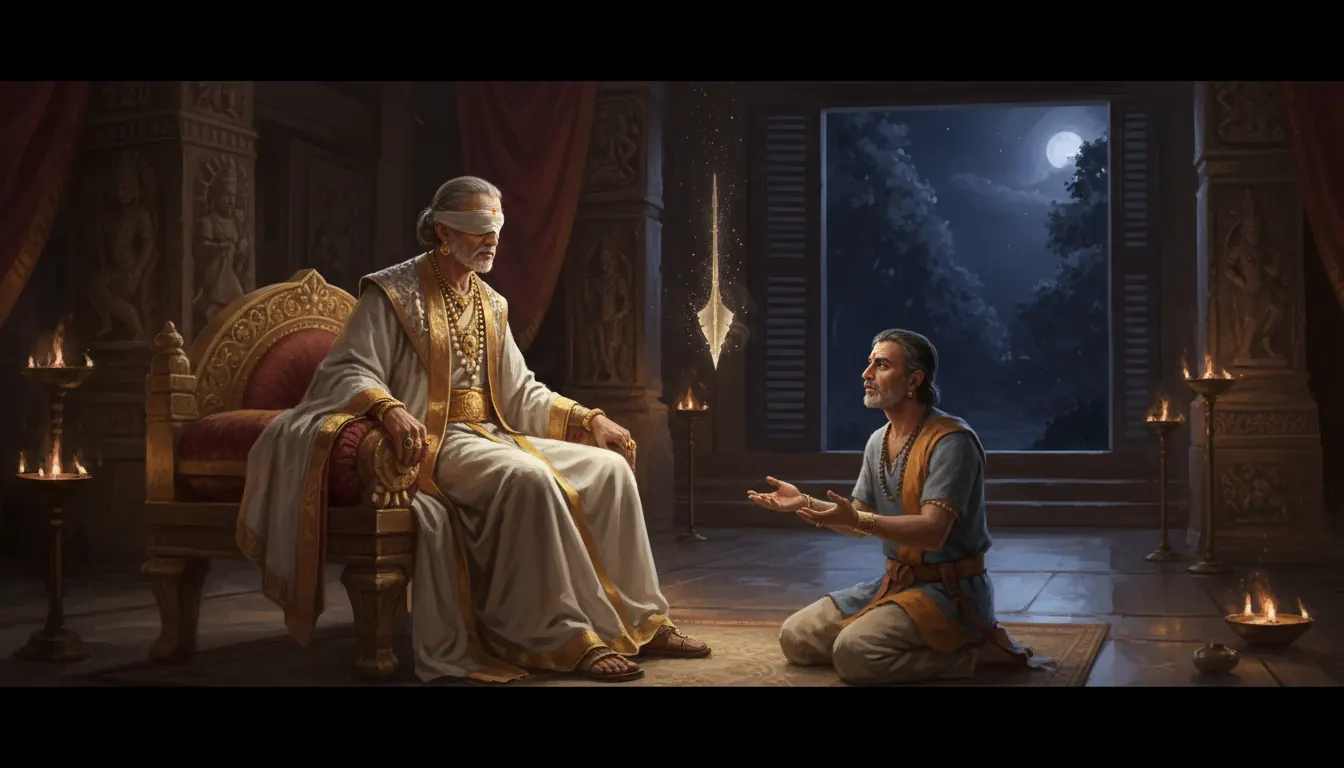
The Dart That Was Never Thrown
A blind king asks the only question that mattered
In short
With Karna's one-use Vasava dart spent on a Rakshasa, Dhritarashtra demands to know why it was never simply thrown at Arjuna. Sanjaya answers that it was the standing business of every night's council in the Kaurava tent, that they begged Karna to kill Krishna instead because Krishna was the root and the rest only trunk and leaves, and that every single day Krishna arranged for Karna to be occupied elsewhere.
Told in the Drona ParvaSet in Hastinapura and Kurukshetra17 min read
The Only Question He Had Left
The night battle was only half told when the old king stopped his charioteer in the middle of the account.
"Wait," Dhritarashtra said. "Go back."
"King."
"When the Suta's son had a dart in his hand that was certain to kill one person, why did he not hurl it at Partha, and at no one else?"
Sanjaya said nothing, because there was no answer that would not hurt.
"Answer me. If that dart had killed Partha, all the Srinjayas and the Pandavas would have been slain with him. With Phalguna dead, why would the victory not have been ours? Arjuna has made a vow that when he is summoned to battle he will never refuse the challenge. It is a public vow. The Suta's son had only to summon him. Why did Vrisha not meet Phalguna in single combat and kill him with the dart that Shakra gave him?"
Still nothing.
"There is no doubt my son is without both intelligence and counsellors," the king said. "That sinful wretch is forever thwarted by the enemy. How could he ever succeed in defeating his enemies? Here was a mighty weapon on which his whole victory rested, and a rakshasa has made it useless. It has been snatched out of Karna's hand the way a strong man snatches a fruit out of the hand of a cripple with a withered arm."
"That is a fair description of what happened, king."
"It is more than that. In a fight between a boar and a dog, whichever of the two dies, it is the hunter who profits. I think that Vasudeva was the hunter in the battle between Karna and Hidimbi's son. If Ghatotkacha had killed Karna, that would have been a great gain for the Pandavas. If Karna killed Ghatotkacha, that too would have been a great gain for them, because of the loss of the dart. That is how he reasoned, and to do what was good for the Pandavas he had Ghatotkacha killed by Karna in battle."
"That," said Sanjaya, "is exactly what happened. Knowing what Karna meant to do, Janardana ordered the prince of the rakshasas to meet him in single combat, for the express purpose of making the fatal dart useless. And all of it, upholder of Kuru's line, is the result of your own evil policy. We would certainly have succeeded if Krishna had not rescued Partha from Karna's hands. Partha would have been destroyed, with his horses and standard and chariot, if that lord of Yogins had not saved him."
Why Did You Not Remind Him
"My son loves a quarrel," Dhritarashtra said. "His advisers are foolish. He is vain of his own wisdom. That is why this certain means of Arjuna's death has been thwarted."
And then, because he had gone through everybody else, he arrived where he always arrived, which is at the man reporting to him.
"Why did Duryodhana not hurl that fatal dart at Dhananjaya? Or Karna, the greatest of all who wield weapons, a man of great intelligence? And you, son of Gavalgana. Why did you forget this great aim, wise as you are? Why did you not remind Karna of it?"
There was a pause then, king, of the kind that happens when a man who has spent days describing other people's failures is asked about one of his own.
"I did not forget it," Sanjaya said.
"Then."
"Every night, king, this was the subject of our deliberations. Duryodhana, and Shakuni, and Dushasana, and myself. Every single night. It was not an idea somebody had once. It was the standing business of that tent."
The Root, the Trunk, the Branches, the Leaves
"And we said to Karna, 'Leave all the other warriors aside, Karna, and kill Dhananjaya. Then we would lord it over the Pandus and the Panchalas as if they were our slaves.'
"And then one of us would go further, because there was always one who went further, and say, 'Or if, when Partha falls, the hero of the Vrishnis appoints another of the sons of Pandu to carry on the fight, then let Krishna himself be killed.'
"And then we would set it out for him the way you set out a thing for a man who has to do it at a distance of half a mile with one throw and no second chance.
"Krishna is the root of the Pandavas. Partha is like their risen trunk. The other sons of Pritha are the branches. The Panchalas may be called the leaves. The Pandavas have Krishna for their refuge, Krishna for their might, Krishna for their leader. He is their central support, as the moon is of the constellations. So, son of a suta, leave the leaves and the branches and the trunk alone, and kill Krishna, who is everywhere and always the root.
"That was the counsel, king, and it was correct. If Karna had killed the hero of Dasharha's line, that joy of the Yadavas, the whole earth would without doubt have come under your control. If that illustrious one could have been laid lifeless on the ground, the entire earth with its mountains and its forests would have acknowledged you as supreme. We knew it. He knew it. He agreed to it and said, 'So be it.'"
"Then what happened?"
"Morning happened," said Sanjaya. "Every morning we rose having made that resolution about the Lord of the gods himself, Hrishikesha of immeasurable energy. And when the time for battle came, we forgot our resolution."
He Never Placed Arjuna Before Him
"You forgot," the king said. "All of you. Every day since he took the field."
"I have thought about that word a great deal, king, and I no longer think it is the right one. Consider what a day of this war actually is. There is a field two yojanas across with eighteen armies in it. A man in a chariot sees what is within four hundred paces of him and hears almost nothing. Where he goes is decided by where the pressure is, and the pressure is decided by somebody.
"Keshava always protected Arjuna, the son of Kunti. He never once placed Arjuna in front of the Suta's son in battle. Not once, in all the days that Karna was on the field. Achyuta always put some other leading chariot warrior in front of Karna. Bhimasena one day. Yuyudhana another. A rakshasa at the last. Whoever it needed to be, and always somebody worth Karna's whole attention, and always somewhere else.
"He was doing it so that we ourselves would make our fatal dart useless. We would come off the field at evening with the dart still in the quiver and the day gone, and we would sit down and resolve again.
And count the days with me, king, because they are few and they are all accounted for. Ten of them Karna spent in his tent and never came out, because he had sworn not to fight while Bhishma stood. Four more he spent under Drona, and on none of them did he ever get Arjuna alone in single combat. On the fourteenth day the Sindhu king was the whole business of the army and Karna was set to protect him, and Arjuna had to cut his road through a whole army to reach the Sindhu king, and never met Karna alone. And when the sun went down on the fourteenth day and the lamps went up and there was nothing left to interpose, a rakshasa came out of the dark at him with a chariot drawn by things that were not horses, and would not be got rid of, and had to be killed with the only weapon that would kill him.
That is not forgetfulness, king. That is a schedule."
Dhritarashtra said, "And Krishna himself? He was standing in the open in that chariot day after day with no armour and no bow. Why did nobody kill him?"
"When the high-souled Krishna protected Partha from Karna in this way," Sanjaya said, "why, king, would that greatest of beings not protect himself? When I think it over carefully, I see that there is no one in the three worlds who can defeat that chastiser of foes, that hero with the discus in his hand. That is my whole answer and I have no better one."
The Same Question, Asked From the Other Side
And here, king, is a thing you should know: that same night, on the other side of the plain, a man asked exactly the question you have just asked me, of the only person alive who could answer it properly.
Satyaki went to Krishna.
"Janardana. It had been Karna's firm resolve to hurl that dart of immeasurable energy at Phalguna. Everybody knew it. Why then did the Suta's son not actually hurl it at him?"
And Vasudeva told him.
"Dushasana and Karna and Shakuni and the ruler of the Sindhus, with Duryodhana at their head, debated this often. They used to say to him, 'Karna, great bowman, hero of immeasurable prowess in battle, this dart must not be hurled at anyone but Kunti's son. He is the most famous of them, as Vasava is among the gods. Once he is dead, all the other Pandavas and the Srinjayas will lose heart, like celestials without fire.' And Karna agreed and said, 'So be it,' and from that hour the desire to kill the wielder of Gandiva never once left his heart.
"But I always used to cloud the mind of the son of Radha. That is why he did not hurl the dart at Pandu's son of the white horses."
Satyaki said nothing to that, so Krishna told him the rest, which was not a matter of strategy.
"As long as I could not defeat that means of Phalguna's death, I had neither sleep nor joy in my heart. Now that I have seen that dart made useless through Ghatotkacha, I feel that Dhananjaya has been rescued today from the very jaws of Death."
Not Even My Own Life Is So Precious
"Not my father," Krishna said, "nor my mother, nor all of you, nor my brothers, not even my own life, is so precious to me, so worth protecting, as Bibhatsu in battle.
"If there is anything in existence more precious than the sovereignty of the three worlds, I do not want to enjoy it without Pritha's son to share it with me.
"Seeing Dhananjaya today like a man returned from the dead, I am carried away with delight. That is why I sent the rakshasa to fight Karna. No one else could have withstood Karna in battle at night."
So now, king, put the two accounts side by side, since I have given you both.
In your son's tent, night after night: a correct plan, agreed by everyone present, aimed at the right target, never once carried out.
On the other side, night after night: one man arranging, every single day, that the two men should not meet, and losing his sleep over it, and finally sending a boy he had watched grow up to spend himself against Karna in the dark so that the thing in Karna's hand would be gone by morning.
We called it destiny afterwards. Bhimasena's son was fourteen days in the field and is buried nowhere.
And notice what is not in either account. There is no moment anybody can point to. There is no single order given, no messenger, no ambush laid, nothing that a herald could announce or a bard could set to music. The whole of it consists of a meeting that was prevented from taking place, day after day, by a man holding reins. If Karna had thrown that dart on any one of those mornings, every child in this country would know the name of the morning. Because he did not, there is nothing to know. The move that decided your war leaves no monument at all, and the men who made it were the ones who never got to do the thing they had agreed on the night before.
Destiny Is Supreme
The king turned it over for a while and then came back at it from the other side, the way he does.
"I see that this act of Karna and Duryodhana and Subala's son Shakuni, and above all of yourself, has gone entirely against good policy. You knew that dart could always kill one person in battle. You knew that not even the gods with Vasava at their head could withstand or turn it aside. Why then did Karna not hurl it at Devaki's son, or at Phalguna, when he was fighting him before?"
"Every day, when we came back from battle," Sanjaya said, "all of us used to debate in the night and say to Karna, 'Tomorrow morning, Karna, this dart must be hurled at either Keshava or Arjuna.' When the morning came, through destiny, both Karna and the other warriors forgot that resolution.
"I think destiny is supreme, king, since Karna, with that dart in his hands, did not kill either Partha or Devaki's son in battle. Because his understanding was clouded by destiny itself, bewildered by the illusion of the gods, he did not hurl that fatal dart of Vasava, though he had it in his hand, either at Krishna to destroy him or at Partha, whose prowess is like Indra's."
"Destiny," said the old king.
"It is the word we have been using in the tent, king. I am aware of what else it might be called."
You Are Destroyed
And then he worked his way to the end of it, as he always does, and the end of it is always the same two sentences in the same order.
"You are destroyed by destiny," Dhritarashtra said, "by your own understanding, and by Keshava.
"Vasava's dart is lost, spent on killing Ghatotkacha, who was as insignificant as straw. Karna, and my sons, and all the other kings, through this highly impolitic act, have already entered the abode of Yama."
That is the son blamed, king, and the counsellors, and the weapon, and the fate. And then, when there was nobody else in the sentence, he heard what he had just said about a boy who had been killed the same evening and had done nothing to him, and he did not take it back, and he did not defend it, and he went quiet.
And then he said, "Tell me now how the battle raged after the fall of Hidimbi's son."
That is how he ends every one of these. He asks about the next thing. He has never once told me to stop.
But he had said one other thing first, king, and I set it down because of who was missing from it. He said that the act had been Karna's, and Duryodhana's, and Shakuni's, and mine above all. He did not put himself at the head of the list of the guilty, and he did not put himself in the middle of it either. He left himself out of it altogether and put his charioteer at the top, which is where he has always preferred the blame to stand: on the counsellors, and never on the king they counsel.
By Good Luck
There is a coda to it, king, and you should have it, because it settles the argument.
When Ghatotkacha fell, Yudhishthira sat down in his chariot with a wet face and could not fight. Krishna told him to rise. And the son of Dharma answered that the boy had come to him at Kamyaka while Arjuna was away getting weapons, and had stayed with them, and had carried the princess of Panchala on his own back over fastnesses she could not walk across, and that his affection for that prince of the rakshasas was twice what he naturally bore towards Sahadeva.
He said other things too, sitting there with his eyes wet, that were harder to hear. He said that when Abhimanyu was killed, Arjuna had not been on the field and the rest of them had been held in check by the ruler of the Sindhus; that Drona with his son had been the cause of it; that it was the teacher himself who told Karna how to do it, and the teacher himself who cut the sword out of the boy's hand while he was fighting with it. And then he said the thing that had been sitting under the whole of the fourteenth day: that for a little offence, the Sindhu king had been slain by the wielder of Gandiva, and that act had not given him great joy; that if the slaying of foes was just and ought to be done by the Pandavas, then Drona and Karna should have been slain before this; that those two were the root of their woes, and Suyodhana was confident because he had obtained them; and that when it was Drona who should have been killed, or the Suta's son with his followers, Dhananjaya had gone and killed the Sindhu king, whose connection with the affair was very remote.
Then he took up his bow and blew his conch and went off to kill Karna himself, in a temper, with Shikhandi and a thousand chariots behind him, and Krishna said to Arjuna, "It is not right for you to leave this to him," and urged the horses after him.
And Vyasa came out of the field and stood in front of the king's chariot and stopped him.
"By good luck, Phalguna still lives, although he met Karna in battle. Karna had kept his dart, wanting to kill Savyasachin. By good luck Jishnu did not meet him in single combat. Had they done so, each would have challenged the other and shot his celestial weapons in every direction. Arjuna would have destroyed the weapons of the Suta's son, and the Suta's son, hard pressed, would certainly have hurled Indra's dart in that battle. And then, best of Bharata's line, your grief would have been great.
"By good luck the rakshasa has been slain in battle by the Suta's son. It was death himself who killed Ghatotkacha, using the dart of Vasava only as his instrument. Do not yield to anger and do not set your heart on grief. This is the end of all creatures in this world. On the fifth day from this, the earth will be yours. Always think of virtue. Practise kindness, penances, charity, forgiveness and truth. Victory is there where righteousness is."
And having said that, king, he made himself invisible then and there, and left the son of Dharma standing on the field understanding, for the first time, what his ally had spent that night doing on his behalf, and how the bill had been paid, and by whom.
Dharma Lesson
The decisive moves in a long war are the ones that were prevented from happening, and they leave no monument. Krishna won an argument that was never held by making sure the two men who would have settled it never stood opposite each other. Vigilance that succeeds looks, from outside, exactly like luck, and the men it defeats will call it destiny because there is nothing else to call it.