The Bow at the Frontier
Parashurama Tests Rama of Ayodhya and Loses His Energy
In short
At the tirtha of Bhrigu, Lomasa tells Yudhishthira why Parashurama once lost his might and how he got it back. Carrying the bow with which he had destroyed the kshatriyas, the sage went to Ayodhya out of curiosity and dared Dasaratha's son to string it, and the boy strung it without effort, showed him the whole world standing inside his body, and shot a celestial shaft that stripped him of his energy. Sent to Mahendra, he lived there a year in terror and shame until the Pitris told him plainly that he had been in the wrong and sent him to bathe in the fords of the Vadhusara.
Told in the Vana ParvaSet in Kosala, Mahendra Parvata and Ganga14 min read
The Ford Where Rama Bathed
They had come by then to the hermitage of Agastya, the sage who had swallowed the asura Vatapi at a dinner and digested him before his brother could call him out again, and Lomasa, who was walking the Pandavas through the fords of the world one river at a time, stopped and showed Yudhishthira the water.
The Bhagirathi ran past the hermitage. Lomasa described her the way a man describes something he has loved for a long age: gently running, adored by gods and gandharvas, like a breeze-shaken pennon in the sky. Higher up she came over the crags, falling lower and lower, looking like an affrighted she-snake stretched along the hilly slopes. She had issued out of the matted locks of Mahadeva and she went south flooding the country and benefiting it like a mother, and at the end of everything she mingled with the ocean as if she were his favourite bride.
"Bathe as you like in this sacred river, son of Pandu," Lomasa said. Then he pointed a little further along the bank. "And look, there is the tirtha of Bhrigu, famous throughout the three worlds and revered by the great rishis. By bathing here, Rama of Bhrigu's race regained his might, which the son of Dasaratha had taken from him. Bathe here with your brothers and with Krishna, and you will certainly regain the energy Duryodhana has taken from you, just as Rama regained his after Dasaratha's son took it from him in their encounter."
So Yudhishthira went down into the tirtha with his brothers and with Draupadi, and offered oblations of water to the gods and to the Pitris, and when he came up out of it his body blazed with a brighter radiance than it had before, and from that day he was invisible in respect of all his foes.
He stood in the shallows with the water running off him and asked the question that the promise had planted in him.
"Why was Rama's energy and might taken away? And how did he get it back? Tell me everything."
Two Men of the Same Name
"Listen, king," Lomasa said, "to the story of Rama the son of Dasaratha, and of the wise Rama of Bhrigu's line."
Both were called Rama. That is the first thing to hold, because everything that happened between them happened to two men who answered to the same name and were nothing like each other.
The younger was not, in the accounting of the gods, a man at all. For the destruction of Ravana, Vishnu in his own body took his birth as the son of the illustrious Dasaratha. Lomasa, who had been alive for ages and would be alive for ages more, put it in the flattest possible way, as a thing he had seen with his own eyes and not heard about.
"We saw that son of Dasaratha in Ayodhya after he was born."
The elder was Rama of Bhrigu's line, the son of Richika by Renuka, and the site knows him by his other name, Parashurama, the warrior with the axe. He had emptied the earth of kshatriyas. Through the Grandsire's grace he had been given an energy superior to that of the whole warrior order, and he had spent it, and the memory of what he had done stood behind him wherever he went like a shadow that did not move when he did.
Word reached him in his forest that a son of spotless deeds had been born to Dasaratha in Ayodhya, and that people were speaking of the boy's prowess.
He went, Lomasa said, impelled by curiosity. Not by anger, not by any injury done him, not on an errand from anyone. He simply wanted to know what the prowess of Dasaratha's son amounted to, and he intended to find out by a test of his own devising.
And he took with him, out of the forest and down the road to Ayodhya, that celestial bow which had been so fatal to the kshatriyas.
A brahmana walking to a king's capital with the weapon that had killed all the kings.
Enough of Clever Talk
Dasaratha heard that Rama of Bhrigu's race had arrived on the confines of his domains, and he did the correct thing, which was also the dangerous thing. He did not go out himself and he did not send his ministers. He sent his own son Rama to receive the hero with respect.
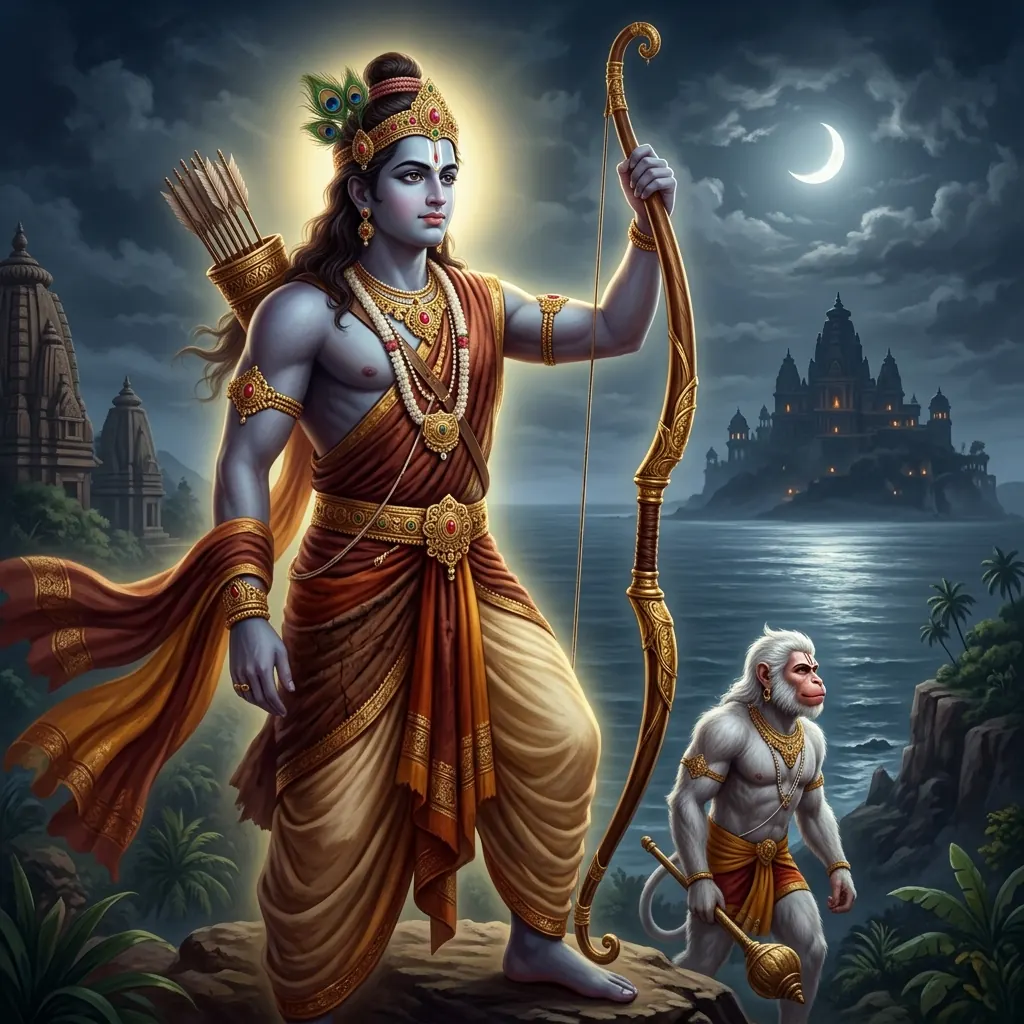
So the young prince came out to the frontier, and he came out armed. He stood in front of the ascetic with his weapons ready, which is how a kshatriya of Ikshvaku's line receives a guest who has arrived carrying a bow.
Rama of Bhrigu's line looked at him and smiled, and made his greeting a challenge.
"King, exalted one, string this bow if you can, with all your might, this bow that in my hands became the instrument for destroying the kshatriya race."
Every word of that was chosen. He was not asking whether the boy was strong. He was telling him, in the boy's own country, on the road his father had sent him down, what the object in his hands had been used for, and inviting him to try to lift it.
Dasaratha's son answered him without raising his voice.
"O illustrious one, you should not insult me like this. Nor am I, among the twice-born classes, lacking in the virtues of the kshatriya order. The descendants of Ikshvaku above all never boast of the strength of their arms."
It is a careful reply and it says three things at once. That the older man has been rude. That the younger is not lacking in what a kshatriya is supposed to have. And that his house does not talk about its strength, which is a courteous way of saying that he is not going to be goaded into a demonstration by being told he cannot manage one.
Rama of Bhrigu's line was not interested in courtesy.
"Enough of all this clever talk, king. Take this bow."
And the boy who had just finished explaining that his family never boasts took the bow, and he took it in anger.
The Twang That Frightened Everything Alive
The bow that had dealt death to the greatest of the kshatriyas passed from the hands of the man who had used it into the hands of the man it had been brought to humble.
And the mighty hero, smiling, strung it without the least exertion.
That is the whole of the event, and its brevity is the point of it. There is no struggle described. No bracing of the foot, no straining, no moment in which the outcome is in doubt. He was handed the thing, he bent it, he set the string in the notch, and it was done, and he was smiling while he did it, which was the smile his guest had been wearing a moment before and had now lost.
The string, when it went home, made a noise like the rattle of thunder, and at that sound every creature alive was affrighted.
Understand what had just been established in front of Dasaratha's frontier guard. Not that the prince was stronger than the ascetic. Something worse for the ascetic than that. The bow which had been the instrument of an entire massacre, the object on which Rama of Bhrigu's line had built his standing in the three worlds, had turned out in another man's hands to be an ordinary bow, strung the way any bow is strung, by somebody who did not have to try.
Then Dasaratha's son spoke, and he was scrupulously polite, and the politeness was the cruellest part of it.
"There, I have strung this bow. What else, O brahmana, can I do for you?"
O brahmana. Not O illustrious one, as before. He had named the order his visitor belonged to, and by naming it had named the order he did not belong to, and had put the question of who was serving whom back on the table with the string still humming.
A man in his position had two ways out. He could laugh, take back the bow, and go home a little smaller.
Or he could raise the stake.
See Me Now in My True Form
Rama, the son of Jamadagni, gave the illustrious son of Dasaratha a celestial arrow.
"Set this on the bowstring," he said, "and draw it to your ear, hero."
A strung bow is a trick of strength. A shaft drawn to the ear is a shot, and a celestial shaft drawn to the ear is a shot that has to land somewhere, and there was nobody standing in front of the prince except the man who had handed it to him. That was the second test and it was not a test any more. It was a demand that the boy either refuse or commit himself.
And at that, Dasaratha's son blazed up in wrath.
"I have heard what you said, and I have even pardoned you. Son of Bhrigu's race, you are full of vanity. Through the Grandsire's grace you have gained energy greater than that of the kshatriyas. And that is why you insult me."
There is the diagnosis, made by the one person present who was in a position to make it. The energy had been a gift. It had been given by Brahma, and it had been given to a brahmana, and it had made him greater than the order he then spent his life destroying, and somewhere in the long work of that destruction the gift had turned into vanity and the vanity had walked him all the way to Ayodhya to pick a quarrel with a child.
"See me now in my true form. I give you sight."
And Rama of Bhrigu's race, who had come to look at the prowess of Dasaratha's son, was given something to look at.
He saw in that body the Adityas with the Vasus, the Rudras, the Sadhyas with the Maruts. The Pitris and Hutasana. The constellations of stars and the planets. The gandharvas, the rakshasas, the yakshas. The rivers and the tirthas, and those eternal rishis, one with Brahma, who are called the Valakhilyas, and the celestial rishis. The seas and the mountains. The Vedas with the Upanishads and the Vashats and the sacrifices. The Samans in their living form. The whole science of weapons, which was the thing he had come to measure. And the clouds, with their rain and their lightning.
There was no part of the world left over to stand outside and judge the contest from.
The Shaft That Came Back
Then the illustrious Vishnu shot that shaft.
The earth filled with sounds of thunder. Burning meteors began to flash through the sky. Showers of dust and rain fell on the surface of the earth. Whirlwinds and frightful sounds convulsed everything that could be convulsed, and the earth herself began to quake, and all of this was the ordinary consequence of one arrow leaving one string in the hands of a man who had been born in Ayodhya a little while before.
The shaft did not kill anybody. It went out, and it confounded by its energy the other Rama, and it came back blazing into the hands that had loosed it.
That is the whole of the punishment. He was not struck. He was not cursed. Nothing was cut off him and nothing was broken. The arrow simply went through the space where his greatness had been standing and took it away, and returned to its owner, who had never had any use for it in the first place.
Bhargava had been deprived of his senses. He came back to consciousness and to life lying where he had fallen, and the first thing he did on regaining either was to bow to Rama, that manifestation of Vishnu's power. There was no argument left in him. He had spent his adult life proving one proposition about the world and had just been shown, in a single afternoon, on a road he had chosen himself, that the proposition was not true.
And Vishnu commanded him, and he went where he was sent: to the mountains of Mahendra, far off, where the hills come down to the sea.
That great ascetic began to dwell there. Lomasa does not say that he lived there in retirement, or in meditation, or in penance, which are the words a story usually reaches for at this point. He says that he dwelt there in terror and shame.
He had killed the kshatriyas of the world and had felt neither of those things. It took a boy with a strung bow and a courteous question to teach him both.
What the Pitris Said After a Year
A year went by on Mahendra.
Then the Pitris came to him, the fathers of his line, the dead of Bhrigu's house who had been watching him from wherever such watching is done, and they found him deprived of energy, his pride quelled, and himself sunk in affliction. And they did not comfort him. The first thing they said to him was that he had been in the wrong.
"Son, when you approached Vishnu, your behaviour towards him was not proper. He deserves worship and respect for ever in the three worlds."
That is a hard sentence to receive after a year of sitting on a mountain in shame, and it is the only diagnosis in the story that comes from his own people. The loss of his energy had not been an accident of a contest that went badly. It had followed from the way he had spoken on a road outside Ayodhya to somebody he should have honoured, and until that was said plainly to his face there was nothing to be done about it.
Then they told him what to do, and the remedy was water.
"Go, son, to the sacred river called Vadhusara. Bathe in all the tirthas of that stream, and you will regain your energy. In that river is the tirtha called Diptoda, where your grandsire Bhrigu, in the celestial age, practised ascetic penances of great merit."
Not a weapon to recover it with. Not an enemy to take it back from. A river his own grandfather had stood in, and the instruction to go and stand in it too.
So Rama did what the Pitris told him. He came down off the mountain and went to the fords of that stream, and bathed in them, and at that tirtha he obtained back the energy he had lost.
"That," said Lomasa, standing on the bank of the Bhagirathi with the exiled king in the water in front of him, "is what happened long ago to Rama of spotless deeds, after he had met Vishnu in the form of Dasaratha's son."
And Yudhishthira, who had lost a kingdom rather than a bow, went on bathing in the ford of Bhrigu.
Dharma Lesson
Parashurama's energy was a gift from the Grandsire, not a wage he had earned, and by the time he carried it to Ayodhya he had forgotten the difference. What the arrow took from him was not his strength but the belief that his strength was an argument. Notice that nobody strikes him, curses him or refuses him afterwards; he is simply shown the whole world inside another man and left to sit with it for a year. And notice the cure the Pitris prescribe: not a rematch, but the truth said to his face and a river his grandfather had stood in.