Twenty-Three Days on the Saraswati
Bhishma fights his own teacher and neither man can win
In short
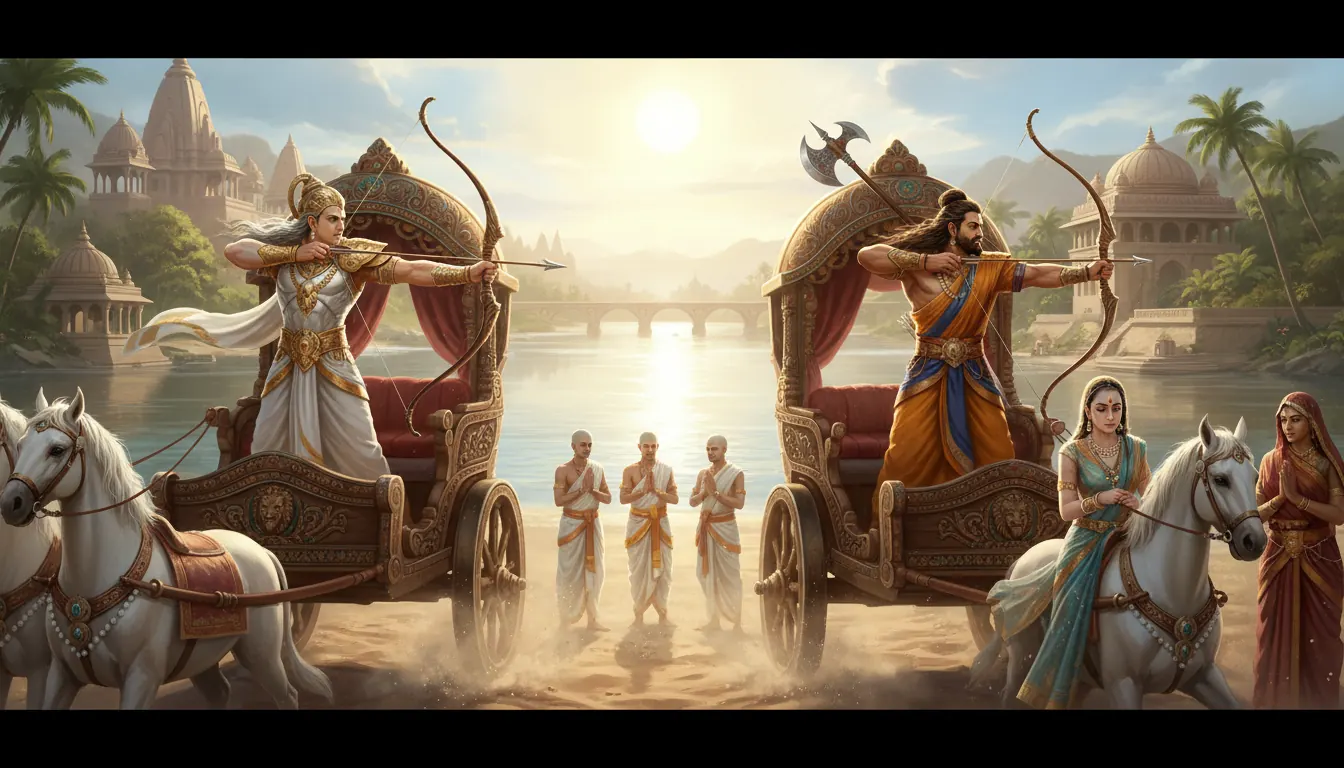
Pressed by Amba, Parashurama summons Bhishma to the Saraswati and orders him to take her back or fight. Bhishma refuses both, and teacher and pupil fight for twenty-three days, with eight shining brahmanas lifting Bhishma off the ground and Ganga herself driving his horses. On the last night the eight give him the Praswapa weapon in a dream, and the gods forbid him to use it.
Told in the Udyoga ParvaSet in Kurukshetra, Saraswati and Hastinapura21 min read
The Old Man Explains Himself
Duryodhana had asked why the commander of his armies would not lift a weapon against the son of Drupada, and Bhishma, who was very old and had been asked worse questions, answered it properly, which meant beginning a long way back.
"There was a girl," he said, "the eldest of the three I carried off from the self-choice at Kashi. Amba. She told me, as the wedding drew near, that she had chosen Shalva in her heart, and I let her go, and Shalva would not have her because I had carried her off. She could not go home, and she went into the forest to undertake penances instead.
"A royal sage came into that hermitage while the ascetics were still debating what to do with her: Hotravahana of the Srinjayas, who heard her out and began to tremble, because he was her mother's father. He took her onto his lap like a child and told her to go to Rama, the son of Jamadagni, on Mahendra. Name me to him, he said, and he will slay Bhishma in battle if Bhishma does not obey him. And while the old man was still speaking, Akritavrana walked in, who was Rama's dearest friend, and told them Rama would come in the morning."
He came, and heard the whole of it, and was not eager.
"Daughter of Kashi," Rama said, "I take up arms now for no one except those who know the Vedas. Bhishma obeys me in everything. Say the word and he will put your feet on his head at my command."
"Slay him," Amba said. "You have promised, and you ought to make your promise true."
It was Akritavrana who closed the trap, gently, the way a friend reminds a friend of what he has not forgotten. "It is not right for you to desert a girl who has come to you for protection. And consider the vow you made before the brahmanas after you had conquered all the kshatriyas: that you would never abandon those who came to you in fright, and that you would slay any proud warrior who had vanquished in battle all the assembled kshatriyas of the earth. Bhishma has done exactly that."
Rama sat a while with his own words being handed back to him. "If he is too proud of his battles to obey me," he said, "I will slay him. You have all seen what my arrows do. They do not stick in a body. They pass through it."
In the morning they brought the girl to Kurukshetra and camped on the Saraswati.
Take Her Back
"On the third day," Bhishma said, "he sent me a message. It said: I have come here, do what pleases me.
"I went out to him with a joyful heart, because he was my master and an ocean of energy, and I took a cow at the head of my train and brahmanas behind me. He accepted the worship I offered, and then he said this.
"Bhishma, what were you thinking when you carried off the daughter of the king of Kashi at her self-choice, when you yourself had no desire for her, and then sent her away afterwards? You have cut this famous lady off from virtue. Who can marry her now? Shalva has rejected her because you carried her off. Take her yourself at my command, and let a king's daughter take up the duties of a wife. This humiliation should not be hers.
"I told him I could not give her to my brother; that she herself had said to me, I am Shalva's; and that it was my firm vow never to abandon kshatriya practice out of fear or pity or greed or lust.
"His eyes rolled with anger and he said, If you do not do as I say I will slay you this very day along with all your counsellors. He said it more than once. I pleaded with him in sweet words and he did not cool. I bowed my head to the ground and asked him plainly why he sought battle with me, and reminded him that while I was a child it was he who instructed me in the four kinds of arms, so that I was his disciple.
"And he answered, with his eyes still red: You know I am your teacher, and yet you will not accept this daughter of the ruler of Kashi to please me. Nothing will satisfy me unless you do it. Take the girl and preserve your line. Since you carried her off, she can find no husband."
The Sloka of Marutta
"Then I said the thing that made the war," Bhishma told him.
"I said: This cannot be, twice-born rishi. All your labour is wasted. As for the girl, I refused her before, and who would let into his house a woman whose heart belongs to another, and who is for that reason like a snake of deadly poison? Not from fear of Vasava himself would I forsake my duty. Be gracious to me, or do at once whatever you think proper.
"And I said: This verse also is heard in the Puranas, sung by the high-souled Marutta. The ordinance allows a man to renounce his teacher when that teacher is filled with vanity, has no knowledge of right and wrong, and is walking a crooked path.
"You are my teacher, and for that reason I have revered you out of love. But you do not know the duty of a teacher, and for that reason I will fight you. I would not slay any teacher in battle, least of all a brahmana rich in ascetic merit; that is why I forgave you. But it can be gathered from the scriptures that a man is not guilty of slaying a brahmana if he kills in battle a man of that order who has taken up weapons like a kshatriya and fights in wrath without trying to flee. I am a kshatriya stationed in kshatriya duty. Come to Kurukshetra, where in days gone by you propitiated your fathers with the blood of kshatriyas, and I will slay you there and propitiate the kshatriyas you slew.
"And I said one thing more, which I am not proud of. For many long years you have boasted that you single-handed vanquished all the kshatriyas of the earth. In those days no Bhishma had been born, nor any kshatriya like Bhishma. You have consumed heaps of straw. The man who will quell that pride is standing in front of you.
"And Rama laughed and said, By good luck you want to fight me. Come to Kurukshetra, and let your mother Jahnavi see you lying dead on that plain and eaten by crows."
All in White, and His Mother in the Way
"I went back into the city and told Satyavati everything, and she had the propitiatory rites performed and blessed me.
"Then I dressed for it. A chariot of silver, roomy, covered on all sides with tiger skin, stocked with weapons, white horses yoked to it, and a charioteer who was well born and brave and had seen many encounters. My mail was white. My bow was white. The umbrella over my head was white, and the fans, and my clothes, and my head-dress, and in that colour I went out of the city named after the elephant to the field of Kurukshetra.
"When I came in sight of him I took up my conch and blew a long blast. Brahmanas and forest ascetics had come to watch, and the gods with Indra at their head were stationed above the field, and there were celestial garlands in the air, and music, and canopies of cloud.
"And at that moment my mother appeared before me in her own form.
"What is this you mean to do? she said. I will go to Jamadagni's son and beg him: do not fight Bhishma, who is your disciple. You are a kshatriya: do not stubbornly set your heart on a fight with a brahmana. Rama is equal in prowess to Mahadeva, and he is the exterminator of your whole order. You do not know what you are asking for.
"I saluted her and told her the whole history of the self-choice, and how I had urged Rama to desist. Then she went, that great river, and stood before the son of Bhrigu and begged him for my sake.
"Go and make Bhishma stop, Rama told her. He will not do what I wish. That is why I have challenged him.
"So she came back to me, and I would not do what she asked either. My eyes rolled with anger and I refused my own mother, and while she was still standing there Rama appeared in my sight and challenged me to the encounter."
The Earth Is My Chariot
"I called out to him, smiling: Standing in my chariot, I do not wish to fight a man who is on the ground. Mount a chariot, hero, and put on your mail, if you wish to fight me.
"And he answered me, smiling: The Earth is my chariot, Bhishma. The Vedas are the good horses that carry me. The wind is my charioteer. My coat of mail is those mothers in the Vedas, Gayatri and Savitri and Saraswati. Well covered by these in battle, I will fight.
"Then he covered me on every side with a thick shower of arrows, and while they were still falling I saw that he was standing in a chariot after all, created by an act of his will, beautiful as a town, decked with gold, bearing the device of the sun and the moon. Akritavrana, who knew the Vedas and was his dearest friend, was holding the reins. And he kept summoning me, Come, come, and it gladdened his heart.
"He poured three showers of arrows on me and curbed my horses. Then I put my bow aside and came down and walked to him on foot and worshipped him, and said: Rama, whether you are my equal or my superior, I will fight you, my virtuous teacher. Bless me and wish me victory.
"And he said: A man who wants prosperity should act exactly like this. This is the duty of those who fight warriors greater than themselves. I would have cursed you if you had not come to me like this. Go, fight carefully. I cannot wish you victory, because I myself stand here to defeat you. Go and fight fairly. I am pleased with your behaviour.
"I bowed and went back and blew my gold-decked conch again, and the combat began, and it lasted many days."
Shame on Battle, Shame on Kshatriya Ways
"He struck first, with nine hundred and sixty straight arrows winged with vulture feathers, and covered my four horses and my driver with them. I sat still in my mail and said to him: You have shown little regard for me, and I have fully honoured you as my teacher. The Vedas that are in your body, the status of brahmana that is in you, the ascetic merit you earned by the severest austerities: I do not strike at these. I strike at the kshatriyahood you have adopted. When a brahmana takes up weapons he becomes a kshatriya. Watch me cut your bow.
"And I cut one horn off his bow with a broad-headed shaft and dropped it on the ground, and put a hundred arrows through his body, and they came out the other side and went on through the air as though they were vomiting blood; and Rama stood covered in it and shone like Sumeru with streams of liquid metal running down its breast, or like a kinsuka tree in flower.
"He took up another bow and answered with golden-winged arrows that pierced my vitals and set me trembling. I gathered myself and put a hundred blazing shafts into him, and he lost his senses where he stood.
"And then I stopped. I was filled with pity at the sight and I stopped of my own accord and said aloud, in front of both camps: Shame on battle. Shame on kshatriya ways. Great is the sin I have committed by following them, for I have wounded with arrows my teacher, a brahmana with a virtuous soul.
"I did not strike Jamadagni's son again that day. The sun went to his chambers in the west and the fighting ended, and in the evening my charioteer drew the arrows out of my body, and out of the horses, and out of himself."
The Eight Who Held Him Up
"So it went on. Each morning the horses were bathed and watered, and each morning I got down from the chariot and saluted him before I fought him.
"We spent the celestial weapons on one another like men spending coin. I sent the Vayavya and he neutralised it with the Guhyaka. I applied the Agneya with its mantras and he put it out with the Varuna. He wheeled suddenly to my right one day and pierced me in the breast, and I swooned, and my driver carried me off the field, and I heard Akritavrana and the ascetics and that girl shouting for joy behind me. Another day I sent an arrow with Death sitting at the head of it, and he dropped, and the whole universe cried out as though the sun had fallen from the sky; and the ascetics knelt around him and comforted him with hands made cold by water, and he got up and fitted an arrow and said in a shaking voice, Stay, Bhishma. You are already slain.
"He threw a lance at me like a meteor with a flaming mouth, and I cut it into three pieces, and breezes charged with fragrance began to blow around me. Then he threw twelve more, blazing like the twelve suns that rise at the end of the universe, and I was afraid, and I burned them with twelve shafts. There were hours when the arrows we shot filled the sky and stayed there without falling, so that the sun could not get its rays through, and the friction of them lit a fire in the air, and they were consumed by the fire they had made and came down on us as ashes.
"On one of those days my beloved charioteer took the arrows meant for me. He swerved in his place, and a total unconsciousness came over him, and he fell on the earth and gave up his life; and while I was still lamenting for him, Rama drove a blood-drinking shaft through my breast and I fell out of the chariot with it.
"Rama roared like a raincloud, thinking me dead. And while I lay there I saw eight brahmanas standing round me, shining like the sun or like fire, holding me up on their arms so that I did not touch the ground, sprinkling me with drops of water and saying over and over, Do not fear. Let prosperity be yours.
"I rose, and my mother Ganga was standing in my chariot with the reins of my horses in her hands. I worshipped her feet and the spirits of my ancestors, and with joined hands entreated her to go, and she went, and I drove myself."
The Weapon Given in a Dream
"That evening I felled him again, and he embraced the earth on his knees with his bow loosened out of his hand, and the sky answered it. Clouds covered the sky and poured down a shower of blood. Meteors fell by hundreds. Rahu swallowed the sun at midday, the earth shook, vultures came down in joy, and drums that no hand touched sounded harshly. Then he rose again, out of his senses with anger, and took up his bow, and I resisted him, and the rishis watching us were filled with pity.
"So it went, sunrise to sunset, and it lasted twenty-three days.
"On the twenty-third night I bowed to the brahmanas and the rishis and the gods and to all the creatures that wander in the dark, and lay down alone and thought: this combat has lasted many days and I cannot vanquish him. If I am in fact able to vanquish this brahmana of mighty strength, let the gods kindly show themselves to me this night.
"And mangled with arrows as I was, lying on my right side toward morning, I saw them. Those same eight, who had held me off the ground and told me not to fear. They stood surrounding the bed and said:
"Rise, son of Ganga. You need have no fear. We will protect you, for you are our own body. Rama will never be able to defeat you in battle; you will conquer Rama in combat. There is a beloved weapon called Praswapa, belonging to the lord of all creatures and forged by the divine artificer, and it will come back to your knowledge, for it was known to you in a former life. Neither Rama nor anyone on earth knows it. Remember it and use it with strength; it will come to you of itself. It will not kill him outright, so you will incur no sin. Struck by its force he will fall asleep, and having vanquished him you will wake him again with that dear weapon called Samvodhana. Asleep or dead, we reckon it the same. Rama will surely not die.
"And they vanished, all eight of them, alike in form."
The Weapon Withdrawn
"I woke filled with joy, and that day's fighting was the worst of the twenty-three. He put a dart into my shoulder like Indra's thunderbolt, and my blood ran down like streams of red earth off a mountain after rain. I put a shaft into his forehead and he stood there beautiful as a crested hill. He invoked the Brahma weapon and I invoked the same, and the two met in mid-air without reaching either of us and blazed there as things blaze at the end of the age, and the earth began to tremble.
"This is the time, I thought. And the mantras for the Praswapa came into my mind of themselves.
"Then a tumult of voices came out of the sky saying, Son of Kuru's race, do not let off the Praswapa weapon. I aimed it anyway. And Narada stood in front of me and said: The gods are stationed above you and they are forbidding you today. Rama is an ascetic rich in Brahma merit, and he is your teacher. Never humiliate him. And while he was speaking I saw those eight again in the air, smiling, saying slowly: Do just what Narada says. That is greatly for the good of the world.
"So I withdrew it, and invoked the Brahma weapon instead, according to the ordinance. And when Rama saw the Praswapa withdrawn he was deeply offended, and cried out suddenly, Wretch that I am, I am vanquished, Bhishma.
"And there in front of him stood his father Jamadagni and his father's fathers, and they said: Never display such rashness again. To fight is the duty of a kshatriya; study and vows are the wealth of brahmanas. Let this battle be your very last. Throw your bow aside and practise austerities. Bhishma is one of the foremost of the Vasus, and it is fortunate that you are still alive. Arjuna the son of Indra has been ordained by the Self-create to be his slayer, and not you.
"And Rama answered his own ancestors: I cannot give up the combat. That is the solemn vow I made. I have never before left a field. Make Ganga's son stop, if you please. I cannot.
"Then they came to me, the ascetics with Richika at their head and Narada in their company, and said, Stop. Honour that greatest of brahmanas. And I said, for the sake of kshatriya morality: this is the vow I have taken, that I would never leave a battle by turning my back, nor let my back be wounded with arrows. Neither temptation nor distress nor fear can make me abandon my eternal duty.
"So they stood in the field between us, the rishis and Narada and my mother Bhagirathi, and I stayed where I was with my bow. And they turned back to him and said, The hearts of brahmanas are made of butter. Be pacified. Bhishma cannot be slain by you, as you cannot be slain by him. And obstructing the field, the Pitris made him lay his weapons aside."
What Rama Told the Girl
"Then the eight said to me once more, out of the sky: Go to Rama, who is your teacher. Do what is good for all the worlds. Seeing that he had stopped at the word of his well-wishers, I accepted the word of mine, and mangled as I was I went to him and worshipped him.
"He smiled at me with great affection and said, There is no kshatriya equal to you on the earth. Go now, Bhishma. In this combat you have pleased me highly.
"Then he summoned the girl in front of everyone, and said this to her, sorrowfully.
"Young lady, in full sight of all these people I have fought to the best of my power. Even with the very best of weapons I have not been able to gain any advantage over Bhishma. Go wherever you wish. What else can I do for you? Seek the protection of Bhishma himself. You have no other refuge now. Shooting mighty weapons, Bhishma has vanquished me.
"He sighed and was silent.
"And she said, It is just as your holy self says. Not even the gods can defeat this Bhishma in battle. You have shown energy that cannot be checked, and weapons of every kind, and you have gained nothing by it. I will not go a second time to Bhishma. I will go where I may obtain the means to slay him in battle myself."
Bhishma stopped there for a while.
"She went out with her eyes agitated by wrath," he said to Duryodhana, "and Rama went back to his mountain, and I rode home and told Satyavati everything, and she blessed me. Then I set intelligent men to follow that girl and bring me word of her, and for years they brought it, and every day I lost a little more of my peace of heart. Narada and Vyasa both told me the same thing: do not give way to sorrow on account of the daughter of Kashi. Who would dare to defeat destiny by his own effort?
"That is where the reason begins why I will not lift my bow against Drupada's son. I fought that girl's quarrel once already, for twenty-three days, against my own teacher, and even he could not settle it."
Dharma Lesson
A vow honestly kept can put two good men on opposite sides of a field, and the only victory left is the one that refuses to be pressed to the killing stroke. Bhishma has the weapon that would end it and puts it down when the gods and his teacher's ancestors ask him to. Rama, who has never left a field, is made to lay his bow aside by his own fathers.