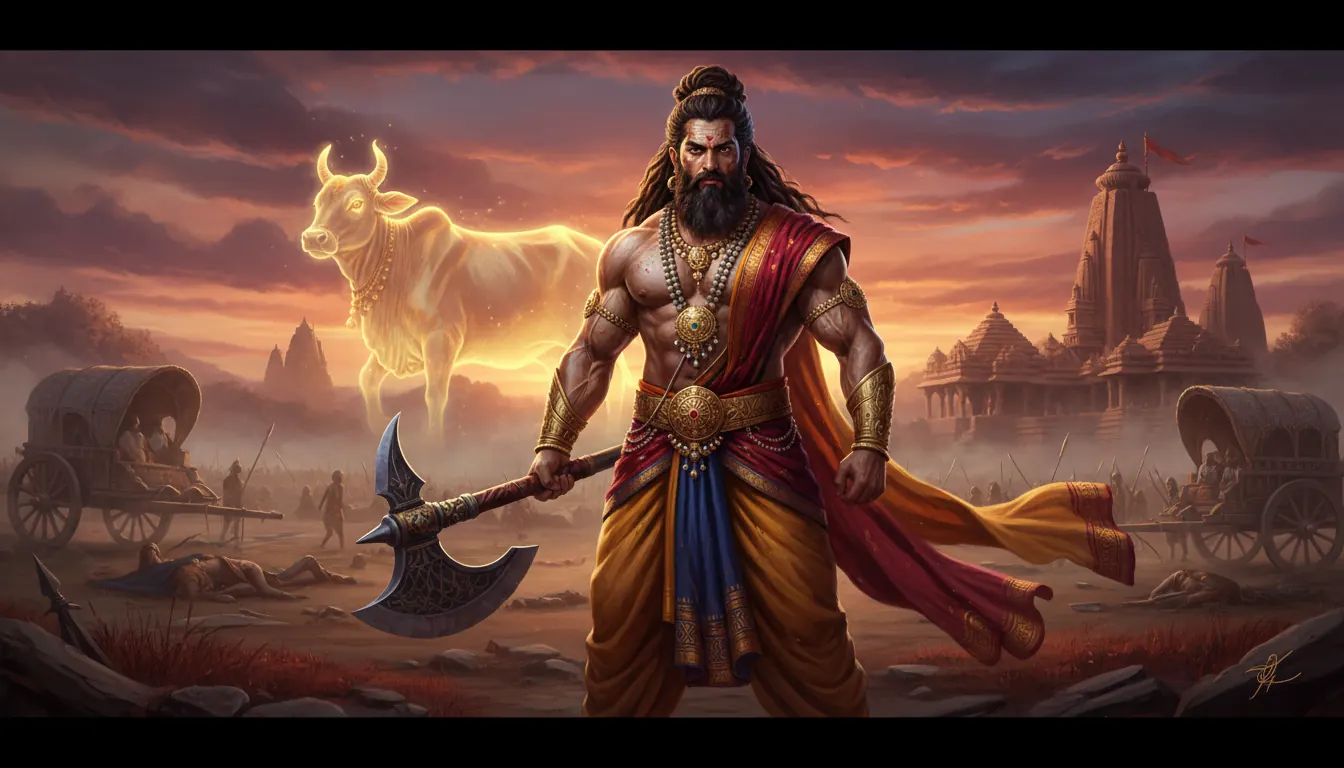
The Five Lakes of Blood
Parashurama's oblation to the fathers at Samantapanchaka
In short
Narada tells the exiled Yudhishthira how Pulastya once described the fords of the earth to Bhishma, and how that road comes at last to Kurukshetra. At its gate stand the five lakes that Parashurama dug after clearing the earth of kshatriyas, filled with the blood of the slain, and used to make an offering to his own fathers. The Pitris are gratified, appear in the sky above him, and offer him any boon he chooses. He asks for his taste for austerity back, for release from the sin of his wrath, and for the lakes themselves to become fords where other men may be made clean.
Told in the Vana ParvaSet in Syamantapanchaka, Kurukshetra and Saraswati19 min read
The Road That Priced Everything
Narada came to the Kamyaka forest in the years of the exile, and Yudhishthira, who had lost a kingdom at dice and had nothing left to spend but time, asked him the question a poor man asks.
Sacrifices, the king knew, are for the wealthy. They need many materials and all kinds of things in great quantity, and a man without cattle or gold or grain cannot perform them at all. Was there anything a man might do instead, alone, without allies, without wife or children, without means, that bore the same fruit?
There was, and Narada did not answer out of his own mouth. He answered by repeating a conversation that had taken place long before, when the Kuru house was young and Bhishma sat in a hermitage asking after the fords, and the sage Pulastya, one of the mind-born sons of Brahma, appeared before him and offered him whatever he cared to ask for.
Bhishma asked about tirthas.
A tirtha is a crossing place. The word means the shallow in a river where a man can get across, and it came to mean any spot where the distance between this world and the other is thin enough to be walked. Pulastya's answer was a road. He named the fords of the whole earth in the order a pilgrim walks them, beginning at Pushkara, which is the tirtha of the God of gods and equal to that deity himself, and going down the Narmada and along the southern ocean and up again by the Sindhu and the Vitasta, and at every stop he priced the merit exactly, in horse sacrifices and in gifts of cows, the way a merchant prices grain.
Yudhishthira listened. Somewhere far along that road, after many hundred fords, it turned inland and came to a flat country lying between two rivers.
"Next, king," Pulastya said, "one should go on to revered Kurukshetra, the very sight of which frees all creatures from their sins."
The Dust of That Country
Everything Pulastya said about that country he said twice, once here and once again at the very end of the road, and it comes out the same both times, which is how this part of the epic marks a thing it does not want misremembered.
Whoever says again and again, "I will live in Kurukshetra," is freed from all his sins. Not the man who lives there. The man who says it. The very dust of Kurukshetra, carried by the wind, leads a sinful man to a blessed fate hereafter, so that a traveller on some road far off, with the wind in his face, is being worked upon without knowing it. Those who live in Kurukshetra, which lies south of the Saraswati and north of the Drishadvati, are said to live in heaven.
That is the boundary, and it is worth holding on to, because everything that follows happens inside it. Two rivers, one above and one below, and the country between them.
A man should stay there a month, Pulastya said. The gods with Brahma at their head go there, and the rishis, the siddhas, the charanas, the gandharvas, the apsaras, the yakshas and the nagas, all of them coming again and again to the most sacred Brahmakshetra, the field of Brahma. Whoever longs to go to Kurukshetra, even in his mind, has all his sins destroyed, and in the end he goes to the world of Brahma. A man who goes there in a devout frame of mind wins the fruit of the Rajasuya and of the horse sacrifice together, which are the two most expensive rites a king can buy, and he wins them by walking.
Bhishma was hearing this a long time before the war. He would be an old man lying on a bed of arrows in that same country before anybody had reason to call it anything except holy.
The road went in at the gate.
The Gate a Brahmana Dug
The fords of Kurukshetra come in a crowd, and Pulastya went through them the way a man counts beads.
First one salutes the yaksha called Mankanaka, the mighty gatekeeper of Kubera, and earns the fruit of giving away a thousand cows. Then the excellent region of Vishnu, where Hari is always present, and a bath there is a horse sacrifice and a passage to the world of Vishnu. Then Pariplava, famous throughout the three worlds. Then Prithivi. Then Shalukini, where a bath in the Dasaswamedha is worth ten horse sacrifices. Then Sarpadevi, that excellent tirtha of the nagas, which carries a man to the world of the nagas. Then Tarantuka the gatekeeper, where staying one night is worth a thousand cows.
Then Panchananda, and the tirtha there called Koti. Then the tirtha of the twin Ashvins, where a man wins personal beauty, which is the only reward on the whole road that nobody would think to ask for out loud. Then Varaha, where Vishnu once stood in the form of a boar. Then Sama in Jayanti, and Ekahansa, and Kritasaucha, where the pilgrim wins the lotus-eyed god and perfect purity of soul. Then Munjavata, sacred to the illustrious Sthanu, where a man who goes a single night without food wins the rank called Ganapatya.
And there, Pulastya said, is the famous tirtha called Yakshini, where a man has all his desires fulfilled.
Then he stopped counting and said two things about it.
That tirtha is held to be the gate of Kurukshetra, and the pilgrim should walk round it with his mind fixed on it.
And: it is the equal of the Pushkaras, and it was made by the great-souled Rama, the son of Jamadagni.
Pushkara was the first ford on the road and the greatest of them, the one that is equal to the deity himself. Here at the entrance to the holiest field on earth stood its equal, and it had not been made by a god or found by a rishi or opened by a river. It had been dug by a brahmana who is remembered for an axe.
Rama of the Bhrigu Race
Who he was can be said in a few lines, and Pulastya did not spend even that many, because Bhishma knew.
Rama was the son of Jamadagni and a descendant of Bhrigu, born into the race of brahmanas whose whole business is the fire and the recitation, and he carried an axe. When the thousand-armed king Kartavirya wronged that hermitage and the sage was killed in it, Rama answered, and the answer did not stop with the man who had done it. He cleared the earth of kshatriyas twenty-one times. That is a story, and it is told elsewhere, and it is not this one.
This one begins where that one leaves off. On the ground, with the work finished and the field full.
The pilgrim, said Pulastya, should next go, with his mind fixed, to the Rama-hrada. The lakes of Rama.
There is a habit in this part of the epic that repays attention. A tirtha is almost never simply a place. It is a place where something happened once that was extreme enough to leave the ground permanently altered, and a pilgrim who bathes there is stepping into the residue of an event. Varaha, a few fords back, is where Vishnu stood in the shape of a boar. Manusha, further on, is where a herd of black antelopes wounded by a hunter's arrows plunged into the water and came out of it human beings. Vyasasthali is where Vyasa, burning with grief for his son, resolved to cast off his body and was talked out of it by the gods.
So a pilgrim arriving at the Rama-hrada with his diet regulated and his senses subdued, standing at the gate of the most sacred field in the three worlds, has to be told what happened there. Pulastya told him in one sentence, before he explained anything at all.
"There, king, the heroic Rama, blazing with energy, wiped out the kshatriyas by his might and dug five lakes."
And Filled Them
Five. Not one, and not a hundred. Five pits opened in the flat ground between the two rivers, and he filled them, tiger among men, with the blood of his victims.
Pulastya put three words at the end of that sentence which are easy to walk past. As heard by us.
The epic uses that formula sparingly. It is what a narrator says when he is handing on something he did not see and will not vouch for beyond the fact that this is what the tradition holds, and it is Pulastya who says it here, a son of Brahma who had told Bhishma at the start of the whole discourse that his eyes could penetrate into everything. He is not softening the account. He is marking it. Whatever else the five lakes are, they are the one item on a road of many hundred fords that arrives with a note attached to it.
Consider what is being described, because the road has been pricing every stop in cattle and horse sacrifices, and it is about to price this one.
A man of the priestly order, whose caste may not take life and whose entire inheritance is the fire and the word, had destroyed the warrior order of the whole earth twenty-one times over, out of grief first and then out of the momentum of it, and when he was finished he did not wash. He dug. He made five reservoirs in the field of Brahma and filled them to the lip with what he had spilled, and there was enough to fill them.
That is what the pilgrim is standing in front of when he comes to the gate of Kurukshetra with his senses subdued and his vows in order. Not a battlefield. Water that is not water, standing still in five pits, in a country where the dust itself carries men to heaven.
And then Rama did the thing that made it a tirtha instead of a monument.
The Oblation
When he had filled those lakes with kshatriya blood, Rama offered blood to his fathers and grandfathers.
There is a rite that everyone in this epic performs, and that Yudhishthira, sitting in the forest listening to Narada, had been told to perform at nearly every ford on the road. You go down into the water. You take it up in your cupped hands and let it fall, and you name your father and your grandfather and his father before him, and the water goes to them. It is the smallest and most ordinary act in the whole literature. A boy can do it. It costs nothing. The entire road Pulastya was describing is built out of it, ford after ford: bathe here, and worship the Pitris and the gods, and earn the merit of giving away a thousand cows.
The Pitris are the fathers. Not the ancestors as a family sentiment, but an order of beings, stationed in the sky, who are fed by their descendants and have no other food.
Rama stood in his own lakes and performed the ordinary rite with the wrong liquid.
He lifted it in his hands and let it fall for Jamadagni, who had been cut down in his own hermitage, and for Jamadagni's father, and for his father, back along the line of Bhrigu, and what ran out between his fingers was the blood of everyone who could be held responsible for that death and of a great many who could not.
By any reckoning it should be the most monstrous act on the road. A man drowning his own fathers in the consequences of his rage and calling it devotion.
The Pitris were pleased.
The Fathers in the Sky
Pleased with the offerings, those rishis then spoke to Rama.
Pulastya calls them rishis at that moment, and the word is worth catching, because it says what the fathers of that house were. Not merely dead men. The seers of the Bhrigu race, and their descendant was standing in a lake of blood in the field of Brahma, and they came and stood in the sky over him and spoke to him like relatives who are pleased.
"Rama, Rama, most fortunate one, we are pleased with you, child of Bhrigu's line, for your devotion to the Pitris and for your prowess, exalted one. Blessings on you. Ask for whatever boon you choose. What is it you want, glorious one?"
Read it for what it praises. Two things, and they are named in one breath. Your devotion to the Pitris, which is the rite he had just performed. And your prowess, which is what had supplied the material for it. They did not separate the two, and nobody standing in the sky above those lakes told him that he had done anything wrong.
That is the difficulty the passage leaves standing, and the epic does not reach in to remove it. The fathers of a brahmana house were satisfied by an offering of blood, and were pleased enough to pay for it, and they used the same tone for the killing that they used for the piety.
Everything now depends on what a man asks for when he is standing in the middle of what he has done and is told that he may have whatever he likes.
Rama joined his hands. He was speaking upward, to figures stationed in the sky above that flat country, with the five lakes at his feet and every reward in the three worlds available to him for the asking.
The Three Things He Asked
"If you are pleased with me," he said, "if I have earned your favour, this is the favour I ask of the Pitris."
Then three things, in order.
"Let me take pleasure in austerities once again."
He did not ask to be able to perform them. A man of his line could always perform them. He asked for the pleasure of them to come back. Somewhere in the long course of his wrath the taste had gone out of the one occupation that was properly his, and he had noticed it, and that is the first thing he wanted returned. It is the request of a man who has counted privately what his anger cost him, before anyone has told him what it cost anybody else.
"And through your power, let me be freed from the sin I committed when, in my anger, I wiped out the kshatriya race."
That is the second, and it is a confession. He names the act. He names the motive, and the motive he names is not justice or duty but anger. He calls the whole of it a sin, and he says so in front of the fathers who had praised him for the same act two sentences earlier. Their approval did not persuade him. He knew the correct name for what he had done, and used it, with the blood still standing in the pits behind him.
"And let my lakes become tirthas famous throughout the world."
That is the third, and it is the strangest of them, and it is the reason a pilgrim was standing at that water listening to the story generations afterward.
He did not ask for the lakes to be drained, or filled in, or covered over, or forgotten. He asked for them to be kept, and named, and visited. He asked that the worst thing he had ever made should become a place where other people could go to be made clean.
Nothing in the three was for himself except the return of an appetite.
They Have Perished by Their Own Misdeeds
When the Pitris heard Rama's blessed words they were delighted, and full of joy they answered him.
They took the three in the order he had asked them.
"May your austerities grow because of your devotion to the Pitris." Granted, and more than granted. He had asked for the pleasure of austerity to come back to him, and he was given growth in it.
"You wiped out the kshatriyas in anger. But you are already free of that sin, for they perished through their own misdeeds."
That is the sentence the episode exists to deliver, and it should be read slowly, because it does not say the comfortable thing. It does not call the killing righteous. It names the anger again and leaves it attached to him. What it says is that the men who died had earned their deaths by their own conduct, so that the sin he was carrying had not in fact been on his account, and that he was free of it already, before he asked, and had been walking about under a debt that was never his.
Then the third.
"Your lakes will certainly become tirthas. And whoever bathes in them and offers their water to the Pitris will please the Pitris, and they will grant him a wish that is hard to win in this world, and eternal heaven as well."
Water. The oblation at the Rama-hrada is the ordinary rite with the ordinary liquid, performed by anybody who walks that far, and it works there better than it works almost anywhere on earth, because of what one man once poured out of his hands on that spot.
When they had granted him these boons, the Pitris joyfully saluted Rama of the Bhrigu race and vanished on the spot.
That, said Pulastya, is how the lakes of the illustrious Rama of the Bhrigu race became sacred. One should bathe in them while living a life of brahmacharya and keeping sacred vows. Whoever bathes there and worships Rama earns the merit of giving gold in abundance.
He had come to that place to make an offering to the dead. He went away from it to sit down and be an ascetic, which was the first thing he had asked for.
The Northern Altar of the Grandsire
The road went on. Pulastya did not linger at the lakes any longer than the story required, and the fords came in a crowd again. Vansamulaka, where a pilgrim raises his own race. Kayasodhana, which purifies the body. Lokoddara, where Vishnu of great prowess once created the worlds. Sree, and Kapila, and Surya, and Gobhavana, and Shankhini. Brahmavarta, and Sutirtha in the Amvumati, where the Pitris are always present along with the gods.
Further along was Saptasaraswata, where the rishi Mankanaka cut his hand on the sharp blade of a kusa grass and plant sap ran from the wound instead of blood, and he danced with his eyes wide in wonder until Mahadeva pressed his own thumb with a fingertip and ashes white as snow came out of it. That is told elsewhere as well.
And there was Prithudaka, of which Pulastya said the largest thing he said about anywhere. The learned have said that Kurukshetra is holy; that holier than Kurukshetra is the Saraswati; that holier than the Saraswati are all the tirthas together; and that holier than all the tirthas together is Prithudaka.
And at the end, Sannihati, where every tirtha on earth or in the sky, every river and lake and spring and tank, large and small, comes month after month and mingles, so that a man who bathes there on the day of the new moon during a solar eclipse and performs a sraddha for his fathers earns the merit of a thousand horse sacrifices properly performed. Near it is Koti-tirtha, where one first worships the yaksha doorkeeper Machakruka.
Then Pulastya said again what he had said on the way in, about the dust that the wind carries, and about the man who has only to utter the words "I will go to Kurukshetra" once to be cleansed of all his sins, and about the country between the two rivers being heaven. And then he closed the boundary.
"The land between Tarantuka and Arantuka and the lakes of Rama and Machakruka is Kurukshetra. It is also called Samantapanchaka, and it is said to be the northern sacrificial altar of the Grandsire."
Four marks at the corners. Two yakshas who keep gates, a doorkeeper, and five pits that a brahmana dug and filled and then gave away.
Narada finished. The Pandavas were still in the forest with years to spend, and the ground he had just measured out by its four corners was the ground they would be given to fight on.
Dharma Lesson
The fathers absolve Parashurama, but they do it without pretending the killing was fine: they name his wrath twice and tell him the dead were destroyed by their own misdeeds, not by his virtue. What the episode watches is the moment he is offered anything he likes and asks for almost nothing, and the one thing he does ask for himself is the ability to enjoy his proper work again, which is what rage had quietly taken from him. The rest he spends on the lakes, requesting not that his worst act be erased but that it be turned into a place where strangers can wash. That is a harder kind of repentance than forgetting, and the epic marks it by making the water of those pits, in every later age, the ordinary water a son pours for his father.