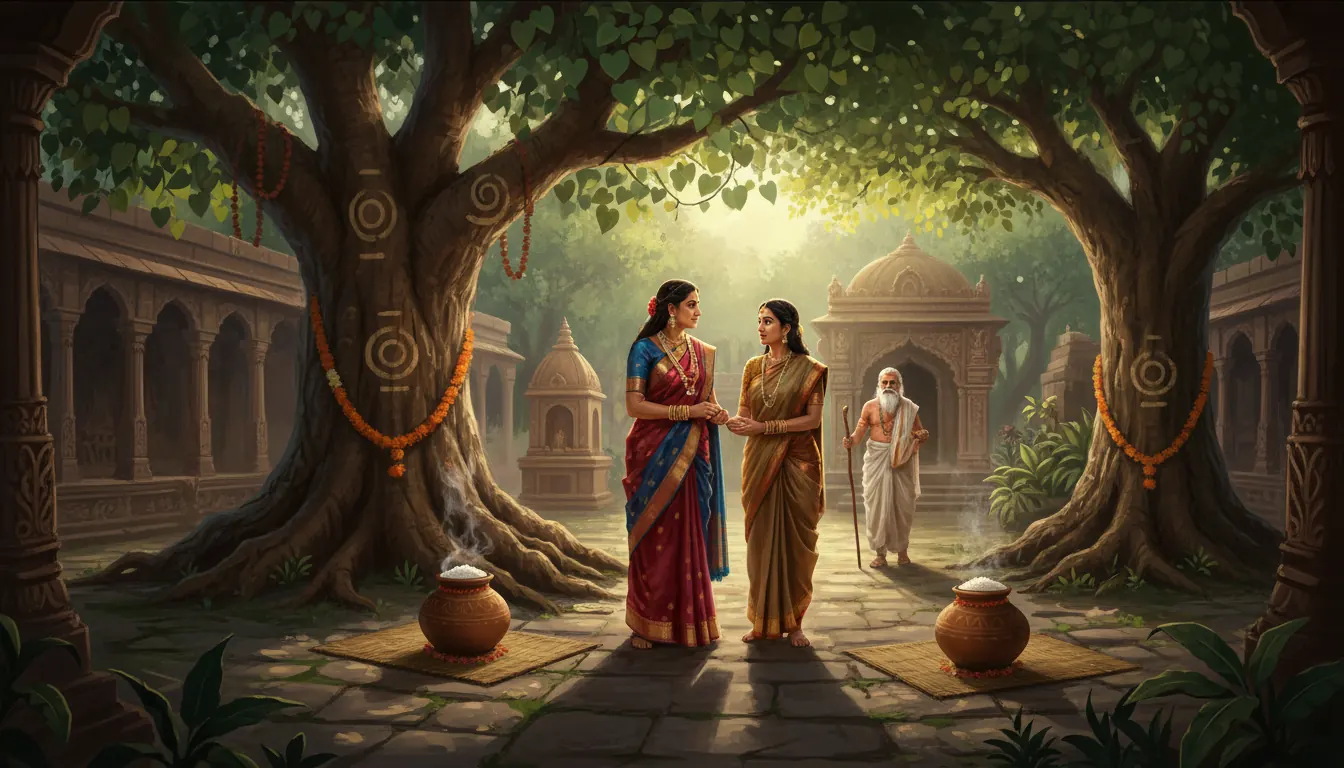
The Two Pots of Rice
A mother and daughter exchange their bowls and exchange their sons
In short
On the night before Parashurama is due to appear, Akritavrana tells Yudhishthira how it began. Richika wins Gadhi's daughter by raising a thousand one-eared horses out of the Ganga, and Bhrigu prepares two charged pots of rice for his daughter-in-law and her mother. The women trade pots and trees, and two dynasties change places before either child is born.
Told in the Vana ParvaSet in Mahendra Parvata, Kanyakubja and Ganga15 min read
A Single Night at the Foot of Mahendra
The protector of the earth spent a single night at the foot of the Mahendra hill, and with his brothers he paid the highest honours to the holy men who lived there.
There were a great many of them. Lomasa walked Yudhishthira along the line of huts and told him the names of all of them: these are of the Bhrigus, these of the Angiras, these the Vasishthas, these the Kashyapas. The royal saint went to each in turn and made obeisance with joined palms, and the sages blessed him, and none of them asked him about his kingdom, which he was grateful for.
At the end of the line stood a broad-shouldered man who did not look like an ascetic at all, and Lomasa named him: Akritavrana, a follower of Rama the son of Jamadagni.
Yudhishthira asked him the question he had been carrying up the hill. "When will the revered Parashurama show himself to the holy men here? I want to see the descendant of Bhrigu while I am here."
"Rama already knows you have come here," said Akritavrana, "for his soul knows everything of itself. He is pleased with you in every way, and he will gladly show himself to you. The saints who practise penances here may see him on the fourteenth and the eighth days of the moon. Tomorrow, when this very night ends, the fourteenth day begins. Then you will see him, dressed in a black deerskin, his hair in a matted mass."
So there was a night to be got through, and a fire, and a man beside it who had followed Parashurama for years.
Tell Me What Started It
"You have followed the mighty Rama, Jamadagni's son," said Yudhishthira. "You must have seen with your own eyes all the deeds he did in the old days. So tell me this. How did Rama defeat the warrior order on the battlefield, and what first started those wars?"
It was not an idle question and Akritavrana did not take it as one. The man asking it was a kshatriya sitting in a forest with his kingdom gone, wanting to know why a brahmana had once decided that men of his order should be cut off the earth twenty-one times over.
"I will gladly tell you that fine story, chief of kings," he said, "the story of the godlike deeds of Rama, the son of Jamadagni, of the race of Bhrigu. I will tell you too of the great ruler of the Haihaya tribe, the king named Arjuna, mighty lord of the Haihayas, whom Rama killed."
And then he did what the old tellers always do when they are asked about a war. He went back two generations before the war, to a marriage, and to a kitchen.
"But if I begin with the battle you will not understand the battle," he said. "The reason a brahmana was born with a warrior's arm in him is older than the quarrel that arm was used in, and it comes down to two women, two trees, and two pots of boiled rice. Sit, son of Pandu. The night is long and the fourteenth day is not here yet."
The King With a Thousand Arms
Arjuna of the Haihayas (said Akritavrana) had a thousand arms, and by the favour of Dattatreya he owned a celestial chariot made of gold. His rule reached over every living thing, wherever it lay on this earth, and that mighty king's chariot could go anywhere without hindrance. Nothing stopped it. No wall, no boundary, no sky.
Made irresistible by a boon he had been granted, he rode that chariot everywhere and trampled gods and Yakshas and saints on every side, and every living being, wherever it was, suffered at his hands. He did not conquer countries. He rode over them.
So the gods and the saints of strict virtue met together and went to Vishnu, the god of gods, the slayer of demons, whose prowess never failed, and they said one thing to him and no more than one thing. "Blessed and revered lord, to save all living beings, you must kill Arjuna."
And while that petition was still being weighed, the lord of the Haihayas mounted his celestial chariot and went up and insulted Indra himself, while the god was taking his pleasure with Shachi, his queen. A man who will do that will do anything.
Then the blessed god took counsel with Indra about destroying Kartavirya's son, and the lord of the gods told him everything that was for the good of the world of beings. When he had heard it, the god the world worships went away to do what had to be done. He went to the delightful Badari wood, which was his own chosen retreat for the practice of penances, and there he began.
"Remember that," said Akritavrana. "The answer to the man with a thousand arms was not another army. It was a sage going quietly into a wood."
The King of Kanyakubja Goes to the Woods
At that very time there lived on earth a mighty king in the land of Kanyakubja, a ruler with a very great army, and his name, Gadhi, was famous in the world.
He had everything a king is supposed to want and he put it down. He took to a forest life, and while he was dwelling in the midst of the wood there was born to him a daughter, beautiful as a nymph of heaven. Her name was Satyavati. She grew up among the trees with a retired king for a father and no court around her at all.
And Richika, the son of Bhrigu, a man of strict austerity, came and asked for her hand in marriage.
It was an awkward proposal and Gadhi knew it while he was hearing it. Here was a brahmana of the highest line asking for the daughter of a kshatriya who had renounced his throne. The girl could not be refused to such a man. The girl also could not be given away in a manner that broke the usage of a royal house, retired or not, because a custom does not lapse merely because the man who keeps it has moved into a hut.
So Gadhi answered him carefully, and what he said became the hinge of everything that came after.
The Family Custom
"There is a custom in our family," said Gadhi. "My ancestors set it long ago. Know, best of brahmanas, that the bridegroom must offer a dowry of a thousand swift horses, all of them white, and every one with a single black ear."
Then he added, at once, the two sentences that made the demand impossible to walk away from.
"But a holy saint like you cannot be asked to give that. Nor can my daughter be refused to a great-souled saint of your rank."
That is a father telling a suitor, in the politest words available, that the door is open and the doorway is too small. He was not refusing. He was excusing. A poor ascetic could no more produce a thousand white horses each with one black ear than he could produce a thousand mountains, and both men in the hut knew it, and the honourable thing was for Richika to accept the exemption and take the girl as a gift.
Richika did not accept the exemption.
"I will give you a thousand swift horses, white, each with a single black ear," he said. "Let your daughter be given in marriage to me."
He had no horses. He had no wealth of any kind. He had given his word in a hut in the woods to a man who had offered to let him off, and having given it, he got up and went out to find a thousand horses.
The Horses Come Out of the Ganga
He went to Varuna, lord of the waters, and asked him plainly, as one asks a neighbour for a tool.
"Give me a thousand swift horses, white, each with one black ear. I need them as the dowry for my marriage."
To him Varuna at once gave a thousand horses, and they did not come across a plain or down a road. They came out of the river Ganga, climbing up out of the water at one place on the bank, a thousand of them, white, and each with a single black ear, shaking the river off their backs in the morning. Men gave that place a name for it, and it is called the horse's landing place to this day, and pilgrims still stop there.
So Richika got his thousand horses, and the daughter of Gadhi, Satyavati by name, was given to him in marriage in the city of Kanyakubja. The gods themselves were of the party of the bride, and stood on her side of the ceremony as her kinsmen, which is a thing that has happened at very few weddings.
So that best of brahmanas had done three things at once: he had brought a thousand horses out of a river, he had gained a sight of the dwellers of heaven, and he had won a wife in the proper form, with no rule bent and no custom set aside. And he took his pleasure with that slender-waisted girl, and in her fulfilled every wish and desire he had ever had.
The Father-in-Law's Boon
When the marriage had been celebrated, Richika's father Bhrigu came to visit his son and his son's wife, and he was glad to see his worthy son. Husband and wife together paid their deepest respects to him whom all the gods worship, and when he had sat down they both stood near him with joined palms, waiting for his commands.
Bhrigu was glad at heart. He looked at his daughter-in-law standing there and said, "Lovely daughter, I will grant you anything you wish."
Satyavati did not ask for wealth, or long life, or a great son for herself alone. She asked for a favour with two names in it: that a son might be born to her, and a son also to her mother.
Her mother was the wife of Gadhi, a kshatriya queen living in a forest hut, who had borne one daughter and no boy, and who was watching that daughter marry into the first family of the Bhrigus. Satyavati thought of her, and asked for her, and that generosity is the beginning of all the trouble that follows, which is worth saying aloud, because the story is usually told as though the fault were entirely at the other end.
Bhrigu granted the favour she asked. Then he gave the instructions, and he gave them with great care, because what he was about to hand these two women was not an ordinary blessing.
Two Trees and Two Pots
"During your season," said Bhrigu, "you and your mother must bathe, with the rite for bearing a male child. Then each of you must embrace a different tree. She a peepal tree, and you a fig tree.
"And, dutiful girl, here are two pots of rice and milk that I have prepared with the utmost care. I have ransacked the whole universe for the herbs whose essence is blended into this milk and rice. It must be eaten with the greatest care."
He set the two pots down, one for the mother and one for the daughter, and said which was which, and then he vanished from sight, as he had come.
What he had not said, because he had not thought it needed saying, was that the two pots were not the same. One had been charged for the wife of a Bhrigu and would bring forth a brahmana. The other had been charged for the wife of a king and would bring forth a kshatriya of enormous power. The trees were paired to the pots. Everything had been weighed and matched and set down in order by a sage who had ransacked the universe for the ingredients, and then left in the keeping of two women who loved each other and were about to make a small, warm, disastrous decision.
For the queen looked at her daughter's pot, and at her daughter's tree, and thought what any mother in her position might think: that the sage had kept the better portion for his own son's wife, and that her own child was to have the lesser one.
The Exchange
The two women made an exchange. They made it in both things: in the pots of rice, and in the trees each was to embrace. The mother took the daughter's pot and the daughter's tree. The daughter, who had asked for her mother's son in the first place, gave them up without an argument.
Then a very great many days passed, and nothing whatever seemed to be wrong.
And then the revered saint came again, and he came knowing, through his divine knowledge, exactly what had happened while he was away. Mighty Bhrigu looked at his daughter-in-law and spoke to her.
"Dutiful girl. My daughter of a lovely brow. You took the wrong pot of rice as food, and it was the wrong tree that you embraced. It was your mother who misled you."
Then he told her what it had cost, and it is one of the coldest sentences in all the old books, because there is no anger in it at all, only arithmetic.
"You will bear a son who, though a brahmana, will have the nature of a warrior. And your mother will bear a mighty son who, though a kshatriya by birth, will take up the life of a brahmana. His power will be great, and he will walk the path of the righteous."
The exchange had not created anything. It had not made a better son for the queen and a worse one for the girl. It had only reversed them, so that the fire meant for a throne would now be born into a hermitage, and the calm meant for a hermitage would be born into a royal house and would have to fight its way out.
Let It Fall on My Grandson
Satyavati did not defend her mother and she did not blame her. She asked for the only thing that could still be changed, and she asked for it again and again.
"Let not my son be of this character," she begged. "Let my grandson be such."
She could not stop the warrior fire from entering the line of the Bhrigus. She could ask that it skip a generation, so that the man who carried it should at least be born already knowing what he was, and not be a scholar surprised by his own hands. Bhrigu heard her out, and was pleased to grant her prayer.
"So let it be," he said.
Then on the expected day she bore a son named Jamadagni, and this son of Bhrigu's line had both splendour and grace. He grew in years and in strength, and he surpassed the other saints in his mastery of the Vedas. And to him, who rivalled the maker of light in brilliance, there came of itself, untaught, the knowledge of the whole art of war and of the four kinds of missile weapons.
No one taught him. He simply had it, the way a man has his father's face. Her mother, in the same season, bore the son who would be Vishvamitra, a kshatriya who would spend his life climbing toward the priesthood.
"And Jamadagni's son," said Akritavrana, "is the man you are waiting to see in the morning. That is what he is. He is the grandson of the woman who let her mother take the better bowl and then begged that the price be charged one generation later. Everything you have heard of him after this, the axe and the twenty-one slaughters and the earth given away to Kashyapa, comes out of a swap made in a forest kitchen by two women who each wanted the other to have the finer thing."
The fourteenth day of the moon was not far off. Yudhishthira sat and waited for it.
Dharma Lesson
A grasp at someone else's better share does not enlarge the share, it only reverses who carries it. The queen took the pot meant for a brahmana's wife and got a son who would spend his life climbing toward the priesthood, while the warrior fire she meant to keep went into a hermitage and came out as an axe. Satyavati could not undo the swap; she could only ask that the cost fall one generation later, and it did.