Rudra's Share and the Sinking Earth
Two quarrels over what may be given away, on the Kalinga shore
In short
On the Vaitarani in Kalinga, Lomasa shows the Pandavas the bank where Rudra once seized a consecrated beast and said it was his share, and where the gods bought it back with worship and then set aside the first portion for him forever. On the same shore Brahma gave away the whole earth as a priest's fee, and the earth went down into the water rather than be handed over.
Told in the Vana ParvaSet in Vaitarani, Kalinga and The Ocean15 min read
Down the Coast from the Kausiki
They left the Kausiki and the lake by Rishyasringa's old hermitage, and after that the son of Pandu went, one after another, to all the sacred shrines there were, in the order in which Lomasa named them, until the pilgrimage stopped being a journey and became a habit.
Then the land ran out. They came to the place where the Ganga falls into the sea, and there, in the midst of five hundred rivers, the prince performed the holy rite of immersion.
It is not a river's mouth so much as a country of water. The great stream lets go of its own banks miles inland and comes apart into channels that come apart again, and the fresh runs into the salt through reed and silt and sandbar, and a man standing waist-deep at the middle of it cannot say with certainty which of the five hundred he is standing in.
When he had bathed, Yudhishthira came up out of it and they went on, all the brothers together, and Drupada's daughter with them, walking south along the shore of the sea with the water always on their left hand, toward the land where the Kalinga tribes live.
Lomasa walked at the king's shoulder. He had been sent to them out of heaven with a message and had stayed to be their guide, and he had a habit that Yudhishthira had come to depend on: he never let them walk over a place without telling them what had happened there.
It was not idleness on the sage's part and Yudhishthira had worked out what it was for. A man who has lost a kingdom walks with his own grievance going round and round in him like a wheel that will not stop, and the only thing that stops it is being told, at every ford and every hill, that somebody stood here before you and had a worse morning. By the time they reached the Kalinga country the eldest son of Pandu had begun to hear his own case as one entry in a very long list.
The Land Where the Kalingas Live
"There, son of Kunti," said Lomasa, "is the land where the Kalinga tribes live. The river Vaitarani runs through it, and on its banks even the god of virtue performed religious rites, after first putting himself under the protection of the gods."
Yudhishthira turned that over as they walked. Even the god of virtue. Even Dharma himself, coming to this water to make an offering, had not simply come and made it. He had put himself under the protection of the gods before he began. If the lord of righteousness took a precaution before opening a sacrifice on that bank, then something had once happened there that made precautions reasonable.
"This is the northern bank," the sage went on, "where holy men live. It is a fit place for religious rites, made lovely by a hill, and the twice-born come here often. In holiness this spot rivals the road by which a virtuous man who has earned heaven goes to the realm of the gods. And on this very spot, in times past, other holy men also worshipped the immortals with rites."
The river ran below them, dark and unhurried, with the low hill standing over the far bank and smoke going up in threads from a dozen fires among the trees where men who had given up everything were doing the same small exact things their fathers had done.
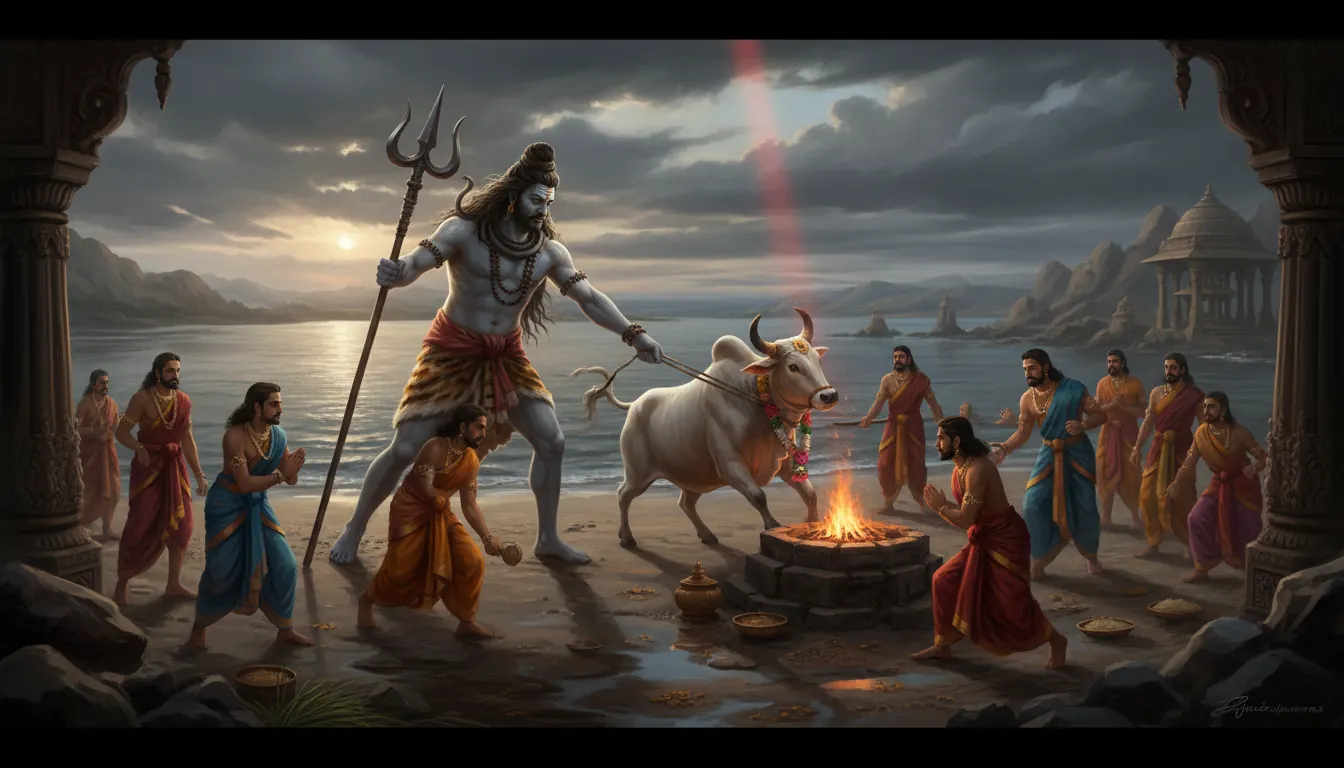
"And on this very spot," said Lomasa, "the god Rudra, king of kings, seized the sacrificial beast and cried, 'This is my share!'"
This Is My Share
Understand what a sacrificial beast is, before you decide how large the offence was.
It is not a thing anybody owns in the ordinary way at the moment it is taken. It has been washed, and bound, and consecrated, and by the consecration it has stopped belonging to the man who bought it and has not yet been given to anybody. It stands at the post for that one interval, in the hands of the ritual, and the whole enormous apparatus of the sacrifice exists to determine, by rule, which god is to receive which portion of it and in what order and after what words are said.
Into that interval Shiva put out his hand and took it, and said aloud what he was doing.
He did not make a case. He did not say that the portion allotted to him was too small, though every telling of every other quarrel about him says exactly that. He said four words, and the four words were a claim of right and not a request.
When Shiva carried the beast off, the gods said to him, "Do not cast a greedy eye on what belongs to others, and do not brush aside all the rules of righteousness."
It is worth hearing what is in that sentence, because it is the whole of their case and they never improve on it. They do not deny that he is a god or that gods receive shares. They say two things only: that the beast was somebody else's property at the moment he took it, and that there are rules for the taking, and that he went around them. That is the entire indictment. Not greed. Procedure.
How a Seizure Is Made Lawful
They did not take it back from him.
That is the part of the story Lomasa wanted the king to notice, and he said it plainly. There was no contest on that riverbank, no weapon lifted, no reversal. Instead the gods spoke pleasing words of praise to Rudra, satisfied him with an offering, and paid him the honours due to what he was.
At that he gave up the beast and went away by the road the gods walk.
"So he returned it," said Yudhishthira.
"He returned an animal," said Lomasa. "Look at what the animal was when he let go of it. He had taken it out of the rite by force and it went back into the rite as the honoured portion of a god who had just been praised, and sacrificed to, and given the courtesies of his rank, in front of everyone who had seen the seizure. The beast stood where it had stood before. Nothing else in that field stood where it had stood before.
"This is a thing kings should know and mostly learn too late. What is taken by force has afterwards to be regularised, and the regularising is never free. The gods paid for that beast twice: once in the sacrifice they had already prepared, and once again in the sacrifice they had to offer to get it back. And the second one bought them the animal for that afternoon. It did not buy them the precedent."
Fresh, and Not Stale
"Learn now what happened to Rudra after that," said Lomasa, "for it is the reason you will see what you are about to see at every altar between here and the western sea.
"Out of dread of him, the gods set apart for evermore, out of all shares whatsoever, the best allotment, fresh and not stale, for that god to take."
Yudhishthira asked him to say the words again, and he said them again, and the king counted what was in them.
For evermore: not once, not that afternoon, but permanently and by standing rule. Out of all shares: not out of some particular sacrifice but out of every one. The best allotment: the first and highest portion, taken off the top before anything is apportioned. Fresh, and not stale: nothing left over, nothing that has waited, nothing that has already been offered elsewhere and passed along.
And the reason given for the whole arrangement, in the only words the story allows, is the dread of Rudra.
"They made him a rule," Yudhishthira said slowly, "so that he would never again have to make himself an exception."
"That is what a first portion is," said Lomasa. "Every offering you have ever poured out with the first of it set aside was poured out in the shape this quarrel left behind on this bank. And whoever bathes at this spot and recites this ancient story as he does so sees, with his mortal eyes, the road that leads to the realm of the gods."
Libations to the Names of Their Fathers
Then all the sons of Pandu, and Drupada's daughter too, all of them favoured by Fate, went down to the Vaitarani and poured out offerings of water in the names of their fathers.
They stood in the current with their sacred threads shifted over the right shoulder and let the water go out of their cupped hands, naming as they poured, and the names went down the dark river toward the sea: Pandu, and the fathers behind Pandu, and Drupada's dead, and the whole long line of people who had died expecting the family to hold together.
When Yudhishthira came up out of the water he was not the same as he had been on the bank.
"Lomasa," he said, "how great the power of a holy act must be! Now that I have bathed here in the proper way, I no longer seem to be touching the world of mortal men. I can see all the worlds. And that sound is the great-souled forest hermits reciting their prayers aloud."
He said it easily, like a man remarking on birds.
"Yudhishthira," said Lomasa, "the place that sound comes from, to reach your ears, is a full three hundred thousand yojanas away."
The king stood still in the shallows with the water running past his ankles.
"Lord of men, be still," said the sage, "and say nothing."
And the king, who had spent the years of his exile being told what he was no longer permitted to say, stood in the shallow water of the Vaitarani and kept his mouth shut, and listened to men praying three hundred thousand yojanas away.
The Forest of the Self-Existent One
"This, king," Lomasa said when he judged the king could hear ordinary speech again, "is the divine forest of the Self-existent One, which has now come into view. Here Vishvakarma, of fearsome name, once performed religious rites.
"At that great sacrifice the Self-existent One gave this whole earth, with all its hills and forests, to Kashyapa, as his fee for serving as priest."
Yudhishthira had been a giver of fees himself. He had held a sacrifice at which the kings of the earth stood in line with tribute, and he knew what a priest's gratuity is: it is the closing of the rite, the thing that makes the whole enormous business valid, and it is fixed by custom and paid without haggling, and no man who has ever performed a great sacrifice would think of underpaying it.
But he also knew what the gift consisted of here.
"He gave away the earth," he said. "The whole of it, hills and forests, at the end of a sacrifice, to a brahmana, as a fee."
"He did," said Lomasa. "And on that occasion, son of Kuru, even as the goddess was being given away, the Earth grew sad at heart, and she spoke angrily to that great lord, the ruler of the worlds."
The Earth Goes Down
"Mighty god," said the Earth, "it is beneath you to give me away to an ordinary mortal. And this gift of yours will come to nothing. For here I go, down to the bottom of the underworld."
And she went down.
Notice what her objection is, because it is not the one that would be expected. She does not say that she is not his to give; she does not dispute his title. She says that the recipient is beneath the gift, and that she will not be handed to a man, and that the transfer will therefore fail. She does not appeal, she does not curse, and she does not stay to argue. She simply removes the thing that was given, by taking it into the water with her, and leaves the giver holding a promise with no earth under it.
Then the blessed sage Kashyapa saw the goddess Earth downcast and sad, and he did the only intelligent thing that was left to do. He did not go after his fee. He performed an act of propitiation meant to soothe her anger.
And then, son of Pandu, the Earth was pleased with his holy act.
She rose again out of the waters and showed herself, and she came up in a shape that had not been discussed by either of them: she rose in the form of a sacred altar.
"This, king, is the spot that plainly shows the form of an altar," said Lomasa, and there it was in front of them, a long level shelf of ground running out from the shore, exact as masonry. "Climb onto it, and you will gain courage and strength. And this is the very altar that reaches all the way to the sea and rests on its breast."
The Words of Truth Before the Sea
"May good luck be yours," said Lomasa. "Climb onto it, and cross the sea yourself. And as you climb it today, I will perform the rite for warding off all evil from you. For as soon as this altar feels a mortal's touch, it goes straight into the sea."
He performed the rite over him where he stood. Then he taught him what had to be said, because the ocean is not a thing a man may simply walk into.
"Salutation to the god who protects the universe. Salutation to you who are beyond the universe. Lord of gods, grant your presence in this sea.
"And then, son of Pandu, these words of truth must be recited aloud, and while reciting them you must quickly climb up: The god of fire, and the sun, and the organ of generation, and water, and the goddess, and the seed of Vishnu, and the navel of nectar. The god of fire is the organ that fathered the ocean. The earth is your body. Vishnu planted the seed that gave you being, and you are the navel of nectar.
"So the words of truth must be recited aloud, and while reciting them one must plunge into the lord of rivers. Otherwise, most praiseworthy of Kunti's sons, this lord of waters, divine in birth, the greatest store of all the waters of the earth, must not be touched, not even with the tip of a blade of sacred grass."
So the rite for warding off evil was completed on his behalf, and the great-souled Yudhishthira went into the sea and did everything the sage had told him: mounted the altar that was the body of the goddess, and said aloud that the earth was her body and the fire her begetter, and went down into the water holding nothing back.
The Night on Mahendra
From the sea he went inland to the foot of the Mahendra hill, and there the protector of the earth spent a single night.
He had bathed that day at a river where a god once took what had not been given to him and was afterwards paid for evermore to stop taking it; and he had climbed an altar that was a goddess who had gone down into the water rather than be handed over as a fee. Two quarrels on one shore, and both of them about the same question, which is what a man may give away and what is not his to give.
In the morning, with his brothers, he paid the highest honours to the holy men on that hill, and Lomasa told him all their names: the Bhrigus, the Angiras, the Vasishthas, and the Kashyapas, sitting among the rocks in their hundreds, the descendants of the very priest to whom the earth had once been given and had refused to go.
The royal sage visited every one of them and bowed to each with joined palms. And then he asked Akritavrana, a follower of Parashurama, when the revered Rama, Jamadagni's son, would show himself to the holy men there, for he longed to see the descendant of Bhrigu.
And Akritavrana said that the fourteenth day of the lunar month would begin at the end of that very night, and that on that day he would see him, dressed in a black deerskin and wearing his hair in a matted mass; for Rama already knew of his coming, and was well pleased with him in every way.
Dharma Lesson
What is taken by force has to be regularised afterwards, and the regularising is never free. What is given away over the objection of the thing given simply refuses to arrive, and comes back only when the receiver stops pressing his claim and attends to the wrong instead.