Why Rudra Broke the Sacrifice
Krishna explains who really emptied the camp
In short
Yudhishthira asks how a warrior of no great skill killed everyone he loved, and Krishna answers with the oldest quarrel there is. Rudra dived into the water to prepare for creation and stayed so long that a second creator was made in his place. Later the gods gave him no share of their sacrifice, so he built a bow out of the rite itself.
Told in the Sauptika ParvaSet in Munjavat and Kurukshetra16 min read
How Could a Man of No Great Skill Do It
Vaishampayana said, "When all the troops had been killed in their sleep by those three chariot warriors, King Yudhishthira, in deep grief, spoke to Krishna of the Dasharha clan.
'Krishna, how could my sons, mighty chariot warriors every one of them, be slaughtered by that sinful wretch Ashwatthama, who has no great skill in battle? How could Drona's son kill the sons of Drupada, all of them skilled with weapons, all of them brave, men able to fight hundreds of thousands of enemies? How could he kill that greatest of chariot warriors, Dhrishtadyumna, whom even the great bowman Drona could not face? What did our teacher's son do, bull among men, that let him kill all our men by himself?'
Mark the question, Janamejaya. It is not the question of a man asking who is to blame. He knew who had done it. He had seen the camp. What he could not get past was the sum: one middling swordsman, and every skilled man he loved dead in a single night, and no account of the world that he had been taught would make those two facts sit down together.
Draupadi had risen from her fast only a little while before, and the gem off a man's head was now fastened on her husband's brow. The bodies of five young men lay where they had been carried in. Nakula's son had been killed with a chariot wheel in his hands. Prativindhya had been struck in the belly and had fallen without a sound. Every one of them had been a trained warrior, and every one of them had been taken by a man whom Yudhishthira, who had watched him fight for eighteen days, considered ordinary.
And Krishna did not answer him with the camp, or with the gate, or with the sword. He answered with a quarrel among the gods that was older than the Kurus and older than the earth they had been fighting over."
I Know Mahadeva Truly
The holy one said, "Drona's son had sought the help of the highest of all the gods, the eternal Mahadeva. That is how he was able to kill so many warriors by himself.
When Mahadeva is pleased, he can grant even immortality. Girisha can give a man courage enough to hold back Indra himself. That is the whole of the mechanism you are asking about, son of Pandu, and it is a very short answer. The skill of the hand had nothing to do with it. The god was pleased, and a man of no great skill went through your camp like a fire through dry grass.
I know Mahadeva truly, best of the Bharatas, and I know the deeds he did long ago. Others worship him and get what they ask for; I have worshipped him with truth and purity and austerities from a long way back, and what I have of him is not a boon but an acquaintance. He is the beginning, the middle and the end of all creatures. This whole universe acts and moves by his energy.
But you will not understand what happened at that gate unless you understand what kind of power that is, and what it is like when it is left out of a reckoning. So hear how he came to be what he is, and hear what he did the first time the gods forgot him. It begins before there were any creatures at all."
So Be It, He Said, and Went Into the Water
"The mighty Grandsire wanted to create living creatures, and he saw Rudra. 'Create living creatures without delay,' the Grandsire told him.
Thus asked, Rudra of tawny locks said, 'So be it.'
Then he plunged into the water and practised austerities there for a very long time, because he understood the flaws that living creatures would have.
Sthanu they call him for that, king, which is to say the motionless one, the post driven into the ground; and Girisha, and Sharva, and Bhava, and Kapardin, and each of those names is a different age of him, and one of them is this one. Before he was the god at the burning-grounds with the skulls and the ashes, he was a workman who had been given a commission and had gone away to think about it properly.
Understand that, king, before you judge anything that follows. He did not refuse the work. He agreed to it, and then he went under the water to prepare himself for it, because he had looked ahead at what he was being asked to make and had seen the flaws in it. Hunger was in it. Weakness was in it. Everything that would have to eat something else in order to go on living was in it. He would not put his hand to that until he had made himself equal to it, and there is no measure given for how long he stayed down there, only that it was long.
And while he was under the water, being thorough, the work was given to somebody else."
Is There Anyone Born Before Me
"The Grandsire waited a very long time for Rudra. Then, by a simple act of will, he called another being into existence, to be the creator of every kind of living thing.
That second being was no fool, and the first thing he did was ask the one question that mattered.
Seeing Girisha sunk in the waters, he said to his father, 'If no one was born before me, then I will create living creatures.'
His father answered, 'There is no other first-born besides you. This Sthanu has gone down into the water. Go and create living creatures, and do not worry.'
So the Grandsire told him that there was nobody before him, and in the same breath told him where the somebody before him was. Both halves were true and the two halves together were a falsehood, and the second being took the answer he wanted, as men do, and went away and began to work.
And from that moment there were two makers in the world with a claim on the same office, one of them busy, and one of them under the water and not yet finished.
Nothing in what followed was a plot, king. Nobody in this part of the story intends any harm. The Grandsire wanted the work begun. The second being wanted to be certain he was entitled to begin it, and asked, and was answered, and believed the answer. The first-born wanted to do the work well. Every one of them behaved reasonably, and out of the four reasonable acts came an injury that has never entirely healed, and a god who has to be counted in every reckoning ever afterwards because of the one time he was not."
The Creatures That Ran at Their Father
"That being then created seven Prajapatis, having Daksha for their first, and they created all these creatures of four kinds.
But the moment they were created, king, they ran at their makers, the Prajapatis, tormented by hunger and wanting to devour them.
There is the flaw that Rudra went into the water to think about, and there it is on the very first day, running at the man who made it with its mouth open. The makers, who had asked no questions about defects, fled from their own offspring and ran to the Grandsire for protection.
'Illustrious one,' they said, 'protect us from these, and give these creatures food of their own.'
Then the Grandsire gave them herbs and plants and other green things for food, and to the strong he gave the weaker creatures to live on. That is the arrangement you live under, son of Pandu. It was not designed. It was an emergency measure, taken for makers who were being eaten by their own work and needed the problem to stop that afternoon.
Once their food had been settled, the new creatures all went off to the regions they liked, and happily multiplied, each mating with its own kind.
And so the world you and I stand in was settled in a single afternoon, by frightened makers and an obliging grandfather, on the principle that whatever cannot be fed shall be food. Eighteen days of this war have been the working out of that principle among kings. You are asking me, son of Pandu, why a camp full of sleeping men was eaten in the dark, and I am telling you that the rule was written before there were men, by somebody who was in a hurry."
What Use Is This Limb of Mine
"After the creatures had multiplied and the Grandsire had become well pleased, the first-born rose from the water.
He looked at the living world. He saw that creatures of every kind had been made, and that they had multiplied by their own power. Everything he had gone down to prepare for had been done, badly, and finished, and populated, and nobody had come to the water to tell him.
At this sight Rudra became angry, and caused his procreative limb to disappear in the bowels of the Earth.
Unfading Brahma soothed him with gentle words. 'Sharva,' he said, 'what were you doing all that time in the water? And why have you made your limb of generation vanish into the depths of the Earth?'
The lord of the universe answered Brahma in anger. 'Someone else has created all these creatures. What use, then, is this limb of mine? By my austerities, Grandsire, I have created food for all these creatures. These herbs and plants will multiply too, just like the creatures that will live on them.'
Hear what he says he was doing down there. He was making the food. All that time under the water, while the office was being given away, he was making the thing that would let the creation eat without eating itself, and it was already done, and it was the one part of the arrangement that worked.
With these words Bhava went away, joyless and angry, to the foot of the Munjavat mountains, to practise still harsher austerities."
A Bow Made Out of the Sacrifice
The holy one said, "When the krita age had passed, the gods wished to perform a sacrifice, and they prepared for it properly, following the rules laid down in the Vedas. They gathered clarified butter and everything else that was needed. And they not only settled what the sacrifice would require, but also decided which of them should have a share in the offerings.
The celestials knew who Rudra was and what his true nature was, king, and still they set aside no share for the divine Sthanu.
They did not debate him. That is worth having exactly right. There was no hearing in which his claim was weighed and dismissed. They sat down and made a list of who was to be given a portion, and though they knew who he was, he was not on it, because he had been under the water and then on a mountain and had never been at any of their gatherings. He was left out the way a name is left off a list.
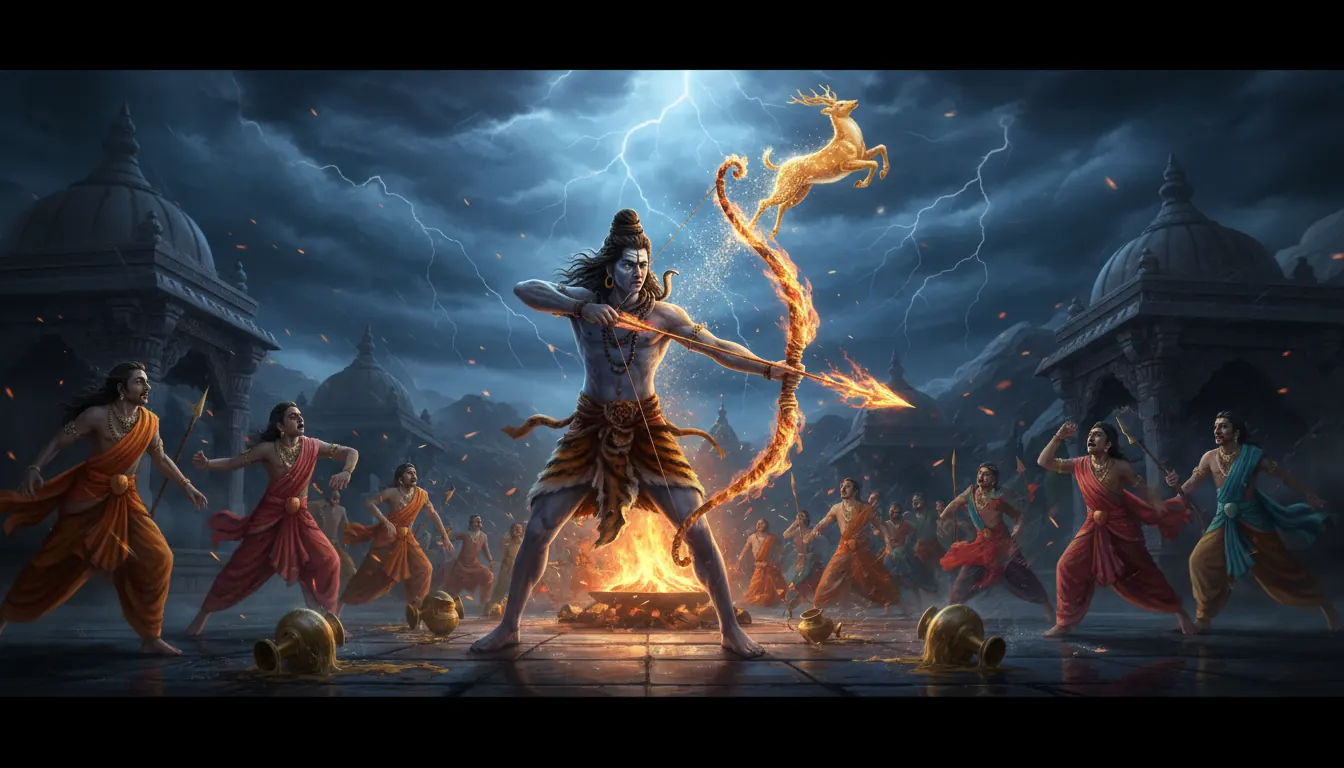
When Sthanu, dressed in deerskins, saw that the celestials had given him no share in the offerings, he resolved to destroy that Sacrifice, and to do it he made a bow.
There are four kinds of Sacrifice: the loka Sacrifice, the Sacrifice of special rites, the eternal household Sacrifice, and the Sacrifice that is the pleasure a man takes in enjoying the five elements and the things made from them. The universe has sprung from these four kinds of Sacrifice. Kapardin made that bow out of the first and the fourth.
The bow was five cubits long. The sacred mantra 'vashat,' Bharata, became its string. The four parts that make up a Sacrifice became its ornaments. He built the weapon out of the rite itself. When it was finished he took it and walked to where they were sitting."
The Sacrifice Ran Away as a Deer
"Then Mahadeva, full of rage, took up that bow and went to the place where the celestials were performing their Sacrifice.
When the goddess Earth saw unfading Rudra arrive there dressed as a young brahmacari and armed with that bow, she shrank in fear, and the very mountains began to tremble. The wind stopped blowing. Fire itself, though fed, would not blaze. The stars wandered anxiously from their courses. The Sun's splendour dimmed. The Moon's disc lost its beauty. The whole sky was wrapped in thick gloom. The celestials were overwhelmed and did not know what to do. Their Sacrifice stopped blazing. The gods were all terrified.
Consider what they were looking at, king. They had assembled to perform a rite, and the rite was walking toward them in the shape of a young man with a bow, because that is what he had made the bow out of. Their own ceremony had been taken apart and bent into a weapon and strung with the word that they themselves shout when the butter goes into the fire, and it was five cubits long, and it was coming across the sacrificial ground toward the offerings they had just finished dividing among themselves.
Then Rudra shot the embodied Sacrifice through the heart with a fierce arrow.
The embodied Sacrifice took the shape of a deer and fled, and the god of fire fled with him. In that form he rose to heaven, blazing with beauty. But Rudra chased him through the skies, Yudhishthira. Once Sacrifice had fled, the gods lost their splendour. They lost their senses and stood dazed.
Then the three-eyed Mahadeva, with his bow, broke in rage the arms of Savitri, and plucked out the eyes of Bhaga, and knocked out the teeth of Pushana.
The gods then fled, and so did all the parts of the Sacrifice. Some of them reeled as they tried to escape and fell down senseless. The blue-throated Rudra, having thrown them into such confusion, laughed aloud and, whirling the tip of his bow, froze them where they stood."
The Settlement
"Then the celestials cried out. At their command the bowstring snapped, and with the string broken, the bow sprang out straight.
Then the gods went up to the god of gods, now without his bow, and together with the embodied Sacrifice they took refuge with mighty Mahadeva and tried to win his favour.
The great god was pleased, and he threw his anger into the water, king; and that anger, taking the form of fire, is forever at work consuming the waters. Then he gave Savitri back his arms, and Bhaga his eyes, and Pushana his teeth. And he restored the Sacrifices too, Pandava. The world was safe and whole again. The arms went back onto Savitri. The eyes went back into Bhaga's head. Pushan got his teeth. The deer came down out of the sky and was a Sacrifice again, and the fire was fed, and the gods sat down.
And the gods gave Mahadeva all the offerings of clarified butter as the great god's share.
That is the settlement, son of Pandu, and I want you to look at what it cost and what it bought. It bought him a share. It is exactly what he would have had if his name had been written on the list at the beginning, at no cost at all, before the arms were broken and the eyes were plucked out and the Sacrifice itself was shot through the heart and driven into the sky in the shape of an animal. Nothing else was gained by anyone. When Mahadeva was angry, the whole world was in turmoil; when he was pleased, everything was safe."
It Was Not Drona's Son
"The god Mahadeva, whose energy is boundless, was pleased with Ashwatthama.
That is why that warrior could kill your sons, those mighty chariot warriors. That is why he could kill so many other heroes, the Panchalas and all their followers.
Do not let your mind dwell on it. It was not Drona's son who did that deed. It was done by the grace of Mahadeva.
Do now what should next be done."
Vaishampayana continued, "And there the answer ended, Janamejaya, and it is an answer that has been argued over ever since by men who were not on that field and did not have to get up the next morning.
Yudhishthira had asked how a middling swordsman had killed everyone he loved. He was told: a power was left out of a reckoning once, at the beginning of the world, and it has never been safe to leave out since, and last night it was standing at a gate in the dark and a man walked up to it and offered it everything he had, and it took him.
And having said it, Krishna gave him the only instruction that was any use to a king with a kingdom of corpses and a wife who had only just risen from her fast. Not that it was just. Not that it was undeserved. Only that grief was not now the business in front of him, and that there were rites to be performed and water to be offered and the living to be seen to.
Do now what should next be done."
Dharma Lesson
A power left out of the reckoning does not go away; it comes back armed, and the only settlement is to give it its share. What the gods finally hand Rudra is exactly what he would have had for nothing if his name had been on the list, and everything broken in between was the price of the omission.