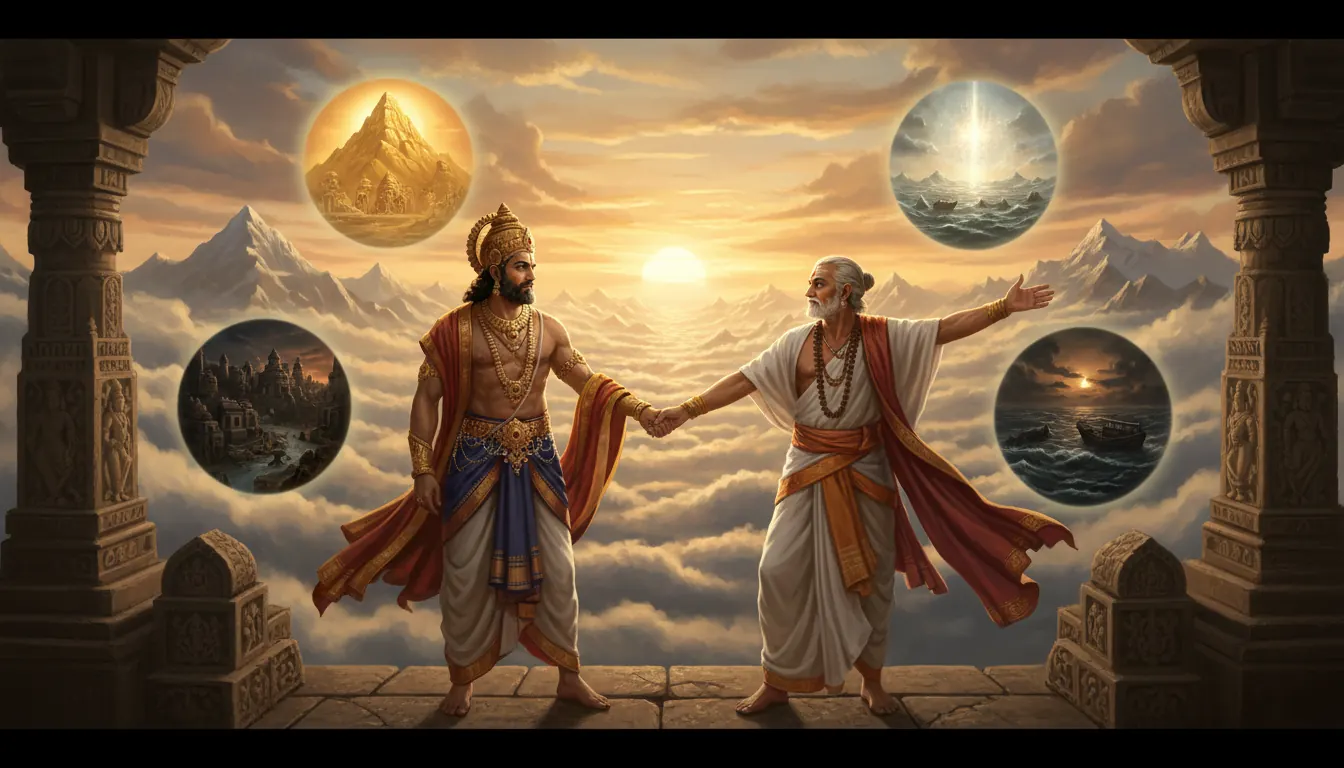
The Islands Beyond Jambudvipa
Sanjaya measures the seven islands, the world elephants and the sun
In short
Dhritarashtra asks Sanjaya for the dimensions of the earth while the armies wait at Kurukshetra. Sanjaya describes Sakadwipa with its seven jewelled mountains, its rivers and its four provinces that have no king, then the northern islands ringed by oceans of clarified butter, curds and wine, then the four great elephants at the edge of the world whose breathing is the wind. He ends with the measures of Rahu, the moon and the sun, and with one piece of advice about Duryodhana.
Told in the Bhishma ParvaSet in Hastinapura, Mount Meru and The Ocean16 min read
The King Asks for Measurements
Sanjaya had already told the whole of Jambukhanda, the great island of the rose apple tree, with its mountains and its rivers and its four ages, and the blind king in the hall at Hastinapura was not satisfied. The war had not yet begun, and his son's army stood waiting at Kurukshetra. He asked instead about the size of the world.
"Sanjaya, you have duly described Jambukhanda to me," Dhritarashtra said. "Now tell me truly how large it is and how far it reaches. Tell me too the extent of the ocean of Sakadwipa, and of Kusadwipa, Salmalidwipa and Kraunchadwipa, truly and leaving nothing out, and tell me also, son of Gavalgani, of Rahu and Soma and Surya."
Sanjaya, the suta who had been given the divine sight so that nothing on earth or above it would be hidden from him, sat down to answer the largest question he had yet been asked.
"There are many islands, king, across which the Earth stretches," he said. "But I will describe to you only seven islands, and the moon, and the sun, and the planet Rahu too."
He began with a number, because that is what had been asked for.
"The Jamvu mountain stretches over a full eighteen thousand six hundred yojanas. The salt ocean is said to be twice as large."
Twice. That is the rule the whole account runs on, and it does not stop running. Every ring outward from where the Kurus had gathered to kill one another is double the ring before it, so that the field at Kurukshetra sits at the centre of a world that doubles and doubles until the arithmetic outruns the mind that is following it.
"That ocean is covered with many kingdoms," Sanjaya said, "and adorned with gems and corals. It is decked, besides, with many mountains streaked with metals of every kind. Crowded with Siddhas and Charanas, the ocean is round."
A circle of salt water with gems in it, and cities on it, and perfected beings walking about upon it. That was the first ring outward. There were six more.
The Island Where Nobody Dies
"Now I will tell you truly about Sakadwipa, Bharata," Sanjaya said. "Listen, son of Kuru's race, as I describe it to you properly."
The figures came first again. That island is twice the size of Jambudvipa, and the ocean that holds it is twice the size of that island, and it surrounds Sakadwipa on every side, so that the land floats in a ring of water twice as wide as itself.
Then he said the thing that must have been hard to hear in that hall.
"The kingdoms there are full of righteousness, and the men there never die."
He did not pause on it. He let it stand and went straight on, and the next sentence he spoke was a question he asked of himself and answered as though the answer were obvious.
"How could there be famine there? The people are all forgiving and full of energy."
Consider where this was being said. It was being said to a king whose hunger for a kingdom had put two armies in a field, in a city that would soon be waiting every evening to be told the number of its dead. Somewhere out past the salt water there were kingdoms full of righteousness where nobody starved and nobody died, and the reason given for both was the same, that the people there were forgiving.
"Bull of the Bharatas, I have now duly given you a brief description of Sakadwipa. What else, king, do you wish to hear?"
It was an offer to stop. Dhritarashtra did not take it.
"Sanjaya, you have given me a brief description of Sakadwipa," the king said. "You who are so wise, now tell me everything truly, in detail."
So the suta went back to the beginning of that island and named its mountains one by one.
Seven Mountains, and the Dark One
"On that island there are seven mountains decked with jewels, mines of gems and precious stones," Sanjaya said. "There are many rivers on that island too. Everything there, king, is excellent and delightful."
He took them in order, going outward.
The first is called Meru, and it is the home of the gods, the rishis and the Gandharvas. The next, stretching towards the east, is called Malaya, and Malaya is where the clouds are made; every cloud that has ever crossed a sky was born on that mountain and scattered from it in every direction. The third is the great mountain called Jaladhara, the water holder, and from Jaladhara Indra takes water every day, water of the finest quality, and it is out of that water that the seasonal rains are poured on men.
The fourth is the high mountain called Raivataka, and over Raivataka, fixed in the sky, the Grandsire himself has placed the constellation Revati for ever, so that the star and the peak stand one above the other and neither has moved since.
"North of this is the great mountain called Syama," Sanjaya said. "It has the splendour of newly risen clouds, very high, beautiful and bright. And since those mountains are dark in colour, the people living there are all dark-skinned, king."
Dhritarashtra stopped him there.
"What you have said raises a great doubt in my mind, Sanjaya. Why, son of a suta, would the people there be dark-skinned?"
The answer he got was flatter than the question and better than it.
"Great king, in every island there are men who are fair, and men who are dark, and men born of a union of the fair and the dark races. But because the people there are all dark, that mountain is called the Dark Mountain."
The mountain is named after the men, not the men after the mountain. The blind king had assumed the hill had coloured its people, and was told that the people had named the hill.
The Tree in the Middle of Saka
There were two mountains left. After Syama comes the great mountain called Durgasaila, the fortress rock, and after Durgasaila comes Kesari, and the breezes that blow off Kesari are all laden with fragrance, so that a man knows he has come near it before he sees it.
"Each of these mountains is double the size of the one named just before it," Sanjaya said, and the doubling runs through the whole range, Meru to Malaya to Jaladhara to Raivataka to Syama to Durgasaila to Kesari, each one twice the last.
Between the seven mountains lie seven Varshas, seven regions, and the wise have given each of them a name. The Varsha of Meru is called Mahakasa, the great sky. That of water-giving Malaya is Kumudottara. The Varsha of Jaladhara is Sukumara. That of Raivataka is Kaumara. That of Syama is Manikanchana, which is jewel and gold. The Varsha of Kesara is Mandaki, and the region beyond it is called Mahapuman.
"In the middle of that island is a great tree called Saka," Sanjaya said. "In height and breadth that tree is equal to the Jamvu tree in Jambudvipa. And the people there always worship that tree."
That is where the island got its name, as this one of ours got its own, from a tree standing at the centre of everything with people worshipping at the foot of it.
On that island there are many delightful provinces where Shiva is worshipped, and the Siddhas, the Charanas and the gods go there. The people are virtuous. All the four orders keep to their own work, and not a single theft is to be seen there.
"Free of old age and death and blessed with long life," said Sanjaya, "the people there grow like rivers in the rainy season."
It is the only image in the whole passage that shows what a happy life looks like from outside, and it is not a picture of stillness. Men there increase the way water increases when the rain comes, faster and fuller and going somewhere.
The Rivers, and the Four Provinces With No King
"The rivers there are full of sacred water," Sanjaya said, "and Ganga herself is there, divided into many streams."
The Ganga that the Kurus knew, the river the grandsire's mother had walked out of, was on that island too, broken into channels and running under other names. He gave the names as he had them. Sukumari, and Kumari, and Seta, and Keveraka, and Mahanadi, and the river Manijala, and Chakshus, and the river Vardhanika. These and many other rivers by thousands and by hundreds, all full of sacred water, and it is from these that Vasava draws the water he showers as rain.
"It is impossible to list the names and lengths of the rivers," he said. "All of them are the finest of rivers, and they wash away sin."
Then he named the peoples, and this is the part of the account that a court at war ought to have heard twice.
On that island of Saka there are four sacred provinces, called the Mrigas, the Masakas, the Manasas and the Mandagas. The Mrigas are mostly brahmanas devoted to the work of their order. Among the Masakas are virtuous kshatriyas who grant brahmanas every wish they have. The Manasas live by the duties of the vaishya order, and with every wish of theirs fulfilled they are brave besides, and firmly devoted to virtue and profit. The Mandagas are all brave shudras of virtuous conduct.
Four orders, four countries, each keeping its own work. And then the line that finishes it.
"In these provinces, king, there is no king, no punishment, no one who deserves to be punished. They know what duty requires, they all keep to their own duties, and they protect one another."
No king. Sanjaya said it to a king, in a hall where the question of who ought to be king was about to kill men by the ten thousand, and he did not linger over it and did not point at it.
"This much can be said of the island called Saka," he said. "And this much is worth hearing about that island of great energy."
The Oceans of Butter, Curds and Wine
"Kauravya, I will tell you what is heard about the islands to the north," Sanjaya said. "Listen to me now."
There in the north is the ocean whose waters are clarified butter. Then comes the ocean whose waters are curds. Next comes the ocean whose waters are wine, and then another ocean of water. The islands double in area one after another as they go further and further north, and each of them is surrounded by one of these seas.
On the island in the middle there is a great mountain called Goura, made of red arsenic. On the western island is the mountain Krishna, the favourite home of Narayana. There Keshava guards heavenly gems in abundance, and from there, in his grace, he gives happiness to creatures.
Each of the northern islands keeps one holy thing that gives it its name and takes its worship. In Kusadwipa it is the celestial clump of kusa grass. On the island of Salmalika it is the salmali tree. On the Krauncha island it is the mountain called Maha-krauncha, a mine of every kind of gem, always worshipped by all the four orders of men. There too is the mountain called Gomanta, huge and made of every kind of metal, where the mighty Narayana, also called Hari, blessed with prosperity and with eyes like lotus leaves, always lives among those who have been emancipated.
In Kusadwipa there is another mountain, streaked with corals and named after the island itself, inaccessible and made of gold. There is a third mountain of great splendour called Sumida. The sixth is called Harigiri. These are the six principal mountains, and the spaces between them double as they go north.
The seven Varshas that lie among them are named in order. The first is Audhido, the second Venumandala, the third Suratha, the fourth Kamvala, the fifth Dhritimat, the sixth Prabhakara, the seventh Kapila.
"In these, gods and Gandharvas and other creatures of the universe play and take delight," Sanjaya said. "In these Varshas the people never die. There are no robbers, and no tribes of Mlecchas. All who live there are almost white-skinned, and very delicate, king."
The Four Elephants and the Breath of the World
"As for the rest of the islands, I will tell you all I have heard," Sanjaya said.
On the Krauncha island there is a great mountain called Krauncha. Next to it is Vamanaka, and next to Vamanaka Andhakara, and after Andhakara that excellent mountain called Mainaka, and after Mainaka that best of mountains called Govinda, and after Govinda the mountain called Nivida.
The region near Krauncha is called Kusala, that near Vamanaka is Manonuga, and after Manonuga come Ushna, then Pravaraka, then Andhakaraka, then Munidesa, then Dundubhiswana, which teems with Siddhas and Charanas. The people are almost white-skinned, and all these countries are the homes of gods and Gandharvas.
On the island of Pushkara is a mountain called Pushkara, rich in jewels and gems, and there the divine Prajapati himself always lives, whom all the gods and the great rishis worship reverently with pleasing words. All kinds of gems from Jambudvipa are used there.
"In all these islands," Sanjaya said, "the Brahmacharya, the truthfulness and the self-control of the people, and their health and their length of life, double as the islands grow more and more remote."
Everything doubles going north, including goodness.
"The land on those islands makes up a single country, for a country is said to be one where one religion is found. The Supreme Prajapati himself always lives there, raising the rod of punishment, protecting those islands. He is the king. He is their source of bliss. He is the father and the grandfather, and he protects all creatures there, moving or unmoving. Cooked food comes there of its own accord, and the creatures eat it every day."
Past all of it lies a dwelling called Sama, star-shaped, with four corners and thirty-three mandalas, and in it live four princely elephants worshipped by all: Vamana, and Airavata, and another, and also Supratika.
"King, I do not dare to reckon the size of these four elephants, with their rent cheeks and mouths. Their length, breadth and thickness have never been measured."
There in those regions the winds blow wildly from every direction. The elephants seize them with the tips of their trunks, which are the colour of the lotus and can draw up everything in their way, and soon after seizing them they let them out again.
"The winds that those breathing elephants let out come over the Earth," Sanjaya said, "and that is why creatures draw breath and live."
Every man on the field at Kurukshetra was breathing out of the lungs of four animals at the edge of the world.
Rahu, the Moon and the Sun
"You have told me everything about the first subject in great detail," Dhritarashtra said. "You have also shown me where the islands lie. Now tell me, Sanjaya, about what remains."
"Indeed, great king, I have described all the islands to you," Sanjaya said. "Listen to what I truly say about the heavenly bodies, and about the size of Swarbhanu."
It is said that the planet Swarbhanu, whom men call Rahu, is round. Its diameter is twelve thousand yojanas, and its circumference, because it is so large, forty-two thousand yojanas, as the learned of olden times said.
The diameter of the moon is said to be eleven thousand yojanas, and the circumference of that illustrious planet of cool rays thirty-eight thousand nine hundred.
It is said that the diameter of the kindly, swift and light-giving Sun is ten thousand yojanas, and his circumference, because he is so large, thirty-five thousand eight hundred. These, Bharata, are the measurements of Arka as reckoned here.
"Because of his greater bulk, the planet Rahu covers both the Sun and the Moon at the proper times. I tell you this in brief."
Twelve thousand against eleven thousand against ten thousand. The eclipse is not a portent but a matter of size: the largest of the three passes in front of the other two because it is the largest, and the light goes out of the sky at the appointed hour for no other cause.
"With the eye of science, great king, I have now told you everything you asked. May you have peace. I have now told you how the universe is built, as the Shastras show it."
Then, having laid out oceans of wine and mountains of gold and four elephants breathing for the world, the charioteer came back in one sentence to the only thing he had ever been talking about.
"So, Kauravya, calm your son Duryodhana."
A kshatriya who listens to this delightful Bhumi Parva gains prosperity, sees all his desires fulfilled, and wins the approval of the righteous. The king who listens to it on the days of the full moon or the new moon, carefully keeping his vows all the while, has his life, fame and energy all increased, and his departed fathers and grandfathers are pleased.
"You have now heard all the merits that come from this Varsha of Bharata where we now are."
The blind king had asked how large the world was. He was told, in yojanas, out to the last ocean, and then told that the whole account came down to one act he could perform before nightfall, and would not.
Dharma Lesson
Sanjaya says himself what the measuring was for: calm your son. He has just described islands where nobody starves, where no theft is seen, where there is no king and no punishment because every order keeps its own work and protects the others, and the man listening presides over the exact opposite of all of it. Scale is the argument. Set beside oceans of wine and mountains of gold and four beasts whose proportions cannot be reckoned, the quarrel over one kingdom in one varsha does not become unimportant; it becomes visible for what it costs.