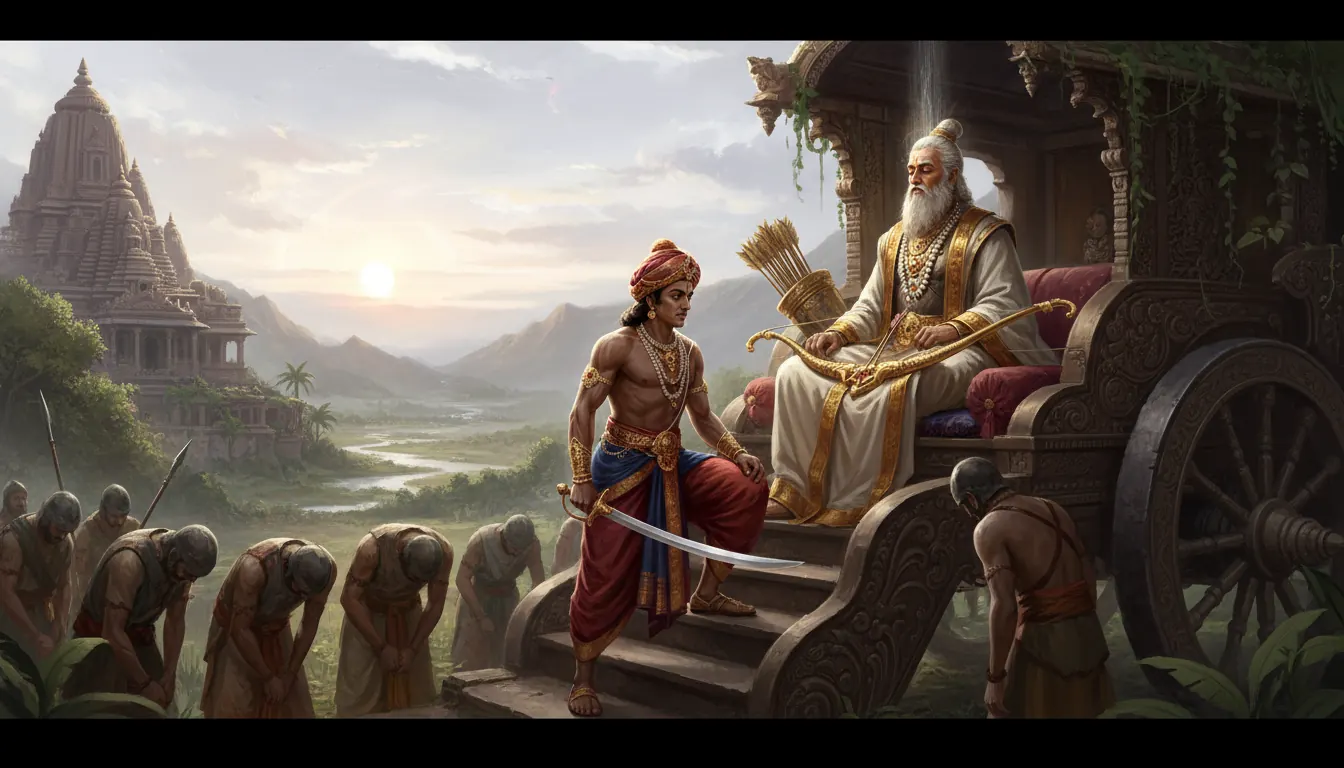
The Arrow Cut in the Air
Satyaki saves Dhrishtadyumna from the teacher's shaft and holds three great bowmen at once, and the day ends with Drona's head in the dust
In short
On the fifteenth day Satyaki cuts down the arrow Drona had aimed at the disarmed Dhrishtadyumna, and then stands alone against Karna, Kripa and Duryodhana while both armies stop to applaud him. Yudhishthira uses the opening to send the Srinjayas against the Pot-born. Drona, warned by omens and by the rishis, kills a hundred and twenty-four thousand men and then lays down his weapons at Bhima's words about his son, and Dhrishtadyumna beheads him while Arjuna is still shouting to take him alive.
Told in the Drona ParvaSet in Kurukshetra17 min read
The Circle That Closed on Satyaki
Sanjaya was telling the fifteenth day to a blind king in a hall, and he began this part of it with one man alone in the middle of the Kaurava line.
Drona had set on his bowstring an arrow of tremendous force, meant for Dhrishtadyumna, the Panchala prince who had been born out of a fire to kill him and who was at that moment standing in front of him without chariot, sword or shield. The teacher was about to kill the disciple who was like his own son to him. Satyaki cut that arrow out of the air with ten arrows of his own.
He did it in the sight of Duryodhana and in the sight of Karna, and Dhrishtadyumna, who had been on the point of going down, was still alive.
Satyaki of the Satvata race, the grandson of Shini, was a Vrishni and Krishna's kinsman, and he had spent that whole day doing things of this kind for people who could not do them for themselves. Now he was ranging along the chariot tracks of the Kuru warriors, inside the reach of the arrows of Drona and Karna and Kripa at once, and destroying the celestial weapons of all three as they came.
From somewhere across the field Krishna and Arjuna saw him doing it.
"Excellent," they said. "Excellent." They said it loudly, so that men heard.
"Look, Keshava," Arjuna said, "look at Satyaki, the upholder of Madhu's race, whose prowess is real, playing with the teacher and those mighty chariot warriors, and gladdening me and the twins and Bhima and King Yudhishthira. See how he ranges over the battle, the pride of the Vrishnis, with skill won by practice and without a trace of arrogance, toying all the while with those mighty chariot warriors."
The Siddhas in the sky were applauding him. The warriors of both armies were applauding him.
When they saw what the Satvata hero was doing, Duryodhana and the others, full of rage, quickly surrounded the grandson of Shini on every side.
One Man Against the Downpour
Kripa came at him with keen arrows, and Karna, and Duryodhana's own division, and the whole weight of that quarter of the field turned inward on one chariot.
Then Yudhishthira saw it, and mighty Bhimasena, and the two sons of Madri, and they came and stood around Satyaki to keep him alive.
It was not needed. Fighting all those chariot warriors at once, the grandson of Shini checked that terrible downpour of arrows as suddenly as his enemies had loosed it. They aimed celestial weapons at him, the great ones, the ones a man spends a lifetime earning the right to call, and Satyaki answered each of them with a celestial weapon of his own and put it out. Karna's, Kripa's, Duryodhana's. He met them all as he should, said Sanjaya, which is a small way of putting what was happening.
What the field looked like while those royal fighters fought is set down without softening.
It was like that scene of old when Rudra, in his rage, destroyed all creatures. Human arms and heads and bows lay in heaps. Umbrellas knocked from chariots, and yak-tail whisks, the ornaments of kings, lay in the same heaps with the arms and the heads. The earth was quickly strewn with broken wheels and with chariots, with massive arms lopped from their trunks, with brave horsemen lying dead. And great numbers of warriors, torn by falling arrows, could be seen rolling and writhing on the ground in the last spasms of death.
That was the ground on which the two armies were watching one Vrishni fight, and admiring him.
The old comparison for such a battle is the war between the gods and the Asuras, and Sanjaya used it, because there was nothing on earth left to compare it to.
And while it was at its worst, Yudhishthira the just looked past Satyaki and past Karna at the one man on that field whose death would end the day, and gave an order.
Rush Against the Pot-Born
"Put out all your strength," the king told his great chariot warriors, "and rush at the Pot-born."
They called Drona that because of his birth. He had not been carried in a woman's body; the sage Bharadwaja's seed had been kept in a vessel, a drona, and the boy had grown in it, and the name that came of that was still on him at eighty-five with an army at his back.
"There is the heroic son of Prishata fighting Drona," Yudhishthira said. "He is doing everything in his power to kill the son of Bharadwaja. From the look of him in this great battle, it is plain that in his rage he will bring Drona down today. All of you together, fight the Pot-born."
It is worth noticing what the king was ordering and what he was not. He did not send them to kill Drona. He sent them to converge on him, so that the man ordained to kill him would have the room and the time to do it. Yudhishthira had already spent one lie that morning on the same purpose, indistinctly adding the word elephant to a name, and he had said it because Krishna had told the sons of Pandu to lay righteousness aside and look to victory. The order he gave now was the second half of the same decision, and there was no lie in it at all, only arithmetic.
So ordered, the mighty chariot warriors of the Srinjayas rushed with great force to kill the son of Bharadwaja.
And Drona, whose aim never missed, rushed at the warriors coming at him.
Sanjaya said the thing plainly, because he wanted his king to understand that the teacher was not surprised by any of what followed. That mighty chariot warrior went out to meet them knowing for certain that he would die.
The Earth Trembled and His Left Hand Twitched
When Drona went forward, the earth trembled violently.
Fierce winds began to blow, filling the enemy ranks with fear. Great meteors fell, seeming to come out of the sun itself, blazing fiercely as they came down, foretelling great terrors. His weapons seemed to blaze in his hands. The chariots rattled loudly of their own accord. The horses shed tears.
And the mighty chariot warrior Drona seemed to have lost his strength. His left eye began to twitch, and his left hand with it.
He looked up and saw Prishata's son in front of him again, and he remembered what the rishis had said to him earlier in the day about laying down his weapons and leaving the world for heaven, and his heart sank.
Then he made the only decision left to a man in that position, and it was not surrender. He wanted to give up his life fighting fairly.
Surrounded on every side by the troops of Drupada's son, the old man began to range over that battle, burning up kshatriyas. Sanjaya gave his king the count, because the count was the point. After killing twenty-four thousand kshatriyas, he sent ten times ten thousand more to Yama's realm with his keen-pointed arrows. Fighting with great care, he seemed to stand in that battle like a smokeless fire.
A smokeless fire is the image for something burning at its absolute limit, with nothing left over, nothing wasted, no soot and no obscurity, only the flame.
Then, to wipe out the kshatriya race, he turned to the Brahma weapon.
This is the aged brahmana whom Bhima was about to lecture on the duties of brahmanas. He was dark-skinned, with white hair hanging down to his ears, eighty-five years old, and for Duryodhana's sake alone he had been ranging over that field as nimbly as a youth of sixteen, for five days, and he was not finished yet.
The Burden Rests Upon You
Somewhere inside that fire the prince of the Panchalas was still on his feet, and he had nothing.
Drona had taken his bow, his chariot, his horses, his driver, his mace, his sword and his shield decked with a hundred moons, one after another, and Dhrishtadyumna had gone on attacking him anyway, on foot, at close quarters, near enough to be killed by a man shooting arrows a span long.
Bhima saw the famous and irresistible prince of the Panchalas without chariot or weapons, and went to him quickly.
He did not tell him to withdraw. He reached down and took him up onto his own chariot, standing beside him where the driver's rail was, with the noise of a hundred and twenty-four thousand deaths going on around the two of them, and said one thing.
"No one but you would dare to fight the teacher. Kill him, and be quick. The burden of killing him rests on you."
That is the whole speech. It is a strange kind of comfort, and it was the truest thing anyone said to Dhrishtadyumna in his life. He had been born out of Drupada's sacrificial fire for one purpose, at a great cost, and he was the only man on the Pandava side whom nobody had asked to spare the teacher, because he was the only one who had never been the teacher's pupil in any way that mattered.
At Bhima's words, mighty-armed Dhrishtadyumna quickly took up a strong bow, a new one, a superb one, that could bear a great strain.
He was full of rage. He shot his arrows at the irresistible Drona and covered the teacher with them, meaning to hold him back, and for a time he did more than hold him back.
Two Ornaments of Battle
Those two ornaments of battle, both great fighters, both full of rage, called up the Brahma weapon and other celestial weapons of every kind, and threw them at each other across a few yards of ground.
Dhrishtadyumna covered Drona with many mighty weapons. And then he did the thing that no one else on that field had managed all day. He destroyed every weapon of Bharadwaja's son as it came, every one, and having destroyed them he turned on the men who were keeping his enemy alive.
The Vasatis, the Sivis, the Bahlikas and the Kurus: those were the troops posted to protect Drona, and the Panchala prince began to kill them where they stood. Shooting showers of arrows on every side at once, he looked at that moment, said Sanjaya, as splendid as the sun shedding his thousand rays.
It did not last. Drona once more cut the prince's bow, and then pierced the prince himself in the vitals with many arrows, and Dhrishtadyumna, standing on Bhima's chariot with his hands empty for the sixth or seventh time that afternoon, was in great pain.
That is the moment at which the war stopped being decided by archery.
Bhima, in a great rage, drove his own chariot up against the teacher's, and took hold of it. He laid his hand on the rail of Drona's chariot, the way a man stops a cart in a lane, and the arrows did not come, because the two of them were now closer than arrows.
And Bhimasena, who had killed twenty and thirty men at a time that week without saying a word to any of them, spoke slowly, so that the old man would hear every part of it.
Why Do You Not Feel Ashamed
"If the wretches among the brahmanas, who are not content with the work of their own order and are well versed in arms, did not fight," Bhima said, "the kshatriya order would not have been wiped out like this.
"Not harming any creature is said to be the highest of all virtues. The brahmana is the root of that virtue. And you are the foremost of all who know Brahma."
He was not inventing a rule for the occasion. The man holding the chariot was a kshatriya doing exactly what his order required of him, and he was telling a brahmana, over the heaped arms and heads of a hundred thousand men, that the whole catastrophe had one root, and that the root was a teacher who would not stay a teacher.
"You have killed all these Mlecchas and other warriors, who were only following the proper work of their order. You were driven to it by ignorance and folly, and by the desire for wealth for the good of sons and wives. Truly, all for the sake of one son," Bhima said. "Why do you not feel ashamed?"
And then he said the sentence he had come to say.
"He for whom you took up arms, and for whom you live, lies dead on the battlefield today, without your knowing it, behind your back. King Yudhishthira the just has told you so. You should not doubt it."
Bhima had spoken the lie first, that morning, a little shamefaced, and Drona had not believed him. Yudhishthira had spoken it second, adding the word elephant so quietly that only the horses heard it. Now Bhima said it a third time, and what he offered as proof was the king's own honesty.
At Bhima's words, Drona laid aside his bow.
Two Suns in the Sky
Wanting to lay aside all his weapons, Bharadwaja's virtuous son first thought of the men he was leaving, and called out to them across the noise.
"Karna, Karna, great bowman. Kripa. Duryodhana. I tell you again and again: fight with care. Do not let the Pandavas harm you. As for me, I lay aside my weapons."
Having said that, he began to call Ashwatthama's name aloud. He said his son's name over and over, out loud, in the middle of a battlefield, and it is not recorded that anyone answered him.
Then he put his weapons down on the floor of his chariot and sat on it, and gave himself to Yoga, and in doing so he gave all creatures assurance and drove away their fears, which is the office of a brahmana and the one he had abandoned long before.
Sanjaya described the posture exactly, because he was one of the few who saw it. Face bent slightly down. Chest pushed forward. Eyes closed. Resting in the quality of goodness. Heart turned to contemplation. Thinking on the single syllable Om, which stands for Brahma, and remembering the mighty, supreme and indestructible God of gods.
And the radiant Drona, great in ascetic merit, the teacher of the Kurus and the Pandavas, went to heaven, which even the pious find hard to reach.
"When Drona went to heaven like that," Sanjaya said, "it seemed to us that there were two suns in the sky. The whole sky was ablaze, one vast expanse of even light, as the sun-like son of Bharadwaja, radiant as the sun, disappeared." Confused sounds of joy were heard from the delighted gods.
Five men among all those thousands saw it: Sanjaya himself, Arjuna, Ashwatthama, Krishna, and Yudhishthira the just.
Nobody else saw anything at all. And Dhrishtadyumna, who was standing right beside him, saw least of all, knowing nothing of any of it.
Do Not Kill Him, Bring Him Alive
What Dhrishtadyumna saw was an old man sitting still with his eyes shut and no bow in his hands.
He gathered all his strength. He laid his own formidable bow down on the chariot with an arrow still on the string, took up a sword, jumped down from the chariot and ran at Drona.
All creatures, human beings and others, cried out in grief. Loud cries of Oh and Alas went up, and cries of Oh and Shame, from both armies at once. Arjuna, the mighty-armed son of Kunti, was shouting across the field with his arms raised, and what he shouted was this:
"Son of Drupada, bring the teacher alive. Do not kill him. He must not be killed."
All the troops cried out the same thing. Arjuna above all, melting with pity, cried it again and again. Every king on that field was saying it.
Ignoring the cries of Arjuna and the cries of all the kings, Prishata's son killed Drona, that bull among men, on the floor of his chariot. He looked at the head, and dragged it, and lopped it from the trunk with his sword, and his enemy never said a word.
Then he was filled with great joy and roared like a lion, whirling the sword.
Covered in Drona's blood, he jumped down from the chariot onto the ground, red as the sun, and very fierce to look at. He carried that great head across the ground and threw it down in front of the Kaurava warriors, where they could see whose it was.
Meanwhile Drona, rising through the skies, had entered the path of the stars. Through the grace of the rishis and of Krishna Dvaipayana, the son of Satyavati, Sanjaya said, he had been allowed to see the true circumstances of that death, and he had seen that glorious man moving on after he had risen, like a smokeless brand of blazing splendour.
On the ground, nobody was looking up.
I Will Embrace You Again
The Kaurava soldiers saw the head, set their hearts on flight, and ran in every direction.
When Drona fell the Kurus and the Pandavas and the Srinjayas all lost heart and ran, and the army broke up. Many had been killed and many wounded by keen arrows. The Kaurava warriors above all seemed more dead than alive. Beaten, and afraid of what was coming, they felt they had lost both worlds, this one and the next, and lost all self-control.
The kings went searching over that field for the body of Bharadwaja's son, and could not find it, because the ground was covered with thousands of headless trunks and one of them was his.
The Pandavas, who had won the victory and great hopes of fame, made a loud din with their arrows and their conchs and roared like lions. And in the middle of that army two men were seen holding each other: Bhimasena and Dhrishtadyumna, the son of Prishata, embracing in the noise.
"I will embrace you again, son of Prishata, as a man crowned with victory," Bhima said, "when that wretch the Suta's son is killed in battle, and that other wretch, Duryodhana, with him."
He named the two men who were left. Karna would command the army by morning, and there were two days in it for him. Duryodhana would last until the eighteenth.
With those words Bhimasena, wild with joy, made the earth tremble by slapping his armpits, and the Kaurava troops, terrified by the sound, ran further, forgetting the duties of kshatriyas and setting their hearts on flight.
The day had opened with Satyaki cutting one arrow out of the air to keep the fire-born prince alive, in the sight of Karna and of Duryodhana, while both armies stood and applauded a man doing something beautiful. It ended with a severed head thrown down in the dust in front of those same armies, and no one applauding, and the Pandavas very glad.
Dharma Lesson
Satyaki's ten arrows were the finest archery on that field, and both armies knew it and said so out loud, and none of it altered what the day was for. Skill of that order can hold a circle of enemies off a friend for as long as the arrows last; it cannot make the friend's purpose any better than it is. What decided the fifteenth day was not marksmanship but the three sentences Bhima said with his hand on Drona's chariot, and the choice of an old man who preferred to put his weapons down rather than go on being the reason the kshatriya order was being erased. The applause went to the man who saved a life. The war went to the men who took one.