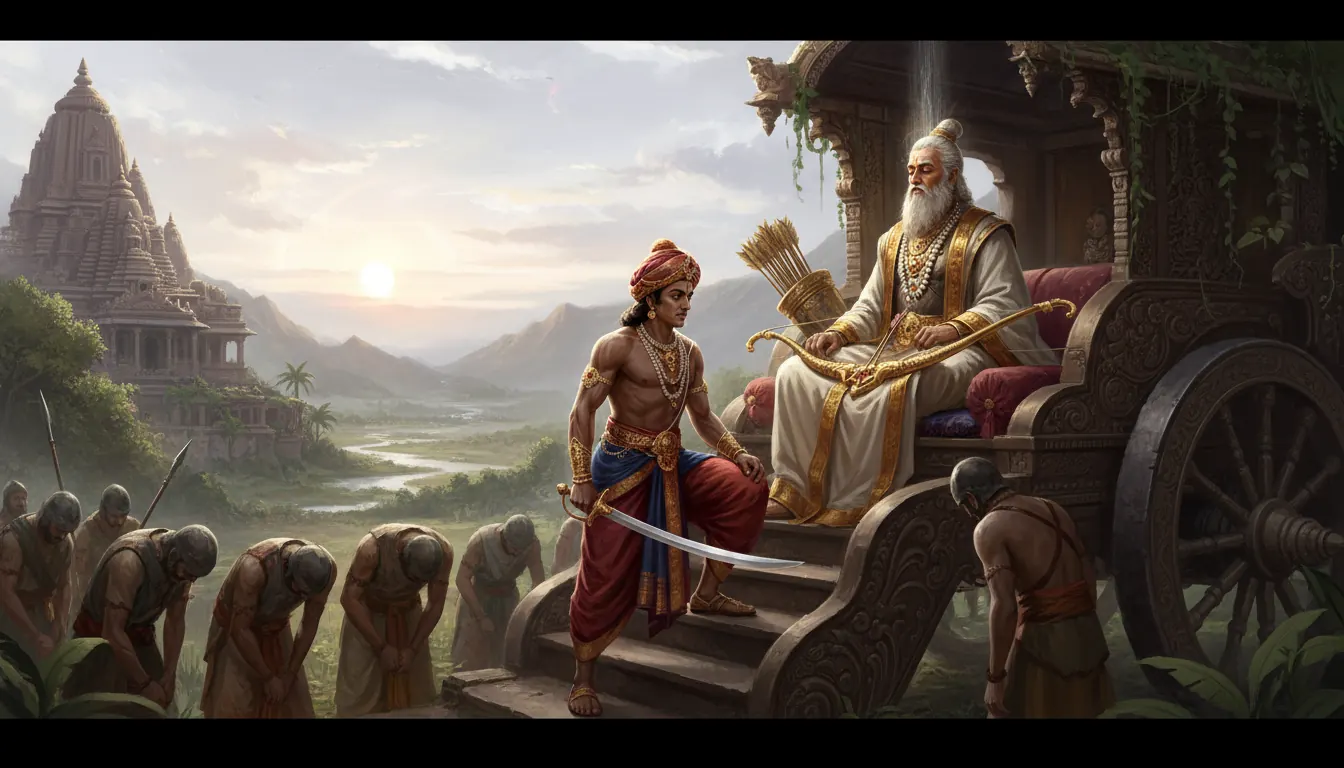
The Whole Host Against Drona
Yudhishthira sends every man he has at the teacher, and the fifteenth morning breaks into duels
In short
After Vyasa turns him back from hunting Karna, Yudhishthira names every warrior in his army and orders all of them at Drona at once. The night battle ends in a truce Arjuna calls for exhausted men, Duryodhana accuses his commander of sparing his old pupils and hears in reply that nobody alive can kill Arjuna, and Bhima shames Dhrishtadyumna into charging the man he was born to kill. As the sun comes up the field sorts itself into single combats: Duryodhana forces Nakula to turn back, Sahadeva takes the head off Dushasana's driver, and Drona and Arjuna answer each other weapon for weapon until neither can win.
Told in the Drona ParvaSet in Kurukshetra22 min read
The Order Given in the Dark
Vyasa had come out of the darkness to Yudhishthira, told him that the rakshasa had been slain by death itself with Indra's dart for its instrument, told him that on the fifth day from that night the earth would be his, and then made himself invisible where he stood.
Sanjaya, telling it afterwards to a blind king in a hall, said that the son of Dharma obeyed him. He gave up the intention of going after Karna with his own hands.
He did not give up the grief. Ghatotkacha was dead in the middle of the night, and the king had loved that boy, who had carried the princess of Panchala on his back over ground she could not walk, twice as much as he loved Sahadeva. So the grief in him turned into orders.
He looked out over the field, where his vast host was being held in check by Bhima alone, and he spoke to Dhrishtadyumna.
"Hold back the Pot-born! Scorcher of foes, you sprang from the fire in mail, armed with bow and arrows and scimitar, to destroy Drona. Rush gladly into battle. You have nothing to fear."
The prince of the Panchalas had been born out of Drupada's sacrificial fire for one purpose only, and the king was reminding him of it in front of the army.
Then he named the rest, and the naming went on until there was nobody left to name. Janamejaya and Shikhandi, Durmukha's son and Yasodhara, were to rush at the Pot-born from every side. Nakula and Sahadeva and the sons of Draupadi and the Prabhadrakas. Drupada and Virata with their sons and brothers. Satyaki, the Kaikeyas, the Pandavas, Dhananjaya. And after the great names, the others.
"And let all our chariot warriors, all our elephants and horses, and all our foot soldiers bring down the mighty chariot warrior Drona in battle."
They went. Every division that had a man standing in it went, in the dark, at one old brahmana in a chariot.
And Drona, that foremost of all wielders of arms, received them.
The Night of Nine Hours
Duryodhana rushed in to protect Drona's life, and the two hosts roared at each other, and then the thing that had been coming all night arrived.
The animals were tired. The men were tired. Great chariot warriors, with their eyes closing and their arms spent, no longer knew what to do. That night of nine hours, said Sanjaya, seemed to them to be everything there was, and by midnight the kshatriyas of both armies were dispirited and the quivers were empty.
What happened then was worse than a rout. Men who had modesty and energy and a regard for the duties of their order kept their places in the line and swayed there. Others let their weapons fall out of their hands and lay down where they were, on chariot floors, on the necks of elephants, on horseback, and slept, and men still awake sent those sleepers to Yama's abode without their ever knowing it. Some, dreaming, killed their own comrades. Some walked about the field blind with sleep and struck at whatever their hands found.
It was Arjuna who stopped it, in a voice loud enough to carry across the whole plain.
"All of you, and your animals, are worn out with effort and blind with sleep. Warriors, you are wrapped in darkness and dust. So rest, if you wish. Close your eyes for a while, here on the battlefield. Then, when the moon rises, Kurus and Pandavas, you can fight one another again for the sake of heaven, having slept and rested."
The Kuru warriors took it up and shouted it along their own line, calling to Karna and to their king to hold. Both armies lay down.
And Dhritarashtra's own troops blessed the man who had been killing them since sunrise. "The Vedas and all weapons are in you. Intelligence and prowess are in you. Righteousness and compassion for all creatures are in you, mighty-armed one. You have given us comfort, and we wish you well, Partha."
Then elephants breathed on the ground and cooled it, and the sleeping host looked like a picture drawn on canvas by skilful artists, and the moon came up out of the east like a lion out of a cave with a mane of yellow rays.
That sea of troops woke as a bed of lotuses opens, and began again.
The Kindness You Showed Them
Duryodhana did not lie down. He came to Drona's chariot with his anger already chosen, and he spoke to inspire the old man with joy and provoke him at the same time, which was the only way he knew how to speak to him.
"We should have shown our enemies no mercy while they were disheartened and worn out and resting, especially since they all shoot so true. To please you we were kind to them and left them alone. But the tired Pandavas have grown stronger. As for us, we are losing energy and strength in every way. The Pandavas, with you to protect them, keep on prospering."
Then the flattery, which was the barb inside it.
"Every celestial weapon and every weapon of Brahma is in you. I tell you truly that neither the Pandavas nor we nor any other bowmen in the world can match you when you are fighting. With your celestial weapons you could certainly destroy the three worlds, with the gods, the asuras and the gandharvas. The Pandavas are all afraid of you. But you forgive them, remembering that they were your pupils, or perhaps because of my ill luck."
Drona had been fighting since the eleventh day. He had killed Drupada's allies in heaps, he had taken the Sindhu king under his own protection and lost him, and he was eighty-five years of age, and his king had just told him in the hearing of the guard that he was going easy on the boys he had taught.
He answered in anger, and every word of the answer was a promise.
"Old as I am, Duryodhana, I am still fighting with every bit of strength I have. All these men know nothing of weapons, and I know them well. If I killed them for the sake of victory, there could be no baser act for me. But whatever is in your mind, good or bad, I will do at your command, Kaurava. It will not be otherwise. I will put forth my prowess in battle and kill all the Panchalas, and then I will take off my armour, king. I swear this to you truly."
He would kill every Panchala on the field, and then he would take his armour off. He said the second half as calmly as the first.
The Man You Cannot Kill
Then Drona turned to the other thing his king had said, that Arjuna was worn out and could be finished in the morning.
"You think Arjuna, the son of Kunti, was worn out in battle. Listen to the truth about his prowess. Once Savyasachin's wrath is roused, neither gandharvas nor yakshas nor rakshasas dare face him."
He went through the record like a teacher reading marks. At Khandava that boy had met the chief of the celestials himself and stopped the pouring rain of Indra with his shafts. On the occasion of the tale of cattle, when the gandharvas headed by Chitrasena carried the Kauravas off as prisoners, it was Arjuna who beat them and brought his cousins back. "That firm bowman rescued you, while you were being carried away." The Nivatakavachas, whom the gods themselves could not kill, he had killed, and thousands of danavas in Hiranyapura he had defeated alone.
"How then can human beings withstand him? King, you have seen with your own eyes how this host of yours, for all its heroic fighting, has been destroyed by the son of Pandu."
Duryodhana heard his teacher praising the enemy, and grew angrier.
"Dushasana and Karna and my uncle Shakuni and I will divide this Bharata host into two and kill Arjuna in battle today."
Drona laughed at him.
"Blessings on you. What kshatriya could kill that bull among kshatriyas, the bearer of Gandiva, whom no one can kill? Neither the Lord of treasures, nor Indra, nor Yama, nor the asuras, uragas and rakshasas can stop Arjuna when he has his weapons. Only fools talk the way you have just talked. Who has ever met Arjuna in battle and come home safe?
"As for you, you are sinful and cruel and you suspect everybody. You are ready to scold like this even those who are working for your good. You are the root of this hostility. So go against Arjuna yourself. And let this uncle of yours, this gambler skilled at dice, wedded to deceit, a master of cunning and trickery, who knows every way to cheat, let him defeat the Pandavas in battle.
"With Karna beside you, you have often boasted in your father's court that the three of you would kill the sons of Pandu. Keep your vow. Be true to your word with them. There stands your mortal enemy in front of you. You have given in charity. You have had as much wealth as you wished. You have no debts. Do not be afraid. Fight the son of Pandu now."
With those words said, the battle began.
Prayers at the Edge of the Dust
When three-fourths of the night had worn away the fighting had begun again, and both sides went into it elated, which is what men are when they have slept. Then Aruna, the charioteer of the sun, came up ahead of his master and weakened the moon, and the sky turned coppery, and the east reddened like a circular plate of gold.
And every man on that field, on both sides, got down.
They came off their chariots and off their horses and out of the litters borne by men, and stood facing the sun with their palms joined, and said the prayers of the twilight of dawn, in the middle of a battle that had been going since the previous sunrise and had killed a rakshasa, an army and most of a night. Then they got back on and killed each other.
The Kuru host had been divided into two bodies as Duryodhana promised. Drona took one of them, with the king riding in front of him, and moved against the Somakas and the Panchalas.
Krishna saw the split and told Arjuna what to do with it. "Keep the enemy on your left, and put this division on your right." Arjuna obeyed the counsel and moved to the left of those two mighty bowmen, Drona and Karna.
Bhima understood what Krishna intended and said his own piece to his brother, who was standing at the very front of the army.
"Arjuna, Bibhatsu, listen to me. The moment for which kshatriya women bear sons has come. If you do not strive to win prosperity now, you will be acting as meanly as any wretch. Put forth your prowess and pay the debt you owe to Truth, Prosperity, Virtue and Fame. Greatest of warriors, break through this division, and keep these on your right."
Urged by Bhima and by Keshava together, Savyasachin went in and prevailed over Drona and Karna and began to resist the enemy on every side, consuming the foremost of them like a raging fire. Duryodhana and Karna and Shakuni covered him with showers of shafts, and he stopped all three and put ten keen-pointed arrows into each of them.
After that nobody could see anything. The dust went up, the arrows came down, darkness set in at sunrise, and the kings on that field fought by guesswork and by the names men shouted, striking at voices.
The Smokeless Fire in the North
Out of that blindness Drona did something simple. He drew off from the fighting, went north, and stood there.
He was alone, resplendent, blazing with energy, and Sanjaya says he looked like a fire without any smoke in it. The Pandava troops, seeing him standing apart and waiting, began to tremble. He was summoning the hostile army to come to him, like an elephant in rut, and the enemy became utterly hopeless of defeating him, as the danavas are hopeless of defeating Vasava.
What men do at such a moment is worth recording, and Sanjaya recorded it. Some lost heart. Some, who had energy, grew angry instead. Some were filled with wonder. Some could not bear the challenge at all. Some squeezed their hands together. Some, out of their senses with rage, bit their lips. Some whirled their weapons and some rubbed their arms.
And some, with great energy and their souls under complete control, went at him.
The Panchalas went first, afflicted already by his shafts, fighting in great pain. Then the two old kings, Drupada of Panchala, who had been Drona's friend as a boy and his enemy for forty years, and Virata of the Matsyas, in whose kitchens and stables the Pandavas had hidden through the thirteenth year. Behind them came three grandsons of Drupada and the Chedis.
Drona killed the three grandsons with three sharp shafts, one each, and the princes fell dead from their chariots. He beat the Chedis, the Kaikeyas and the Srinjayas. He beat every Matsya on the field.
Then Drupada and Virata shot showers of arrows at him together, and he covered them both, and they went on piercing him in a rage until he cut off both their bows with two broad-headed shafts. Virata sent ten lances and ten arrows at him. Drupada hurled a dart of iron decked with gold, like a large snake, at his chariot. Drona cut the ten lances out of the air, and then the dart with its gold and its lapis lazuli, and then, with one well-tempered broad-headed shaft for each of them, he sent both those old kings to the abode of Yama.
Dhrishtadyumna had watched his father and Drupada's three grandsons killed in front of him within a few minutes. He swore aloud, where all the chariot warriors could hear it.
"May I lose the merit of all my religious acts, and my kshatriya and Brahma energy too, if Drona escapes me alive today, or if he defeats me."
What Bhima Said to the Fire-Born
The oath was magnificent and it changed nothing, because Drona was not standing alone any more.
Duryodhana and Karna and Shakuni and the king's brothers born of the same mother had closed round the teacher in order of rank, and behind that screen he was untouchable. The Panchalas struck at one side of him and Arjuna at the other, and struggle as they might, Sanjaya says, the Panchalas could not even look at him. Dhrishtadyumna advanced with his own division and stopped where the arrows stopped him.
And Bhima, watching the man who had sworn the oath sit at a distance from the man he had sworn it about, became highly angry, and stung him with words.
"What man counted a kshatriya, born in the race of Drupada, the greatest of all who know weapons, would just look like this at his enemy standing in front of him? What man who has seen his father and his son killed, and above all who has sworn such an oath in the presence of the king, would be so indifferent to his enemy?"
Then he pointed at Drona, and what he said about him was not an insult. It was an assessment, and it was accurate.
"There stands Drona like a fire swelling with its own energy. With bow and arrows for fuel, he is burning up all the kshatriyas with his energy. Soon he will wipe out the Pandava army."
And then, because there was nobody else left to do it, he took the job himself.
"Stand back and watch what I do. I will go against Drona himself."
Vrikodara went into Drona's array filled with rage, and began to afflict that host and rout it. He did not go round the screen of princes. He went through it.
Dhrishtadyumna, shamed, came after him, broke into the same great host, and at last came to grips with Drona.
The battle that began there was one that Sanjaya, who had seen fourteen days of this war, said he had never seen or heard the like of before. Chariots were entangled with one another and could not be pulled apart. Bodies were scattered over the whole field. Men crossing to another part of the line were killed on the way by people they never saw, and men running away were struck in the back, and men were struck in the side.
And while that was going on, quietly, behind the dust, the morning sun came up.
Four Pairs, and a Brother on the Right
The men who had fought all night fought on into the daylight against the same men they had been fighting in the dark. Many of them, weak with hunger and thirst and worn out with exertion, lost their senses where they stood. Horses and elephants stood on the field with their limbs perfectly motionless. Horses of the noblest breed trembled with the effort of dragging chariots whose wheels had sunk into ground made soft by blood, and there was no path anywhere for a chariot, because of the dead and the dying and the animals that had come to eat them.
Sanjaya, who had to describe it to a man who could not see it, reached for washing-day. Swords hurled from the hands of heroes lay heaped on the field like heaps of cloths at the washing ground, and the sound of blades lifted and brought down in heroic arms was the sound of cloth being thrashed for wash. The river that ran off that field toward the regions of the dead had blood for its current, weapons for its fish, wails of pain for its roar and banners for its froth.
In all that host, he said, only two men were not afraid: Drona and Arjuna. Each side had exactly one refuge, and everyone who met either of those two went to Yama.
Then, out of the general confusion, the fighting sorted itself into four pairs. Karna took Bhima. Arjuna took the son of Bharadwaja. And Duryodhana with his brothers came against the twins.
Duryodhana got Nakula, and Nakula was pleased to see him.
Madri's son cheerfully shot hundreds of shafts and manoeuvred until he had placed the king of the Kurus on his right, which is the position a chariot warrior wants and cannot usually get, and the Pandava troops gave him a great cheer for it. Duryodhana, put on the right by his own cousin in front of both armies, filled with rage and began to fight back from that very side, countering him wonderfully. Nakula, who knew every course a chariot can be driven in, worked to hold him there. But Duryodhana afflicted him with showers of shafts, resisted him on every side, and made him turn back, and this time it was the Kaurava troops who applauded.
Nakula did not go far. He turned in his chariot and called after the man, and what he said was very short, and thirteen years old.
"Wait. Wait."
The Driver Who Had No Head
Dushasana came at Sahadeva with such speed that the earth shook under the chariot.
Sahadeva did not shoot at him. He shot one broad-headed arrow and took off the head of the driver, head-gear and all, while the chariot was still coming, and he did it so quickly that neither Dushasana nor anybody in either army noticed that it had happened. The reins were not being held by anyone. The horses ran where they liked. That was how Dushasana learned that his driver was dead.
What he did then his enemies applauded. He knew how to manage horses, and he took the reins himself and fought from a driverless chariot, fearlessly, with great activity and skill, and friends and foes alike called out at the sight.
Sahadeva shot the horses. In pain, they bolted, running wherever they chose, and Dushasana had to put his bow down to catch at the reins and put the reins down to pick up his bow, and every time he laid one of them aside the son of Madri covered him with arrows.
Karna saw it and came to rescue him. Bhima met Karna first, drew his bow to its fullest stretch and put three broad-headed shafts into his chest and arms, and Karna, struck like a snake with a stick, stopped and turned on him.
They came so close so fast that neither could shoot. So they took up maces.
Bhima broke the shaft-pole of Karna's chariot at one blow, which the whole field thought wonderful. Karna hurled a mace at Bhima's chariot and Bhima broke it with his own. Bhima threw a heavy mace and Karna hit it in the air with volleys of beautiful winged shafts, and it came back toward the thrower like a snake afflicted by incantations, and on the way it snapped Bhima's great standard and knocked his driver senseless. Bhima answered with eight arrows and cut away Karna's standard, his bow and his leather fence.
Karna took up another bow, gold-decked and invincible, and killed Bhima's horses, which were the colour of bears, and then both his drivers.
And Bhima, with his chariot ruined under him, jumped across into Nakula's, the way a lion jumps down on to a mountain summit.
Teacher and Pupil
Meanwhile the other pair had found each other, and the war stopped to watch.
Drona and Arjuna, teacher and student, fought in a way that dazzled the eyes and minds of the men around them: the lightness of the hands, the sureness of the aim, the motions of the two chariots. The warriors nearest them gave up fighting and trembled. Each kept trying to work his chariot round so as to place the other on his right, and neither could do it, and Sanjaya says the whole thing was like two hawks in the sky fighting over a piece of meat.
Whatever Drona did to defeat the son of Kunti, Arjuna did the same thing back at him, and it cancelled.
So Drona went to the weapons. He called up the Aindra, the Pashupata, the Tvashtra, the Vayavya and the Yamya astras, and as fast as they left his bow Dhananjaya destroyed them. He shrouded his pupil in the mightiest of the celestial weapons and every one was met and stopped.
And Drona, seeing his whole armoury turned back at him, applauded Arjuna in his heart. He thought himself, at that moment, superior to every man in the world who knew anything about arms, for the reason that this man had been his pupil.
The sky filled up. Celestials and gandharvas in thousands, rishis, siddhas, apsaras and yakshas gathered until the sky seemed clouded over, and an invisible voice went through the firmament praising both of them, and the siddhas said what they were seeing.
"This is no battle of men, or asuras, or rakshasas, or gods, or gandharvas. This is surely a high contest of Brahma. Now the teacher gets the better of the son of Pandu, and now the son of Pandu gets the better of Drona. No one can tell any difference between them. Only if Rudra split himself in two and fought himself could anything be found to match this. Science, gathered in one place, is in the teacher. The science and the means are both in the son of Pandu."
Then Drona invoked the Brahma weapon.
The earth trembled with its mountains and waters and trees. Fierce winds got up. The seas swelled. Both armies were filled with fear when he lifted it.
Arjuna stopped it fearlessly with a Brahma weapon of his own, and the world went quiet again.
Neither of them could beat the other. That is all. The armies closed over the top of them and the dust came back, and nothing on that field could be distinguished any longer, and the shafts fell so thickly that the creatures who live in the air could find no passage through their own element.
Dharma Lesson
Yudhishthira answers grief by ordering everyone at one man, and the order is obeyed and achieves nothing, because a host is not a weapon and Drona is. What moves the day is not the mass but the individuals inside it: an oath that Dhrishtadyumna swears and then sits on, Bhima's refusal to let the oath stand unused, a younger brother who works a king into a bad position for the pleasure of saying wait to him. Notice also who gets applauded here. Dushasana, of all people, is cheered by both armies for driving his own ruined chariot, and Drona, beaten back at every weapon, ends the morning admiring the pupil who is beating him. The epic keeps insisting that the side a man fights on and the quality of his conduct in an hour are two separate accounts.