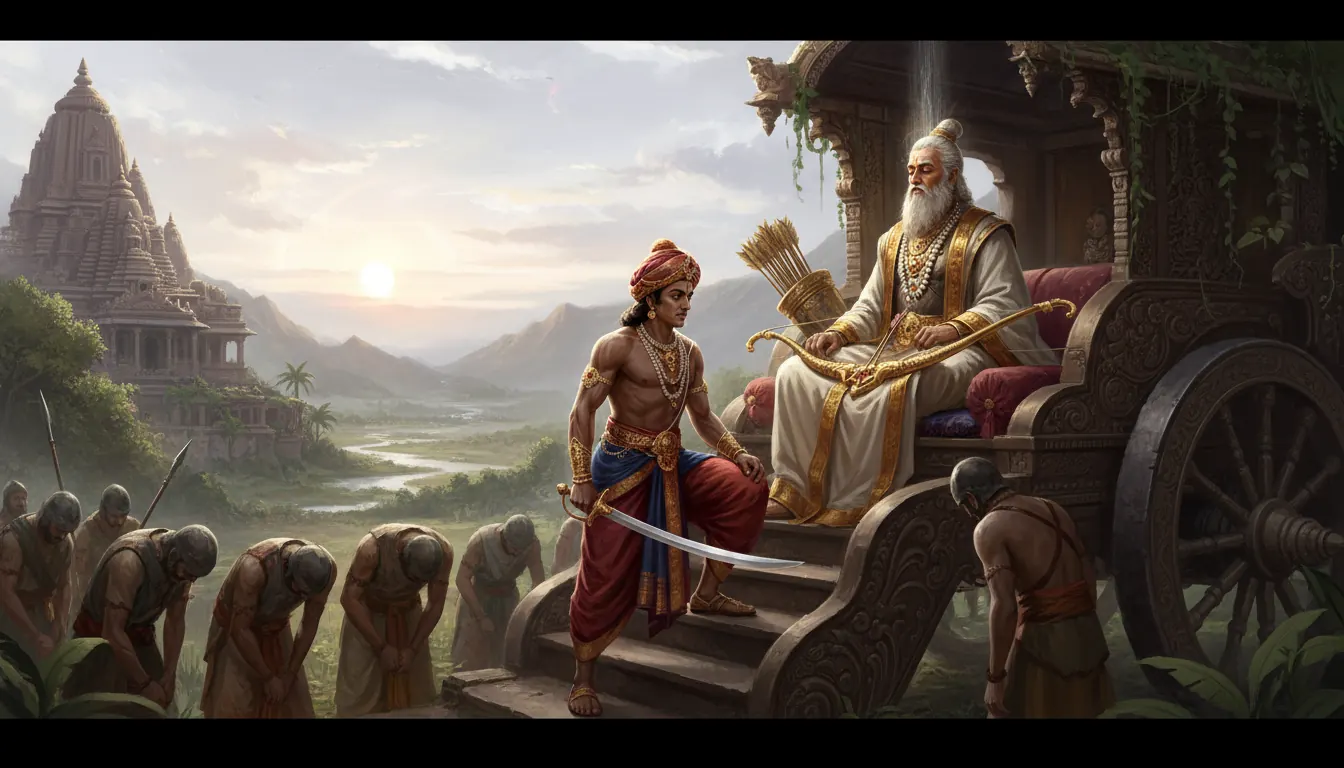
The Two Who Remembered
Duryodhana and Satyaki meet on the fifteenth day and talk about their childhood before they fight
In short
On the fifth day of Drona's command, Duryodhana and Satyaki come face to face and recognise each other as the boys who once played together in their teacher's house. They lower their bows, smile, and hold a short conversation about wrath, wealth and Time. Then Satyaki tells the king to kill him quickly and advances, and the two of them fight until Karna and Bhima carry the battle away from them.
Told in the Drona ParvaSet in Kurukshetra15 min read
The Fifth Day of Drona's Command
Sanjaya had been talking since morning, and the man he was talking to could not see any of it.
It was the fifth day since Drona had taken the command of the Kaurava host, and by then the field had swallowed Bhishma and Abhimanyu and the king of the Sindhus. Dhritarashtra sat in his hall and listened, and Sanjaya, who had been given the sight to watch the whole of Kurukshetra at once, told him what his sons were doing on it.
"During that fearful slaughter of men and horses and elephants, king," Sanjaya said, "Dushasana met Dhrishtadyumna."
Dhrishtadyumna was the son of Drupada, who had come out of a sacrificial fire for one purpose, the killing of Drona, and everybody on that field knew it, including Drona. He was mounted in his golden chariot. Dushasana's arrows hurt him badly, and the anger came up in him through the pain, and he showered his own arrows on the horses of the man in front of him.
Covered by the arrows of Prishata's son, Dushasana's chariot, with its standard and its driver, soon became invisible.
That is the word Sanjaya used to a blind king. Invisible. There was a chariot somewhere inside that cloud, and a prince standing in it, and nobody watching from either army could have found either one. Battered by those showers of arrows, Dushasana could no longer hold his ground before the illustrious prince of the Panchalas.
So the Panchala forced him, by means of his shafts, to turn back. And then did not follow him.
He scattered his arrows and went on, past the man he had beaten, in the direction of the one man he had been born to reach.
He proceeded against Drona.
The Weapons They Would Not Use
At that moment Hridika's son, Kritavarma, appeared with three of his brothers born of the same mother and tried to stop him.
Kritavarma was a Vrishni, of Krishna's own clan out of Dwaraka, and he had brought the Vrishni armies to Duryodhana while Krishna went unarmed to the other side. He came in across the Panchala's road with his brothers behind him, four chariot warriors against one.
Then the twins came up. Nakula and Sahadeva, following in the wake of Dhrishtadyumna, who was proceeding like a blazing fire towards Drona, began to protect him.
Then all those great chariot warriors, mighty and roused to rage, began to strike one another, with death as their goal. And here Sanjaya stopped the account of the fighting to say a thing about these seven men that he says of almost nobody else in the whole war.
Pure in soul and pure in conduct, with heaven in view, they fought by righteous methods, each wanting to defeat the others. Stainless in lineage and stainless in their acts, those rulers of men fought fair battles with each other. There was nothing unfair in that fight, and no weapon was used that was regarded as unfair.
Then the list of what was not used, which is worth going through slowly, because every item on it is a thing that men elsewhere on that same field were using that afternoon.
No barbed arrows. None of those called nalikas. None that were poisoned. None with heads made of horns. None equipped with many pointed heads. None made of the bones of bulls or of elephants. None having two heads. None having rusty heads. None that were not straight going.
All of them used simple and fair weapons, and desired to win both fame and regions of great blessedness by fighting fairly. They were also, the entire time, trying to kill one another, and nothing in the epic finds that strange.
Held back by those two lions among men, the four heroes threw themselves at the twins like the wind beating on two mountains in its way. And Dhrishtadyumna, very quick with his weapons, saw that his road had been cleared for him, and took it.
Two Men Who Smiled
Duryodhana saw the whole of it from where he stood.
He saw the invincible prince of the Panchalas going after Drona, and he saw his own four heroes held up by the twins, and there was nobody else near enough to be sent. So the king of the Kurus went himself, rushing to that spot, scattering showers of blood-drinking arrows.
Seeing this, Satyaki quickly approached the Kuru king.
Satyaki was the grandson of Shini, a bull of the Satvata race, a Vrishni out of Dwaraka and Arjuna's own pupil in arms, and he was the man the Pandavas sent when a thing had to be done and there was nobody left to do it. On this same field he had already cut a road for himself alone through the entire Kaurava army.
But long before Dwaraka and long before the war, he had been a boy in Hastinapura, in the same house and under the same teacher as the prince who was now coming at him with his bow bent.
Those two tigers among men, the descendant of Kuru and the descendant of Madhu, came up to each other, each wanting to strike the other in battle.
And then neither of them shot.
Remembering how they had been with each other as children, and thinking back on it with pleasure, they gazed at each other and smiled again and again.
Sanjaya does not say how long it lasted. There was an army on either side of them and a teacher being hunted a little way off, and in the middle of it two men held their bows half drawn and looked at one another across the space between two chariots, and smiled, and then smiled again.
Then king Duryodhana, blaming himself in his mind, spoke to Satyaki, the friend who had always been dear to him.
A Curse on Anger
"A curse on anger, my friend," the king said, "and a curse on vindictiveness. A curse on the kshatriya code, and a curse on might and prowess, since you are aiming your weapons at me, and I am aiming mine at you, bull of Shini's race."
Four things cursed in one breath, and the third of them is the code he had lived his entire life inside. A kshatriya fights. That is the whole of the code, and it is the argument Duryodhana had used against every man who ever came to him asking for peace, including the one who had asked for five villages and been refused a needle's point of ground. Standing in front of Satyaki with his bow up, he spat on it.
"In those days you were dearer to me than life itself, and I was the same to you."
He was not being polite. The two of them had been raised in the same courtyard, and in the epic's reckoning of who loved whom in that generation, this is a fact recorded and then never used again.
"Alas, all those things we did as children, you and I, that I remember, have become quite insignificant on the field of battle."
Not forgotten. He remembered them. He was reciting them to himself while he said this. What he says is that they had become insignificant, which is a different and worse thing, because it means he could still see them clearly and they had stopped weighing anything.
"Alas, driven by anger and greed, we are here today to fight each other, you of the Satvata race."
Anger and greed. He names the two causes correctly, in public, on the fifteenth day of a war that had already emptied his house of brothers, and he names his own share in them without argument. No man in the epic ever accused Duryodhana of not knowing what he was doing.
He simply never once stopped doing it. The bow stayed up while he spoke.
This Is No Assembly
To the man who had said those words, Satyaki, master of high weapons, picking up some sharp arrows, replied with a smile.
He was choosing his arrows while he answered. The text puts the two actions in the same sentence, and it is the whole of Satyaki's character in one line.
"This is no assembly hall, prince, nor our teacher's house, where we played together in the old days."
That is all he gives him. You are remembering a hall and a teacher's house. Look around you.
Duryodhana would not let it go.
"Where have those games of our childhood gone, bull of Shini's race, and, alas, how has this battle come upon us? It seems that the power of Time cannot be resisted. We are driven by desire for wealth, yet what use is wealth to us, that greed for wealth has brought us here together to fight?"
He asks how the battle came upon them, as though it had come upon them like weather. Then he answers himself with Time, which is the answer that costs nobody anything. And then, at the very end, without seeming to notice that he is doing it, he asks the only question in the speech that has teeth in it. What use have we of wealth, when the wealth has brought us here?
He never waited for an answer to that one, and Satyaki did not give him one.
"This has always been the code of the kshatriyas," Satyaki said, "that they must fight even their teachers. If I am dear to you, king, then kill me without delay. Through you, bull of Bharata's race, I will then enter the realm of the righteous. Show all your might and prowess, and do not delay. I do not wish to see this great calamity of friends."
He had picked up the one thing Duryodhana had cursed, the kshatriya code, and set it back on its feet. Then he offered the king his own life as the shortest available way out of the conversation, and told him to hurry.
With that answer and that reasoning, Satyaki, fearless and without a thought for his life, quickly advanced on Duryodhana.
The Count of the Arrows
When he saw him coming, Dhritarashtra's son met him and poured a perfect shower of arrows on the man of Shini's race.
Then commenced a terrible battle between those lions of Kuru's and Madhu's races, resembling an encounter between an elephant and a lion.
Duryodhana, filled with wrath, pierced the invincible Satyaki with many keen arrows shot from his bow drawn to its fullest stretch. Satyaki pierced the Kuru prince in return with fifty keen shafts, and once more with twenty, and again with ten. Then the king, smiling the while, pierced Satyaki in return with thirty arrows shot from his bowstring drawn to his ear, and then, shooting a razor-headed arrow, cut off in twain the bow of Satyaki with the arrow still fixed on it.
Very quick of hand, the Satvata took up a tougher bow and shot showers of arrows at him.
As those lines of arrows advanced for compassing the death of Duryodhana, the king cut them to pieces in the air, and the troops on his side shouted. It was, so far, the best hour Duryodhana had in the whole war. With great swiftness he afflicted Satyaki with seventy-three shafts equipped with wings of gold and steeped in oil, shot from a bow drawn to its fullest stretch.
All those arrows, and the bow that had sent them, and the arrow standing ready on it, Satyaki quickly cut off. Then he poured his own showers on his antagonist.
Deeply pierced by Satyaki and in great pain, Duryodhana, badly shaken, took shelter in another chariot.
He rested there a while and recovered, and then came out again and advanced on Satyaki, shooting at his chariot; and, smiling, said Sanjaya, Satyaki shot swarms of arrows at his without pause. The arrows of both met and mingled in the sky. Falling fast on every side, they made a sound like a raging fire consuming a mighty forest. With the thousands of arrows shot by the two of them the earth was densely covered, and the sky was filled as well.
Neither of them had said another word since the advance. Whatever they had been to each other in their teacher's house, it had lasted exactly as long as the conversation.
The Chariot With One Wheel
Seeing that this great chariot warrior, the hero of Madhu's race, was mightier than Duryodhana, Karna rushed to the spot to rescue the king.
Mighty Bhimasena, however, could not brook that attempt. He quickly proceeded against Karna, shooting innumerable shafts, and the two of them met once more, as they had met before in that war.
Cutting off all those shafts of Bhima with the greatest ease, Karna cut off Bhima's bow, his arrows and his driver also, with his own shafts.
Then Pandu's son, filled with rage, took up a mace.
He crushed his opponent's bow with it, and the standard, and the driver, and then he broke one of the wheels of Karna's chariot.
Karna, however, stood in his chariot with its broken wheel, as unmoving as Meru, the king of mountains. That beautiful chariot, which now had only one wheel, was carried along by his horses like the one-wheeled chariot of Surya drawn by the seven celestial horses.
Sanjaya gives the comparison without comment, and it is the most generous thing said about Karna anywhere in this section, and it is also the shape of his death. There is a wheel of Karna's that everyone in the audience is waiting for. It has not sunk into the earth yet. Here it is merely broken, and the horses keep the wreck moving, and the sun's son stands in the sun's chariot and goes on shooting.
Unable to bear Bhimasena's feats, Karna kept fighting him, using many kinds of arrows in great numbers and many other weapons besides. And Bhimasena, also filled with wrath, continued to fight with the Suta's son.
Somewhere behind them Duryodhana had been let alone, and the duel that had begun with two men smiling at each other was over, and neither of them had killed the other, and nobody on that field remarked on it at all.
The Order the King Gave
When the engagement had become general and confused, the son of Dharma looked at the Panchalas and the Matsyas standing at the edge of it, and spoke to them.
"Those who are our life, those who are our heads, the strongest among us, those bulls among men are all locked in battle with the Dhartarashtras. Why then do you stand here as if stunned and out of your senses? Go where those chariot warriors of my army are fighting."
He gave them a reason next, and it is the plainest arithmetic Yudhishthira ever spoke aloud.
"Put away your fears, keep the duties of kshatriyas in view, and fight, for then, victorious or killed, you will reach a worthy goal. If you win, you can perform many sacrifices with rich gifts to brahmanas. If, on the other hand, you are killed, you will become equal to the gods and win many realms of bliss."
Win and you can pay for the rites. Die and you have already been paid. That was the whole of the offer, and it is the same offer Satyaki had made to Duryodhana an hour earlier when he told him to kill him quickly, and it is what the men on both sides had been living on since the first morning.
Urged on by the king, those heroic and mighty chariot warriors went into battle, mindful of kshatriya duty, and quickly advanced on Drona. The Panchalas attacked him from one side with countless arrows, while others led by Bhimasena began to hold him back from another.
Then Bhimasena and the twins addressed Dhananjaya loudly.
"Go quickly, Arjuna, and drive the Kurus away from Drona. If the teacher can be stripped of his protectors, the Panchalas can then kill him easily."
At that, Partha suddenly rushed at the Kauravas, while Drona rushed against the Panchalas headed by Dhrishtadyumna.
And on that, the fifth day of Drona's command, said Sanjaya to the blind king, those heroic combatants were grounded and crushed with great celerity by the son of Bharadwaja.
Dharma Lesson
Duryodhana names his own faults exactly, wrath and covetousness, and curses the code that brought him there, and then keeps his bow up and shoots. Knowing what is wrong with you turns out to be no part of stopping. Satyaki answers him with the harder honesty: this is not the teacher's house, the usage of kshatriyas is to fight even those we love, and if the memory is worth anything then kill me now and let me go to the region of the righteous. Between a man who mourns what he is doing and a man who refuses to pretend the mourning changes it, the epic gives the last word to the second.