The Cow Born of Nectar
Daksha's gift, Mahadeva's third eye, and why cattle wear many colours
In short
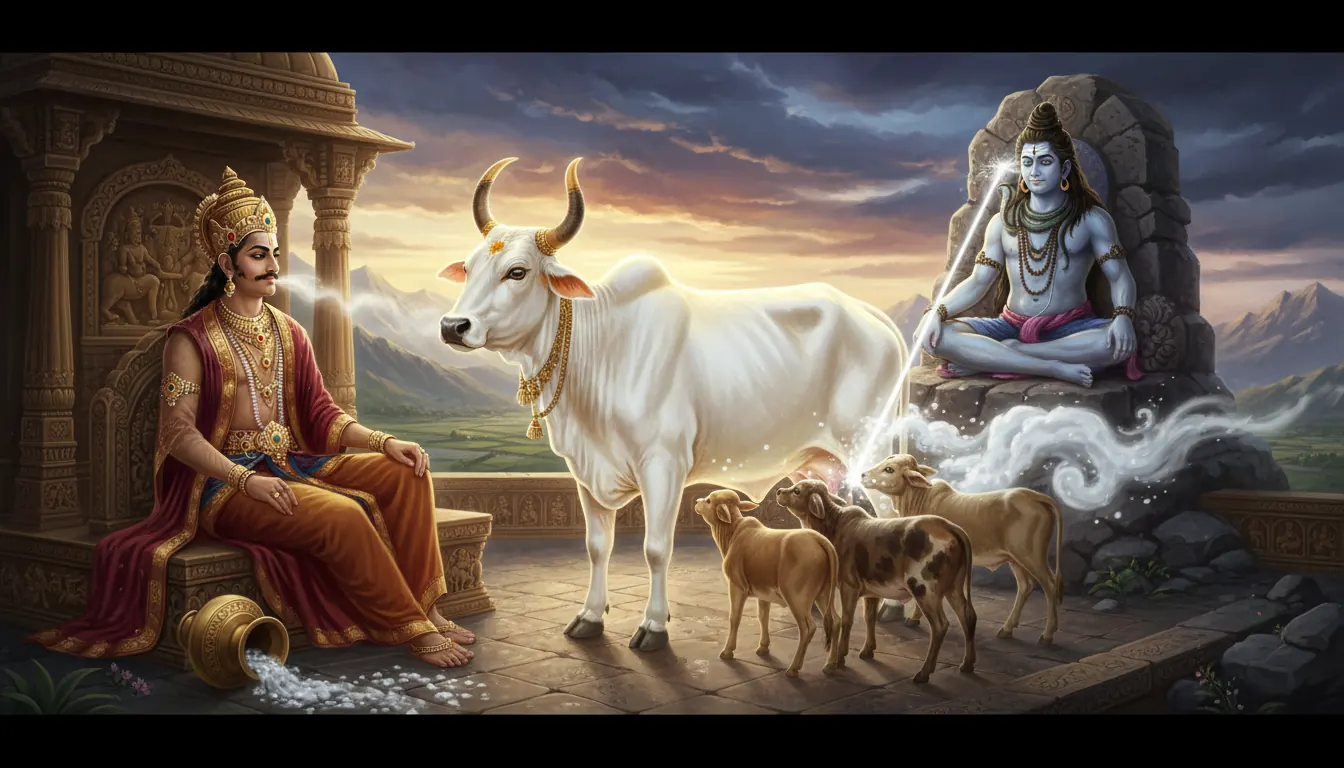
Yudhishthira asks once again about the gift of cows, and Bhishma answers him with an origin. Commanded to create, Daksha makes food before he makes creatures, and when the newborn cry for it he drinks the nectar himself; from his fragrant breath comes the cow Surabhi. Froth from her calves falls on Mahadeva, whose third eye scorches the herd into every colour cattle have worn since.
Told in the Anushasana ParvaSet in Kurukshetra and Brahmaloka14 min read
Not Yet Satisfied
"King Yudhishthira, in all humility, once again asked the royal son of Shantanu about the gift of cows in detail," said Vaishampayana.
Janamejaya moved his hand. "Again? He had already asked."
"He had asked before, king, and he asked again, and this is what he said to the old man on the arrows. 'Speak to me once more, Bharata, in detail, on the merits of giving away cows. Truly, hero, I have not yet been satisfied with hearing your words, which are like nectar.'
"You must understand what the request was really for. The war was over. Every man of that generation whom Yudhishthira had grown up beside was ash on the Kurukshetra plain, and the grandsire was going to die as soon as the sun turned north, and the king had discovered the one thing that would keep him talking. So he asked about cows. And Shantanu's son, when Yudhishthira the just had said this, began once again to speak in detail on the merits of the gift of cows, and did not once say that he had covered it already."
Janamejaya said, "And this is where the cow of the gods comes into it."
"This is where she comes into it," said Vaishampayana. "But Bhishma began with the cows a man can actually put his hand on, because he always did, and the celestial part only arrived because the king interrupted him with a question about colour."
Which Cow May Be Given
"'By giving a brahmana a cow with a calf,' said Bhishma, 'a gentle cow of good qualities, young in years, and wrapped in a piece of cloth, a man is cleansed of all his sins. There are many regions in hell that are sunless. One who gives such a cow does not have to go there.'
"Then he turned it over, because the shape of a duty is best seen from its wrong side.
"'But the man who gives a brahmana a cow that cannot drink or eat, whose milk has dried up, whose senses have all weakened, that is diseased and worn out with age, a cow that is like a tank whose water has dried up, that man, who gives only pain and disappointment to the one he pretends to honour, must certainly enter dark hell.
"'A cow that is angry and vicious, or diseased, or weak, or that was bought without the agreed price being paid, a cow that would only bring distress and disappointment to the twice-born who receives it, should never be given. Whatever regions such a man may win as the reward of other righteous acts will give him no happiness and no energy. Only cows that are strong, well behaved, young in years, and fragrant are praised as gifts.'
"He let that stand a moment, and then he added the sentence that started everything else.
"'Truly, as Ganga is the greatest of all rivers, so a Kapila cow is the best of all cows.'"
Why the Tawny One?
"'Why, grandsire,' said Yudhishthira, 'do the righteous praise the gift of a Kapila cow as more meritorious, when all good cows that are given away should be thought equal? You are able to speak on this. I want to hear what it is that sets her apart.'
"It is a small question and it opened a door in the old man. He was quiet for a while, the way a man is quiet who is going a long way back.
"'I have heard old men tell this story,' he said, 'about how the Kapila cow was created. I will tell you that old story.
"'Long ago, Brahman the Self-born commanded the rishi Daksha, saying, Create living creatures.
"'Now mark what Daksha did with that order, because it is not what anyone else would have done with it. He was told to make creatures. Wishing to do good to the creatures, Daksha first created food.
"'As the gods live on nectar, so all living creatures, mighty one, live on the sustenance Daksha assigned to them. Among all things, moving and unmoving, the moving are higher. Among moving creatures the brahmanas are higher. The sacrifices all rest on them. It is by sacrifice that Soma is got. And sacrifice itself rests on cows, for it is from the cow that the offering comes. The gods are pleased by sacrifices. So the chain runs down from the gods to the grass, and at the middle of it stands a cow.
"'In the creation, then, the means of support came first, and the creatures came next. Remember the order. It is the whole of Daksha's wisdom.'"
The Children Cried for Food
"'As soon as the creatures were born,' said Bhishma, 'they began to cry aloud for food.
"'There is no dignity in the beginning of the world. Picture it as it was. Everything that breathes has just been made, all of it at once, and none of it knows anything, and every one of them opens its mouth and makes the one sound that a new creature makes. All of them then came to their creator who was to give them food, like children coming to their father or their mother.
"'And Daksha, the holy lord of all creatures, knew the intention that moved them. He had prepared for exactly this. He had made the food before he made the mouths.
"'What he did then is the strangest turn in the story, and I have never heard it explained. For the sake of the beings he had created, he himself drank a quantity of nectar.
"'He did not pour it out for them. He did not hand it down. He drank it, himself, on their behalf, as a mother eats so that a child may be fed. He was satisfied with the nectar he had drunk.'"
Janamejaya said, "And nothing came of it?"
"Everything came of it," said Vaishampayana, "and it came out of his mouth."
The Fragrant Breath
"'Then a belch came out of him,' said Bhishma, 'spreading an excellent perfume all around.
"'That is what the text says and I will not dress it up for you. The mother of the cattle of this world was born of a belch. There is a lesson in that for men who are particular about where holiness is permitted to come from.
"'From that belch, Daksha saw, a cow had been born. He named her Surabhi, the fragrant one, and so Surabhi was a daughter of his who had sprung from his mouth.'
"Consider her a moment," said Vaishampayana, "before the story runs on and leaves her behind. She was not created by a plan. She was the overflow of a father's satisfaction after he had swallowed sweetness on behalf of his crying children, and she came out of him smelling of it, and every cow that has ever stood in a field chewing in the sun is her daughter, and that faint sweet smell that hangs about a cattle byre at evening is her name. Surabhi. The fragrance.
"And Daksha, having been ordered to make creatures and having made food first, now found that food had made herself into a creature, and that the creature would go on making food forever. That was the end of the problem of hunger, and he had solved it by drinking."
The Mothers of the World
"'The cow called Surabhi brought forth a number of daughters,' said Bhishma, 'who came to be regarded as the mothers of the world.
"'Their colour was like gold, and they were all Kapilas. There is your answer, son of Pritha, and it has taken us this far to reach it. The tawny gold cow whose gift the righteous praise above every other is not merely a fine animal of a favoured colour. She is the colour they were all born in. She is what the daughters of Surabhi looked like before anything happened to them.
"'They were the means of sustenance for all creatures. Everything that eats, eats from them, either directly or at one remove or at ten. And those cows, whose colour was like Amrita, since they had come out of nectar and were nectar in another form, began to pour milk.
"'And here the trouble starts, and it starts for the reason trouble usually starts, which is that something good was overflowing and it splashed on somebody important.
"'The froth of that milk rose and began to spread on every side, as when the waves of a running stream dash against one another and plenty of froth is made that spreads on every side. Milk enough for the world makes froth enough for the world. It went out in every direction from under the calves, white and warm and full of air, and it went where nobody had directed it, because that is the nature of froth.'"
It Fell on Mahadeva
"'Some of that froth fell,' said Bhishma, 'from the mouths of the calves that were sucking, upon the head of Mahadeva, who was then sitting on the earth.
"'He was not enthroned. He was not in his mountain. He was sitting on the ground, as he does, in the middle of the new world, and the spatter of milk that a calf shakes off its muzzle came down on the head of the god who wears the moon.
"'The mighty Mahadeva, filled with anger, turned his eyes on those cows.
"'Understand what was in the anger, for it was not simple bad temper. What had touched him was ucchishta, the leavings of another mouth, the remnant of food that somebody else has been eating. A god who has been touched by leavings has been defiled, and defilement in a being of that power does not stay a private matter.
"'With that third eye of his which adorns his forehead, he seemed to burn those cows as he looked at them.'"
"Every herd on earth," said Vaishampayana, "stood in the open with the eye on them, and not one of them had done anything except be a mother and let a calf drink."
Why Cattle Wear Many Colours
"'As the sun tinges masses of clouds with many colours,' said Bhishma, 'so the energy that came from Mahadeva's third eye, king, gave those cows many colours.
"'That is the answer to a question no one thinks to ask. Go out at dawn and look at the cattle standing in the mist and count what you see. Black, red, dun, brindled, white with a black shoulder, roan, spotted along the flank. Not one of those colours was intended. They are all scorch marks. They are what the light did to gold as it passed over the herd, the way a cloud takes on twenty colours when the sun goes across it, and the cattle of this world have worn the record of one god's bad morning ever since.
"'But those among them that escaped Mahadeva's glance by entering the realm of Soma kept the colour they were born with, for no change came over them.
"'They ran into the moon and the moon hid them. Those are the Kapilas, the tawny gold ones, who kept the colour of nectar because they were not standing in the open when the eye opened. So when you are told to give a Kapila cow above all others, you are being told to give one of the unaltered ones, a daughter of Surabhi as she came from Surabhi, with nothing burnt into her hide.'"
The Argument of Daksha
"'Seeing that Mahadeva had grown very angry,' said Bhishma, 'Daksha, the lord of all creatures, spoke to him.
"'Do not imagine he began by apologising. He began by correcting the god's understanding of what had happened.
"'You have been drenched with nectar, great god. The milk or the froth that escapes from the mouths of calves sucking their mothers is never thought of as an impure remnant. Chandramas, after drinking the nectar, pours it out again, and it is not thought impure on that account. In the same way, the milk these cows yield, being itself born of nectar, should not be thought impure, even though the calves have touched the udders with their mouths.
"'Then he gave the list, and it is worth learning by heart.
"'The wind can never become impure. Fire can never become impure. Gold can never become impure. The ocean can never become impure. The nectar, even when the gods drink it, can never become impure. In the same way, the milk of a cow, even when her calf sucks her udders, can never become impure.
"'These cows will support all these worlds with the milk they will yield and the ghee that will be made from it. All creatures wish to enjoy the auspicious wealth, one with nectar, that cows possess.
"'There is the whole doctrine, son of Pandu, in six examples and a conclusion. Some things are of such a nature that use does not soil them. What feeds the world cannot be made filthy by the mouth that feeds from it, any more than the sea is made filthy by the rivers that run into it or fire by what is thrown on it.'"
The Bull on the Banner
"'When he had said this,' said Bhishma, 'the lord of creatures gave Mahadeva a bull, together with some cows. With that gift Daksha pleased the heart of Rudra.
"'And Mahadeva, pleased, made that bull his mount. He made that bull's form the device on the standard that flies over his war chariot. That is why Rudra came to be known as the bull-bannered god. And it was on that occasion too that the gods joined together and made Mahadeva the lord of animals, and the great Rudra became the master of cattle.
"'So the god who came to that herd in anger left it as its own master, and he has carried it on his flag ever since, and he rides it still. That is why, king, when it comes to giving away cows, the gift of Kapila cows is held most desirable, for they have great energy and their colour is unchanged. So cows are the best of all creatures in the world. From them have flowed the means of sustenance for all the worlds. They have Rudra for their master. They yield Soma in the form of milk. They are auspicious and sacred, granters of every wish, and givers of life.'"
Vaishampayana turned back to Janamejaya. "Hearing these words of his grandsire, Pritha's son, the royal Yudhishthira of Ajamida's race, joined his brothers and began to give bulls and cows of different colours to the best of brahmanas. To win regions of bliss in the next world, and great fame, that king performed many sacrifices, and as sacrificial gifts he gave away hundreds of thousands of cows.
"Of different colours, king. He had just been told which colour was best, and he gave away all of them."
Dharma Lesson
What feeds the world cannot be made impure by the mouth that feeds from it, and Daksha proves it not by apology but by argument: wind, fire, gold, the ocean and nectar itself are all things that use does not soil. The order of creation carries the same lesson, for the maker who was told to produce creatures produced their food first. The god who came to that herd in anger left it as its own master, riding one of them and carrying their shape on his banner.