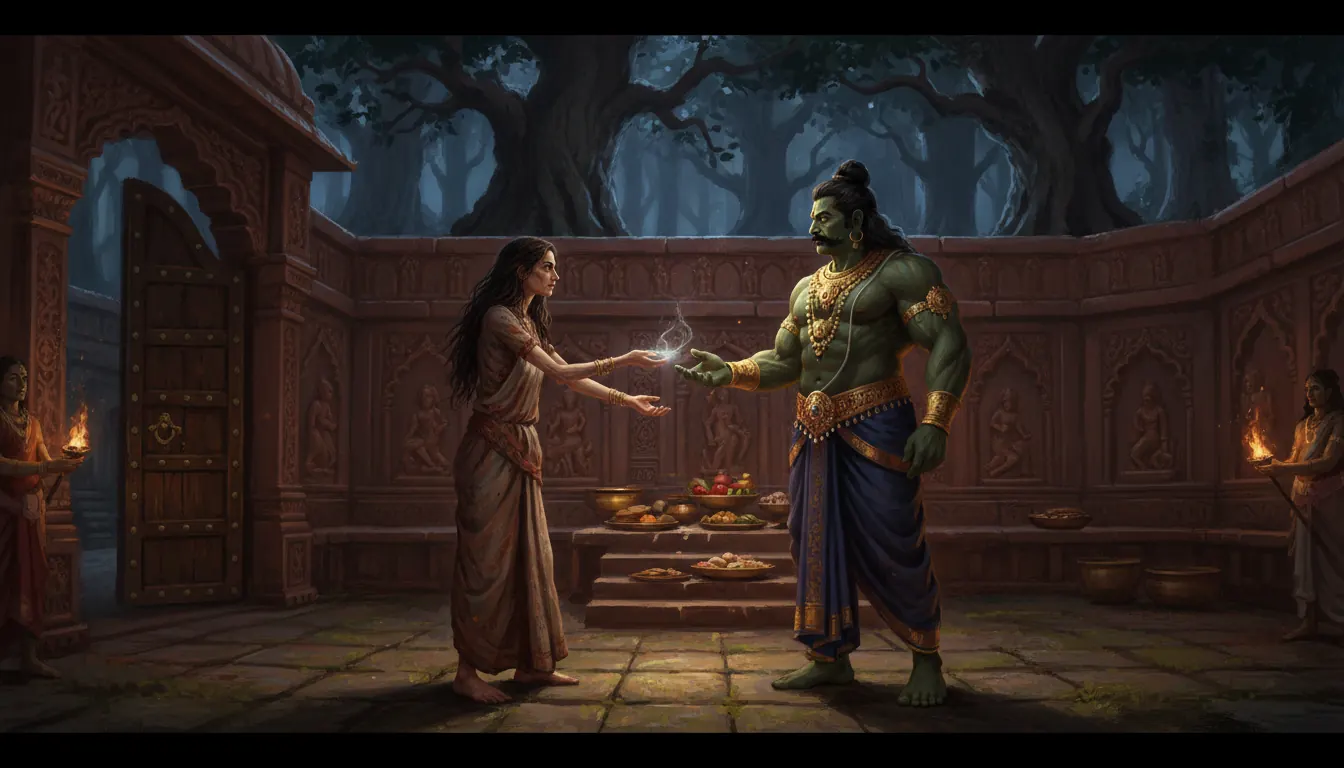
The Yaksha Who Lent His Manhood
Sthuna, Shikhandini, and the curse that made the loan permanent
In short
Told that his child will be female first and male after, Drupada lets his queen give out that their daughter is a son. When the bride's father Hiranyavarman learns the truth and marches on Kampilya, Shikhandini walks into a forest to die and meets the yaksha Sthuna, who lends her his sex. Kubera curses the loan into a permanent exchange.
Told in the Udyoga ParvaSet in Kampilya, Dasharna and Forest Hermitage16 min read
A Son to Kill the Grandsire
"Tell me, grandsire," Duryodhana said, "son of Ganga, how Shikhandi, who was born a daughter, later became a man."
The old commander had just finished telling his king which of the enemy he would kill and which he would not, and the one name he would not touch had stuck in the room like a bone in the throat. So Bhishma answered him, and Sanjaya carried the whole of it back to Dhritarashtra afterwards.
"The eldest and best-loved queen of King Drupada," said Bhishma, "was childless at first. And during those years Drupada worshipped the god Shankara for the sake of offspring, and he practised the harshest of penances, and he was not asking for a child. He was asking for a weapon.
"'Let a son, and not a daughter, be born to me,' he said. 'I want a son, god, to take my revenge on Bhishma.'
"And that god of gods answered him: 'You will have a child who will be female and male. Stop, king. It will not be otherwise.'"
Duryodhana said nothing. Bhishma went on.
"He went back to his capital and said to his wife, 'I have made a great effort. I performed austerities and worshipped Shiva, and Shambhu told me that my child would be a daughter first and would later become a male. And though I begged him again and again, Shiva only said: This is Destiny's decree. It will not be otherwise. What is destined must happen.'"
The Queen Gives Out That It Is a Son
In due time the wife of Prishata conceived, as Destiny had decreed, and the lotus-eyed queen carried the child; and because he was childless, mighty-armed Drupada saw to every comfort of that dear wife of his out of pure affection, so that a woman who had wanted one thing all her life had every wish granted in those months except the one that mattered.
And the queen gave birth to a daughter of great beauty.
And the strong-minded wife of the childless king gave out that the child she had borne was a son.
"She kept her secret very carefully," said Bhishma. "No other man in the city except Prishata himself knew the sex of that child. And Drupada, trusting the words of the god of unfading energy, hid it too, saying, She is a son. He had all the rites prescribed for a male child performed for that misrepresented daughter, exactly as if she had really been one, and he gave her the name of Shikhandi.
"I alone knew the truth. I knew it through the spies I had set around Drupada, disguised as idiots and as men who could neither see nor hear, and I knew it from the words of Narada, having already been told of the god's words and of Amba's austerities. From the beginning, king, I have known what that child was and what that child was for."
Raised, Taught, and Then Married
Drupada gave great attention to everything to do with that daughter of his. She was taught writing and painting and all the arts. In arrows and in weapons the child became a pupil of Drona, and stood in the same yard as the sons of Pandu and the sons of Dhritarashtra, and nobody in that yard ever guessed.
Then, when the child had grown to full youth, the mother began to urge the king to find a wife for her, as if she were a son.
Drupada, who by then was quite sure of his daughter's sex, talked it over with his queen.
"This daughter of mine, who adds so much to my sorrow, has grown up," he said. "I have kept her hidden until now, because of the words of the trident-bearing god."
"Those words can never be false," the queen replied. "Why would the Lord of the three worlds say something that would not come to pass? If you please, king, hear what I have to say and then follow your own judgment. Let this child be carefully married to a wife. The god's words will come true. This is my firm belief."
So the two of them settled that matter between them, and royal Drupada, that lion among kings, looked into the purity of descent of all the rulers of the earth, as a careful father does, and chose the daughter of the king of the Dasharnas as his son's wife.
What the Bride Found Out
The king of the Dasharnas was named Hiranyavarman, and he was a powerful king, hard to defeat, impossible to resist, and with a large army. Bhishma named all four of those things when he came to that part of the tale, in the way a soldier names the weather before a march.
Hiranyavarman gave his daughter to Shikhandi.
Some time after the wedding the daughter of Hiranyavarman grew to womanhood, and the daughter of Drupada had grown to hers, and Shikhandi came back to Kampilya with a wife; and the bride soon came to know that the person she had married was a woman like herself.
She was young and she was ashamed, and she did what a frightened girl in a strange city does: she told her nurses. She told them, shyly, everything about the so-called son of the king of the Panchalas.
And the nurses from the Dasharna country, deeply grieved, sent messengers to their own king.
The Man Cased in Golden Mail
Hiranyavarman heard the news a few days later and was furious, and he sent a messenger to Drupada's palace. The messenger came alone, took the king aside, and said it in private, which was the last courtesy Drupada was to receive in the matter.
"The king of the Dasharnas, deceived by you and enraged at the insult you have given him, says this to you. You have humiliated me. It was certainly not wisely done. In your folly you asked for my daughter for your daughter. You wicked man, now reap the fruit of that deception. I will kill you now with all your kin and counsellors. Wait a little."
"At these words," said Bhishma, "King Drupada, like a thief caught in the act, could not speak."
He did his utmost afterwards. He sent smooth-spoken envoys with careful instructions to say, This is not so, and to call the other man brother, and to calm him. Hiranyavarman made sure once again that the child of the king of the Panchalas was really a daughter, and marched out of his city without losing any time.
He sent word to all his powerful friends about the deception practised on his daughter. He mustered a large army. And in council with those great-souled kings it was agreed among them that if Shikhandi was indeed a daughter, they would bind the ruler of the Panchalas and drag him out of his own city, set another king over the Panchalas, and kill Drupada together with Shikhandi.
Then he sent one more envoy, with one line in it: "I will kill you. Be calm."
The Truth Told in Front of Witnesses
"King Drupada," said Bhishma, "was not a naturally brave man."
He fortified a city that was already well protected by nature. He consulted his ministers on how best to protect his subjects. And then, stricken with grief and badly frightened, he went to his favourite wife, the mother of Shikhandi, and asked her a question to which he already knew the answer, and asked it in the presence of others, so that the court should hear his own innocence proclaimed.
"My powerful brother, King Hiranyavarman, is coming against me in anger with a large army. Fools that we both are, what are we to do now about this daughter of ours? Your son Shikhandi is suspected of being a daughter. Tell us now what is true and what is false in this. When I have heard it from you first, I will decide what to do. I am in danger, and this child is in danger, and you are threatened too. Although you deceived me about the duties I owe a son, I will still be kind and act properly towards you both. Do not be afraid."
The queen did not defend herself for long.
"Great king, I was childless," she said, "and out of fear of my co-wives, when my daughter Shikhandini was born, I told you it was a son. Out of love for me you backed my word, and you performed all the rites prescribed for a son for this daughter of mine. Then you married her to the daughter of the king of the Dasharnas, and I agreed to that too, remembering the god's words: Born a daughter, she will become a son. I did not stop it."
And there it stood: two frightened parents in a fortified city, an army on the road, and between them a girl who had heard every word of it.
The Forest Nobody Entered
"It is because of me that these two are sunk in grief," Shikhandini said to herself.
She resolved to end her own life. Her mind made up, she left home, weighed down with sorrow, and went into a dense and lonely forest, and she chose it deliberately, because it was the haunt of a very fearsome Yaksha called Sthunakarna, and for fear of that Yaksha men never went into it. She wanted a place where nobody would come after her and nobody would talk her out of it.
Inside the forest stood a mansion with high walls and a gateway, plastered with powdered earth, and full of smoke sweet with the scent of fried paddy. Somebody lived there and lived well.
Shikhandini, the daughter of Drupada, went into that house and began to waste herself away by going without food, for many days together.
And the Yaksha named Sthuna, who was kind-hearted, showed himself to her.
"What is it you are trying to achieve?" he said. "I will do it for you. Tell me at once."
"You cannot do it," she said.
She said it again when he pressed her, and again after that.
"I will do it," said the Guhyaka, at once. "I am a follower of the Lord of treasures. I can grant boons, princess. I will grant you even what cannot be given. Tell me what you have to say."
The Loan and Its Term
So she told him all of it in detail, and ended with the only thing she wanted.
"My father will soon be destroyed. The ruler of the Dasharnas is marching against him in a rage, and that king in his golden mail has great might and great courage. So save me, Yaksha, and my mother, and my father. You have already pledged yourself to relieve my distress. By your grace, let me become a complete man. Until that king leaves my city, great Yaksha, show me that grace."
The Yaksha thought it over, and what he said first he said to himself.
"It was surely ordained to be so. And it was ordained for my grief."
Then he spoke to her.
"Blessed lady, I will certainly do what you wish. But listen to the condition I make. I will give you my manhood for a certain time. You must come back to me when the time is up. Pledge yourself to do so. I have immense power; I range the skies, wander as I please, and can accomplish whatever I set out to do. By my grace, save the city and all your kin. I will bear your womanhood, princess. Give me your word, and I will do what you want."
"Holy one of excellent vows," said Shikhandini, "I will give you back your manhood. Wanderer of the night, bear my womanhood for a short while. Once the ruler of the Dasharnas in his golden mail has left my city, I will become a maiden again and you will become a man."
They made that pact, the two of them, and gave each other their sexes. The Yaksha Sthuna became a female. Shikhandini received the blazing form of the Yaksha.
He knew when he said yes that it was ordained for his grief. He said yes anyway. That is the part of the story that nobody in Kampilya was ever told.
The Young Ladies Sent to Look
Shikhandi, now a man, entered his city full of joy and went to his father and told him everything that had happened, and Drupada was overjoyed, and he and his queen remembered together the words of Maheshvara. He sent a messenger at once to the ruler of the Dasharnas: "This child of mine is a male. Believe it."
Hiranyavarman had by then arrived at Kampilya, full of sorrow and grief, and he answered courtesy with a brahmana envoy chosen from among the foremost of those who knew the Vedas. Drupada, with Shikhandi standing beside him, offered that envoy a cow and honey.
The brahmana would not accept the homage. He stood in the middle of the council and delivered the words he had been given.
"You vile man, you have deceived me, using your daughter to do it. I will wipe you out, with your counsellors and sons and kin."
Drupada, putting on a mild manner for friendship's sake, said only that his answer would be carried to his brother by his own envoy; and he sent a brahmana learned in the Vedas to say it.
"This child of mine is really a male. Let it be proved by witnesses. Someone has told you a lie. It should not be believed."
Then the king of the Dasharnas, when he heard this, sent a number of very beautiful young ladies to find out whether Shikhandi was a male or a female.
They went, and they found out, and they came back joyful, and they told the king of the Dasharnas that Shikhandi was a powerful person of the male sex.
At that testimony Hiranyavarman was filled with great joy. He went to his brother Drupada and spent a few happy days with him and gave Shikhandi much wealth, many elephants and horses and cows, and then he left, having first scolded his daughter for what she had told her nurses.
Kubera Above the Roof
Some time after the exchange of sexes, Kubera, who is always carried on the shoulders of human beings, came in the course of a journey to Sthuna's home, and stayed in the air above that mansion, and looked down at it.
It was finely adorned. It was hung with beautiful garlands of flowers and perfumed with fragrant grass roots and many sweet scents. It was decked with canopies and incense, beautiful with standards and banners, full of every kind of food and drink, garlanded with jewels and gems, well watered and well swept. Everything in it said that the master of the house knew the Lord of treasures was passing.
The master of the house did not come out.
"This mansion of Sthuna's is finely adorned," said the lord of the Yakshas to his followers. "So why does that wicked-minded creature not come to me? Since he knows I am here and does not come to me, he should be severely punished. That is what I intend."
And the Yakshas told him. Drupada had a daughter named Shikhandini; to her, for some reason, Sthuna had given his own manhood, and having taken her womanhood upon himself he stays in his house as a woman; in a woman's form, he is ashamed to come before you.
"Stop the chariot here. Bring Sthuna to me. I will punish him."
So Sthuna came out in a woman's body and stood in front of him and was ashamed, and the giver of wealth cursed him in anger.
"Guhyakas, let this wretch's womanhood stay as it is. Since you have shamed all the Yakshas by giving your own sex to Shikhandini and taking her womanhood from her, since you have done what no one has ever done, from this day on you will remain a woman and she will remain a man."
The other Yakshas began at once to soften Vaishravana on Sthunakarna's behalf, saying over and over, "Set a limit to your curse." And he set one, wanting to free that great-souled Yaksha from anxiety: after Shikhandi's death, this one will regain his own form.
When the time came, Shikhandi went back to the forest without losing a moment, as he had pledged. "I have come to you, holy one."
"I am pleased with you," said Sthuna, and said it again, seeing that prince come back to him without any guile. Then he told him what had happened while he was away. "Son of a king, because of you I have been cursed by Vaishravana. Go now, and live happily among men as you choose. Your coming here and the arrival of Pulastya's son were, I think, both ordained in advance. None of this could have been prevented."
"That," said Bhishma to Duryodhana, "is the story of Shikhandi's birth, as my spies brought it to me and as I have carried it since. She who was born the eldest daughter of the ruler of Kashi, famous by the name of Amba, was born in Drupada's line as Shikhandi. My vow is known all over the world: I will not use weapons on a woman, nor on one who was a woman before, nor on one who bears a woman's name, nor on one whose form is like a woman's. If Bhishma kills a woman, the righteous will all speak ill of him. So I will not kill Shikhandi, even if he comes at me bow in hand and eager to fight. I will not look at him even for a moment."
And Duryodhana, after thinking for a moment, decided that even that behaviour was proper for Bhishma.
Dharma Lesson
A debt taken on to save others can end by being paid by someone who never agreed to pay it. Sthuna knows as he speaks that the boon is ordained for his own grief and grants it anyway, and Kubera's curse turns a loan of a few days into the rest of a life. Destiny arranges its instruments long before they know what they are for, and it does not ask them.