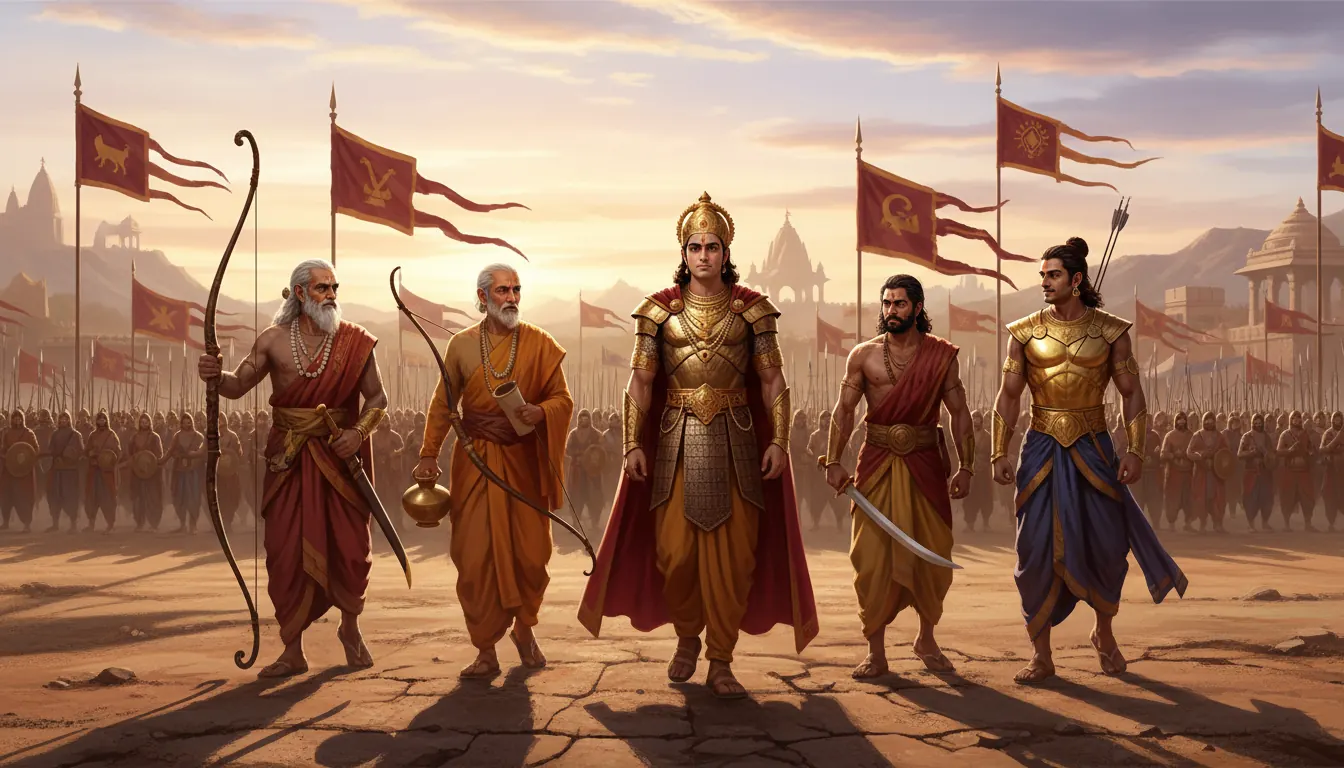
In short
On the last morning before the war Duryodhana asks each of his commanders how long he needs to annihilate the Pandava host. Bhishma says a month, Drona says a month and blames his age, Kripa says two months, Ashwatthama ten nights, and Karna five days, at which Bhishma laughs aloud. Yudhishthira's spies bring the whole exchange back before noon.
Told in the Udyoga ParvaSet in Kurukshetra, Pandava Camp and Hastinapura16 min read
The Question Asked in Front of Everybody
Sanjaya said: The night before, the grandsire had finished telling your son the whole history of Drupada's child, how the eldest daughter of the king of Kashi had been born again in that line, and how a yaksha had exchanged sexes with her; and he had ended by saying that he would not shoot weapons at a woman, or at one who had been a woman before, or at one bearing a woman's name, and that he would therefore not slay Shikhandi even if Shikhandi came at him weapon in hand. Duryodhana reflected on that for a moment and thought even that behaviour proper for Bhishma. He did not argue. He had learned by then which of the old man's positions were worth arguing with.
When the night had passed away and morning came, your sons went once more to their grandsire, in the midst of all the troops, and asked him a question, and they asked it where the army could hear the answer.
"Son of Ganga," said Duryodhana, "look at that army. It is ready to fight. It is full of men and elephants and horses. It is crowded with maharathas. It is protected by mighty bowmen of great strength, by Bhima and Arjuna and the others, with Dhrishtadyumna at their head, and every one of them is like a regent of the world. It is invincible and it cannot be withstood. It is like the boundless sea.
"Not even the gods could stir that sea of warriors in battle.
"In how many days, son of Ganga, can you annihilate it? And in what time can our teacher, that mighty bowman? And in what time the mighty Kripa? And in what time Karna, who takes a pleasure in battle? And in what time that best of brahmanas, the son of Drona?
"All of you in my army know the celestial weapons. I want to know this. The curiosity in my heart is great. Please tell me."
It was, on the face of it, a reasonable question for a king to ask on the last morning before a war. It was also, and every commander standing there understood this perfectly, a public auction, and the bidding had been opened by a man who was about to compare the bids.
The Grandsire Counts It Out
"Foremost one of the Kurus, lord of the earth," Bhishma said, "you enquire about the strength and the weakness of the foe. That, indeed, is worthy of you. Listen, king, while I tell you the utmost limit of my power in battle, and of the energy of my weapons, and of the might of my arms.
"Ordinary combatants a man should fight without guile. Those who have the powers of deception he should fight with the ways of deception. That is what has been laid down for the duties of warriors."
Then he gave the figure, and he gave it the way an old quartermaster gives a figure, in units and in days.
"I can annihilate the Pandava army, blessed monarch, taking ten thousand ordinary warriors and one thousand chariot-warriors as my share every morning, day after day. Clad in mail and always fighting hard, I can annihilate that large force in this way, in both the number and the time.
"But if I take my stand in battle and shoot my great weapons, the ones that slay hundreds and thousands at a time, then I can finish the slaughter in a month."
Eleven thousand men a day, or a month with the great weapons. It was not a boast. It was an inventory, delivered by a man who had been counting armies since before most of the kings present had been born, and nobody in the hearing of it laughed.
Notice what he had actually offered. Two methods, priced separately. The first was the slow one, a daily allotment taken off the enemy strength morning after morning, which is how a field army is really destroyed and which a commander can promise honestly because he has done the sum. The second was the fast one, and he mentioned it second and hedged it with an if. He did not say he would use the great weapons. He said that if he did, the thing would take a month.
The Teacher Says the Same Thing and Apologises for It
Duryodhana turned then to that foremost one of Angira's race.
"Teacher, in what time can you annihilate the troops of Pandu's son?"
Drona smiled before he answered, which was not his habit.
"I am old, mighty-armed one. My energy and my activity have both become weak."
He let that stand for a moment. There was not a man on the field who did not know that this was the teacher who had taught the archery of both armies, and that the greatest bowman on the other side had learned every string he knew from the person now describing himself as weak.
"With the fire of my weapons," he went on, "I can consume the army of the Pandavas, like Shantanu's son Bhishma, in a month's time, I think. That is the limit of my power. That is the limit of my strength."
Two commanders, and both of them had said a month, and both of them had put a qualification on it. The first had said if I use the great weapons. The second had said I think, and had begun with an excuse about his age. These were the two oldest men on that field and the two who had least appetite for the work, and their answers were the only two that agreed.
Both of them, moreover, were about to fight for the side they had argued against. Both of them had sat in the hall at Hastinapura when the envoy came asking for peace, and both had said, in their different ways, that the villages should be given. Being overruled, they had put on their mail like everybody else. Now the man who had overruled them was asking them how quickly they could do the thing they had said should not be done, and they answered him honestly, which is a kind of loyalty that gets very little credit afterward.
Two Months, and Then Ten Nights
Then Sharadvan's son said that he could annihilate the foe in two months' time.
Kripa was the only man to name a longer period than the grandsire, and he named it without any apology attached to it, and moved on. He had been in that family longer than almost anybody. He had taught these princes when they were children. He had watched the dice game from the floor of the hall and had said nothing that anyone recorded. Two months was his figure, and he did not decorate it, and it was the longest period any man named that day. Of the five men who answered, he and Drona's son were the only two still standing when the eighteen days were over.
Then Drona's son pledged himself to annihilate the Pandava army in ten nights.
Ashwatthama knew weapons of great power and everybody knew it, and he had said in one sentence that he could do in ten nights what his father had asked a month for. The father was standing beside him. Nobody remarked on it. There is a particular quality of quiet that falls on a gathering when a son has just outbid his father in public, and that quiet lasted exactly as long as it took the next man to speak.
The numbers were falling now the way numbers fall at any auction, and they were falling in the same direction as the speakers' ages. A month from the oldest. A month from the next. Two months from the third, who was the only one indifferent to the bidding. Ten nights from the young man. And the last man had not spoken yet, and everybody standing in that field knew what he was about to say, and Duryodhana had arranged the order of the questions so that he would say it last.
Five Days
Karna, however, who also knew weapons of great power, pledged himself to achieve that feat in five days.
Five. Not five and something. Not five if the omens hold, or five with the great weapons, or five, I think. Bhishma had said a month with the weapons that kill by the thousand. Drona had said a month and blamed his age for it. Kripa had doubled the grandsire. Drona's son had cut it to ten nights.
The son of Radha said five days, and stood there in the sun in his golden colour and let the number sit in the middle of the assembly, and it was the number Duryodhana had come out that morning hoping to hear, from the one man in his camp who had sworn to stay off the field for as long as Bhishma commanded it, and who had plainly been composing that sentence for some time.
And hearing the words of the Suta's son, the son of the ocean-going Ganga laughed aloud.
Until You Meet Him
It was not a chuckle and it was not private. The commander of the army laughed out loud, in the middle of all the troops, at the man his king had just been listening to, and then he explained the joke.
"As long, son of Radha, as you do not encounter in battle Partha with his arrows and his conch and his bows, rushing into the fight on his chariot with Vasudeva beside him, so long may you think so.
"Why, you are capable of saying anything. Even what you please."
Nobody answered him. Karna had sworn already, in front of this same court, that he would not take up arms while Bhishma lived, and Bhishma had returned the compliment by naming him a half-warrior; and here, on the last morning of peace, the old man had found one more occasion to say the thing in public and had taken it.
Duryodhana did not intervene. He had his five days. He had heard a month, a month, two months, ten nights and five days, and he had asked the question in order to find out which of his commanders wanted the war, and now he knew.
Sanjaya said: I was standing near enough to hear it, king, and I will tell you what struck me. Not one of those five men said what he would do about Arjuna. They gave periods for the annihilation of an army, which is a matter of arithmetic, and the grandsire alone named the difficulty by name, and he named it as an insult rather than as a warning, which is how the most useful things generally get said in a camp on the last morning.
And all of it, every figure and the laugh at the end of it, was carried out of that camp before the sun was high.
What the Spies Brought Back
Yudhishthira summoned all his brothers and spoke to them in private, and what he had to say he had received that same morning.
"The spies I placed in the army of Dhritarashtra's son brought me this news at dawn.
"Duryodhana asked Ganga's son of great vows: lord, in what time can you annihilate the troops of Pandu's sons? And he gave the wicked Duryodhana this answer: in a month.
"Drona also declared that he could do the same feat in about the same time.
"Gautama named twice that period, as we have heard.
"Drona's son, who knows weapons of great power, declared that in his case the period was ten nights.
"Karna too, who knows weapons of great power, when asked in the midst of the Kurus, declared that he could complete the slaughter in five days."
He had it in order and he had it exactly, down to which man had said what and in what words, and his brothers sat and listened to five men price them like cattle.
It is worth saying what that report cost and what it was worth. The Kaurava commanders had held their auction in the open, in the middle of the whole host, on the morning before the fighting, because Duryodhana wanted the army to hear it. An army that hears its generals promise a month is steadied. But whatever a hundred thousand men hear before breakfast is in the other camp by noon, and it was, and the king of the Pandavas read it out to his brothers with the dust of the messenger still on him.
"So I too want to hear what you have to say," the king said, and turned to the third of them. "In what time can you, Falguni, exterminate the foe?"
In the Twinkling of an Eye
Dhananjaya of the curly hair cast a look at Vasudeva before he said anything, and then he began, as he generally did, by conceding the other side's case.
"All these are great-souled warriors, accomplished in arms and skilled in every way of warfare. Without doubt, king, they can wipe out our forces just as they say. They have not been lying to their master."
Then he said, "Let your heart's anguish be dispelled, however.
"I tell you truly that with Vasudeva as my ally I can, on a single chariot, wipe out the three worlds with even the immortals in them, indeed all mobile creatures that were, that are, and that will be, in the twinkling of the eye. This is what I think.
"That terrible and mighty weapon which the Lord of all creatures gave me on the occasion of my hand-to-hand encounter with him, when he came in the guise of a hunter, still exists with me. Indeed, tiger among men, that weapon which the Lord of all creatures uses at the end of the age for the destroying of created things exists with me now.
"Ganga's son does not know that weapon. Nor does Drona. Nor Gautama. Nor Drona's son. How, therefore, can the Suta's son know it?"
Every other commander that morning had answered in mornings. Bhishma in a month of them, Drona in a month, Kripa in two, Ashwatthama in ten nights, Karna in five days. Arjuna had just answered in the time it takes to blink, and he had named the weapon he would do it with, and he was the only man of the six who had said where his weapon came from.
He had also, without appearing to, answered a different question from the one his brother asked. Yudhishthira had asked how long it would take to exterminate the enemy. Arjuna told him instead what he was capable of, which was the extermination of everything that exists, and then let the silence run on for a moment so that the difference between capability and intention could be felt by everybody in the tent.
And Then He Declined to Use It
"But it is not right to slay ordinary men in battle with celestial weapons," Arjuna said. "We will defeat our foes in a fair fight.
"And then, king, these tigers among men are your allies. All of them are well versed in celestial weapons and all of them are eager for battle. All of them, after their initiation in the Vedas, have undergone the final bath in sacrifices. All of them are undefeated. They are able to slay in battle even the army of the celestials.
"You have Shikhandi, and Yuyudhana, and Dhrishtadyumna of Prishata's race. You have Bhimasena and these twins. You have Yudhamanyu and Uttamaujas. You have Virata and Drupada, who are the equals in battle of Bhishma and Drona. You have the mighty-armed Shankha, and Hidimbi's son of great might, and his son Anjanaparvan, strong and full of prowess, and Shini's descendant well versed in battle, and the mighty Abhimanyu, and the five sons of Draupadi.
"And you yourself are able to wipe out the three worlds. I know it, Kaurava, and it is plain to see, that the man on whom you turn your eyes in anger is sure to be destroyed."
Sanjaya said: That was the last thing said in either camp on that subject.
Next morning, under a cloudless sky, all the kings set out at your son's urging against the Pandavas. They had purified themselves with baths. They were decked in garlands and attired in white robes. They had poured libations on the fire and had brahmanas utter benedictions over them, and then they took up their weapons and raised their standards.
And the Kuru king had his encampment adorned so that it looked like a second Hastinapura, and the tents covered a full five yojanas of that field, and even those who were clever among the citizens of Hastinapura could not have told their own city from it.
Five commanders had been asked how long it would take. Their answers came to a month, a month, two months, ten nights and five days. Eighteen days after the standards went up, Bhishma lay on his bed of arrows and Drona and Karna were dead; the two who walked away were Drona's son and Kripa, who had asked for the longest period of all and had been the only one not bidding.
And the one man who could have made the shortest promise of them all, and could have kept it, was the one who declined to make it.
Dharma Lesson
Boasting is a form of accounting, and the only commander worth trusting is the one who names a weapon he owns and then declines to use it. Five men priced an army in mornings and three of them had fallen within eighteen days. Arjuna alone answered that he could end the three worlds in an instant, and in the same breath refused to spend a celestial weapon on ordinary men.