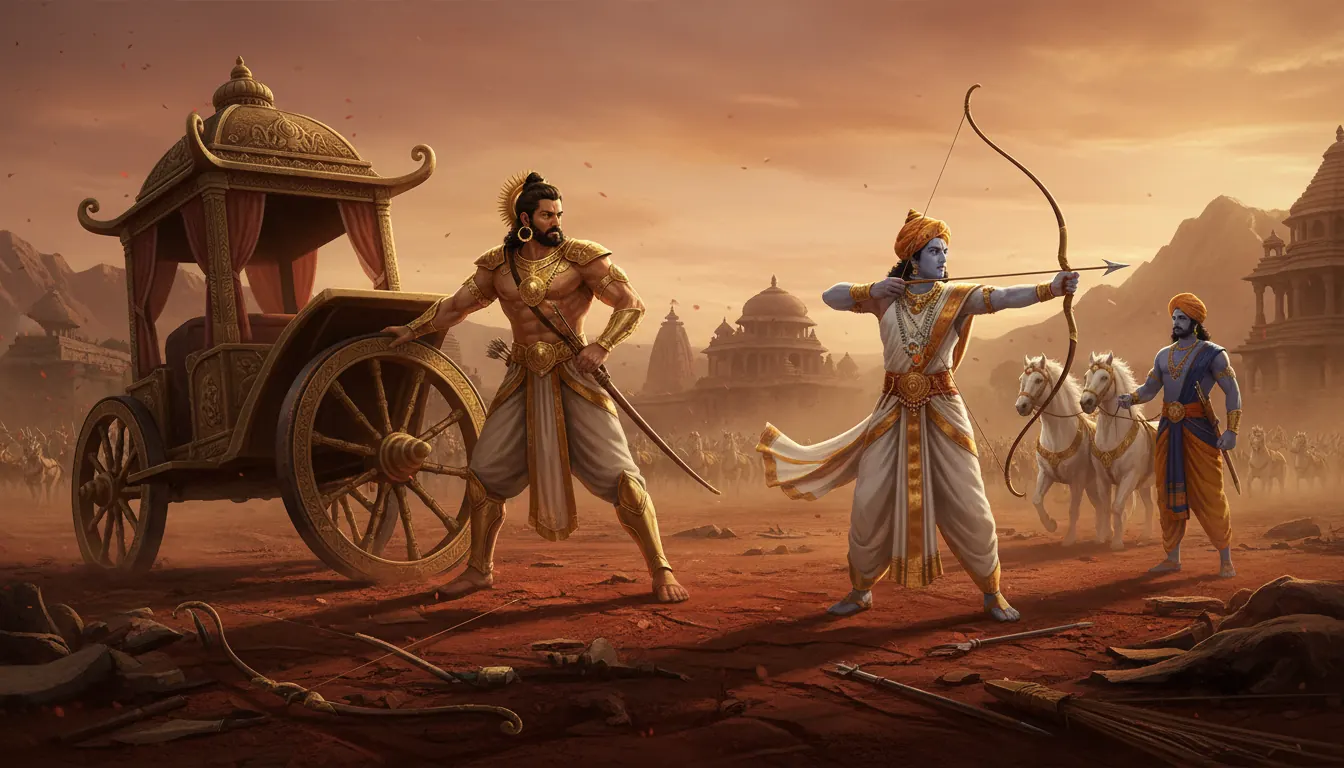
The Prince Who Went In for Shikhandi
Kripa strips Shikhandi on the seventeenth day, and a young ally buys him a way out with his life
In short
On the seventeenth day, with the Kaurava army breaking under Arjuna, Kripa steadies the line and Shikhandi attacks him. Kripa destroys his chariot, cuts away his hundred-moon shield, and leaves him advancing on foot with a sword, while every warrior who moves to rescue him is intercepted. A young prince named Suketu, son of Chitraketu, drives in unasked, cuts Kripa's bow and wounds his driver, and is beheaded for it. In the same stretch of field Dhrishtadyumna and Kritavarma fight until Dhrishtadyumna kills Kritavarma's charioteer.
Told in the Karna ParvaSet in Kurukshetra12 min read
The Vessel Wrecked on the Ocean
Sanjaya had the divine sight, and he used it that evening in the hall at Hastinapura to tell a blind king what the seventeenth day of the war had looked like from inside it.
Arjuna was somewhere out in the dust with Krishna driving him, killing samsaptakas by the thousand, and the twang of Gandiva came back across the field like weather. What Sanjaya described next was not Arjuna. It was the effect of Arjuna on the army Dhritarashtra had sent out.
"The army, king, was stricken with fear of Pandu's son, and could not hold together, like a vessel wrecked on the ocean."
So the men who held the Kaurava line together went in to save it, all at once and at great speed. Kritavarma of the Bhojas, a Vrishni and Krishna's own kinsman, fighting on the wrong side of his family. Kripa, son of Sharadvata, the old teacher of arms who had trained both sets of princes and had by now buried most of them. Ashwatthama, Drona's son, two days a mourner. Karna, who had been commander of the host since the morning after Drona died. Uluka and Shakuni, and the king himself with his uterine brothers, the ones who were left.
The battle they made lasted only a short time, Sanjaya said, and while it lasted it heightened the fears of the timid and the joy of the brave.
It was Kripa's arrows that did the work. He shot in dense showers, thick as flights of locusts, and they came down on the Srinjayas, who were the Panchala levies. Old men are supposed to be spent by the seventeenth day of anything. Kripa was a brahmana who had given his whole long life to a science he had not chosen, and there was nothing spent about him. The Srinjayas began to give ground.
Then one man in that division turned his chariot around and went at him.
The Prince and the Bull Among Brahmanas
The man was Shikhandi, and there was a reason he was willing.
He was Drupada's child, born in Kampilya to be the death of Bhishma, and before that he had been Amba, a princess whom Bhishma carried off and then would not marry. Seven days earlier he had stood in front of the grandsire with Arjuna shooting past his shoulder, and Bhishma had lowered his bow and refused to fight what he insisted on calling a woman. Everything Shikhandi had been made for was finished by the tenth day. He had the rest of the war left over and nothing in particular to do with it.
Filled with rage, he went at the grandson of Gautama and poured downpours of arrows on that bull among brahmanas from every side.
Kripa knew the highest weapons. He checked the downpour without much apparent trouble and answered it, wrathfully, with ten arrows into Shikhandi. Shikhandi took them and sent back seven straight shafts equipped with Kanka feathers, and put them in deep.
That was the whole of the exchange between them as equals. The twice-born Kripa, deeply pierced with those keen arrows, then did what a great chariot warrior does to a man he has finished measuring. He shot away the horses, and then the driver, and then the chariot, in that order, and Shikhandi was standing on the ground in the middle of the seventeenth day.
He did not withdraw. He took up a sword and a shield and rushed headlong at the brahmana on foot.
As the Panchala prince advanced, Kripa quickly covered him with many straight arrows, and Sanjaya, who had watched arms all his life, said that the sight was truly wonderful, like rocks flying.
And Shikhandi, thus assailed, remained perfectly inactive.
That is the phrase, and it is worth keeping. Not driven back. Not killed. Stopped. A man with a sword in his hand and nowhere to put it, pinned in the open by a rate of shooting he could neither close through nor answer.
Every Rescuer Given a Man of His Own
Dhrishtadyumna saw it happen.
He was Shikhandi's brother, the fire-born prince of Prishata's line, commander of the whole Pandava army, and he had killed Drona two days before with the field watching. Seeing Shikhandi covered with Kripa's arrows, he turned his chariot and drove for the old man at speed.
He did not arrive. The great chariot warrior Kritavarma came rushing across his path and met him.
That is how the rest of it went, all down the line, inside the space of a few breaths. Every man who moved to help was given a man of his own.
Drona's son held back Yudhishthira, who was rushing towards the chariot of Sharadvata's son with his son and his troops behind him. Duryodhana, shooting a shower of arrows, met Nakula and Sahadeva, those two swift great chariot warriors, and held them where they stood. And Karna, whom men called Vaikartana, resisted Bhimasena and the Karushas and the Kaikayas and the Srinjayas together, which was four things at once and no more than was expected of him.
Written down in a list it looks like coincidence. It was not. An army in that condition survives by interception, and the Kaurava high command that morning was still, whatever else had gone wrong for it, the most experienced set of chariot warriors alive. They had come in to plug a hole, and they plugged it by taking each rescuer in turn as he committed himself.
Which left one place on that field with nobody free to reach it.
Meanwhile Sharadvata's son went on busily speeding arrows at Shikhandi, as if he meant to burn him outright.
The Shield of a Hundred Moons
What Shikhandi did then was the best thing he did all day, and nobody remembers it.
He whirled the sword. Not at anything, since there was nothing within reach of it. He whirled it repeatedly in front of his own body and cut off the arrows in the air, all of them, decked with gold, sped at him from every side by one of the four best archers alive.
A man can do that for a while.
The grandson of Gautama watched him do it, and then quickly cut off with his arrows the shield of Prishata's son, the one that was decked with a hundred moons.
At this feat of his the troops made a loud uproar. Sanjaya reports the noise to the blind king and not the meaning of it, but the meaning is not difficult. Every soldier within sight of the two of them understood exactly what had just been taken away, and how long the rest would last.
Stripped of his shield, king, and at Kripa's mercy, Shikhandi still rushed forward, sword in hand.
Sanjaya, describing this to the father of the men who were winning, chose his comparison carefully. He said the prince advanced like a sick man towards the jaws of Death.
Not like a hero going to a good end. Like somebody who is already ill walking into the thing that is going to finish him, without hurry, because there is nothing else left to walk toward. The man who had been born to kill Bhishma, and had done it, was about to be shot to pieces on foot by an old brahmana in front of two armies, and he had stopped trying to prevent it.
Then somebody else came across the field.
Suketu, Son of Chitraketu
His name was Suketu and he was the son of Chitraketu, and this stretch of the seventeenth day is the only place in the whole war where he is named.
He was young. The text says so twice, prince and young prince, and calls him of immeasurable soul, and gives him nothing else: no kingdom described, no earlier feat, no father who speaks, no last words. He was one of the sons of allied kings who filled out the Pandava host. He saw the mighty Shikhandi plunged into such distress and assailed in that manner by Kripa with his arrows, and he did what a boy with a chariot and a very good bow does.
He rushed towards the chariot of Sharadvata's son and poured countless keen arrows on that brahmana in that battle.
It worked. That is the part worth stopping over. Kripa turned to deal with the new arrivals, and Shikhandi, seeing that brahmana of strict vows now busy fighting someone else, retreated hastily from that spot, and lived.
Meanwhile Suketu pierced the son of Gautama with nine arrows. Then with seventy. Then with three more.
Then the prince cut off Kripa's bow with the arrow still fixed upon the string, and with another shaft struck the old man's driver hard in a vital limb.
There is no way to read that except as very good shooting. In under a minute a young man nobody in either army had heard of had cut the bow of the teacher of the Kurus, wounded his charioteer, and lifted the whole weight of him off Drupada's son.
He had also made himself the only thing standing in front of Kripa.
The Head with the Blazing Earrings
The grandson of Gautama, filled with rage, took up a new and very strong bow.
He struck Suketu with thirty arrows in all his vital limbs.
With all his limbs badly weakened, the prince trembled in his fine chariot like a tree shaking violently in an earthquake. He did not fall and he did not step down. He stood where he was, holding on, shaking, in front of the whole line.
With a razor-headed arrow then, while the boy was still trembling, Kripa struck off from his trunk the head, decked with a pair of blazing earrings and with the head-protector still fastened on it.
That head fell down on the Earth like a piece of meat from the claws of a hawk.
Then his trunk also fell.
The epic gives the head and the body their separate falls and their separate moments, and the two half-lines do a thing the epic keeps for the young. The ornaments are named first. The earrings were blazing. Somebody had fastened them on him that morning, or he had fastened them on himself, because he was a prince going out where he would be seen, and by the middle of the afternoon they were lying in the dirt with his face still between them.
When Suketu fell, king, his troops took fright, and keeping clear of Kripa, fled in every direction.
That was the whole of him. He came in out of nowhere, saved the most heavily symbolic man on the Pandava side, put a shaft through the teacher's bow and another into his driver, and was dead perhaps two minutes after his first arrow, and his men ran, and the war did not pause for any part of it.
Two Hawks Over a Piece of Meat
Across the field the other half of the interception was still running.
Kritavarma had Dhrishtadyumna encompassed, and he was cheerful about it. "Wait," he called to him. "Wait!"
The encounter that then took place between the Vrishni and the Panchala, Sanjaya said, became exceedingly fierce, like a fight between two hawks, king, over a piece of meat.
Each of them had his reasons. Kritavarma was the son of Hridika and the ruler of the Bhojas, a Vrishni who had brought his division to Duryodhana while Krishna held the reins on the other side. Dhrishtadyumna had come out of a fire to kill Drona, and had done it in a way that half his own camp could not forgive.
Filled with rage, Dhrishtadyumna struck the son of Hridika with nine arrows in the chest and hurt him badly.
Kritavarma, thus deeply struck, answered by covering his attacker, his horses and his chariot together, and Dhrishtadyumna went out of sight inside that shrouding, like the Sun shrouded by rain-charged clouds.
He came out of it, warding off those arrows decked with gold, and Sanjaya says he looked splendid in his wounds, which is the kind of thing men say about a commander who is bleeding and still steering.
Then the son of Prishata approached and poured a fierce shower of arrows upon him, and Kritavarma, with many thousands of arrows of his own, destroyed that whole impetuous shower in the air before it arrived.
So Dhrishtadyumna stopped shooting at the man and closed with him instead. He came up close, fought him at close quarters, and with one very sharp broad-headed arrow sent Kritavarma's driver to Yama's abode. The driver fell dead from the chariot.
Both combats in that quarter of the field ended the same way, and neither ended with a champion. Kripa had his charioteer wounded and kept his own life, and took a boy's head for it. Kritavarma lost his charioteer outright and kept his own life too.
Having defeated his mighty opponent, the son of Prishata did not lose a moment. He turned and began to hold off the Kauravas with arrows, and your warriors, king, rushed towards Dhrishtadyumna uttering loud lion-like roars, and a battle once more took place between them.
Dharma Lesson
Suketu is given three sentences and a pair of earrings, and he is the reason Shikhandi walks off that field. The epic is careful about this: the men whose names the war remembers are kept alive, again and again, by men whose names it records only once. Dharma on a battlefield is not usually the grand vow or the famous duel. It is a boy turning his chariot toward the one place nobody else is free to reach, knowing roughly what it will cost him.