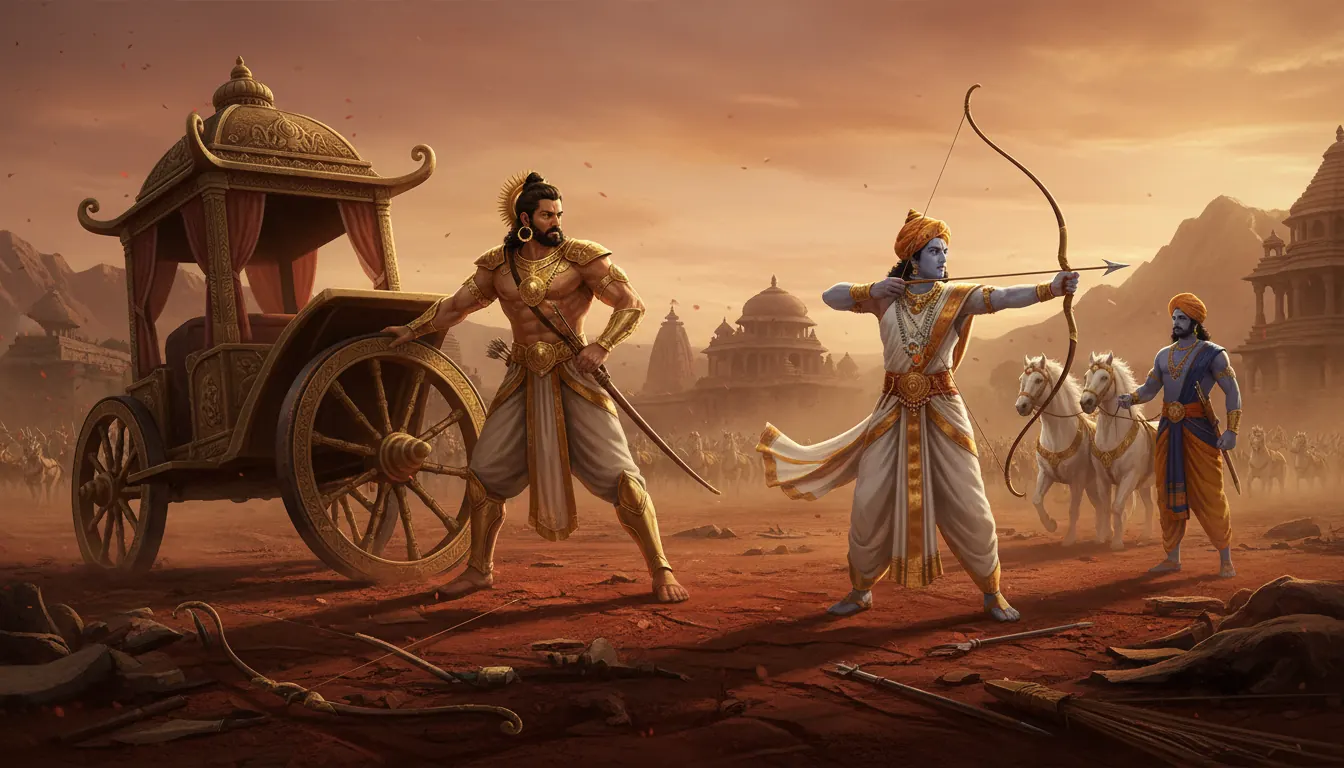
The Gates of Heaven Stand Open
Duryodhana tells his kings that dying well is winning, and Krishna drives Arjuna through what that costs
In short
On the afternoon of the seventeenth day Duryodhana rides to Karna and Shalya and tells the assembled kings that the occasion every kshatriya trains for has arrived without being sought: either the Earth or the region reserved for heroes, and no third outcome. Ashwatthama answers with an oath not to remove his armour until Dhrishtadyumna is dead, the gods and Apsaras come down to watch, and flowers fall on men killing each other. Then Arjuna, unable to find Yudhishthira's standard, asks to be driven to his brother, and Krishna crosses the field naming everything on it aloud.
Told in the Karna ParvaSet in Kurukshetra19 min read
The Third Part of the Day
It was the seventeenth day, and Sanjaya, telling it afterwards to a blind king in a hall in Hastinapura, kept coming back to the same accounting. Arjuna was breaking the samsaptakas. Bhima was breaking the Kurus. Karna was breaking the Panchalas. Three men, three armies, and the field between them emptying out.
Yudhishthira had already gone back about two miles with his wounds to sit down and breathe. Duryodhana had been unhorsed by Dhrishtadyumna and carried off by one of his brothers with his standard cut and his weapons cut and no chariot under him. The elephant device worked in jewels, the golden Angadas on the flagstaff, all of it lay in the dust where the prince of the Panchalas had put it.
He came back. That is the thing about Duryodhana that the epic never lets you forget. He came back, and he went looking not for a physician but for Karna.
He found him with Shalya, the ruler of the Madras, who was holding Karna's reins that day and holding his temper with them, and with the other lords of Earth who had come to Kurukshetra on the Kaurava side and were still alive at noon on the seventeenth day. Kings of countries that would have no kings by tomorrow evening. Men who had brought elephants and drummers and their own poets.
Sanjaya says he addressed them. Not commanded, not pleaded. Addressed, the way a host addresses guests when the thing he has invited them to has finally arrived.
The sun stood a little past the meridian. A third part of the day still remained. The Earth along the track of Karna's chariot was strewn with fallen elephants and horses and men, and the wind coming across it carried what such a wind carries.
Duryodhana looked at that field, and what he saw there was not a defeat.
This Moment Has Come Unsought
"This moment has come unsought," Duryodhana said, "and the gates of heaven stand wide open."
That is how he began. Not with the kingdom, not with the insult at the dice, not with Draupadi or the thirteen years or any of the grievances he had been feeding for half his life. He began with a door.
"Happy are the kshatriyas, Karna, who are given such a battle."
Understand what he was saying to men standing in that particular place at that particular hour. The whole apparatus of a kshatriya's life, the training from boyhood, the bow, the vow, the horses bred for it, exists for an encounter that most warriors never actually get. Skirmishes, cattle raids, the punishment of some minor chief. What the books promise is a meeting with an enemy of equal weight, and the books are honest that such a meeting is rare.
"Brave heroes who fight brave kshatriyas equal to them in might and prowess win great good, son of Radha. And such is the moment that has come."
Then he set out the two outcomes, and he set them out as though they were both prizes.
"Either let these brave kshatriyas kill the Pandavas in battle and win the wide Earth, or let them fall in battle to the enemy and win the blessed world kept for heroes."
There is no third clause. He does not say, and if we survive without winning. He does not say, and if the war goes on another month. Earth or heaven, and no other door out of the afternoon, and he offered it to them as good news.
It was good news, by the reckoning of the order he belonged to. That is what makes the speech terrible rather than merely mad. Every man listening had been raised on the same arithmetic. Duryodhana was not lying to them. He was reminding them of what they had all agreed was true, at the one moment when believing it would cost them everything.
And the bulls among the kshatriyas heard him and raised loud, cheerful shouts.
The Instruments Answer
They beat and blew their musical instruments. Conches, drums, the whole noise a host makes when it has decided something, rolling out over a field covered with the men who had decided it yesterday.
Sanjaya, who was standing where he could see it, does not describe the joy as foolish. He says the force became filled with joy, and he leaves it there, and lets the blind king in Hastinapura do with that what he can.
Into that joy stepped Drona's son.
Ashwatthama had a reason to speak and a reason to be heard. He was the son of the teacher who had taught both armies, the man who had made Arjuna what Arjuna was, and Drona had died on the fifteenth day sitting in yoga on the terrace of his chariot with his weapons laid aside, having been told a lie about his son and having believed it. Dhrishtadyumna had taken him by the hair and cut his head off while he sat there unarmed. Every man on that field knew it. Ashwatthama had been away at the far end of the line when it happened.
"In full sight of all the troops," he said, "before the eyes of every one of you, my father had laid his weapons aside, and Dhrishtadyumna killed him."
He did not shout it. He gladdened them, Sanjaya says, which is a strange verb for what follows.
"By the wrath such an act must kindle, and for my friend's sake too, kings, I swear truly before you all. Hear my oath. Until I have killed Dhrishtadyumna I will not take off my armour. If I do not fulfil this vow, may I not go to heaven."
Then he widened it, in case anyone thought there was a way to protect the Panchala prince.
"Whether it is Arjuna, or Bhimasena, or anyone else, whoever comes against me I will crush, one or all of them. Of that there is no doubt."
Duryodhana had opened the gates of heaven for his army. Ashwatthama, standing next to him, had just wagered his own place on the other side of them against one man's life.
The Gods Come Down to Watch
After Ashwatthama had spoken, the entire Bharata army, united together, rushed against the Pandavas, and the Pandavas rushed against them.
The collision of the leaders of the chariot divisions was awful. A destruction of life set in at the van of the Kurus and the Srinjayas that resembled, Sanjaya says, what takes place at the last great universal dissolution, when the worlds are folded up and nothing is kept.
And it was at that moment, with the two hosts going into each other, that the sky filled with spectators.
Various superior beings came, with the gods among them, and they brought the apsaras with them, to watch those greatest of men. They had come for the sight. There is no other reason given.
Filled with joy, the apsaras began to cover the warriors with celestial garlands, and with diverse kinds of celestial perfumes, and with diverse species of gems. Flowers came down on men who were killing each other. Soft winds carried those fine scents to the nostrils of the leading warriors, and the warriors breathed in the perfumes the wind brought them, took up the battle once more, and striking one another, began to fall to the Earth.
Read that sequence carefully, because the order of it is the whole of it. The perfume arrives. The men breathe it. The men fight harder. The men fall.
Strewn with celestial flowers, and with beautiful shafts equipped with wings of gold, and with many of the greatest warriors, the Earth looked beautiful, Sanjaya says, like the sky spangled with countless stars.
That is the image the epic chooses for a killing field at midafternoon on the seventeenth day. Not a slaughterhouse. A night sky. The bodies are the stars.
Then, with the cheers coming down from the sky and the noise of the musical instruments, the fighting became truly fierce, with the twang of bows in it and the clatter of chariot wheels and the shouts of men, and above it the applause of the gods, who could not be hurt by any of it and had come a long way to see.
Arjuna Cannot Find His Brother
Across the field, Arjuna had just finished with Ashwatthama.
He had cut the son of Drona's bow and standard and umbrella and banners and chariot and dart and mace, and put calf toothed arrows deep into his shoulder, and Ashwatthama had gone down in a swoon against his own flagstaff and been carried off insensible by his driver. Before that Arjuna had exterminated the wing and the further wing of the samsaptakas, ten thousand kshatriyas and then the Kambojas and the Yavanas and the Sakas after them.
He had won everything in front of him, and he looked around and could not see his brother.
"Look, mighty-armed Krishna," he said, "the Pandava army is running away. Look, Karna is killing our great chariot warriors in this battle."
Then the thing that was actually frightening him.
"I cannot see King Yudhishthira the just. And I cannot see the standard of Dharma's son, the finest of warriors."
A standard is how a man is found on a field of that size. It is carried high for exactly this reason. Yudhishthira's was not there, and Arjuna did not know that his eldest brother had gone two miles to the rear with his wounds, and the arithmetic he could do from where he stood had only bad answers in it.
"A third part of the day is still left, Janardana. Not one of the Dhartarashtras comes out to fight me."
He had beaten everyone who would face him, and it had bought him nothing he wanted.
"So do what I ask, and drive to where Yudhishthira is. Once I have seen Dharma's son safe and sound in battle with his younger brothers, I will fight the enemy again, you of the Vrishni line."
He was asking to be taken to see that his brother was alive, and he was promising, like a man bargaining with himself, that he would go straight back to work afterwards.
Krishna turned the white horses and went, toward the place where Yudhishthira and the Srinjaya chariot warriors were fighting with the enemy, making death their goal.
Look at the Weapons
They had to cross the field to get there, and while they crossed it Krishna began to talk.
He did not comfort Arjuna and he did not hurry him. He pointed at things.
"Look, Partha, how great and terrible is this slaughter of kshatriyas on Earth, Bharata, for the sake of Duryodhana."
That is the sentence the rest hangs from. For the sake of Duryodhana. Then, having named the cause, Govinda spent the whole ride naming the effects, one by one, and he began with the weapons, because the weapons were what these men had loved.
"Look at the gold-backed bows of the dead warriors, and their costly quivers slipped from their shoulders. Look at those straight shafts with wings of gold, and those long arrows washed with oil, like snakes that have shed their skins."
Washed with oil. Someone had prepared them the night before, in a tent, with care.
"Look at those scimitars decked with gold, with ivory handles, and those fallen shields embossed with gold. Look at those lances decked with gold, those darts with golden ornaments, and those huge maces wound round with gold. Look at those swords adorned with gold, those axes with golden ornaments, and the heads of those battle axes fallen from their golden handles."
The gold keeps coming back. Every line of the catalogue has gold in it, because everything a kshatriya carried was made beautiful before it was made deadly, and none of that beauty is doing anybody any good now.
"Look at those iron Kuntas, those very heavy short clubs, those beautiful rockets, those huge bludgeons with spiked heads, those discs fallen from the arms of the men who wielded them, and those spears used in this dreadful battle."
And then the line that turns an inventory into a horror.
"Warriors who were full of energy while they lived, who came to battle with every kind of weapon in their hands, lie there dead as if they were still alive."
Every man on that ground still had his hand where he had put it. Nothing had been let go of.
An Altar Strewn With Extinguished Fires
Then Krishna moved from the weapons to the men, and did not soften the transition.
"Look at the thousands of warriors lying on the field, their limbs crushed by maces, or their heads broken by heavy clubs, or torn and mangled by elephants and horses and chariots."
The field, he said, was covered with shafts and darts and swords and axes and scimitars and spiked maces and lances and iron Kuntas and battle axes, and with the bodies of men and horses and elephants, hacked with many wounds, covered with streams of blood, deprived of life.
And then, in the middle of that, he used a word that stops the passage cold.
"The Earth looks beautiful, Bharata, with arms smeared with sandal paste, decked with golden Angadas and Keyuras, their ends cased in leather guards."
Beautiful. He says it deliberately and he says it again. Arms that had been perfumed with sandalwood paste that morning, still wearing their armlets, still wearing the leather guard against the bowstring, lying by themselves on the ground.
"With hands cased in leather guards, with scattered ornaments, with the severed thighs of many active warriors lying like elephants' trunks, with the fallen heads of large-eyed heroes decked with costly gems and earrings, the Earth looks exceedingly beautiful."
Krishna is not being cruel here and he is not being ironic. He is showing Arjuna the exact thing that men fight for, which is splendour, and showing it to him in pieces, still splendid, with nobody inside it.
"With headless trunks smeared all over with blood, with severed limbs and heads and hips, the Earth looks, best of the Bharatas, like an altar strewn with extinguished fires."
That is the sentence to carry away. An altar. The place where offerings are made, after the rite is finished and the flames have gone out and there is nothing left on the stone but ash and the smell of what was burned.
The war had been called a sacrifice by both sides since before it started. Krishna, driving through the middle of it, agreed with them, and finished the metaphor for them.
The Furniture of Kings
He went on, and the catalogue widened out from the men to everything the men had brought with them.
"Look at those beautiful chariots with rows of golden bells, broken in every way, and those dead horses lying scattered over the field, with arrows still sticking in their bodies. Look at those chariot floors, those quivers, those banners, those standards of every kind, the huge white conches of the chariot warriors scattered all over the field."
Every one of those conches had a name and a history and a man who blew it at the start of the day.
"Look at those elephants, huge as hills, lying on the Earth with their tongues lolling out, and those other elephants and horses, lifeless and decked with triumphal banners."
Decked with triumphal banners. Somebody had dressed those animals for a victory before leading them out.
"Look at the elephants' housings, and those skins and blankets, and those other beautiful, many-coloured, torn blankets. Look at those rows of bells, torn and broken in every way where gigantic elephants fell, and those beautiful goads set with lapis lazuli, and those hooks fallen on the ground. Look at those whips adorned with gold and studded with gems, still in the grasp of dead horsemen, and those blankets and skins of the Ranku deer fallen on the ground, which served as seats on horseback."
Still in the grasp. Krishna keeps noticing the hands.
"Look at those gems made to adorn the diadems of kings, and those beautiful necklaces of gold, and those fallen umbrellas and yak tail fans."
The umbrella and the yak tail whisk are not weapons. They are the marks of sovereignty. A king does not carry them himself, he has men to hold them over him, and they were on the ground now with nobody underneath.
"Look at the Earth, muddy with blood, strewn with the faces of heroes, with beautiful earrings and well-cut beards, shining like the moon and stars."
Men had trimmed those beards before riding out. Krishna made Arjuna look at the faces last.
Those in Whom Life Is Not Yet Extinct
And then, having gone through everything that was finished, he turned Arjuna's eyes to what was still happening.
"Look at those wounded warriors in whom life is not yet extinct, lying all around and crying out in pain. Their relatives, prince, have thrown aside their weapons and are tending them, weeping without end."
The weapons go down. That is the first thing a man does when the wounded one on the ground turns out to be his own.
"Look at those fighters who have covered many warriors with arrows and killed them: full of energy, longing for victory and swelling with rage, they are going back into battle against their enemies. Others are running this way and that over the field."
Then the water.
"Fallen heroes have begged for water, and their kinsmen have gone to look for something to drink. Many, Arjuna, are breathing their last in the meantime."
The man goes to find water for his brother. While he is gone, his brother dies. That is one sentence in the epic and it is the truest sentence in the passage.
"Their brave relatives come back, see that they have lost their senses, throw down the water they brought and run wildly about, shouting to one another. Look, many have died after quenching their thirst, and many, Bharata, are dying while drinking."
Dying while drinking. Not before the water came and not after it did any good. Exactly in the middle.
"Others, for all their love of their kin, can be seen leaving their dear relatives behind and rushing at the enemy in this great battle."
And the last of them, which is the picture Krishna leaves with Arjuna before he stops describing and starts pointing.
"Others again, best of men, are biting their lower lips, their faces made terrible by their knitted brows, and are looking all around the field."
Men standing still in the middle of it with their teeth in their own lips, turning their heads, looking for whoever did this. Arjuna, sitting behind Krishna in a chariot crossing that same ground, was doing the same thing, and had been all afternoon, and had not yet found his brother.
Proceed, Proceed
While Vasudeva was saying all this, he was driving. He had not slowed the horses once.
And Arjuna, who had caught sight of the king in that great battle at last, was not listening the way the passage deserves to be listened to. He kept urging Govinda on.
"Proceed. Proceed."
That is all he says in the whole of the second half of the section. Two words, repeated. Krishna had unrolled the entire ruin of the kshatriya order in front of him, the gold and the arms and the water carriers and the extinguished fires, and Arjuna wanted to get to his brother.
So Madhava, having shown the field of battle to Partha, went quickly, and spoke once more, slowly this time, and now he was not describing the dead.
"Look at those kings rushing at King Yudhishthira. Look at Karna on the field of battle, like a blazing fire. Over there the mighty bowman Bhima is going into battle. The leaders of the Panchalas, the Srinjayas and the Pandavas, with Dhrishtadyumna at their head, are following Bhima. The vast army of the enemy is broken again by the charging Parthas. Look, Arjuna, Karna is trying to rally the fleeing Kauravas."
Then the one that mattered, because of an oath sworn earlier that afternoon in front of the kings.
"Like the Destroyer himself in his fury, and like Indra himself in prowess, there goes Drona's son, hero of Kuru's line, the greatest of all who wield weapons. The mighty chariot warrior Dhrishtadyumna is rushing against him. The Srinjayas are following Dhrishtadyumna's lead."
And last, flatly, the way a driver reports the road ahead.
"Look, the Srinjayas are falling."
So the invincible Vasudeva described everything to the diadem-decked Arjuna.
Then, Sanjaya said, commenced a terrible and awful battle. Loud lion-like shouts arose as the two hosts encountered each other, making death their goal, exactly as Duryodhana had told them at noon that they should want to.
That, lord of Earth, is how your evil counsels brought destruction on Earth, to your own warriors and to the enemy's.
Dharma Lesson
Duryodhana is not lying to his kings. By the code every man on that field was raised on, a battle against equals really is the rarest gift a kshatriya can receive, and he offers it honestly. What the epic does is let him finish the speech and then drive a chariot slowly across the ground where the offer is being accepted. The gold is still on the bows, the sandal paste is still on the severed arms, the whips are still in the hands of dead horsemen, and a man is running back with water to a brother who has already died. Krishna calls that field beautiful, and he means it, and he also calls it an altar with the fires gone out. Both descriptions are accurate. A creed can be perfectly coherent and still leave nothing standing.