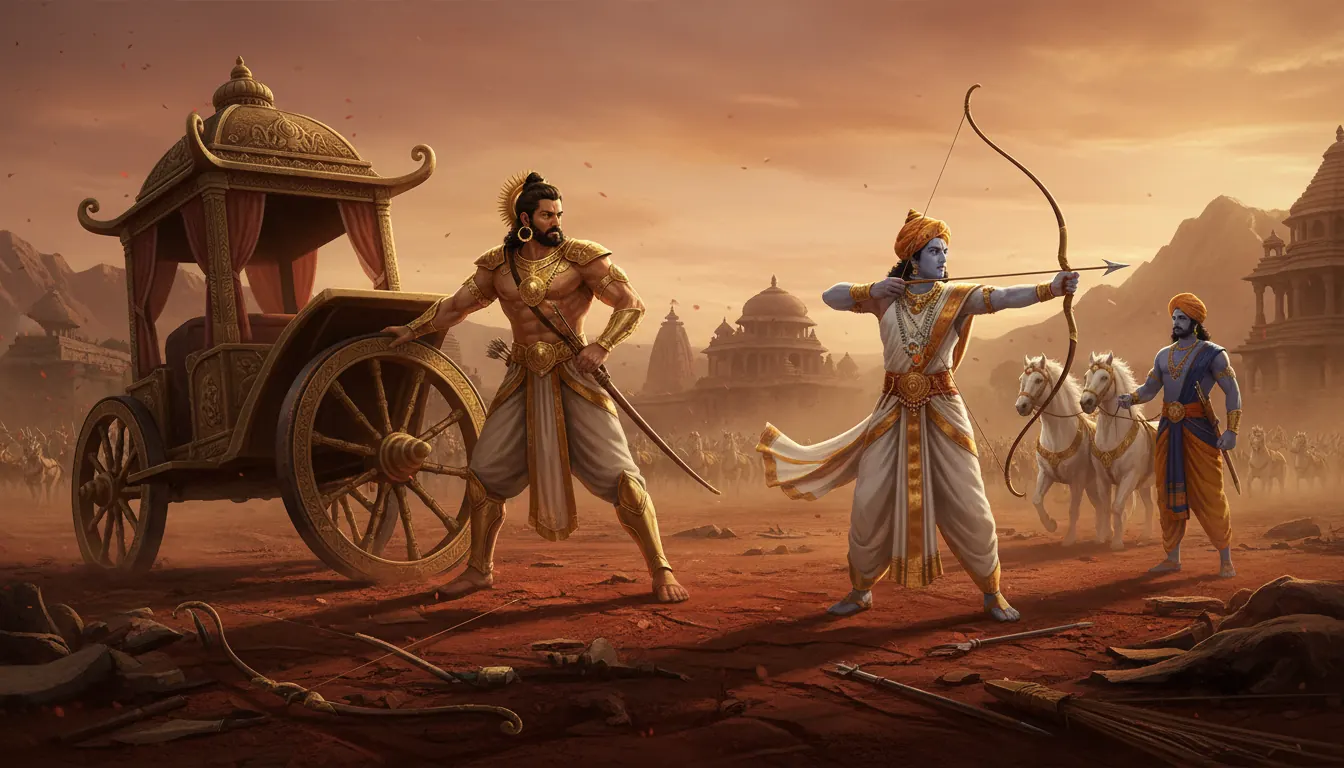
The Price on Arjuna's Head
Karna offers everything he owns to any man who will point out Arjuna
In short
On the seventeenth morning Karna rides into the Pandava army and offers a reward to any enemy soldier who will show him where Arjuna is. The bid climbs from a cart-load of jewels to ten thousand horses, six hundred elephants, fourteen villages, and at last his own sons and wives. Nobody answers him, and Shalya, holding his reins, laughs and tells him he will see Dhananjaya today for nothing.
Told in the Karna ParvaSet in Kurukshetra and Hastinapura13 min read
The Second Morning of the Sun's Son
Sanjaya, who had the sight Vyasa gave him and the unhappy office of telling a blind king what his sons were doing, had come in his account to the seventeenth day of the war.
Bhishma had gone down on the tenth. Drona had been cut down on the fifteenth. On the sixteenth the command of the Kaurava host passed to Karna, the son of a suta and the son of Surya, whom the Kurus called Vaikartana and the Pandavas called the charioteer's boy, and on the seventeenth morning he went out again with Shalya, the king of the Madras, holding his reins.
The chariot was the one Rama had given him, covered with tiger-skins, its axle silent, its seat of gold and its trivenu of silver, with white horses yoked to it and wheels that rattled deep as thunder. In it, said Sanjaya, Karna rode out with a cheerful heart, cutting down great numbers as he went, like the Sun driving away the dark.
Then he came within sight of the Pandava army, and did the thing that no other commander in that war had done.
He did not send out scouts. He did not ask his own men. He rode into the enemy and asked the enemy.
Every Pandava soldier he met with that morning, Sanjaya said, he spoke to, and what he spoke was not a challenge and not an insult. It was an offer.
"Whoever shows me the great-souled Dhananjaya of the white horses today, I will give him whatever wealth he wants."
He said it to men who were shooting at him. He had two objects on that field and neither of them was victory: to find Arjuna, and to be found by him. Everything else on the seventeenth day, the whole vast machinery of two armies, was in his way.
Whatever Wealth He Desires
The first offer was open, and an open offer from a man who had been king of Anga for as long as Duryodhana had needed him was not a small thing. Whatever wealth he desires. No figure, no limit, nothing named, because Karna at that moment could not think of a price he would not pay.
Then, as though he had watched the soldier's face and read a hesitation in it, he began to name things.
"If he gets that and is still not satisfied, then to the man who finds Arjuna for me I will give a cart-load of jewels and gems as well."
That is the shape of the whole speech, and it is worth watching, because it is the shape of a man bidding against himself. Nobody had refused him. Nobody had answered him at all. There was no soldier standing at his wheel driving the figure up. There was only Karna, in a moving chariot, in the middle of an enemy army, imagining the refusal and then answering it.
"If that is not enough for the man who shows me Arjuna, I will give him a hundred cows, and as many brass pails to milk them into."
A hundred cows, and a hundred brass pails to milk them into. It is the most domestic item in the whole catalogue, the kind of wealth a village measures itself by, and he put it in as carefully as he had put in the jewels.
"I will give a hundred of the finest villages to the man who shows me Arjuna."
A hundred villages. Not fields, not revenue, villages, with the people in them, given away by a commander on the morning of a battle for a piece of information that any man on either side of that field could have supplied by lifting his arm and pointing.
The Kaurava troops behind him heard it and were delighted. Shalya, in front of him, holding the reins, heard it too, and said nothing yet.
Damsels, White Mules, and Six Bulls
He went on. The list left the countryside behind and turned to the things a king gives when he wants to be remembered for giving.
"To the man who shows me Arjuna I will also give a number of long-haired, black-eyed young women, and a chariot drawn by white mules."
Then, immediately, the refrain again, the answer to a refusal that nobody had made.
"If that is not enough for the man who shows me Arjuna, I will give him another splendid chariot, made of gold, drawn by six bulls as big as elephants."
It is the strangest item on the list, and it is the one Shalya would remember. A chariot of gold drawn not by horses but by six bulls the size of elephants, a vehicle out of a story rather than out of any stable in Bharata. Karna offered it in the same breath in which he had offered the milking pails.
"I will also give him a hundred young women decked with ornaments, with collars of gold, fair-skinned and skilled in singing and dancing."
Sanjaya reported the words as they were spoken, and the words are a court inventory read aloud in the middle of a battle. Women counted like cattle, cattle counted like coin, all of it moving in one direction, all of it flowing out of Karna's hands toward a man who did not exist yet, an informer who had not come forward and was never going to come forward, because the Pandava soldiers he was addressing were the men Arjuna had come out that morning to protect.
There is no record that anybody answered him. Not one soldier in that army, on a day when their formations were being broken open, stepped out of the line and said, he is over there.
So Karna raised the figure again.
Hundreds, and Then Ten Thousand
"If that is not enough for the man who shows me Arjuna, I will give him a hundred elephants, a hundred villages and a hundred chariots, and ten thousand horses of the finest breed, well fed, gentle, full of good qualities, strong enough to pull chariots, and well trained."
Ten thousand horses. The number is the point of it. That is not a gift any longer, it is a cavalry arm, the sort of force a kingdom spends a generation breeding, offered for the direction in which one chariot had gone.
And Karna, who had been a charioteer's son before he was anything else, could not simply say ten thousand horses and stop. He described them. Well fed, gentle, well trained, strong enough to pull chariots. The son of Adhiratha knew what a good animal was, and even in the middle of a boast he graded them like a man walking down a line at a fair.
"To the man who shows me Arjuna I will also give four hundred cows, each with golden horns and each with her calf."
Cows with gilded horns, and every one of them with her calf beside her, which is how the books describe the gift a king makes when he wants merit that will outlast him. Karna was offering the merit-gift of a great sacrifice to an informer.
That was the arithmetic he had come to. Bhishma was lying on his bed of arrows within sight of both camps. Drona was two days dead. There was nobody left in that army whom the Kurus believed could stand in front of Arjuna, and Karna had told Shalya so himself before the horses moved: no one among you but me can stand up to Arjuna when he comes on, that warrior who is like Death himself in his fiercest form.
He believed it. He also could not find the man. So he emptied the treasury of Anga into the air, a hundred at a time, and went on looking.
Kamboja Horses and Elephants From the Western Sea
"If that is not enough for the man who shows me Arjuna, I will give him something richer still: five hundred horses with trappings of gold and jewelled ornaments. And I will give eighteen more horses besides, all of them very gentle."
Eighteen. After the hundreds and the ten thousands, a small exact number, thrown in at the end the way a merchant throws in a handful to close a sale.
"To the man who shows me Arjuna I will also give a bright chariot of gold, adorned with all kinds of ornaments and drawn by the finest Kamboja horses."
Kamboja horses, out of the north-west, the best that came into the country by trade or by conquest. Karna had taken tribute from those lands himself in the years when he rode out to make Duryodhana lord of the earth, and he knew exactly what he was promising.
"If that is not enough for the man who shows me Arjuna, I will give him something richer still: six hundred elephants with chains of gold around their necks and housings of gold on their backs, born on the western shores of the ocean and trained by elephant masters."
Six hundred elephants, and even here the specification is exact: where they were born, what hangs on them, whose hands broke them in. This is not a man throwing numbers about. This is a man going through his own possessions in his head, item by item, and finding that there is nothing among them he wants to keep.
Sanjaya, telling it afterward in a hall in Hastinapura, neither softens the list nor condemns it. He lets the inventory run, because the inventory is the portrait. Behind the six hundred elephants and the golden collars stands a man with one thing left to buy and no way at all to buy it, who kept raising the bid because raising the bid was the only action available to him while his charioteer drove him up and down the dust looking for a banner with an ape on it.
Sons, Wives, and Whatever Is Left
The end of the list is the part to read slowly.
"If that is not enough for the man who shows me Arjuna, I will give him something richer still: fourteen vaishya villages, full of people and full of wealth, near forests and rivers, safe from every danger, well provided, and fit for kings to enjoy."
Fourteen villages, described with the care of a man who has walked in them. Then a hundred slave girls from the land of the Magadhas, very young, with collars of gold.
And then Karna stopped naming things, because he had run out of categories and not out of willingness.
"If that is not enough for the man who shows me Arjuna, I will give him something richer still: whatever he asks for himself. My sons, my wives, and every pleasure and comfort I own, all of it I will give him if he wants it."
Sons. Vrishasena was on that field, fighting within his father's sight, and the men of Karna's own house were in the line that morning. He offered them, and his wives with them, to any stranger in the opposing army who would raise an arm and point.
Then the last clause, which gives away what all the rest of it was for.
"And to the man who shows me Keshava and Arjuna, once I have killed the two of them, I will give all the wealth they leave behind."
Not their heads. Their property. He would take the two Krishnas out of the world and hand over whatever they left behind, as though the killing were the fee and the plunder only the change.
When he had said all this, there in the battle, Karna blew his fine sea-born conch, and it gave out a sweet blare.
Duryodhana, hearing words so entirely in keeping with the nature of the friend he had made a king, was filled with joy, and all his followers with him. The cymbals went, and the drums, and the elephants grunted, and the lion-roars of men who believed the war had turned went up out of that army.
The Laughter of the Madra King
There was one man on that chariot who was not delighted, and he was standing at the front of it with the reins in his hands.
Shalya, the ruler of the Madras, uncle of Nakula and Sahadeva, had been talked into driving Karna by Duryodhana on the argument that only a king of his rank was fit to be set against Krishna, and he had taken the office and taken with it, by his own bargain, the right to say whatever he pleased. He had already used it once that morning, before the army moved, when Karna first began to boast of what he would do to Arjuna, and had asked him to his face: where is Dhananjaya, the best of men, and where are you, the lowest of men?
Now, while the drums were still going, he laughed in scorn and turned round on the box.
"Son of a suta, do not give anyone a golden chariot drawn by six bulls the size of elephants. You will see Dhananjaya today."
That is the whole answer, in two sentences. The gifts were unnecessary. The bounty was a bounty on a meeting that was coming anyway, and coming free.
"You are giving away wealth like a fool, as if you were the Lord of treasures himself. You are throwing it away without a thought, and you do not see the harm in gifts made to people who do not deserve them. With all the wealth you are so eager to give away, you could certainly perform many sacrifices. So perform them, son of a suta."
Then the line that cut, because it was not about the money at all.
"We have never heard of two lions being brought down by a fox. You are chasing what you should never chase. It seems you have no friends to stop you, though you are rushing headlong into a blazing fire."
Karna heard his own charioteer call him a fox, and did not raise the offer, and did not withdraw it.
"I seek Arjuna in battle trusting in the strength of my own arms. But you are an enemy wearing a friend's face, and you want to frighten me. No one will turn me from this resolve, not even Indra himself with his thunderbolt raised. What need is there to speak of a mortal?"
The white horses went forward. Nobody on either side of that field ever came to claim the hundred villages.
Dharma Lesson
Karna's open hand was the best thing in him, and here it is spent on nothing. A gift has worth where there is a fit receiver and a fit purpose, and a man who will hand over his herds, his villages, his wives and his sons for one piece of battlefield gossip has stopped weighing either. Shalya's mockery is cruel and it is also correct: that wealth would have paid for sacrifices, and the meeting Karna was bidding for was already on its way to him without a fee. Wanting something greatly does not purchase it. It only shows everyone watching what the wanting has already cost.