The Afternoon of the Eighteenth Day
Satyaki takes Kritavarma's chariot again, Duryodhana holds the field alone, and the last elephants fall
In short
After Shalva's elephant is brought down, Kritavarma rallies the broken Kaurava host and Satyaki kills king Kshemadhurti and strips Kritavarma of his chariot a second time. The army runs and Duryodhana turns and fights the whole Pandava line by himself, taking arrows from the whole Pandava line at once without giving ground. By late afternoon Arjuna has burned the Kaurava chariot force with Gandiva, Bhima has gone in among the last three thousand elephants on foot with his mace, and Sanjaya, the man telling the story, is taken alive by Satyaki.
Told in the Shalya ParvaSet in Kurukshetra22 min read
After Shalva Fell
Sanjaya was still in the hall at Hastinapura, still telling a blind man what his sons were doing on a field two days' ride away, and the part he had reached was the afternoon of the eighteenth day.
Shalva, the ruler of the Mlecchas, had just been killed on the back of his elephant, and the animal and the king had come down together like a mountain summit split by a thunderbolt. Sanjaya did not soften what happened next.
"Once the heroic Shalva, that ornament of assemblies, had been slain," he said, "your army quickly broke, like a mighty tree broken by the force of a storm."
That is the state of the Kaurava host at the point where this account begins. Bhishma had lain eight days on his bed of arrows. Drona was gone. Karna was gone. Shalya, the fourth commander, had been killed at midday that same day by Yudhishthira, and there was no commander left at all, only a king in the middle of the wreckage and whatever men would still stand near him.
One man stopped the rout. Kritavarma of the Bhojas, the Satvata warrior who had come to this war on the Kaurava side while his own kinsmen fought on the other, put himself across the front of the broken army and resisted the Pandavas alone. He stood there, said Sanjaya, like a hill pierced all over with arrows.
The men who had run saw him standing and came back. That is how armies work.
So a battle began again, between the Pandavas and the Kurus who had returned with death itself for their goal, and it was a strange and fierce thing to watch, because one man was holding an invincible army by himself and his friends were shouting for him loudly enough, Sanjaya said, that the noise seemed to reach heaven.
The Panchalas heard that shouting and were afraid.
Then Satyaki came to that spot.
Seven Shafts for Kshemadhurti
Satyaki, the grandson of Shini, was a Vrishni, and he had come to Kurukshetra as Krishna's kinsman and Arjuna's pupil. He had spent this war doing the errands nobody else could survive: the crossing of the whole Kaurava host to reach Arjuna on the fourteenth day, the night battle, the long feud with the house of Bahlika. By the eighteenth day there were very few men left on either side who could make him hesitate.
The first man in his way was king Kshemadhurti, one of the many allied kings whose names appear in this epic once, at the moment they are killed. He was a warrior of great strength standing in a rallied line, doing what the line required of him.
Satyaki sent him to Yama's abode with seven keen shafts.
That is the whole of Kshemadhurti in the Mahabharata. Seven arrows, one sentence, and the account moves on. It is worth stopping on him for a moment anyway, because on the eighteenth day the field was covered with men exactly like him, kings with their own capitals and their own halls and their own sons at home, who had come north for somebody else's quarrel and who had reached the point in it where they were being spent at the rate of one line apiece.
Then the son of Hridika came for him.
Kritavarma had been holding the front alone; now the Pandava who mattered had walked into his reach, and he rushed at that bull of Shini's race with his shafts already flying. The two of them roared like lions and struck each other with the force of two elephants meeting.
They were both Vrishnis. They had grown up in the same city, under the same elders, in the same clan of Andhaka and Satvata blood, and they had chosen opposite sides of this war for reasons that no longer mattered to anybody. The Pandavas stopped to watch. The Panchalas stopped to watch. Sanjaya said the arrows they sent at each other looked, from where he stood, like flights of swiftly coursing insects crossing the sky.
The Second Time Satyaki Took His Chariot
They careered in every kind of track, wheeling and cutting across each other, and afflicted each other with showers of arrows until neither could be seen except as a shape inside a moving cloud.
Kritavarma got in first. He came close and put four keen shafts into Satyaki's four horses.
Satyaki, said Sanjaya, was enraged at that like an elephant struck with a lance, and answered with eight arrows into the man himself. Kritavarma drew his bow to its fullest, sent three stone-whetted shafts through him, and with a fourth cut his bow in two.
There is a rhythm to these duels that the epic never varies. The bow goes. The man does not stop. Satyaki laid the broken stave aside, took up another with an arrow already fixed on the string, and could not bear what had just been done to him. He rushed straight at Kritavarma with ten keen shafts and struck the driver, the horses and the standard with all of them.
Kritavarma looked at his own gold-decked chariot, which had no driver on it and nothing alive in the traces, and became filled with rage. He lifted a pointed lance and hurled it with the whole force of his arm, meaning to end Satyaki with it.
Satyaki cut the lance out of the air with a volley of arrows and dropped the fragments on the ground. Sanjaya says the sheer speed of it stunned the man of Madhu's race, who had just watched his best throw taken apart in flight. Then a broad-headed arrow went into Kritavarma's chest, and without horses, without driver, without chariot, he came down onto the earth on his own feet.
The Kaurava troops had already lost their nerve once that afternoon. Seeing the one man who had stopped their rout standing on the ground in front of Satyaki, they lost it again, and a great sorrow went through Dhritarashtra's sons.
Kripa saved him. The old teacher drove at Satyaki intending to send him to Yama, and instead did the thing that actually needed doing: he took Kritavarma up onto his own chariot in the sight of every bowman there and carried him out of the press.
That was the second time that day that Satyaki had left Kritavarma standing in the dirt without a chariot. The Kuru army did not wait for a third.
The Only Man Who Did Not Run
The whole army of Duryodhana turned away from the fight.
They were lucky in one thing. A dusty cloud had come down over that part of the field, and the enemy could not see that the men in front of them had gone. Sanjaya, who watched it, put it in a single sentence that he must have known would land on his listener like a stone.
All your warriors fled, monarch, except king Duryodhana.
He was close enough to see his own army break. He did not go with it and he did not try to stop it. He drove forward into the gap it had left and assailed the victorious enemy alone, resisting all of them by himself.
Understand what alone means here. It means Yudhishthira and Bhima and Arjuna and Nakula and Sahadeva. It means Dhrishtadyumna, who had killed his teacher; Shikhandi, who had brought down his grandsire; the five sons of Draupadi; the massed bands of the Panchalas and the Kaikeyas and the Somakas. It means every living enemy he had, in one place, with nothing between them and him.
He went at all of it with keen arrows and no fear whatever.
Sanjaya, who had spent eighteen days finding images for men in battle, reached for a strange one for Duryodhana at this moment. He said that his mighty son stood in that battle with firm determination like a blazing and mighty fire on a sacrificial platform, sanctified with mantras. Not a fire in a forest, not a fire in a house. The fire in the middle of a rite, fenced, fed, correctly kindled, doing precisely what it was lit to do.
It is the most generous thing anybody says about Duryodhana in the entire war, and it is said by a man whose whole account has been an argument that this war was Duryodhana's fault.
He careered over the field, and his foes could not approach him, said Sanjaya, as living creatures cannot approach the Destroyer.
Then the son of Hridika came back to the field on another chariot, and the afternoon began again.
The Arithmetic of One Man
Riding in his chariot and filled with the courage of despair, Duryodhana looked in that battle like Rudra himself.
With the thousands of shafts he shot, the earth was covered. He drenched his enemies the way clouds pour rain on the breast of a mountain. Sanjaya swore to what he saw: there was not a man among the Pandavas in that great battle, not a horse, not an elephant, not a chariot, that was not struck by Duryodhana's arrows.
"Whichever of the warriors I looked at then," he said, "I saw that every one had been struck by your son's arrows. Among those thousands upon thousands of warriors on the field, on your side or the enemy's, it seemed to me that Duryodhana was then the only man."
The epic then does what it does when it wants a claim believed. It counts.
A hundred arrows into Yudhishthira. Seventy into Bhimasena. Seven into Sahadeva. Sixty-four into Nakula. Five into Dhrishtadyumna. Seven into the sons of Draupadi. Three into Satyaki. Then a broad-headed shaft that cut Sahadeva's bow in half.
And they answered him, all of them, in the same currency. Sahadeva took up another bow and put ten shafts into him. Nakula put in nine and roared. Satyaki struck him with one straight arrow, the sons of Draupadi with seventy-three, Yudhishthira with seven, Bhimasena with eighty.
Pierced from every side by all of those illustrious warriors at once, Duryodhana did not waver, in the presence of all the troops who stood there as spectators. His quickness and his skill and his prowess, Sanjaya said, were seen by everyone there to exceed those of any creature.
That was what brought the army back. The Dhartarashtras had not run far, and when they saw the king still up they returned to him clad in mail, with a noise like the roar of the ocean in the rains.
So the duels started again, the way they had started every day for eighteen days. Ashwatthama took Bhima, and the two of them counteracted each other and frightened the whole universe. Shakuni killed Yudhishthira's four horses and roared, and Sahadeva carried his beaten brother out of it, and Yudhishthira came back on another chariot and put fourteen arrows into Shakuni. Uluka went at Nakula. Kritavarma found Satyaki again. Duryodhana cut Dhrishtadyumna's bow and fought him bowless until he found another.
And Kripa fought the five sons of Draupadi at once, which the epic likens, with a straight face, to a man's struggle with his own five senses.
Dust, and Then Blood, and Then the Portents
Men fought with men, elephants with elephants, horses with horses, chariot-warriors with chariot-warriors. Here an encounter was beautiful, said Sanjaya, and there another was awful, and there another was terribly fierce.
Then the dust came up. It was raised by the wheels and by the running horses and by the breath of the elephants, and the wind carried it from one part of the field to another until it stood in the sky like an evening cloud and dimmed the sun. The great chariot-warriors could not be seen at all.
What settled it was not rain.
"Soon that disappeared and everything became clear," Sanjaya said, "when the Earth became drenched with the blood of heroes."
With the dust laid, he could see the single combats again, each man fighting at noon of day according to his strength and his rank, and the noise of falling shafts was like a vast forest of bamboo burning on every side.
By then both armies were fighting by guesswork and by the names men shouted. Neither side had anybody left who would turn away. And it was at that point, with the fighting at its most general and its most pitiless, that the sky began to comment on it.
The earth trembled with her mountains and her forests, and made a loud noise doing it. Meteors like blazing brands with handles on them fell out of the sky on every side, as if they were dropping from the disc of the sun. A hurricane got up and blew from all quarters, carrying hard pebbles along the ground. The elephants shed copious tears and stood shaking.
These are the standard portents of the epic, and they are always read the same way: something is about to end.
The kshatriyas on that field looked at all of it and disregarded it. They took counsel with one another and cheerfully stood up again for battle, on the beautiful and sacred field called after Kuru, from a desire to obtain heaven.
Then Shakuni, the son of the Gandhara king, said: "All of you fight in front. I will kill the Pandavas from behind."
The Madrakas near him were filled with joy and shouted, and other men took up the shout, which tells you something about what the Kaurava host had been reduced to on the eighteenth day: a plan to attack the enemy's back was received as good news.
Ten Thousand Horse at the Rear
The Pandavas came on again, shook their bows, and covered the Kauravas with arrows, and the Madrakas were cut down where they stood. Duryodhana's troops turned away once more.
"Stop, you sinful men," Shakuni shouted at them. "Fight. What use is running away?"
He had ten thousand horsemen with bright lances, and he took them round to the rear of the Pandava army and began killing it from behind. The vast force of the Pandus broke apart, said Sanjaya, like a mass of cloud dispersed by a mighty wind.
Yudhishthira saw his own army going and did not raise his voice.
"There is the son of Subala, harrying our rear, standing there in his mail," he said to Sahadeva. "He is slaughtering our forces. Look at that wicked wretch, son of Pandu. With the sons of Draupadi to help you, go at him and kill Shakuni, the son of Subala. Meanwhile, sinless one, with the Panchalas behind me, I will destroy the enemy's chariot force. Let all the elephants and all the horse and three thousand foot go with you."
Seven hundred elephants with bowmen on them, five thousand horse, three thousand foot, the sons of Draupadi and Sahadeva went for Shakuni.
What followed was not a battle of chariots. The horsemen went into Subala's division and got in among his chariot-warriors, and after that the twang of bowstrings was not heard on that part of the field at all, because every chariot-warrior there had become a spectator. It was maces and lances and swords, hurled from close range, and Sanjaya says the darts crossing the sky looked like meteors and the lances hanging in the air looked like swarms of locusts.
Horses came down in hundreds and thousands with their limbs bathed in blood. Men dragged each other off their saddles by the hair and killed each other on the ground like wrestlers. Many were carried away dead on the backs of their own horses. Darkness came down with the dust, and out of it men and animals stumbled clear, vomiting blood.
The ground filled up with bodies until no rider could get through, and both sides pulled back with six thousand horse apiece, which is what remained of the cavalry of the world.
The Pandava horsemen, covered in blood, made the only sensible remark of the afternoon. "It is no longer possible to fight here in chariots. How much harder, then, to fight here on elephants. Let chariots go against chariots, and elephants against elephants."
Then Shakuni came back and fell on Dhrishtadyumna's division anyway.
Where Is the King
When the noise had subsided a little and the Pandavas had killed a great many of them, Shakuni came out of it once more with seven hundred horsemen, telling them to fight cheerfully, and then asked the kshatriyas around him a question.
"Where is the king, that great chariot-warrior?"
They pointed. "That great chariot-warrior, the Kuru king, is over there, where you can see that large umbrella as bright as the full moon, where those chariot-warriors in mail are standing, where that loud noise, deep as the roar of clouds, can be heard. Go there quickly, king, and you will see the Kuru monarch."
That is how you found Duryodhana on the eighteenth day. By the white umbrella, and by the noise.
Shakuni rode to him through the ruins and spoke like a man whose plans had all come off. "Destroy the chariot divisions of the Pandavas, king. I have defeated all their horses. Yudhishthira cannot be conquered in battle unless one is ready to lay down one's life. Once that chariot force has been destroyed, we will kill all those elephants and foot-soldiers and the rest."
The Kaurava warriors heard it, shook their bows, and roared, and went forward one more time.
On the other side of the field Arjuna watched them come with their bows raised and turned to the man holding his reins.
"Urge the horses on fearlessly and drive into this sea of troops. With my sharp shafts I will bring these hostilities to an end today. Today is the eighteenth day, Janardana, of this great battle. The army of Dhritarashtra's son, which was as vast as the ocean, has met us and been reduced to the size of the hollow left by a cow's hoof."
Then he made the long count that this site tells elsewhere, the roll of every death after which the carnage did not cease, from Bhishma to Drona to Karna to Dushasana, and ended it where he had begun. "Drive into the Bharata army, hero, for I will kill the wicked-souled Duryodhana and his army today with my sharp shafts."
Krishna, reins in hand, drove into that host without a word of argument. It was a forest they were entering, Sanjaya said, and he named its parts: darts for its prickles, maces and spiked bludgeons for its paths, chariots and elephants for its great trees, cavalry and infantry for the creepers between them.
The white horses went in.
Three Thousand Elephants
What Gandiva did to the Kaurava army in the next hour is described in the epic as a fire in dry grass.
Arjuna shot hundreds of keen shafts like a cloud pouring rain. The arrows went through armour and into the ground. They struck men and elephants and horses and fell with a noise like winged insects. The whole world seemed to be full of gold-winged shafts steeped in oil, polished by the hands of the smith, and marked with Partha's name, and he did not have to shoot a second arrow at any man, horse or elephant, whatever its size.
That army broke in the sight of Duryodhana. Some men deserted their fathers and brothers, some their friends. Some had lost their horses, some their drivers, some had poles and yokes and wheels broken. Some had simply shot away all their arrows. Some, unwounded, ran anyway. Some stopped to lift wounded men onto their own chariots, gave them water, sat with them a while, and then went back into the battle. Some changed their armour, or groomed their horses, or carried a brother back to camp, and then came back too, and drew up their chariots in order of rank and advanced again with rows of bells ringing on them, looking, Sanjaya said, like Danavas intent on the conquest of the three worlds.
Some of those went at Dhrishtadyumna, and the Panchala prince met them with Shikhandi and with Satanika, Nakula's son, beside him.
Duryodhana turned his own bow on Dhrishtadyumna and put many arrows into his arms and chest. Pierced like an elephant with lances, Dhrishtadyumna answered by sending the king's four horses to the regions of death and taking the head off his driver with a broad-headed arrow.
Duryodhana came down off the wreck, got onto a horse, and rode a short distance away, and then went looking for Shakuni.
That left the five brothers standing in the open with the Kaurava chariots broken around them, and the last three thousand elephants of that army closed in and surrounded them. They looked, Sanjaya said, like the planets surrounded by clouds.
Arjuna came in among the elephants on his white-horsed chariot with Krishna driving, and began killing them with polished arrows, one arrow to an elephant, and the watchers saw those hill-sized animals fallen and falling all around him.
The Man Who Was Telling This
Bhima did not shoot at them.
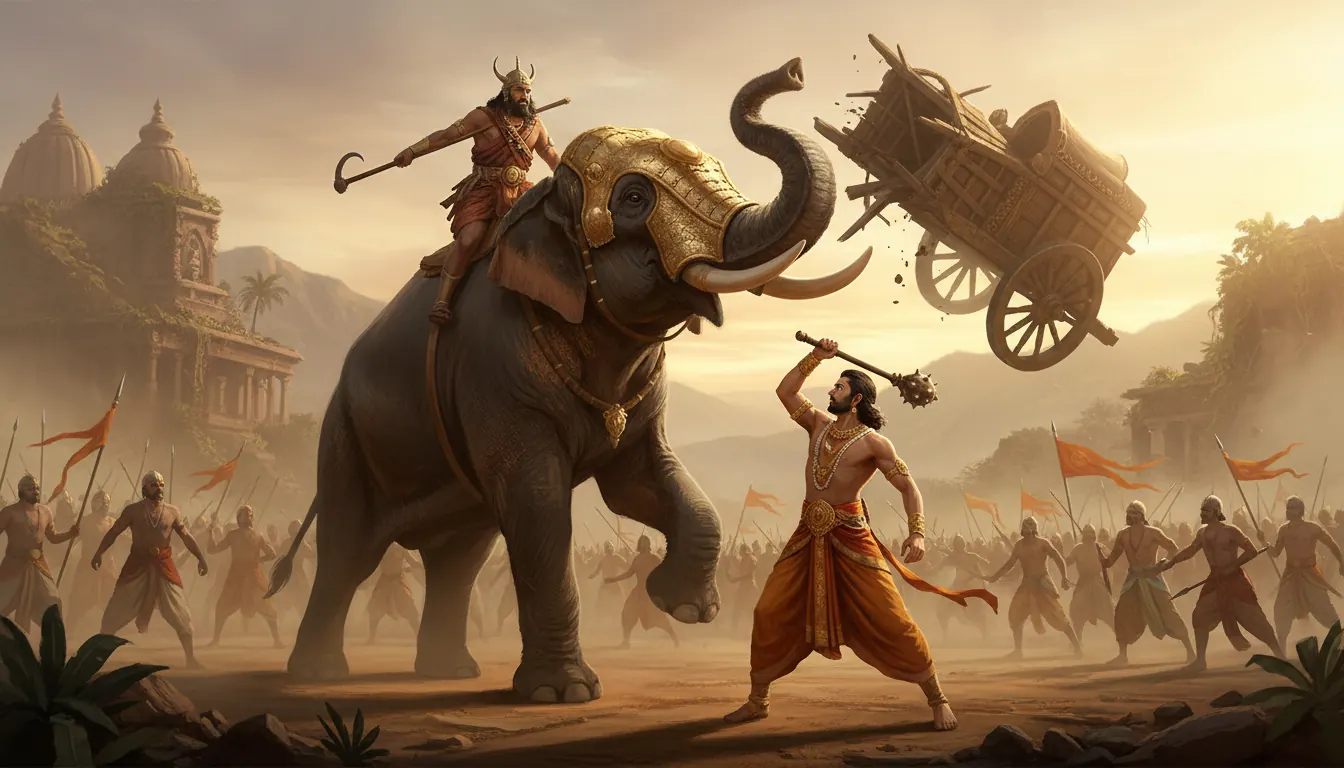
He looked at the elephants, took up his mace, and jumped down off his chariot onto the ground among them like the Destroyer with his club, and the Kaurava soldiers who saw him do it were so frightened that they lost control of their bodies where they stood. The whole army was agitated by the sight of one man on foot with a mace.
Then the elephants began running in every direction with their frontal globes split open and their limbs bathed in blood, and falling as they ran, and crying out, and Sanjaya, looking for the right image one more time, said they came down like mountains that had lost their wings. Yudhishthira and the two sons of Madri shot the men riding them with vulture-winged arrows. Dhrishtadyumna, having just driven the king of the Kurus off his chariot and onto a horse, came across to help kill the rest.
Meanwhile Ashwatthama and Kripa and Kritavarma could not find Duryodhana in the chariot division, and were asking everyone where he had gone. Some said he had ridden to Subala's son after his driver was killed. Others, mangled with wounds and past caring, answered them differently. "What do we need Duryodhana for? See whether he is still alive. All of you fight together. What will the king do to you?" And others, bleeding, with all their kinsmen dead, said: "Let us kill these forces that have surrounded us. Look, the Pandavas are coming this way, having killed the elephants."
The three of them left the field to look for the king anyway.
After they had gone, Sanjaya stopped being a witness and became a participant, and told his listener so.
"Seeing those soldiers of ours almost without weapons and surrounded, I myself, king, with only two kinds of forces, grew reckless of my life, joined the five leaders of our army and fought." They were beaten. He got away from Dhrishtadyumna because Dhrishtadyumna's horses were tired, and rode straight into Satyaki's four hundred chariots, and he described what that felt like exactly: "I fell among the forces of Madhava as a sinner falls into hell."
Satyaki cut his armour off him and wanted him alive. He picked Sanjaya up off the ground where he lay senseless.
And behind them Bhima and Arjuna finished the elephants, and so many hill-sized bodies came down that the Pandavas could not get out. Bhima put his hands on the dead animals and dragged them aside until there was a road.
Dharma Lesson
Sanjaya has spent the whole war telling Dhritarashtra that this ruin is his son's doing, and on this afternoon he still stops to say that Duryodhana stood alone against every enemy he had like a consecrated fire on its platform. Courage is real even when it is spent on a cause that was wrong from the first day, and calling it real costs the judgement nothing. What the day takes from the Kauravas is not their bravery but their purpose: the same king who will not retreat is the king who would not make peace after Bhishma fell, and by evening his army is elephants dragged aside to clear a road.