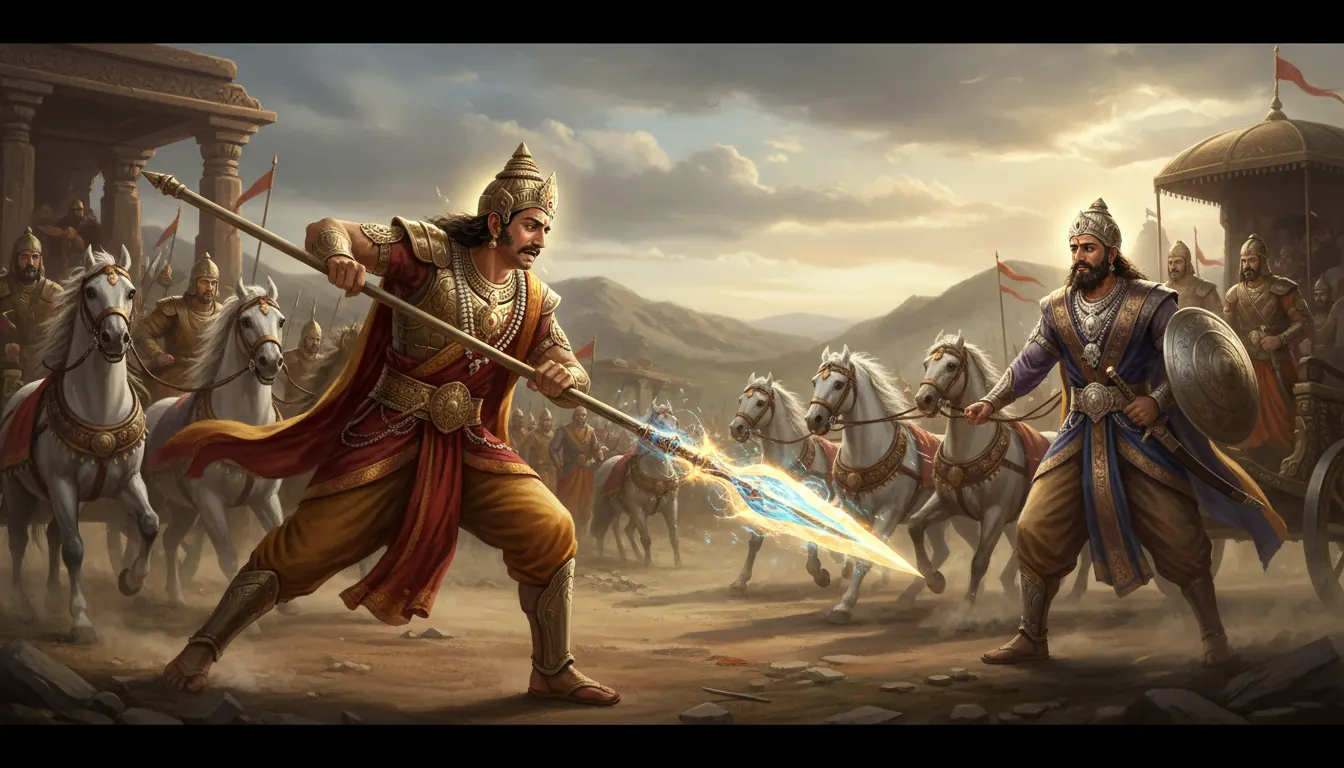
The Seven Hundred
Shalya's followers charge against orders, and Duryodhana's army breaks twice before he turns it round
In short
With Shalya dead at midday on the eighteenth day, the Kaurava host breaks and runs, and Satyaki and Kritavarma, two Vrishnis on opposite sides, fight their first duel of the afternoon. Seven hundred Madraka chariot-warriors refuse Duryodhana's order to stand back and go in to avenge their king, and Shakuni argues the whole Kaurava army into following them. The Madrakas are annihilated before the rescue arrives, Bhima crushes twenty-one thousand foot-soldiers with his mace, and Duryodhana withdraws to the rear and rallies the men who will not run past him.
Told in the Shalya ParvaSet in Kurukshetra and Madra19 min read
Midday on the Eighteenth Day
Sanjaya said: "When that great king and mighty chariot-warrior fell, that hero no one could beat in battle, your troops and your sons almost all turned away from the fight."
He was speaking to a blind man in a hall in Hastinapura, and the hero he meant was Shalya, ruler of the Madras, the fourth man to command the Kaurava host and the last of the four. Bhishma had gone down on the tenth day, Drona on the fifteenth, Karna on the seventeenth. Shalya had held the command for one morning. He lay now on the field with Yudhishthira's dart driven through his broad chest and into the earth behind him, and his younger brother, who had come out to pay the last dues of his house, lay near him without a head.
Sanjaya did not soften the account of what followed.
"Your troops were like shipwrecked merchants on the open sea with no raft to cross it. After the fall of the Madra king, your troops, terrified and torn by arrows, were like men without a master looking for a protector, or a herd of deer set upon by a lion. Like bulls that have lost their horns, or elephants whose tusks have been broken, your troops, defeated by Ajatashatru, fled at midday."
Ajatashatru is one of Yudhishthira's names. It means the man against whom no enemy has been born. Sanjaya used it deliberately, of the mildest of the five brothers, who had spent that morning killing men in hundreds and thousands with his own hands.
"The fear and the grief we had felt, king, at the fall of Bhishma, of Drona, and of the Suta's son, now came over us once more."
And then the sentence that mattered most, because everything in the rest of that afternoon was an argument against it.
"After Shalya fell, no one among your troops had the heart to rally the army or to show his prowess."
None of them yet. The sun was only at the top of the sky.
Two Men of the Vrishnis
Satyaki went after the runners.
He was the grandson of Shini, a Vrishni of Krishna's own clan, and he had come to Kurukshetra to fight on the Pandava side. Shooting his arrows, he went after the frightened Kauravas as they fled, and one man turned round and stopped him.
Hridika's son Kritavarma was also a Vrishni. He had gone to Dwaraka's council and come away with the army, and had brought it here, to this side of the field, and for eighteen days these two kinsmen had been fighting under opposite standards. Now, quickly and fearlessly, he met that invincible warrior as he bore down on the beaten army.
Sanjaya said they met like two furious lions. Both shone like the sun, and they covered each other with arrows of blazing splendour like the sun's rays. The arrows of those two lions of the Vrishni line, shot with force from their bows, looked from a distance like swift insects darting across the sky.
Kritavarma had the better of the opening. He pierced Satyaki with ten arrows and his horses with three, and then with one straight arrow cut his bow at the grip.
Satyaki laid aside that fine bow which had been cut and quietly took up another that was tougher than the first. It was the whole of his answer, and he gave it without a word. With that splendid bow he put ten arrows into the centre of Kritavarma's chest. Then with well-aimed arrows he cut the chariot and its pole to pieces, killed the four horses, and killed the two Parshni drivers, the men who ride at either flank of a chariot to guard its wheels while the charioteer keeps his eyes forward.
Kritavarma stood on a wreck in the middle of a rout with nothing under him and nothing to drive.
Then Kripa, the son of Sharadvan, who had taught both armies their weapons when they were boys, came alongside, took him up into his own chariot and carried him away.
One Man Standing in the Dust
With the king of the Madras killed and Kritavarma left without a chariot, the whole of Duryodhana's army once more turned its face from the battle.
The dust came up so thickly that Sanjaya, who had been given the sight to see everything on that field, could see nothing at all. "We could not see anything," he said. "Most of your army fell. Those who were left alive had turned their faces away from the battle." Then the cloud of dust settled, and Sanjaya named what settled it: the many streams of blood that drenched it on every side.
When the air cleared there was one chariot standing between the Pandavas and the backs of the men running away.
Duryodhana, seeing from close at hand that his army was broken, held off all the Parthas alone as they came on furiously. He saw the Pandavas in their chariots, and Dhrishtadyumna the son of Prishata, and the invincible chief of the Anartas, Satyaki, and he covered all of them with sharp arrows. At that moment the enemy would not come near him, said Sanjaya, just as mortal creatures fear to come near the Destroyer standing before them.
While he held that spot, Kritavarma came back to it in another chariot, which was a brave thing to do twice in one hour. Yudhishthira killed his four horses with four arrows and then put six heavy broad-headed arrows into Kripa, who had rescued him the first time. Ashwatthama drew up beside the second wreck and took Kritavarma aboard and carried him out of Yudhishthira's reach, and Kripa, going away, turned and pierced Yudhishthira with eight arrows and his horses with eight more.
"So, king," said Sanjaya, "the embers of that battle began to glow here and there, because of the evil policy of you and your son."
Across the field the Parthas had understood at last what had happened at noon. They came together and blew their conchs, and they applauded Yudhishthira for the killing of Shalya as the gods long ago applauded Indra after the slaying of Vritra, and they beat every kind of drum they had until the earth resounded on every side with the noise.
Do Not Go Forward
The Madrakas had not run.
After Shalya was killed, the followers of the Madra king, seven hundred heroic chariot-warriors, went into battle with great energy. They were what was left of the contingent their king had brought down from his country in the north-west, and their king was lying out in front of them with a dart-hole in his chest, and they wanted the man who had made it.
Duryodhana rode across their front to stop them. He was on an elephant gigantic as a hill, with an umbrella held over his head and yak-tail fans moving on either side of him, the whole apparatus of a king in the field, and he shouted at them the plainest order he gave all day.
"Do not go forward! Do not go forward!"
Though Duryodhana forbade them again and again, those heroes, bent on killing Yudhishthira, drove into the Pandava army. They were loyal to Duryodhana. Sanjaya says so in the same breath in which he says they disobeyed him. Twanging their bows loudly, they fought the Pandavas.
Word went across the field that Shalya had been killed and that Yudhishthira was now hard pressed by the Madraka chariot-warriors, who were devoted to the good of their Madraka king, and Arjuna came, stretching his bow Gandiva and filling the earth with the rattle of his chariot. Bhima came, and the two sons of Madri, and Satyaki, and the five sons of Draupadi, and Dhrishtadyumna, and Shikhandi, and behind them the Panchalas and the Somakas. They took their places around the eldest brother and began to churn up the enemy force as Makaras churn the ocean, and the Kaurava army trembled like trees in a storm.
In the middle of that the Madrakas were heard shouting for the men they could not find.
"Where is King Yudhishthira? Why are his brave brothers, the Pandavas, nowhere to be seen? What has become of the mighty Panchalas, and of the great chariot-warrior Shikhandi? Where are Dhrishtadyumna and the grandson of Shini and those great chariot-warriors, the five sons of Draupadi?"
The sons of Draupadi were near enough to hear it. They came in and began to kill the men who were still shouting.
Shakuni Speaks to His Nephew
Duryodhana went on trying to call them back. When they saw the heroic Pandavas, the brave warriors of his own army still rushed at them, though he had forbidden it. He went along the line speaking quietly, trying to keep those warriors from fighting the enemy. Not one great chariot-warrior among them obeyed his command.
His uncle watched him do it.
Shakuni, the son of the Gandhara king, is described here by Sanjaya with one word: eloquent. He had been the voice at Duryodhana's shoulder since the dice, and this was very nearly the last thing he ever said to him, and it is worth reading for what it takes for granted.
"What is this, that we stand here while the Madraka army is slaughtered before our eyes? With you here, Bharata, this looks bad! We agreed that all of us would fight together! Why then, king, do you let our enemies slaughter our troops like this?"
Duryodhana answered him with the truth.
"I forbade them before, and they would not obey my command. They have gone into the Pandava army together."
It is a king admitting in the field that his orders carry no weight. Shakuni did not dispute it. He took it as a fact of the world and built the argument on top of it.
"Brave warriors, once their anger is roused in battle, do not obey their leaders' commands. You must not be angry with those men. This is not the time to stand by. So let us all go together, with our chariots and horses and elephants, to rescue those great bowmen, the followers of the Madra king. And let us take great care, king, to protect one another."
That was the whole of it. Nobody is to blame, and therefore everybody must go in.
Thinking as Shakuni did, all the Kauravas then went to the place where the Madras were. Duryodhana too, at his uncle's words, went, surrounded by a large force, roaring like a lion and making the earth resound. Among those troops these were the words that could be heard, and Sanjaya set them down as he heard them.
"Slay, pierce, seize, strike, cut off!"
The Madrakas Are Finished
The Pandavas saw the followers of the Madra king coming at them in one body and changed their shape to meet it. They went against them drawn up in the formation called Madhyama, the middle array.
What happened inside it did not take long. Fighting hand to hand, said Sanjaya, those heroic warriors, the followers of the Madra king, were seen to perish within a short while. "Then, while we were advancing, the Pandavas, all together and moving swiftly, finished the slaughter of the Madrakas." The men who had disobeyed an order to save themselves were dead before the army that had been argued into rescuing them arrived, and the Pandavas, filled with delight, raised shouts of joy.
Sanjaya described the ground afterwards, and he described it in motion, because almost nothing on it was still.
Headless bodies were seen rising up all around. Great meteors seemed to fall from the disc of the sun. The earth was covered with chariots and broken yokes and axles and slain chariot-warriors and dead horses. Horses as swift as the wind, still harnessed to their yokes with no living driver to guide them, dragged chariot-warriors here and there across the field. Some horses dragged chariots with broken wheels. Some ran in every direction with pieces of broken chariots still hanging behind them. Here and there were animals tangled in their own traces, hobbling and pulling and getting nowhere. Chariot-warriors falling from their chariots dropped down, he said, like the dwellers of heaven when their merit is used up.
When the brave followers of the Madra king had been killed, the great fighters of the Pandava army saw a body of cavalry coming toward them and rushed at it swiftly, eager for victory. They made their arrows whistle loudly. They mingled the noise of their bows with the blare of their conchs, shook their weapons over their heads, and roared like lions.
When it saw that great force of the Madra king wiped out, and saw too that their heroic king had been killed in battle, the whole of Duryodhana's army once more turned away from the field. Struck by those steady bowmen, the Kuru army fled in every direction, filled with fear.
It was the second time it had broken since noon.
What the Panchalas Shouted as They Chased
Some fled on horseback, some on elephants, some in chariots, and the foot-soldiers ran between them. Two thousand elephants, huge as hills and trained to strike, went off the field after Shalya's fall, urged on with hooks and with the toes of the men on their necks. Stricken with arrows, said Sanjaya, your soldiers were seen running in every direction, breathing hard.
The Panchalas and the Pandavas, eager for victory, pursued them hotly, and as they ran they talked. Sanjaya reported the talk to Dhritarashtra without editing it, which was its own kind of cruelty, since almost every line of it was about the man listening.
"Today King Yudhishthira, firm in truth, has defeated his enemies. Today Duryodhana has been stripped of his splendour and his royal fortune. Today let Dhritarashtra, that king of men, hear of his sons' deaths and lie stunned on the ground in the sharpest anguish. Let him learn today that the son of Kunti is mighty among all bowmen. Today that sinful, wicked-hearted king will blame himself. Let him remember today the good advice of Vidura. From this day on let him serve the Parthas as their slave. Let that king feel today the grief the sons of Pandu once felt. Let that king know today the greatness of Krishna."
Then they went through the roll of the men chasing them, and it reads like an inventory of everything the Kauravas had left to be afraid of.
Let him hear the terrible twang of Arjuna's bow. Let him know the fearful might of Bhima, who did at the killing of Dushasana what no other man in this world could have done, and who will do the same to Duryodhana as Indra did to the Asura Maya. When he hears that the ruler of the Madras, whom not even the gods could defeat, has been killed, that king will know the prowess of the eldest son of Pandu. When the heroic son of Subala and all the Gandharas have been killed, he will know the strength of the two sons of Madri.
"How can victory not belong to those whose refuge is righteousness?"
Saying this, and filled with joy, the Srinjayas pursued the Kaurava troops, who were badly torn by arrows.
Twenty-One Thousand on Foot
Arjuna drove his chariot against what was left of the enemy's chariot-division. The two sons of Madri and Satyaki went after Shakuni.
Duryodhana, watching his own men run in fear of Bhimasena, smiled, and spoke to his driver.
"Partha, standing there with his bow, is getting past me. Take my horses to the rear of the whole army. As the ocean cannot get past its shores, Kunti's son Dhananjaya will never dare to get past me if I take my stand at the rear. Look, driver, at this huge army being chased by the Pandavas. Look at this cloud of dust that has risen on every side. Listen to those many lion-roars, so terrible and loud. So go slowly, and take up your position at the rear. If I stay in the battle and fight the Pandavas, my army will rally and come back to the fight with vigour."
Sanjaya called these the words of a hero and a man of honour, and the driver slowly urged those horses in their trappings of gold to the back of a fleeing army.
But twenty-one thousand men had not gone anywhere.
They were foot-soldiers, left without elephants or horses or chariot-warriors, and they were ready to lay down their lives. Born in many countries and from many towns, they stood their ground because they wanted great fame and because there was nothing else left to want. The clash of them as they came on, full of joy, was loud and terrible.
Bhimasena and Dhrishtadyumna met them. Other foot-soldiers came straight at Bhima, shouting and slapping their armpits, all of them driven by the wish to go to heaven. They surrounded him. They did not speak to one another at all. They struck him from every side and beat off anyone who came to get him out, and Bhima did not stir from where he stood, fixed like the Mainaka mountain.
Then he got down from his chariot and went at them on foot with the mace, and began to kill them like the Destroyer himself armed with his club.
With his mace the mighty Bhima crushed those twenty-one thousand foot-soldiers who had no chariots or horses or elephants. When he had destroyed that strong division, he showed himself again with Dhrishtadyumna in front of him.
They lay bathed in blood, said Sanjaya, like Karnikara trees with their loads of flowers laid low by a storm. Wearing garlands of many flowers and earrings of many kinds, those men of many races who had come from many kingdoms lay dead on the field under their own banners.
There Is No Better Path
The mighty chariot-warriors who fought under Yudhishthira all went after Duryodhana at the rear, and they could not get past him.
"Those great bowmen, seeing your troops turn away from the battle, went after Duryodhana, but they could not get past him, just as the ocean cannot get past its shores." Sanjaya said the prowess he saw then in the king's son was a great wonder, since all the Parthas together could not get past him alone. It was the thing Duryodhana had told his driver would happen, and for once it happened.
Behind him his army had stopped running, though only because it had run out of will rather than out of fear. Mangled with arrows, it had set its heart on flight and was standing still, waiting to be told. He turned round and told it.
"I see no place on plain or mountain where the Pandavas will not chase you and kill you if you run. So what use is running? The Pandava army has been thinned. The two Krishnas are badly wounded. If we all make a stand, victory will certainly be ours. If you run away in disorder, the Pandavas will chase you and kill you all. But if we make a stand, good will come of it.
"Listen, all you kshatriyas who are under attack here. Since the Destroyer always kills heroes and cowards alike, what man is so stupid that he calls himself a kshatriya and will not fight? Good will come to us if we stand our ground in front of the angry Bhimasena. Death in battle, fighting as kshatriyas fight, brings happiness. Win, and one has happiness here. Be killed, and one wins great rewards in the other world. Kauravas, there is no better path to heaven than battle. Killed in battle, you may at once win all those blessed worlds."
The man who had spent the morning being disobeyed was obeyed now. The Kuru kings heard his words, applauded them loudly, and rushed once more at the Pandavas to fight them.
And seeing them come, the Parthas, drawn up in order, skilled at striking, furious and eager for victory, rushed to meet them. The valiant Dhananjaya, stretching his bow Gandiva, famous throughout the three worlds, drove his chariot against the enemy. The two sons of Madri and Satyaki went once more for Shakuni.
And the rest of the Pandava heroes, said Sanjaya, charged your forces headlong, smiling.
Dharma Lesson
Duryodhana gives the only sensible order of his afternoon, twice, and nobody takes it; then Shakuni tells him that angry men never obey their leaders and that the answer is to follow them, and he does, and the men he went to rescue are dead before he arrives. Loyalty and obedience are not the same virtue, and an army that has plenty of the first and none of the second is not an army any longer. What is strange is the end of it. The man who could not be heard when he was saving lives is heard at once when he offers his troops nothing but a good death, which suggests that they had stopped listening for orders long before, and were only waiting for someone to tell them the fight was worth dying in.