In short
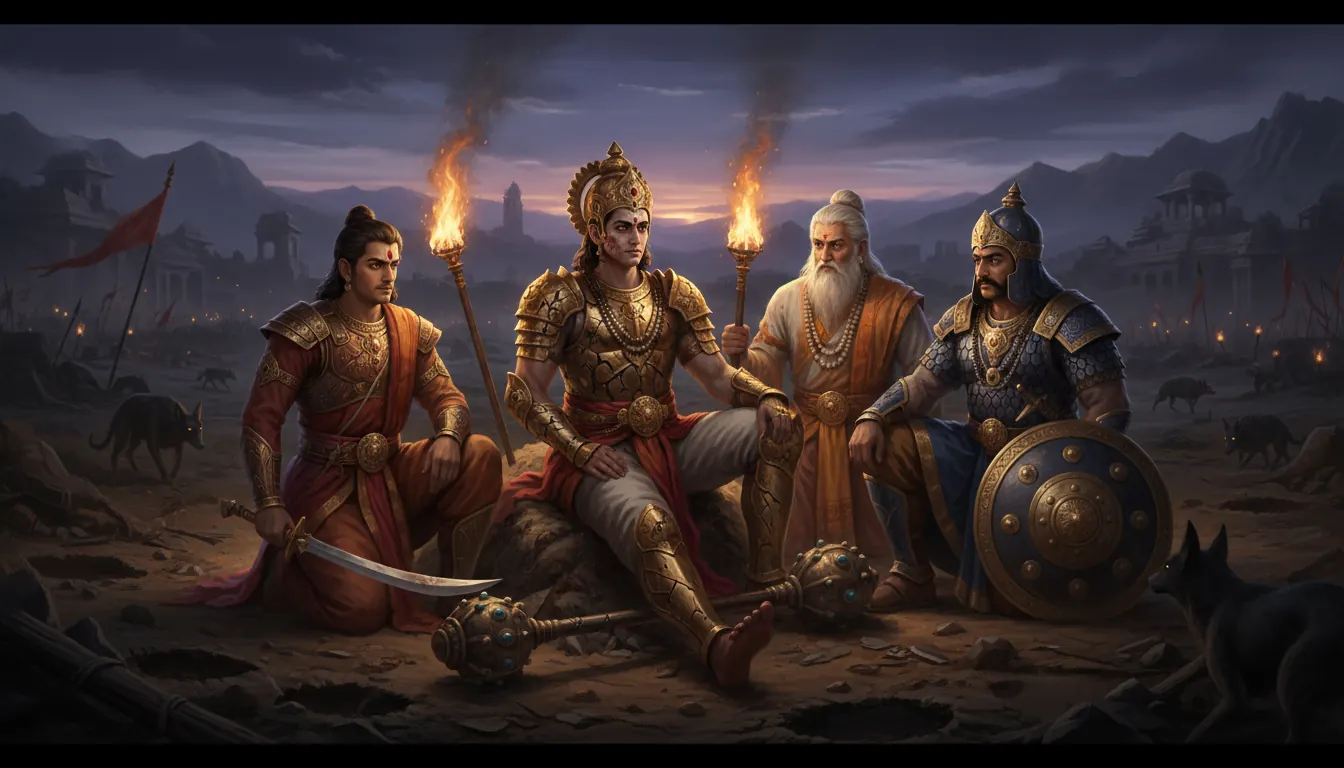
Before dawn the three killers ride back across the field to where Duryodhana lies with shattered thighs, driving jackals off his own body with his hands. They wipe the blood from his face and sit around him like three fires round an altar. Ashwatthama gives him errands to carry to the dead, and the king wakes long enough to die content.
Told in the Sauptika ParvaSet in Kurukshetra and Pandava Camp16 min read
Good Luck, They Said to Each Other
Sanjaya said, "When morning was near, Ashwatthama wanted to leave the camp. He was soaked in human blood, and the hilt of his sword had stuck so fast in his grip that hand and sword had become one thing, king. He could not have put it down if he had wanted to.
He had walked a path that good warriors never tread, and after that slaughter he looked like the blazing fire at the end of the yuga, when it has burned every creature to ash. He had done the deed as he had vowed, he had gone the way no one goes, and Drona's son forgot his grief for his father's death. That is the plain fact of it, king, and I set it down without ornament: the grief went out of him. It had been in him without stopping since the day his father's head was taken, and it had kept him from sleeping under the banyan, and now it was gone, and what stood in its place was a man in a good humour with a sword grown into his hand.
He came out through the gate where he had gone in. Outside the camp the valiant son of Drona met his two companions and joyfully told them what he had done, and the news delighted them. They were devoted to him, and in return they gave him their own good news: they too had slaughtered thousands of Panchalas and Srinjayas at the gates, and had let no man who ran for it in the dark get away with his life.
The three great chariot warriors met and cried out, 'Good luck!' His two companions congratulated Ashwatthama and embraced him, and there in the smoke, with the fires they had set still burning in three places behind them, he said what men say when the thing is finished and there is nobody left to say it to.
'All the Panchalas are dead, and all the sons of Draupadi. I have killed all the Somakas too, and all that was left of the Matsyas. We have done what we set out to do. Let us go at once to where the king is. If he is still alive, we will give him this joyful news.'
So they mounted their chariots and went back the way the war had come, across the field, to look for a man with broken thighs."
What Was Waiting Around Him
"When they had killed all the Panchalas and the sons of Draupadi, the three Kuru heroes came together to the place where Duryodhana lay, struck down by his enemies. There they saw that the king was not quite dead.
He was lying with his thighs broken. He was almost senseless, and his life was about to ebb away. Every so often he vomited blood, and his eyes were lowered. And he was not alone. Around him was a crowd of flesh-eating animals of terrible shapes, wolves and hyenas among them, waiting close by to feed on his body.
Understand what your son had been doing, king, through the hours in which we were busy in the camp. He was keeping them off. With great difficulty the king was keeping back those beasts of prey that stood waiting to feast on him. A man who cannot stand, who cannot crawl, whose thighs are shattered, lying on his back on the open field and driving away wolves with his hands and his voice, hour after hour, in the dark, so that his body should not be eaten before he was done with it. He was writhing on the earth in great agony.
The field itself, king, was by then such a place as I have no words equal to. It swarmed with creatures of every kind. Your sons and your well-wishers and your friends lay upon it, covered with blood, their bodies mangled, their heads cut from their bodies, and among them moved the things that come after a battle. Through all of that the three of them rode, looking for one particular man, and they had to go slowly, and they had to look at everything on the way.
That is how they found him. When they saw him lying on the earth, bathed in his own blood, the three heroes who were the only survivors of his army, Ashwatthama and Kripa and Kritavarma, were overcome with grief."
Three Fires Round an Altar
"They jumped down from their chariots and gathered round your son.
They sat around him on the ground, the three of them, covered with blood and breathing hot sighs. Ringed by those three mighty chariot warriors, the Kuru king looked like a sacrificial altar with three fires around it.
It is a strange comparison to have come to me, king, and I have not been able to get away from it since. A few hours earlier, riding out to the camp in the dark, they had shone like three blazing fires in a sacrifice, fed with libations of clarified butter. Now they were three fires burning down around an altar with a dying man on it, and there was nothing left to offer and nobody to receive it.
Seeing the king brought so low, so far beneath what he deserved, the three heroes wept with a grief they could not bear. They wiped the blood from his face with their hands, and as the king lay there on the battlefield they lamented over him, piteously, where he could hear.
They had come with good news. It is worth saying plainly, because the whole shape of this hour depends on it: they had ridden all that way in the dark with a piece of news they believed would make him happy, and when they arrived and saw the state of him, none of them could get it out. They wept first. They cleaned his face first. The message waited.
He could hear them. That is the thing to hold on to. Almost senseless he was, and his eyes were downcast, and he did not answer for a long while; but he heard every word of what was said over him, and when at last he spoke, it was clear that he had been listening from the beginning."
The Mace Lying Beside Him
Kripa said, "Nothing is too hard for destiny to bring about. Even King Duryodhana, who commanded eleven akshauhinis of troops, sleeps on the bare ground, struck down by his enemies and covered in blood.
Look. He loved the mace, and that mace covered in pure gold still lies beside the king, whose splendour is still like pure gold. In no battle did that mace desert this hero, and even now, when he is about to go up to heaven, it does not leave this glorious warrior. Look at it, adorned with pure gold, still lying at his side, like a loving wife beside her husband as he lies on his bed in their chamber.
See how Time turns everything upside down. This scourge of his enemies, who used to walk at the head of all crowned kings, now eats the dust. He used to strike down his enemies and leave them lying on the bare ground, and now, alas, the king of the Kurus lies on the bare ground himself, struck down by his enemies. He before whom hundreds of kings used to bow in fear lies today on the battlefield, surrounded by beasts of prey.
Brahmanas used to wait on this lord for wealth. Now, alas, beasts of prey wait on him to feed on his body.
Eleven akshauhinis, son of Drona. Count it once more with me, since we three are what is left to count it. Eleven armies came to this field under that mace. Kings of the east and of the south and of the mountains came because he asked them, and they lie out there in the dark in whatever posture they fell, and here at the middle of all of it is the man they came for, and he cannot lift his head, and the only thing still lying faithfully at his side is a piece of gilded iron."
Time Is Mightier Than Everything Else
Sanjaya continued, "Seeing that chief of the Kuru line lying on the ground, Ashwatthama lamented piteously."
Ashwatthama said, "Tiger among kings, everyone called you the greatest of all bowmen. They said too that with the mace you, a pupil of Sankarshana, were the equal of the Lord of treasures himself. Then how, sinless one, could Bhima catch you off your guard? You were always mighty and skilled, and he is a wicked wretch.
There can be no doubt, king, that Time is mightier than everything else in this world, for here we see even you struck down by Bhimasena in battle. Alas, how could that wretched, low Vrikodara strike you down by foul means, you who knew every rule of righteousness? Time cannot be resisted. Alas, Bhimasena called you to a fair fight and then put out all his strength and broke your thighs.
And shame on that wretched Yudhishthira, who let a man struck down unfairly in battle have his head touched with a foot. Warriors in every battle will surely condemn Vrikodara for as long as the world lasts. There is no doubt that you were struck down unfairly.
The valiant Rama of the Yadu line always used to say that no one could equal Duryodhana with the mace. That hero of the Vrishnis used to boast of you, my lord, in every assembly, saying, 'Duryodhana of the Kuru line is a worthy pupil of mine.'
You have reached the end that great rishis call the highest reward of a kshatriya who dies in battle with his face to the enemy."
I Do Not Grieve for You
Ashwatthama said, "It is not for you that I grieve, Duryodhana, bull among men. I grieve only for your mother Gandhari and your father, childless as they are now. Stricken with sorrow, they will have to wander the earth begging for their food.
Shame on Krishna of the Vrishnis, and on Arjuna with his wicked mind. They think of themselves as men who know what is right, and yet both of them stood by and did nothing while you were being killed. And the other Pandavas, shameless as they are, king, how will they tell the story of how they brought about your death?
You are very fortunate, son of Gandhari, for you died on the battlefield advancing fairly against the enemy. But alas, what will become of Gandhari, childless now, who has lost all her kinsmen and relatives? And what will become of the blind king? A hundred sons, bull among men, and their sons after them, and by this morning there is not one of them left to bring an old woman water."
Sanjaya said, "He said that, king, kneeling in the dust with your son's blood on his hands, and he said it to a man who could not answer him. And I have carried it to you exactly as it was spoken, because you asked me for all of it, and because there is no part of this that I am able to soften."
Where Can Men Like Us Go Now
Ashwatthama said, "Shame on Kritavarma, on me, and on the mighty chariot warrior Kripa, for we have not yet gone to heaven with you, our king, ahead of us. Shame on us, the lowest of men, for we do not follow you, who granted every wish, protected all men and did good to all your subjects.
Through your power, tiger among men, the houses of Kripa, of myself and of my father, and of all who depend on us, are full of wealth. By your grace we and our friends and relatives have performed many of the greatest sacrifices, with lavish gifts to brahmanas.
Where can men like us go now, sinners that we are, when you have gone to heaven and taken all the kings of the earth with you? It is because the three of us are not following you, king, to the highest end a life can reach, that we lament like this. Without your company, without wealth, our minds aching with the memory of your greatness, what will become of us, since we are not going with you? There is no doubt, chief of the Kuru line, that we will have to wander the earth in grief. Without you, king, where can we find peace, and where can we find happiness?"
Sanjaya said, "And that, king, was the true lamentation of the three of them, under the piety of the rest. They had wealth through him and houses through him and sacrifices performed through him. They had spent eighteen days destroying the world on his account and had just spent a night finishing the work, and now they knelt in the dust and asked the dying man what was to become of their households."
Errands for the Dead
Ashwatthama said, "When you leave this world, king, and meet the mighty chariot warriors who went before you, greet them for me one after another, in the order of their rank and years.
Pay your respects to your teacher, the greatest of all bowmen, and tell him, king, that I have killed Dhrishtadyumna.
Embrace King Bahlika, that mighty chariot warrior, and the ruler of the Sindhus, and Somadatta, and Bhurishravas, and the other great kings who have gone to heaven before you. Embrace them all for me, and ask after their welfare."
Sanjaya continued, "Consider what he was asking, king. He was giving a dying man errands to run, in the order of rank and years, as though the road out of this world were a road to a court where the proper forms would still be observed and the proper greetings given. And in the middle of that list of courtesies he set down the only sentence he had ridden across the whole field to say: tell my father that I killed the man who killed him.
He could not say it to Drona. There was no way left of saying it to Drona. So he said it to a man who was dying, and asked him to carry it."
Seven on Their Side, Three on Ours
Sanjaya continued, "When he had said this to the king, who lay senseless with his thighs broken, Ashwatthama looked at him once more and spoke again."
Ashwatthama said, "Duryodhana, if there is any life left in you, listen to this. It will be sweet to hear.
On the side of the Pandavas, only seven are alive, and among the Dhartarashtras, only we three. The seven on their side are the five brothers and Vasudeva and Satyaki. On our side, we three are myself and Kripa and Kritavarma.
All the sons of Draupadi are dead, and all the children of Dhrishtadyumna. All the Panchalas are dead too, Bharata, and what was left of the Matsyas. See how we have paid them back for what they did. The Pandavas have no children now. Every man and every animal in their camp was killed in its sleep.
I got into their camp in the night, king, and killed Dhrishtadyumna, that wretch and evildoer, the way one kills an animal."
Sanjaya said, "He gave the count first, king. Seven and three. He had done the arithmetic on the way over and he led with it, the way a commander reports to a king who is still a king. And then, at the end, he set down the one item that was his own, and he did not dress it up. He did not say that he had killed Drupada's son in battle. He said that he had killed him the way a man kills an animal, and he said it as the best thing he had to offer, and he was right about how it would be received."
I Count Myself the Equal of Maghavat
"When Duryodhana heard those words, so welcome to his heart, he came back to his senses," Sanjaya said, "and he answered."
Duryodhana said, "What neither Ganga's son, nor Karna, nor your father could do, you have done at last today, with Kripa and Bhoja beside you. You have killed that low wretch who commanded the Pandava army, and Shikhandi too. Because of this I count myself the equal of Maghavat himself. Blessings on you all. May you prosper. We will all meet again in heaven."
Sanjaya continued, "When he had said this, the great-souled king of the Kurus fell silent. He let go of his grief for all his slain kinsmen, and then he gave up his breath. His soul rose to sacred heaven, and only his body stayed on earth.
So, king, your son Duryodhana breathed his last. He was the one who started the battle, and in the end his enemies killed him.
The three heroes embraced the king again and again and gazed at him steadily. Then they mounted their chariots. I had heard the piteous lament of Drona's son, and at early dawn I came away towards the city. That is how the armies of the Kurus and the Pandavas have been destroyed. Great and terrible has been the slaughter, king, and your own bad policy caused it.
And after your son had gone to heaven, I was overcome with grief, and I lost the spiritual sight the rishi had given me. I can see nothing now, king. I am only a man in a room, telling you what I saw while I could still see."
Vaishampayana continued, "The king, hearing of his son's death, breathed long and hot sighs, and sank into deep anxiety."
Dharma Lesson
A last comfort bought with a massacre is still a comfort, and the epic lets the worst man in it die happy so that the reader has to decide what that is worth. Nothing in Duryodhana's end is earned and nothing in it is withheld; he hears the news he wanted, says he is equal to Indra, and goes.