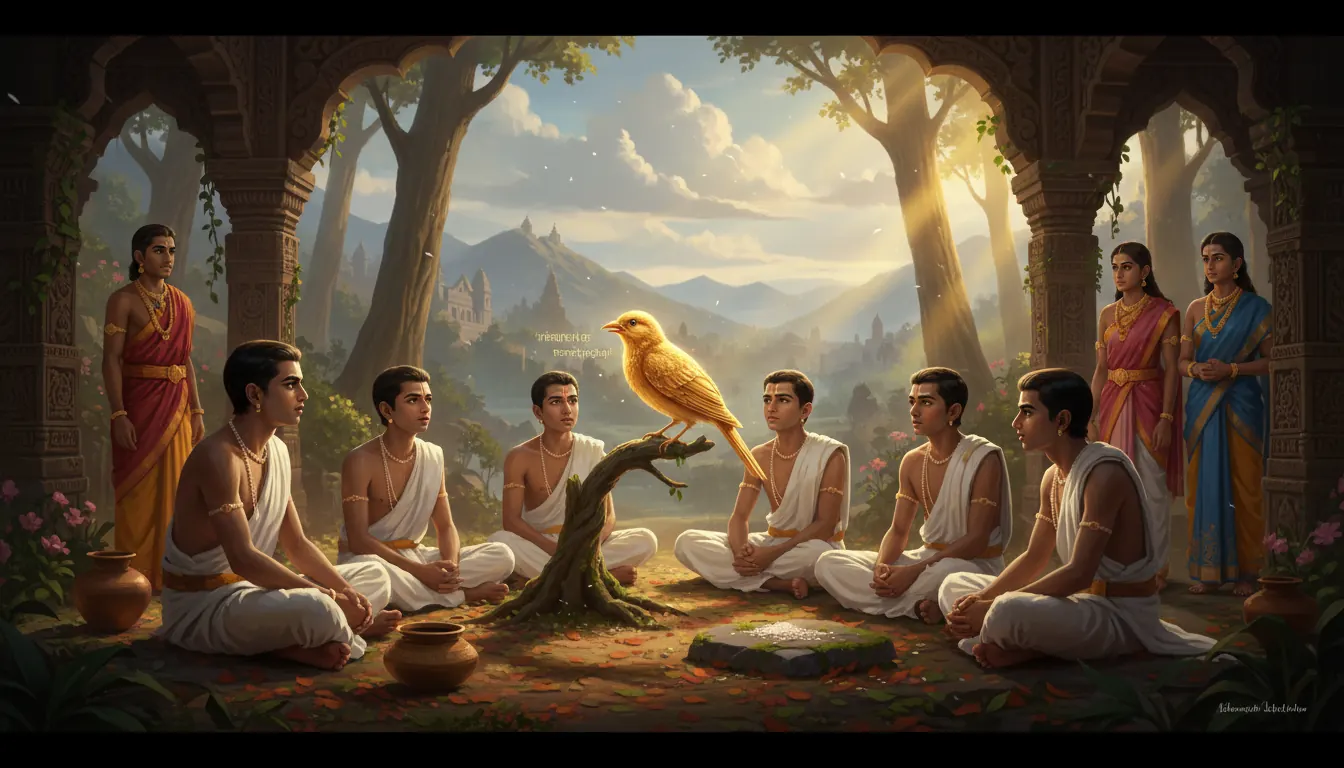
The Bird That Sent the Boys Home
Indra in golden feathers argues young renouncers back to their fathers
In short
Camped on the Bhagirathi, Yudhishthira lays out the forest life he intends to take up, and Bhima answers with wells left before the water. Then Arjuna cites an old history: beardless brahmana boys who left full houses for the woods, and the golden bird who praised the eaters of sacrificial remnants, let the boys claim the compliment, and then told them flatly what they were.
Told in the Shanti ParvaSet in Ganga and Naimisharanya15 min read
The King Who Wanted to Go Into the Woods
They were camped on the bank of the Bhagirathi, outside the Kuru city, passing the month of mourning where the water-rites had been performed, and Yudhishthira had stopped talking about the kingdom and started talking about the forest.
"For a little while, Arjuna," he said, "gather your attention and fix your mind and your hearing on your inner soul. If you listen to my words in that frame of mind, you will approve of them. Giving up all worldly pleasures, I will take the path the righteous walk. I will not, for your sake, walk the path you recommend."
And then he described it, at length, the way a man describes a thing he has been building in his head at night for some time.
"I will wander in the forest with the animals that live there, living on fruit and roots. Pouring offerings on the fire at the proper hours, and bathing morning and evening, I will thin myself on a meagre diet, and dressed in skins, wear matted locks on my head. Enduring cold and wind and heat, and hunger and thirst and toil too, I will waste my body with penances as the rules lay down. I will not do the slightest harm to any creature. Living alone and keeping a vow of silence, with my head shaved clean, I will get my food each day by begging from only one tree. Smearing my body with ashes, and sheltering in abandoned houses, or lying at the foot of trees, I will live, giving up all things dear or hateful. Speaking to no one, I will take on the outward form of a blind and deaf idiot, while living in contentment and finding happiness in my own soul."
His brothers listened to the whole of it. He had counted out the number of houses he would beg at, and the hour he would choose, and he had thought about what he would do if one arm were struck off and the other smeared with sandal-paste, and he had decided he would wish neither of the two men anything.
The Well Left Before the Water
Bhimasena answered first, and he was not gentle.
"Your understanding, king, has gone blind to the truth, like that of a foolish and dull reciter of the Veda who has recited those scriptures over and over. If you condemn the duties of kings and want to lead a life of idleness, then this destruction of the sons of Dhritarashtra was wholly needless. If we had known that this was what you meant to do, we would never have taken up arms and killed a single creature. We would have lived by begging until this body perished. This terrible battle between the rulers of the earth would never have taken place either."
Then he gave the pictures, one after another, and they are the pictures of a man who is very angry and very clear.
"What we have done is like a man who digs a well, stops work before he reaches water, and comes up smeared with mud. Or it is like a man who climbs a tall tree and takes honey from it, and dies before tasting it. Or a man who sets out on a long road and comes back in despair without reaching his destination. Or a man who kills all his foes and at last falls by his own hand. Or a starving man who is given food and refuses to eat it.
"If anyone could find success through renunciation, then mountains and trees would surely find it. They are always seen to live lives of renunciation. They do not harm anyone. They always keep apart from worldly life, and they are all Brahmacharins.
"Look, the world moves on, with every creature in it doing the acts proper to its nature. So one should take to action. The man without action can never find success."
Arjuna Cites an Old History
Arjuna waited until his brother had finished, and then took a different road to the same place.
"There is an old story told in this connection, bull of Bharata's race," he said, "the conversation between some ascetics and Shakra.
"A number of well-born brahmana youths of little understanding, without so much as a beard, left their homes and came to the woods to lead a forest life."
He had put three things into that sentence and he meant all three to be heard. They were well-born, so nothing had gone wrong for them. They were of little understanding, which at their age is not a fault but is a fact. And they were without so much as a beard: not one of them was yet old enough to grow one.
"Taking that to be virtue, those youths of ample means decided to live as Brahmacharins, leaving their brothers and fathers behind."
Abundant resources. There was no famine driving them and no creditor. They had left full houses. And what they had abandoned is named exactly: not property, not pleasure, but brothers and fathers, which is to say the living people who had a claim on them and who were now standing in doorways looking down a road.
They went out into the woods and set up the observances, and kept them, and were quite sincere, and were certain that what they were doing was the highest thing a man could do.
A Golden Bird in the Branches
"It so happened," said Arjuna, "that Indra became compassionate toward them."
That is the hinge of the whole story and it is easy to walk past. The lord of the three worlds looked at a group of beardless boys squatting in a wood on scraps and gleanings, thoroughly pleased with themselves, and what rose in him was not contempt. It was pity. He did not send a curse or a storm or a rebuke through some passing sage. He came himself.
But he did not come as Indra. A boy who is told by the king of heaven that he is wrong will obey and will not believe. So the holy Shakra took the form of a golden bird, and settled in a branch above them where they were sitting, and began to talk to nobody in particular in the way that birds do.
And what he talked about was not renunciation, and it was not their fathers, and it was not any of the subjects they were braced against.
He praised somebody else.
The Praise of the Eaters of Remnants
"What is done by those who eat the remnants of a sacrifice," said the bird, "is the hardest of all the acts men can achieve."
The boys looked up.
"Such an act is highly meritorious. The lives of such men deserve every praise. Those men, devoted to virtue, achieve the purpose of life and reach the highest end."
He said it as a golden bird says a thing, aloud and to the air, and then he waited.
Now, the eaters of remnants are householders. They are the men who serve the gods and the rishis and the guests at the door and the kinsmen of the house, morning and evening, and then eat what is left over when everyone else has been fed. It is the most ordinary condition in the world and the least admired. That is why the bird chose it, and that is exactly what the boys did not know.
What the boys heard was a compliment lying unclaimed on the ground.
"Look," said the rishis to one another, delighted, "this bird praises those who live on the remnants of sacrifices. He is telling us about it, for we live on such remnants."
They did live on remnants, in a manner of speaking. They ate what was left at the edges of other people's rites, and what could be gathered, and what was given. They had heard a description of a difficult and meritorious life and had recognized themselves in it within a moment, which is the fastest way there is to find out what a man privately thinks of himself.
The bird let them finish congratulating each other. Then he spoke again.
I Do Not Praise You
"I do not praise you."
There was nothing before it and nothing after it to soften it, and the golden bird went straight on to say what he did mean.
"You stand in filth and are very impure. You live on refuse, and you are wicked. You are not people who live on the remnants of sacrifice."
It is a hard thing to say to boys. He named the difference between the two lives and refused them the honour of the comparison. The householder eats last, after he has fed everyone he is answerable for. These boys ate leavings too, but they had fed nobody at all, and had left behind them in their houses the very people it was their business to feed. The same food, in the same order, means the opposite thing depending on who has been served first.
The boys did not argue and they did not walk away. That is to their credit, and it is why the story ends the way it does.
"We think our way of life highly blessed," they said. "Tell us, bird, what is good for us. Your words fill us with great faith."
The bird made one condition before he would go on, and it is a condition worth remembering whenever anybody asks to be taught.
"If you do not withhold your faith from me by setting yourselves against your better selves, then I will tell you words that are true and helpful."
He was not asking them to agree with him. He was asking them not to take up arms against the part of themselves that already suspected he was right.
"We will listen to your words, lord," they said, "for you know all the different paths. Righteous one, we want to obey your commands too. Instruct us now."
The Cow, the Gold, the Mantras and the Brahmanas
"Among four-footed creatures the cow is the best," said the bird. "Of metals, gold is the best. Of words, mantras. And of two-footed creatures, the brahmanas.
"These mantras govern all the rites of a brahmana's life, beginning with those that belong to birth and the time after it, and ending with those that belong to death and the burning ground. These Vedic rites are his heaven, his path, and the best of sacrifices. If it were otherwise, how could I find that the acts of those who seek heaven succeed through mantras?"
He was telling them what they had walked out of. Not a house, not an inheritance. A sequence of observances that begins at a man's birth and does not let go of him until his body is on the fire, and that has a place in it for him at every age he will ever be, including the age they were then.
"He who in this world worships his soul, firmly regarding it as a god of a particular kind, wins success in keeping with the nature of that particular god. The seasons measured by half-months lead to the Sun, the Moon, or the Stars. These three kinds of success, which depend on action, are desired by every creature.
"The householder's life is very high and sacred, and is called the field in which success is grown."
A field, said the bird, and not a granary. Nobody gets anything out of a field by admiring it. It is the place where the work is done and where the crop is possible, and a man who declines to stand in it because it is muddy will be hungry on principle for the rest of his life.
By What Path Do Those Men Go?
Then the bird put the question that the boys had never been asked, because everyone who met them had been too impressed by their vows to ask it.
"By what path do those men go who condemn action?"
And he answered it himself.
"Of little understanding and without wealth, they fall into sin. And since those men of little understanding live by abandoning the eternal paths of the gods, the paths of the rishis, and the paths of Brahma, they come to paths the Srutis disapprove of.
"There is a command in the mantras which says: Sacrificer, perform the sacrifice of giving valuable things, and I will give you the happiness of sons, animals, and heaven. To live by this command is said to be the highest asceticism of the ascetics. So you should perform such sacrifices and such penances in the form of gifts.
"The proper performance of these eternal duties, the worship of the gods, the study of the Vedas, the satisfaction of the Pitris, and respectful service to teachers, these are called the most austere of penances. The gods themselves, by performing these very hard penances, have won the highest glory and power. So I tell you to bear the very heavy burden of the householder's duties."
The very heavy burden. He never once called their forest life easy in order to shame them, and he never once called the householder's life pleasant in order to tempt them. He called it a burden, and heavy, and told them to pick it up.
"Without doubt, penances are the highest of all things and are the root of all creatures. But asceticism is to be won by living the householder's life, on which everything depends.
"Those who eat the remnants of feasts, after properly sharing out the food morning and evening among their kinsmen, reach ends that are very hard to reach. They are called eaters of the remnants of feasts who eat after serving guests and gods and rishis and kinsmen."
So there at last was the definition, held back until they could hear it. The praise they had reached for at the beginning had never been out of their reach. It was waiting for them in the houses they had walked out of, and the price of it was to go back and serve at the meal instead of being served at it.
"Free from pride, those who achieve the hardest feats reach heaven, and live for endless time in the regions of Shakra."
There Is Nothing In It
"Those ascetics then," said Arjuna, "hearing these words that were helpful and full of righteousness, abandoned the religion of renunciation, saying, 'There is nothing in it,' and took up the householder's life."
They did not debate it. They did not ask for a second discourse, or set a date, or resolve to consider the question after another season of vows. Boys who had left home in a body went home in a body, and the sentence they said as they went was five words long and had no piety in it whatever. There is nothing in it. They had been sitting in the woods living on offal and calling it holiness, and a bird had made them say the compliment out loud, and once they had heard themselves say it they could not go on.
Arjuna turned back to his brother, who had been listening on the bank with his chin down.
"So, you who know righteousness, call to your aid that eternal wisdom and rule the wide world, king, now that you have no foes left."
It was not a subtle application and it was not meant to be. Yudhishthira had described a forest life in every particular, down to the ashes and the shaved head and the seven houses. Arjuna had answered with a company of boys who had described one just as carefully, and had been perfectly sincere, and had been wrong, and had found out that what they were running from was not the world but a duty that had not yet fallen due.
Yudhishthira said nothing. And Nakula, of mighty arms and a broad chest, temperate in speech, rose next to speak.
Dharma Lesson
A young man's renunciation is often only the abandonment of duties he was never yet asked to carry, and a compliment accepted too eagerly is the fastest way to expose it. The bird never called the forest easy or the household pleasant; he called domesticity a very heavy burden and told them to pick it up. The praise they had reached for was waiting in the houses they walked out of, at the price of serving the meal instead of being served at it.