The Victory Nobody Wanted
Five brothers, a wife and a sage argue a king back onto his throne
In short
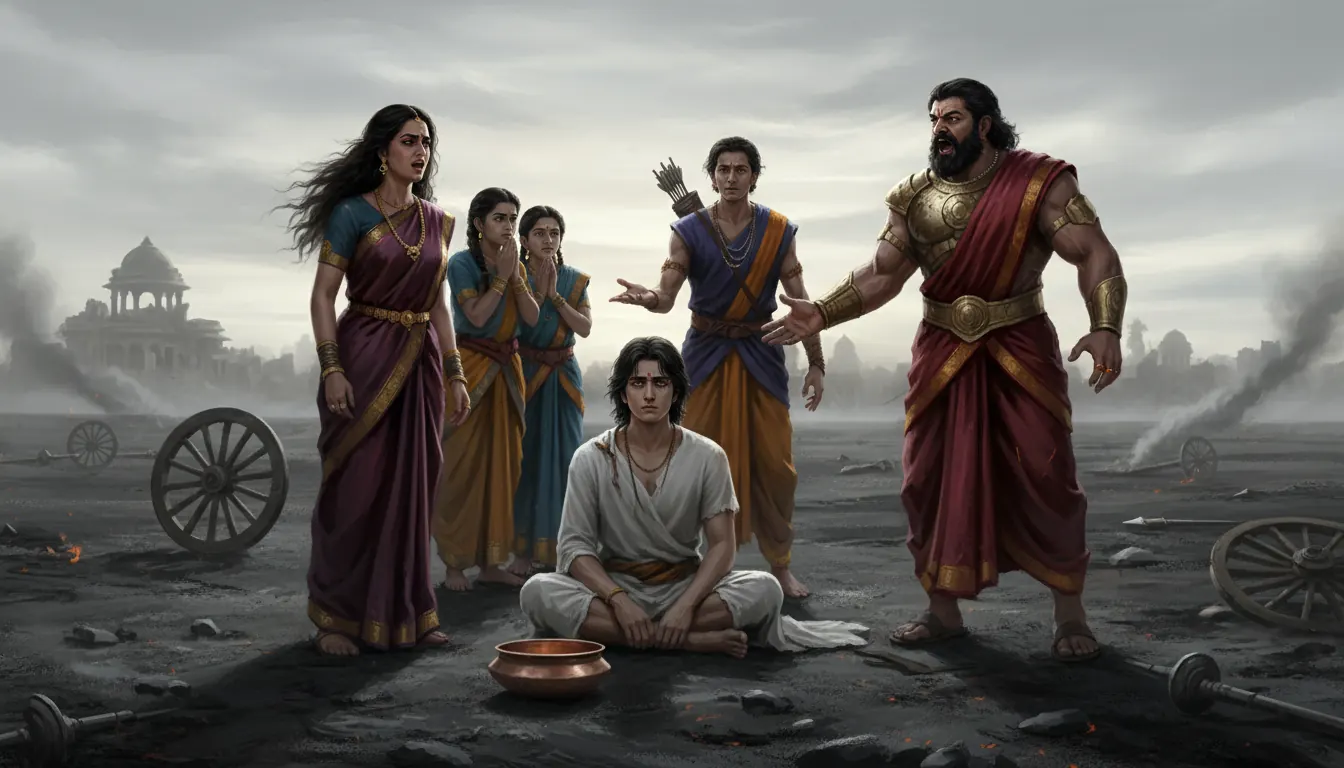
With the water poured for the dead, Yudhishthira announces that he will shave his head, beg at seven houses and walk into the woods, and the whole family turns on him. Arjuna argues that wealth is the root of every duty, Bhima calls him a blind reciter, the twins answer from the Vedas, and Draupadi, who has lost every child she bore, uses the word madness.
Told in the Shanti ParvaSet in Kurukshetra, Mithila and Hastinapura21 min read
Shame on the Ways of Kshatriyas
"When the water had been poured for the dead," said Vaishampayana, "and the field of Kuru had gone quiet at last, the righteous Yudhishthira sat down among his brothers with a troubled heart, and would not be comforted. He was grieving for Karna. He sighed and sighed again, and then he turned to Arjuna and began to speak.
"'If we had gone and lived by begging in the cities of the Vrishnis and the Andhakas,' the king said, 'this end would not have been ours. We would not now be men who have wiped out their own kin. Our enemies the Kurus have gained in prosperity, and we have been stripped of everything a man lives for. What fruit of righteousness can there be for us, when what we have done is self-slaughter?
"'Shame on the ways of kshatriyas. Shame on strength and valour, and shame on anger, since it is through these that this calamity has come. We were full of pride. Through greed and folly, and from the desire to taste the sweets of sovereignty, we have fallen into this.
"'Like a pack of dogs fighting one another over a piece of meat, we have been overtaken by a great disaster, and the meat is no longer dear to us. It will be thrown aside. Mothers carried those sons ten months in the womb and asked themselves, Will these live? Will they give us happiness in this world and the next? Their sons went out young and splendid in their earrings, and were killed, and every one of those hopes has been given up.
"'A sin once committed, Dhananjaya, is atoned for by repentance, by alms, by penances, by journeys to the sacred fords. But of all men, the one who has practised renunciation is held unable to commit sin again. So, with your leave, I will go to the woods, take the vow of silence, and walk the way that knowledge points out. Govern this earth yourself. Her thorns are drawn. I have no need of a kingdom and no need of pleasure.'
"With these words king Yudhishthira the just fell silent. And his younger brother Arjuna answered him."
Arjuna Speaks for Wealth
"Arjuna licked the corners of his mouth like a man unwilling to forgive an insult, and he smiled while he spoke, and what he said was heavy.
"'Oh, how painful this is. How distressing. You have achieved a feat beyond the power of men, and now you are set on throwing the whole of it away. Having killed your enemies, having won the sovereignty of the earth by the duties of your own order, why should you abandon everything out of fickleness of heart?
"'Where on earth has a eunuch, or a man who puts things off, ever won sovereignty? Why then did you, mad with rage, kill all the kings of the earth? A man who lives by begging can never enjoy the good things of the earth. If you abandon this thriving kingdom and take up the wretched life of a beggar, what will the world say of you?
"'King Nahusha, having done many wicked things in a state of poverty, cursed that state, and said that poverty is for recluses. Making no provision for tomorrow is a practice that suits the rishis. But the religion of royalty depends entirely on wealth, and one who robs another of his wealth robs him of his religion as well. A poor man, it is seen, is falsely accused even when he is only standing nearby. Poverty is a state of sinfulness. I do not see the difference between a fallen man and a poor man.
"'From wealth spring all religious acts, all pleasures, and heaven itself. The acts of one who lets himself be stripped of wealth dry up like shallow streams in summer. He who has wealth has friends. He who has wealth has kinsmen. Wealth brings more wealth, as tame elephants are used to capture wild ones. He who is lean in horses and cattle and servants and guests is truly lean, and not the man whose limbs alone are thin.
"'This earth belonged in her time to Dilipa, and to Nahusha, and to Mandhatri. She belongs now to you. A great sacrifice awaits you, and if you do not perform it, then the sins of this kingdom will all be yours. That auspicious path is eternal, and its fruits are never destroyed. If you abandon it, king, what other path would you take?'"
Seven Houses and No More
"Yudhishthira heard him out, and answered without heat.
"'For a little while, Arjuna, fix your mind and your hearing on your inner soul. If you listen to me in that frame of mind, you will approve of my words. I will not, for your sake, walk the road you recommend. You ask what road is good for a man to walk alone. I will tell you, and if you do not wish to ask, I will tell you unasked.
"'I will wander in the forest with the animals that live there, living on fruit and roots. I will pour offerings on the fire at the proper hours, and dress in skins, and wear matted locks on my head. Enduring cold and wind and heat, and hunger and thirst, I will wear the body down by the penances the rules lay down. I will do no harm to the smallest creature, and what need is there to speak of men who live in villages and towns?
"'Or else, living alone and keeping the vow of silence, my head shaved clean, I will beg each day from one tree only. I will smear my body with ashes and shelter in abandoned houses or lie at the foot of trees. Speaking to no one, I will take on the outward form of a blind and deaf idiot, and find my happiness in my own soul. I will ask nobody the way. I will go along whatever road I happen to meet, taking no note of the quarter of the sky I am heading for, and I will not look behind me.
"'If pure food, even a little of it, is not to be had at the first house, I will go to others, and if I fail even on that round, I will go to seven houses one after another and satisfy my hunger. I will wait until the smoke of the houses has stopped and the hearth-fires are out, until the husking-rods are put away and everyone inside has eaten. Then I will choose my moment and beg at two houses, or three, or five at the most.
"'If one man cuts off one of my arms and another smears the other arm with sandal-paste, I will wish neither evil to the one nor good to the other. Tearing off every bond and tie, I will live as free as the wind.'"
Bhima Calls Him a Reciter
"Then Bhimasena spoke, and he did not soften it.
"'Your understanding, king, has gone blind to the truth, like the understanding of a foolish reciter of the Veda who has recited those scriptures so often that he no longer hears them. If you mean to condemn the duties of kings and then lead a life of idleness, this destruction of the sons of Dhritarashtra was wholly needless. If we had known this was what you meant to do, we would never have taken up arms. We would never have killed a single creature. We would have lived by begging until this body was finished, and this terrible battle between the rulers of the earth would never have taken place at all.
"'What we are doing now is what a man does who digs a well and stops before the water comes, and climbs out smeared with mud. It is what a man does who climbs a tall tree and takes the honey and dies before he has tasted it. "'We have mighty arms and great energy. Yet we obey the words of a eunuch as though we were helpless. "'It has been laid down that renunciation should be taken up only in times of distress, by kings overcome with age or defeated by their enemies. If success could be won by renunciation, then the mountains and the trees would surely win it, for they are always seen to live lives of renunciation, they harm nobody, and they are all celibate. Look, the world moves on, and every creature in it is busy with the acts proper to its nature. The man without action never finds success.'"
The Golden Bird in the Woods
"Arjuna took up the argument again, and this time he told a story.
"'A number of well-born brahmana youths of little understanding, boys whose beards had not yet come, once left their homes and came into the woods to lead a forest life. Indra took pity on them. He took the form of a golden bird and perched near them and said, Of all the acts men can achieve, the hardest is what is done by those who eat the remnants of a sacrifice. Such an act is highly meritorious.
"'The youths heard it and were delighted. Look, they said to one another, this bird praises those who live on the remnants of sacrifices, and he is telling us so, because we live on such remnants.
"'The bird said, I do not praise you. You stand in filth and are very impure. You live on refuse, and you are wicked. You are not people who live on the remnants of sacrifice at all.
"'That silenced them. Then they said, Tell us, bird, what is good for us. Your words fill us with faith.
"'And the bird said, Among four-footed creatures the cow is the best, of metals gold is the best, of words the mantras, and of two-footed creatures the brahmanas. The mantras govern every rite of a brahmana's life, from those that belong to his birth to those that belong to the burning-ground. By what path do those men go who condemn action? They abandon the eternal paths of the gods and of the rishis, and they come to paths the Srutis do not approve. Bear the very heavy burden of the duties of a householder. Asceticism itself is won through a household life, on which everything depends. Those are called eaters of the remnants of feasts who eat after serving guests and gods and rishis and kinsmen, and they reach ends that are very hard to reach.
"'Hearing those words, brother, the ascetics abandoned the religion of renunciation, saying, There is nothing in it, and took up the householder's life. Call that wisdom to your aid and rule the wide world, which now has no enemy left in it.'"
The Twins Answer From the Vedas
"Then Nakula of the broad chest, sparing of speech, his face gone the colour of copper, looked at the king and laid siege to his brother's heart with reason.
"'The gods themselves set up their fires in the region called Visakha-yupa. Know then that the gods themselves depend on the fruits of action. "'The four modes of life were once weighed in a balance. When the householder's life was placed in one scale, the wise say, the other three together had to be placed in the other to balance it. So the man who takes up this mode of life as his duty, and gives up all desire for its fruit, is the real renouncer. Not the man of clouded understanding who goes to the woods leaving his house behind him. And a man who, under a hypocritical show of righteousness, cannot forget his desires even while living in the woods, is bound by the grim King of death with fetters round his neck.
"'I have never seen a king living the householder's life give up his wealth in any way but through the Rajasuya, the horse-sacrifice, and the other great rites. If, without giving away horses and cattle and elephants in their trappings, without giving villages and fields and houses to the brahmanas, we retire into the woods with hearts that hold no friendly feeling towards our kinsmen, then we will be the Kalis of the kingly order.'
"Then Sahadeva spoke, and he went to the root of it.
"'By giving up outward things alone, Bharata, a man does not win success. Even by giving up attachments of the mind, success is still doubtful. Let the merit and the happiness of the man who has given up outward things while his mind still covets them be the portion of our enemies, and let the merit of the man who governs the earth having given up his inward attachments be the portion of our friends.
"'The word mine, which has two letters in it, is Death himself. The words not mine, which have three, are eternal Brahma. As for the man who lives in the forest on wild fruits and roots but whose attachment to the things of the earth has not ended, that man lives inside the jaws of Death. You are my father, you are my protector, you are my brother, you are my teacher. Forgive these rambling words of a man stricken with grief.'"
Draupadi Says the Word Madness
"The king had listened to his brothers reciting these truths of the Vedas, and he remained speechless. Then Draupadi, the best of women, large-eyed and of noble descent, seated among brothers who were like so many lions and tigers, turned her eyes on her husband and spoke.
"'These brothers of yours, Partha, are crying and parching their throats like chatakas waiting for rain, and you do not gladden them. Why, when we lived beside the Dvaita lake and they sat with you suffering from cold and wind and sun, did you say to them, We will rush to battle for victory, we will kill Duryodhana and enjoy the earth that grants every wish, and all these sufferings of our exile will end in happiness? Having said those words to your brothers then, why do you crush our hearts now?
"'A eunuch can never enjoy wealth. A eunuch can never have children, any more than there can be fish in mud without water. A kshatriya without the rod of punishment can never shine. Friendship for all creatures, charity, the study of the Vedas, penances, these are the duties of a brahmana and not of a king. Restraining the wicked, cherishing the honest, and never retreating from battle, these are the highest duties of kings.
"'It was not by study, nor by gifts, nor by begging that you won the earth. That enemy force, ready to burst on you with all its might, full of elephants and horses and chariots, protected by Drona and Karna and Ashwatthama and Kripa, was defeated and slain by you. That is why I ask you to enjoy the earth.
"'My mother-in-law, who has great foresight, said to me, Princess of Panchala, Yudhishthira will keep you always in happiness. Her words cannot be untrue. And yet I see that through your folly you are about to make the whole feat worthless. When the eldest brother goes mad, all the rest must follow him into madness. Through your madness, king, all the Pandavas are about to go mad. If these brothers of yours were in their senses, they would shut you up with the unbelievers and take the government of the earth on themselves. A man who walks the path of madness should be treated with incense and collyrium and drugs applied through the nose.
"'I am the worst of all women, since I want to live on even though I have lost my children. You should not disregard what I have said, nor what these brothers of yours have said, who are striving to turn you back. Protect your subjects righteously and govern the goddess Earth with her mountains and forests and islands. Do not lose heart.'"
The Battle With No Arrows In It
"After Yajnasena's daughter had spoken, Arjuna took up the argument once more, and this time he spoke of the rod.
"'The man who holds the rod of punishment governs all subjects and protects them. The rod is awake when everything else is asleep. That is why the wise have called it Righteousness itself. "'I do not see in this world the creature that keeps itself alive without harming others. The mongoose devours mice, the cat devours the mongoose, the dog devours the cat, and the dog in his turn is devoured by the spotted leopard. Look, all of them are devoured by the Destroyer when he comes. The ascetics themselves cannot keep alive without killing creatures. There are creatures so tiny that their existence can only be inferred, and the mere falling of the eyelids destroys them.
"'Righteously or unrighteously, this kingdom has now become ours. Our duty now is to abandon grief.'
"Then Bhimasena, mustering all his patience, spoke again, and his second speech was quieter than his first.
"'There are two kinds of disease, of the body and of the mind, and each springs from the other, and neither is ever seen existing alone. He who dwells on regret for past woes reaps woe from woe and suffers twice over. But you were never sad in grief nor glad in bliss. You should not now use your memory to make yourself sad in a time of good fortune.
"'Or if you must remember, remember what you saw. Remember Krishna dragged scantily clad into the assembly while she was in her season. Remember our expulsion from the city and our exile in deerskins. Remember Jatasura, and the battle with Chitrasena, and the distress we suffered at the hands of the Sindhu king, and the kick the princess Draupadi took from Kichaka while we were living in concealment.
"'A fierce battle like the one you fought with Bhishma and Drona is before you now, but it must be fought with your mind alone. There is no need in it of arrows or of friends or of kinsmen. If you give up your life before you have won that battle, then, taking another body, you will have to fight these same enemies over again. Fight it today.'"
Conquer the Stomach First
"Yudhishthira was not moved, and he answered Bhima in the language Bhima had used against him.
"'Discontent, careless attachment to earthly goods, the absence of tranquillity, folly, vanity, anxiety: it is because these have hold of you that you covet sovereignty. That peerless king who governs this boundless earth will still have only one stomach. Why do you praise this way of life? Fire fed with fuel blazes up, and fire not fed goes out. Put out with a little food the fire in your belly when it appears. Conquer your stomach first. Then you will be able to conquer the earth.
"'The tiger, to fill his one stomach, slaughters many animals, and other animals without strength live on what the tiger has killed. Between the king who rules this wide earth and the man who regards gold and a pebble as equal, it is the second who is said to have achieved the purpose of his life.
"'There is a verse that was sung long ago by Janaka, who was free of the pairs of opposites. It runs: My treasures are immense, yet I have nothing. If the whole of Mithila were burnt to ashes, nothing of mine would be burnt. As a man on a hill-top looks down on men on the plain below, so he who has climbed to the top of the mansion of knowledge sees people grieving for things that do not call for grief.'
"And to Arjuna he said, 'You know the science of battle, but you have never sat at the feet of the old. You think there is nothing higher than wealth, and that is an error.'
"He had an answer for each of them, and the answers were good, and still the family sat there unpersuaded, because the thing they were arguing against was not an argument at all but a grief."
The Island-Born Ends It
"Then the great ascetic Devasthana, a man of eloquence, said his piece, and he did not begin by contradicting the king.
"'Phalguna has told you that there is nothing higher than wealth. Four modes of life are laid down in the Vedas, Ajatashatru, and you should pass through them one after another, and not jump. You have righteously won the earth, and having won her, you should not abandon her without cause. King Marutta, the son of Avikshit, surpassed Shakra himself by the abundance of his wealth, and in the great sacrifice he performed every vessel was of gold, and Sree came to it in person.'
"And then, because he had heard the king out and knew what the king was really asking, Devasthana recited to him the words that Brihaspati once spoke to Indra.
"'Contentment is the highest heaven. Contentment is the highest bliss. There is nothing higher than contentment. When a man draws in all his desires as a tortoise draws in its limbs, the natural radiance of his soul soon shows itself. When he fears no creature and no creature fears him, then he is said to see his own soul. Seeing all this, the learned conclude that the religion of harming no creature is the one the righteous should approve. The final emancipation you speak of is very hard to win. Take the sovereignty on yourself, cherish the righteous and restrain the wicked, and at the last hand your crown to your son and go to the woods.'
"Yudhishthira still said nothing. Arjuna pressed him once more, and still he was silent. And then the island-born Vyasa spoke, and the tide began to turn.
"'The words of Arjuna are true. A life of retirement in the woods, casting off the duties of a householder, has not been laid down for you. Birds and animals and every kind of creature are supported by men who live the householder's life. It is the hardest of the four modes of life. Practise that one, Partha, which is hard to practise for men whose senses are unrestrained. Bear the burden of your ancestral kingdom like an ox. Brihaspati sang this verse: Like a snake devouring a mouse, the Earth devours a king who is inclined to peace, and a brahmana who is too much attached to his house.'
"So the king who had asked leave to take a bowl and walk into the forest was talked back onto the throne by his own household, and he had won a victory that not one of them, and he least of all, had any joy in."
Dharma Lesson
Renunciation chosen in the hour when duty is heaviest is not detachment but desertion, and the people who love you most are the ones obliged to say so. Every speaker in this quarrel is right about something, and none of them can reach the grief underneath the argument. Vyasa ends it by telling him to bear the kingdom like an ox, because the difficult mode of life is the one he is trying to leave.