What Sends a Man to Heaven or Hell
Bhishma on gifts, the Shraddha, and the two lists of deeds
In short
Yudhishthira asks the grandsire who deserves a gift, and the answer widens into the whole law of giving: the four voices of Earth, Kashyapa, Agni and Markandeya on conduct and truth, the hours of the Shraddha and the food that becomes the portion of Rakshasas, the men who may not be invited and the men who may. Bhishma then recites the long catalogue of deeds that send men to hell and the deeds by which men ascend to heaven. He closes with what Vyasa once told him, the eight ways of being guilty of brahmanicide without ever touching a brahmana.
Told in the Anushasana ParvaSet in Kurukshetra and Vyasashrama23 min read
Who Deserves the Gift
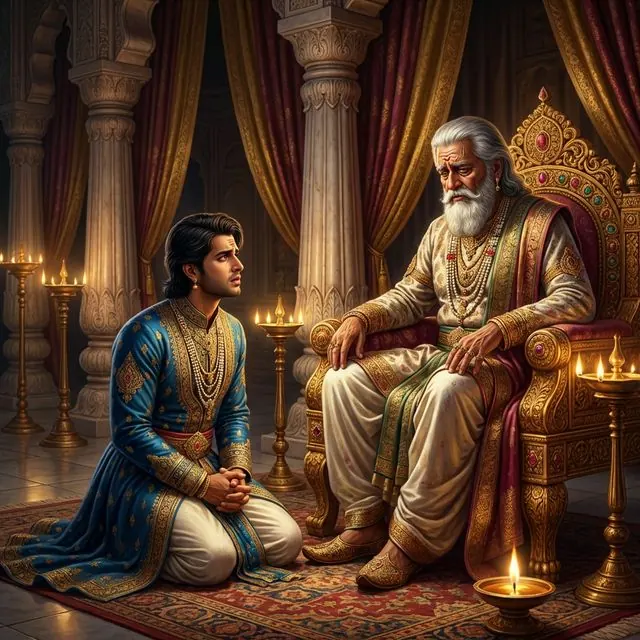
The grandsire was still on the arrows at Kurukshetra, waiting for the sun to turn north, and the king who had won the war was still asking him questions. They had just finished with Ashtavakra and the woman in the north, and Yudhishthira came back from that old tale to a plain matter of household practice.
"Whom do the eternal brahmanas, strict in their religious rites, call a proper recipient of gifts?" he said. "Should it be a brahmana who wears the marks of the stage of life he follows, or one who does not wear them?"
"Gifts should be made to a brahmana who keeps to the duties of his own order," Bhishma said, "whether he wears the marks of a Brahmachari or not. Both are faultless, the one who wears those marks and the one who has put them aside."
"And what fault does an unpurified person incur," Yudhishthira asked, "if he gives sacrificial butter or food with great devotion to members of the twice-born order?"
"Even a man wholly lacking in self-restraint is, without doubt, purified by devotion. Such a man is purified in every act, and not in giving alone."
Then the king raised the distinction the learned draw. A brahmana employed in an act touching the deities is never to be examined; a brahmana employed in an act touching the Pitris is to be examined in both conduct and competence. Why should the two differ?
"As for acts that concern the gods," Bhishma said, "these bear fruit not because of the brahmana employed to perform the rites, but through the grace of the gods themselves. Those who perform sacrifices gain the merit of those acts through the grace of the gods. The brahmanas are always devoted to Brahman. The rishi Markandeya, one of the wisest rishis in all the worlds, said this long ago."
Markandeya is the sage who outlived the flood and came back to describe it, and when a name like that is produced in support of a rule, the rule is meant to be taken as settled.
Four Voices, and an Empty Field
Yudhishthira had heard that five kinds of men are counted proper persons: the stranger, the man of learning, the man related by marriage, the man of penances, and the man devoted to performing sacrifices. He wanted to know why those five.
"The first three," Bhishma said, "strangers, relatives and ascetics, are counted proper persons when they have these qualities: purity of birth, devotion to religious acts, learning, compassion, modesty, sincerity and truthfulness. The other two, men of learning and those devoted to sacrifices, are counted proper persons when they have five of these, that is, purity of birth, compassion, modesty, sincerity and truthfulness."
Then he said that four persons of mighty energy had once given their opinions on this, and he recited them one after another as they had been spoken. There is no debate in the passage and no frame around it. Four beings speak, one line each, and go.
The Earth said: "As a clod of mud thrown into the great ocean quickly dissolves, so every kind of sin disappears in the three high callings: officiating at sacrifices, teaching, and receiving gifts."
Kashyapa said: "The Vedas with their six branches, the Sankhya philosophy, the Puranas and high birth cannot save a twice-born man if he falls away from good conduct."
Agni said: "The brahmana who, busy with study and thinking himself learned, uses his learning to destroy the good name of others, falls away from righteousness and comes to be seen as cut off from truth. Truly, such a destructive man never reaches the worlds of happiness hereafter."
Markandeya said: "If a thousand Horse-sacrifices and Truth were weighed in the balance, I do not know whether the former would weigh even half as heavy as the latter."
"When they had said this," Bhishma said, "those four, each of boundless energy, the goddess Earth, Kashyapa, Agni and Bhrigu's son armed with weapons, quickly went away."
They did not stay to be questioned. The Earth had said that ritual dissolves sin, and Kashyapa had answered that learning saves nobody whose conduct has gone, and Agni had put the scholar who uses his books to ruin other men outside the gate of heaven, and Markandeya had set one thousand of the costliest rites in the world against truth and declined to say that the rites came halfway.
Ten Years of Eating Filth
"If brahmanas keeping the vow of Brahmacharya ask for the offerings one makes to one's dead ancestors at Shraddhas," Yudhishthira said, "can the Shraddha be counted well performed if the performer actually gives those offerings to them?"
"If a brahmana who has kept the vow of Brahmacharya for the prescribed twelve years, and mastered the Vedas and their branches, himself asks for the offering made at a Shraddha and eats it, he is held to have fallen from his vow. The Shraddha, however, is not considered stained in any way."
The beggar falls from his vow, and the grandsire added that a foolish giver who hands such offerings to him goes to worlds of misery. The giver has his own way of going wrong, and Yudhishthira asked next what the settled conclusions are about righteousness, since it is said to have many ends and numerous doors.
"Not injuring others, truthfulness, freedom from anger, compassion, self-restraint, and sincerity or candour," Bhishma said. "These are the marks of Righteousness. There are people who wander over the earth praising righteousness without practising what they preach, and sinning all the while. Whoever gives such people gold or gems or horses must sink into hell and live there for ten years, eating all that time the excrement of those who live on the flesh of dead cows and buffaloes, of the men called Pukkasas, of others who live on the outskirts of cities and villages, and of men who, driven by anger and folly, broadcast what others have done and failed to do."
That is the price of a careless gift to a fraud, stated without softening. Then the king asked what is superior to Brahmacharya, what is the highest indication of virtue, what is the highest purity.
"Abstaining from honey and meat is even higher than Brahmacharya. Righteousness consists in keeping within limits, that is, in self-restraint. The best mark of Righteousness is Renunciation, which is also the highest kind of purity."
And when to do what: "One should earn wealth in the first part of one's life. After that one should earn Righteousness, and then enjoy pleasure. But one should not become attached to any of these."
Then he set out the equivalences. To utter falsehood in a court of justice, to behave deceitfully towards the king, to act falsely towards teachers and seniors, are equal in heinousness to Brahmanicide. To do an act of violence to the king's person, or to strike a cow, is equal to the sin of foeticide. To abandon one's homa fire, to cast off the study of the Vedas, to assail a brahmana by word or act, are all equivalent to Brahmanicide.
The Hours of the Day, and the Portion of the Rakshasas
Yudhishthira asked for the ordinances touching the deities and the departed ancestors at Shraddhas, and Bhishma began with the clock.
"Once one has purified oneself with baths and the other cleansing acts, and then gone through the well-known auspicious rites, one should carefully perform all acts concerning the gods in the forenoon, and all acts concerning the Pitris in the afternoon. What is given to men should be given at midday, with affection and respect. A gift made at the wrong time is taken by the rakshasas."
That last word governs everything that follows. Nothing offered wrongly simply fails. It goes somewhere, and something eats it, and the list of what the rakshasas are fed is long and exact.
Gifts of articles that have been leapt over by anyone, or licked or sucked, that are not given peacefully, or that have been seen by women who are impure because their season has come, produce no merit. They are the portion of the rakshasas. So are gifts proclaimed loudly before many people, and gifts from which a portion has been eaten by a shudra, or which have been seen or licked by a dog.
Food mixed with hair, or in which there are worms, or stained with spittle or saliva, or gazed at by a dog, or into which tear-drops have fallen, or which has been trodden upon, is the portion of a rakshasa. Food eaten by a person incompetent to utter the syllable Om, or eaten by a person bearing arms, or eaten by a wicked person, is the portion of rakshasas.
Food from which someone else has already eaten a portion, or which is eaten without a part first being offered to the gods and to guests and to children, is taken by them. Such stained food, if offered to the deities and the Pitris, is never accepted by them but is taken by the rakshasas.
The food offered at Shraddhas by the three twice-born classes, where the mantras are either not spoken or spoken wrongly and the rules are not followed, goes the same way even when it is distributed to guests. So does food given to guests without having first been dedicated to the deities or the Pitris with a libation on the sacred fire, and food a part of which has been eaten by a person who is wicked or irreligious.
A man may perform the whole rite, feed the whole village, and discover that he has been catering for something else.
Those Who Must Not Be Called
"I have told you what the portions of the rakshasas are," Bhishma said. "Now listen as I lay down the rules for telling which brahmana deserves a gift."
What came next was an exclusion list, and it is worth hearing in its own order, because the categories are not all of one kind.
Brahmanas who have been made outcasts for heinous sins, and brahmanas who are idiots or out of their minds, are not to be invited to Shraddhas where offerings are made to the gods or the Pitris. Nor is the man with leucoderma, nor the impotent man, nor the man with leprosy, nor the man with consumption, nor the epileptic, nor the blind.
Then the callings. Those who practise as physicians. Those who receive regular pay for worshipping images of the gods set up by the rich, or who make a living from serving the gods. Those who keep vows out of pride or other false motives. Those who sell Soma. Those who are by profession vocalists or dancers or players or instrumental musicians or reciters of sacred books, or warriors and athletes.
Those who pour offerings on the sacred fire for shudras, or who teach shudras, or who serve shudra masters. The brahmana who is paid for his services as a teacher, and the pupil who attends a teacher's lessons because he is paid an allowance to do so, for both of them are regarded as sellers of Vedic lore.
The man who has once been persuaded to accept food at a Shraddha at the very outset. The man who has married a shudra wife, even if he has every kind of knowledge. Those who have no domestic fire. Those who tend corpses. Thieves, and those who have otherwise fallen away.
Those whose antecedents are unknown or vile, and those who are Putrika-putras, the sons of daughters given in marriage on the condition that their offspring would belong to the mother's father.
The man who lends money, or lives on the interest of loans, or lives by selling living creatures. Those who are ruled by their wives. Those who live by becoming the paramours of unchaste women. Those who abstain from their morning and evening prayers.
None of these, said the grandsire, deserve to be invited.
Those Who May Still Be Called
"Now listen as I tell you which brahmana is fit for acts done in honour of the gods and the Pitris," Bhishma said. "I will tell you the merits that let a man become a giver or a receiver of gifts at Shraddhas in spite of the faults I have named."
The second list is a set of pardons, and it pardons a great deal.
Those who keep the rites laid down in the scriptures, or have merit, or know the Gayatri, or keep the ordinary duties of brahmanas, may be invited even if they have taken to farming for a living. If a brahmana happens to be well born, he deserves to be invited even though he follows the profession of arms and fights the battles of others. Even one who has taken up trade may be invited, if he is well born.
The brahmana who pours offerings on the sacred fire every day, who lives in a fixed home, who is not a thief, and who is hospitable to guests who come to his house, may be invited. So may the man who recites the Savitri morning, noon and night, or who lives on charity while keeping the rites laid down for his order.
The man who earns wealth in the morning and is poor by the afternoon, or who is poor in the morning and wealthy by evening, or who is free of malice, or is stained by only a minor fault, may be invited. So may the man who is free of pride and sin, who is not given to dry argument, and who lives on alms gathered on his rounds from house to house.
Even the man who keeps no vows, or is given to lying, or is a thief, or lives by selling living creatures or by trade in general, becomes worthy of an invitation if he first offers everything to the gods and afterwards drinks Soma. Even the man who has gained wealth by foul or cruel means becomes worthy, if he spends it on worshipping the gods and on hospitality.
But the wealth acquired by the sale of Vedic lore, or earned by a woman, or gained by meanness such as giving false evidence in a court of law, should never be given to brahmanas or spent in offerings to the Pitris.
A brahmana fails in his duty by telling a lie. A kshatriya incurs four times, and a vaishya eight times, the sin that a brahmana incurs by the same lie.
The Wives Who Wait Like Tillers for Rain
There were smaller rules still, and Bhishma laid them down without hurry.
A brahmana already invited by a brahmana should not eat elsewhere. If he eats at the house of the person whose invitation came later, he is lowered and incurs the sin of killing an animal at a time other than a sacrifice; if he does it after an invitation from a kshatriya or a vaishya, he incurs half of that. The man who eats at these rites without having washed, or while impure because of a birth or a death among his kinsmen, knowing himself to be impure, incurs the sin of uttering an untruth for a cow.
At the completion of a Shraddha the closing word differs by the order of the performer. For a brahmana, the word Swadha should be uttered. For a kshatriya, the words are, May your Pitris be satisfied. For a vaishya, Let everything become inexhaustible. For a shudra, Swasti. The brahmana who, at the end of a Shraddha performed with his aid, refuses to say the words astu swadha, incurs the sin of swearing falsely in a suit for land.
The girdles too are named. That of a brahmana should be made of Munja grass, that of one belonging to the royal order should be made of hemp, and that of a vaishya should be made of Valwaji grass.
Then Yudhishthira asked the question that had been under all the others. By giving to whom does a man earn the fullest reward?
"Feed those brahmanas," Bhishma said, "whose wives wait reverently for what is left on their husbands' plates, as tillers of the soil wait in reverence for the rain to come in its season."
He went on naming them. Those grown thin from going without luxuries and even full meals, who keep the vows that waste the body, and who approach a giver hoping for a gift. Those who regard conduct as their food and their spouses and their strength and their refuge for crossing this world, and who ask for wealth only when it is needed. Those who have lost everything to thieves or oppressors. Those who beg food from a poor man of their own order who has himself just been given something. Those who have lost all in a time of universal distress and been deprived of their spouses in it. Those robbed by powerful men though perfectly innocent, who now wish only to fill their stomachs and no longer ask what the food is. And those who beg on behalf of others, and are satisfied with even a small gift.
The Road Downward
"You have now heard what the scriptures declare about giving," Bhishma said. "Now listen as I explain which acts lead to hell and which to heaven."
Those sink into hell who tell lies, except when the lie serves a teacher's purpose or assures a man in fear of his life that he is safe. Those who violate other people's wives, or help in such acts. Those who rob others of their wealth, or destroy other people's possessions, or proclaim the faults of others.
Those who destroy the water tanks that cattle drink from, who damage public meeting halls, who break down bridges and causeways, who pull down houses. Those who deceive and cheat helpless women, or girls, or old women, or women who have been frightened.
Those who destroy other people's livelihoods, who wipe out other people's homes, who sow quarrels among friends, who destroy other people's hopes, and those who are ungrateful to friends for services done. Those who have no faith in the Vedas, and those who break their own vows or force others to break theirs.
Those who charge excessive interest and make unduly large profits on sales. Those who gamble, those who do wicked acts without scruple, those who slaughter living creatures. Those who make masters dismiss servants who are hoping for a reward, or waiting for wages, or expecting a return for services already given.
Those who eat without offering portions to their wives, their sacred fires, their servants, their guests, their children and the old, and who neglect the rites laid down for honouring the Pitris and the gods. Those who sell the Vedas, those who find fault with the Vedas, and those who write the Vedas down.
Those who live by selling hair, those who live by selling poisons, those who live by selling milk. Those who put obstacles in the way of brahmanas and cows and maidens. Those who sell or forge weapons, and those who make arrows and bows.
Those who abandon teachers and servants and loyal followers who have given no offence, and those who cast off forgiving, self-restrained and wise people once these are no longer of use to them.
Those who set bullocks to work before the animals are old enough, who pierce the noses of beasts to control them better at work, who keep animals always tethered. Those kings who do not protect their subjects while forcibly taking a sixth of the produce of their fields, and those who, though able and with the means, refrain from giving.
All these, said Bhishma, have to go to hell.
The Road Upward
"Now listen, bull of the Bharata line," he said, "as I tell you which men rise to heaven."
He began with a warning turned inside out. The man who wrongs a brahmana by obstructing the rites in which the gods are worshipped loses all his children and animals; those who do not obstruct the religious acts of brahmanas rise to heaven.
Those rise who follow the duties laid down in the scriptures and practise charity and self-restraint and truthfulness. Those who, having gained knowledge by obedient service to their teachers and by austere penances, become reluctant to accept gifts. Those through whom other people are rescued from fear, from sin, from the obstacles in the way of what they wish to achieve, from poverty, and from the suffering of disease.
Those who are forgiving, patient, quick to do righteous acts, and of auspicious conduct. Those who abstain from honey and meat, from intercourse with other people's wives, and from wines and spirits.
Those who help to found hermitages for ascetics, who found families, who open up new lands for settlement and lay out towns and cities. Those who have refrained from injuring any creature, who can endure everything, and who have made themselves the refuge of all creatures. Those who humbly serve their fathers and mothers, who have mastered their senses, and who are affectionate to their brothers. Those who master their senses though they are rich and strong and in the full enjoyment of youth.
Those who are kind even to those who wrong them, who are gentle by nature, and who add to the happiness of others by serving them humbly. Those who protect thousands of people, who give to thousands, who rescue thousands from distress.
Those who give gold and cows, vehicles and animals, the things needed for marriages, menservants and maids, cloth and robes. Those who build public pleasure-houses and gardens and wells, resting houses and tanks where cattle and men can quench their thirst. Those who give houses and fields and inhabited villages to those who ask for them.
And those who, born in families high or low, father hundreds of children and live long lives practising compassion and keeping anger in check.
"I have now explained to you," Bhishma said, "the rites in honour of the gods and the Pitris that are performed for the sake of the other world, the rules about giving, and the views of the rishis of former times on what to give and how to give it."
Killing a Brahmana Without Touching Him
One question was left, and Yudhishthira asked it as a man asks about a thing he fears he may already have done.
"You should answer this question of mine truly and in detail. In what circumstances may a person become guilty of Brahmanicide without actually killing a brahmana?"
"I once asked Vyasa to explain this very subject to me," Bhishma said. "I will now tell you what Vyasa told me then. Listen to it with undivided attention."
He had gone to the son of Parashara, the compiler of the Vedas and the grandfather of both these armies, and had addressed him as a pupil addresses a teacher.
"Great ascetic, you are the fourth in descent from Vasishtha. Explain this to me. In what circumstances does one become guilty of Brahmanicide without actually killing a brahmana?"
Vyasa, deeply skilled in the science of morality, gave him an answer both excellent and certain, and Bhishma repeated it word for word.
The man who, having of his own will invited a brahmana of righteous conduct to his house to give him alms, then refuses him anything on the pretence that there is nothing in the house, is guilty of Brahmanicide.
The man who destroys the livelihood of a brahmana learned in the Vedas and all their branches, who is free of attachment to worldly creatures and goods, is guilty of Brahmanicide.
The man who obstructs thirsty cows while they are quenching their thirst is guilty of Brahmanicide.
The man who, without having studied the Srutis that have passed from teacher to pupil for ages upon ages, finds fault with the Srutis, or with the scriptures composed by the rishis, must be held guilty of Brahmanicide.
The man who does not give his daughter, beautiful and rich in every accomplishment, to a suitable bridegroom is guilty of Brahmanicide.
The foolish and sinful person who causes brahmanas grief that strikes the very core of their hearts is guilty of Brahmanicide.
The man who robs the blind, the lame and idiots of everything they have is guilty of Brahmanicide.
The man who sets fire to the hermitages of ascetics, or to woods, or to a village, or a town, is guilty of Brahmanicide.
Eight men, and not one of them has lifted a hand. That was the answer Vyasa gave, and the grandsire, who had been counting out the last of his own days on that bed, passed it on without adding anything to it.
Dharma Lesson
The epic does not treat giving as a warm feeling. It treats it as an act with a direction, and the direction depends on whom you give to and how, so that a gift laid in the wrong hands can cost the giver ten years of hell while a small one laid in the right hands can rescue a whole family line. What holds the two catalogues together is that almost none of the sins listed are dramatic. They are a withdrawn invitation, a livelihood cut off, cattle turned back from water, a servant dismissed before his wages, an old follower discarded when he stopped being useful. Heaven, in the same lists, is built out of wells and rest houses and patience with people who have wronged you.