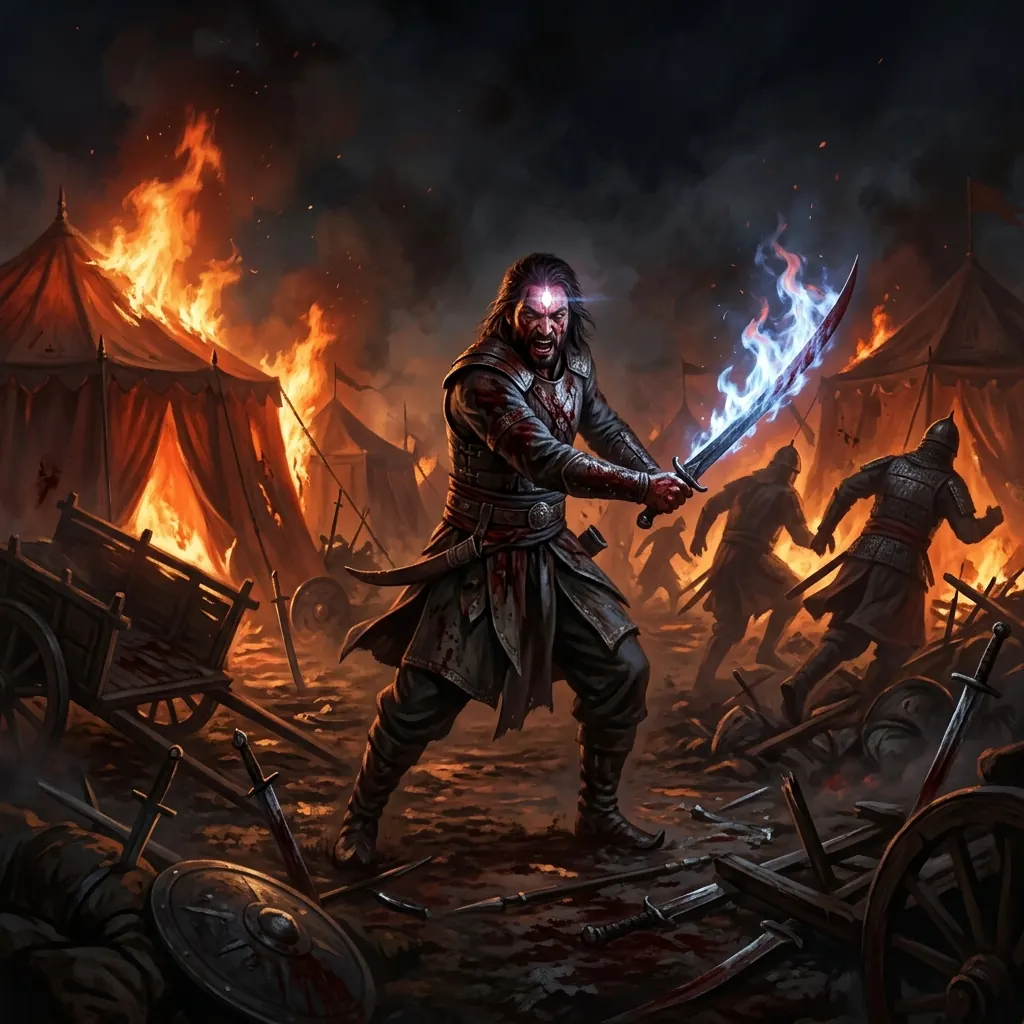
The Duel of the Brahmashira Weapons
Ashwatthama and Arjuna loose the world-ending astra at Vyasa's hermitage
In short
On the morning after the night raid, Bhima drives out alone to kill Ashwatthama, and Krishna follows with Arjuna to warn him that Drona's son holds the brahmashira. Cornered among rishis on the bank of the Ganga, Ashwatthama inspires a blade of grass into that weapon and looses it at the Pandavas, and Arjuna answers with the same astra. Narada and Vyasa stand between the two fires and halt them, but Ashwatthama cannot recall his weapon and turns it instead upon the wombs of the Pandava women. Krishna promises that the child will live, and curses Ashwatthama to wander the earth alone for three thousand years.
Told in the Sauptika ParvaSet in Ganga and Kurukshetra18 min read
The Warning on the Road
Vaishampayana was telling the whole of it to king Janamejaya, and he had come to the morning after the worst night the Kuru race ever had.
Bhimasena had already gone. He had learned where the son of Drona was, and he had taken his chariot and driven out alone, ahead of everybody, with his sons and his nephews lying dead behind him in a camp that had been asleep when the killing started.
Krishna did not like it at all. He turned to Yudhishthira, and what he said was not about grief.
"Son of Pandu, this brother of yours is so overwhelmed with grief at the slaughter of his sons that he is going alone to battle to kill the son of Drona. Of all your brothers, Bhima is your dearest. You see him fallen into great danger: why do you not stir yourself?"
Then he named the thing he was actually afraid of.
"The weapon called brahmashira, which Drona taught his son, can burn up the whole world."
Drona had given that astra to Arjuna first, being delighted with him. His own son, unable to bear that, had begged him for it, and Drona had passed on the knowledge unwillingly, because he knew the restlessness of the boy. And with it he had laid down a command.
"Even if the greatest danger overtakes you in the middle of battle, child, you must never use this weapon, and above all not against human beings."
A little while afterwards the teacher had spoken again, and this time it was not an instruction but a verdict.
"Bull among men, it seems you will not walk the path of the righteous."
Krishna had met the son in Dwaraka in the years of the exile, and had watched him try with both hands to lift the discus he wanted in trade for that astra, and fail to move it off the ground. He knew what kind of man was sitting somewhere ahead of them on the road.
"He is wrathful, wicked-souled, restless and very cruel," he said. "He knows the weapon called brahmashira. Vrikodara should be protected from him."
Then he mounted his chariot, and Arjuna and Yudhishthira came up after him.
A Blade of Grass by the Water
The chariot was equipped with every kind of powerful weapon, and to it were yoked two pairs of the finest horses of the Kamboja breed, adorned with garlands of gold. The pole of it was the colour of the morning sun. Shaibya was on the right and Sugriva on the left, and Meghapushpa and Balahaka pulled in the traces. The standard, made by the divine Artificer, rose above it decked with gems and gold, and Vinata's son Garuda, the enemy of snakes, sat shining on top of it.
Seated on either side of the wielder of sharnga, the two sons of Pandu looked like the twin Ashvins seated beside Vasava. The horses went out at speed, and the noise of their rush was like the noise of birds flying through the air.
They caught up with Bhima on the road. They could not stop him. Three of the greatest chariot warriors alive rode alongside him and said what they had to say, and he drove on past them in his wrath toward the bank of the river that Bhagiratha brought down out of heaven, and they followed him there.
On the edge of the water sat the island-born Vyasa, dark-complexioned, in the middle of many rishis. And beside them, in among the holy men, sat Drona's son of wicked deeds. He was covered with dust. He was dressed in a piece of cloth made of kusha grass and smeared all over with clarified butter, which is the dress of a man performing an expiation, and he was sitting there as though he belonged in that company.
Bhima took up his bow with a shaft already fixed on it and rushed at him.
"Wait," he said. "Wait."
Ashwatthama looked up at the terrible bowman coming at him bow in hand, and at the two brothers standing on Janardana's chariot behind him, and was badly shaken, and thought his hour had come.
His spirit did not sink. He called to mind the high weapon his father had given him. He picked up a blade of grass with his left hand and, in his great distress, charged it with the proper mantras until the grass was the astra.
Then he said, in wrath, in the hearing of the rishis, "For the destruction of the Pandavas."
And he let it go. A fire was born in that blade of grass which seemed able to consume the three worlds, like the all-destroying Yama at the end of the yuga.
Two Ends of the World
Krishna understood from the signs, at the very outset, what the son of Drona intended.
He did not speak to Bhima, who could do nothing about it. He spoke to the man who had been given the same weapon by the same teacher.
"Arjuna, son of Pandu, the time has come to use the celestial weapon you carry in your memory, the one Drona taught you. To protect yourself and your brothers, shoot that weapon now, the one that can neutralise every weapon."
Arjuna got down from the chariot with his bow and a shaft already on the string, and then he did a strange thing for a man standing in front of the murderer of his son's brothers and his own children.
He softly wished good to the teacher's son.
Then good to himself, and then to all his brothers. Then he bowed to all the gods and to all his elders, and with the welfare of all the worlds in his mind he let his weapon go with these words: "Let Ashwatthama's weapon be neutralised by this weapon."
What came out of Gandiva blazed up with fierce flames like the all-destroying fire that appears at the end of the yuga. What Drona's son had shot blazed up in the same way, within a huge sphere of fire, and the two of them stood in the sky over a riverbank in front of a company of seated rishis.
Many peals of thunder were heard. Thousands of meteors fell. All living creatures were filled with great dread. The entire sky was filled with noise and took on a terrible look with those flames in it, and the whole earth, with her mountains and her waters and her trees, trembled.
This is what the two men had between them at that moment. Not a duel. Two ends of the world, lit and facing each other, with the ordinary countryside underneath.
And it had happened after the war was over. Duryodhana was already down in the dust with his thighs broken. Every commander on both sides was dead. There was no army left to defend and no field left to win, and the sky above the Ganga was burning anyway, because one man could not stop and the other could not let him go on.
The Rishis Between the Fires
Then two rishis showed themselves there.
Narada, who is the soul of every creature, and the grandsire of all the Bharata princes, the island-born Vyasa, saw those two weapons scorching the three worlds, and they came and stood in the middle of them.
They knew every duty and wished every creature well; no force could overwhelm them and no living creature could check them. The two of them stood between the weapons like two blazing fires, cancelling the energy of both.
Then they spoke, and what they said was not a benediction.
"The great chariot warriors who have fallen in this battle knew many kinds of weapons. Yet they never shot a weapon like this at human beings. Heroes, what rash thing is this you have done?"
The great chariot warriors who had died at Kurukshetra in eighteen days had known astras. Bhishma had known them, and Drona, and Karna. Not one of them had ever put a brahmashira into a human being. The two youngest of that line had done it inside a single hour, on holy ground, in front of witnesses.
At the very sight of those two rishis, Dhananjaya resolved to take his shaft back. He joined his hands.
"When I loosed this weapon I said, let it neutralise the enemy's weapon. If I withdraw it, Drona's son, whose deeds are so sinful, will certainly burn us all up with the energy of his. You two are like gods. Find some way to keep us safe, and the three worlds too."
With that, he withdrew it.
It should be understood what that took. Withdrawing that weapon is exceedingly difficult even for the gods in battle. No one but the son of Pandu, not even the great Indra himself, could call it back once it had been loosed. It is born of Brahma energy, and no one of uncleansed soul can bring it back. Only one who lives the life of a brahmacari can do it, and if a man who has not kept that vow tries, the weapon strikes off his own head and destroys him with all his equipment.
Arjuna was a brahmacari and kept his vows. He had held that almost unobtainable astra for years and had never used it, not once, even in the greatest danger. He was humble and obedient to all his elders.
That was why the fire came back to his hand.
What He Could Not Take Back
Drona's son stood there looking at the two rishis and could not do it.
He put out his energy and his weapon did not answer him. It was in the air and it was his, and it was no longer his. With a heavy heart he said to the island-born what a man says when he is caught.
"I was in great danger and wanted to save my life, sage, so I let off this weapon out of fear of Bhimasena. This Bhimasena fought falsely and acted sinfully, holy one, when he killed the son of Dhritarashtra in battle. That is why, twice-born one, I let off this weapon, uncleansed as my soul is.
"But I dare not withdraw it now. I charged this irresistible celestial weapon with the energy of fire and let it off to destroy the Pandavas. It was made to destroy the Pandavas, and it will take the lives of all the sons of Pandu. Twice-born one, I have done this sinful deed in wrath."
Vyasa answered him, and he began by defending the man who had shot back.
"Pritha's son Dhananjaya knew the weapon called brahmashira, child. He did not shoot it in wrath, or to destroy you in battle. Arjuna used it to stop your weapon, and he has withdrawn it again. Though he won the brahmastra through your father's teaching, the mighty-armed Dhananjaya did not stray from a kshatriya's duties. Why do you want to destroy such a man, and all his brothers with him?"
Then he told them both what the sky over their heads had been about to cost the countryside.
"Wherever the weapon called brahmashira is stopped by another high weapon, that region suffers drought for twelve years, for in all that time the clouds pour not a drop of water on it. That is why the mighty-armed son of Pandu, though he had the power, would not stop your weapon with his, for he wished to do good to living creatures."
So Arjuna had not fought the thing. He had cancelled it and swallowed it again, because twelve years without rain falls on farmers and not on kshatriyas.
"The Pandavas must be protected," Vyasa said. "You yourself must be protected. The kingdom must be protected too. Withdraw this celestial weapon of yours. Drive the wrath out of your heart and let the Pandavas be safe. The royal sage Yudhishthira never wants to win by any sinful act. Give them the gem on your head. If they take that, the Pandavas will grant you your life in return."
The Gem and the Wombs
Ashwatthama had been born with a gem on his head. It was the one thing about him that had never had to be earned.
"This gem of mine," he said, "is worth more than all the wealth the Pandavas and the Kauravas have ever earned. Whoever wears it need not fear weapons or disease or hunger. He need not fear gods or danavas or nagas. He has nothing more to fear from rakshasas or robbers. Those are the powers of this gem of mine. I cannot part with it on any account."
And then, in the next breath, he parted with it.
"But what you tell me, holy one, I must do. Here is the gem. Here am I."
He surrendered the stone and his life in one sentence, obediently, to the rishi, exactly as he had been told. Everything Vyasa had asked for he gave. What he would not give was the weapon, because he could not, and being unable to give it he chose where to put it down.
"But this blade of grass will fall into the wombs of the Pandava women, for this weapon is high and mighty and cannot be thwarted. Twice-born one, once I have let it off I cannot withdraw it. I will now throw this weapon into the wombs of the Pandava women. In everything else you command, holy one, I will certainly obey you."
The night before, he had gone through a sleeping camp cutting down men who never got up. Now, standing on a riverbank with a sage in front of him and his own life given away, he looked for what was left of the line he had failed to kill, and found it in the unborn.
Vyasa did not stop him. That is the hardest part of the passage to sit with, and it is what the text says.
"Do that, then," said Vyasa. "But have no other purpose, sinless one. Throw this weapon into the wombs of the Pandava women, and stop there."
When he heard the island-born say this, the son of Drona threw the weapon he had raised into the wombs of the Pandava women.
Three Thousand Years
Krishna understood what had been done, and his heart was glad.
"A brahmana of pious vows saw Virata's daughter, who is now Arjuna's daughter-in-law, at Upaplavya, and said that when the Kuru line was dying out a son would be born to her, and that her son would for that reason be called Parikshit."
Uttaraa was carrying Abhimanyu's child. That was the whole of the future of the house, and the whole of the target.
Drona's son, filled with wrath, answered him.
"What you say out of your partiality for the Pandavas, Keshava, will not happen. This weapon I have raised will fall on the foetus in the womb of Virata's daughter, the very foetus you want to protect, Krishna."
"The fall of this mighty weapon will not be fruitless," said the holy one. "The foetus will die. But being dead, it will live again and have a long life."
Then he turned from the child to the man.
"As for you, all wise men know you for a coward and a sinful wretch. You are a killer of children. So you must bear the fruit of your sins. For three thousand years you will wander this earth with no companion, unable to talk with anyone. You will have no place among men. The stench of pus and blood will come from you, and pathless forests and dreary moors will be your home. You will wander the Earth carrying the weight of every disease.
"The heroic Parikshit will grow up, learn the Vedas, and receive every weapon from the son of Sharadvata. That righteous king will rule the earth for sixty years, before your very eyes, wicked one. Though the fire of your weapon will burn him, I will bring him back to life. Lowest of men, see the power of my austerities and my truth."
Vyasa let it stand.
"Since you have ignored us and done this terribly cruel thing, and since you behave like this though you were born a good brahmana, the excellent words Devaki's son has spoken will certainly come true for you."
And Ashwatthama, who had been given his life, accepted the sentence in the only words he had left.
"I will live with you among men, holy one. Let the words of this illustrious man, the greatest of men, come true."
Then he gave his gem to the Pandavas, and heavy-hearted, before their eyes, walked away into the forest.
The Gem on the King's Head
They rode back to the encampment with Govinda and the island-born and the great ascetic Narada at their head, on horses like wings, carrying a stone that had been born on another man's head.
Draupadi was sitting where they had left her, keeping the praya vow, which is the fast a person takes when they have decided not to go on living. Her five sons had been killed in their sleep in one night, and her father's house with them. The great chariot warriors got down from their chariots, more afflicted than she was, and sat round her.
Then Bhima, at the king's wish, put the celestial gem into her hands.
"This gem is yours, gentle lady. The killer of your sons has been defeated. Get up, throw off your sorrow, and remember the duties of a kshatriya lady. Black-eyed one, when Vasudeva was about to set out on his mission of peace, you said these very words to the slayer of Madhu: I have no husbands, I have no sons, no brothers, and you are not alive either, Govinda, since the king wants peace. Those were the bitter words you spoke to Krishna. Remember them now.
"The wretched Duryodhana, who stood in the way of our sovereignty, has been killed. I have drunk the blood of Dushasana while he still lived. We have paid off the debt we owed our enemy. People talking among themselves can no longer blame us. We defeated Drona's son and then set him free, because he is a brahmana and out of the respect we owe our dead teacher. His fame is destroyed, goddess. Only his body is left. He has been stripped of his gem, and on earth he has been stripped of his weapons."
Draupadi looked at the stone that had been cut out of the head of the man who killed her children.
"All I wanted was to pay off our debt for the injury we suffered," she said. "The teacher's son deserves my reverence as much as the teacher himself. Let the king bind this gem on his head, Bharata."
So Yudhishthira took it and set it on his own head, at her wish, regarding it as a gift from his teacher. Holding that excellent and celestial gem, the king looked beautiful like a mountain with the moon above it.
And Draupadi, stricken as she was with grief at the death of her sons, was a woman of great strength of mind, and she gave up her vow and got to her feet.
Dharma Lesson
Arjuna and Ashwatthama were taught by the same man and given the same weapon, and the difference between them showed only at the moment of recall. One had kept his vows and could take the fire back; the other had not, and so his rage went where he could no longer follow it, into the wombs of women he had never seen. A weapon is not the sin. The sin is having nothing inside you strong enough to stop it once it is out of your hand.