The Gem on Ashwatthama's Head
Draupadi sits down to starve until the stone is brought to her
In short
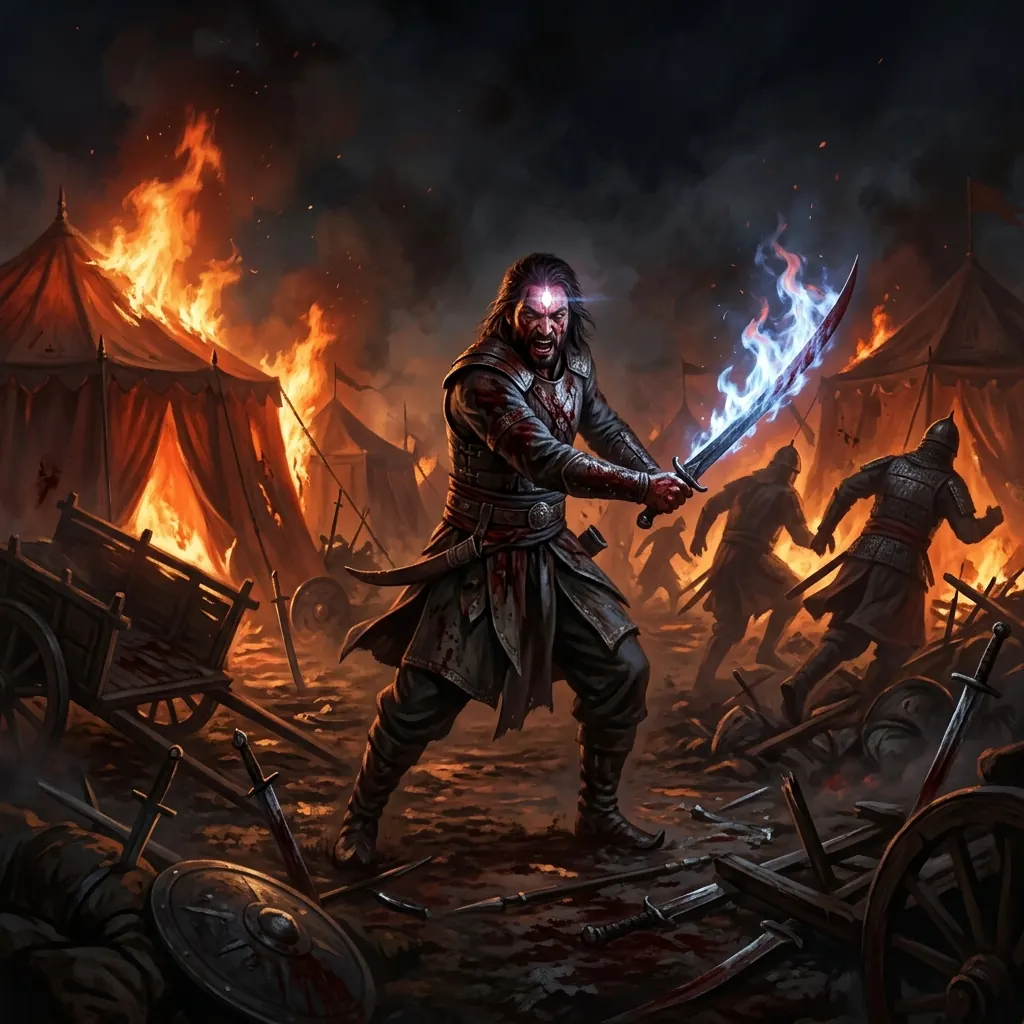
The morning after the night massacre, the sole surviving charioteer brings the news to Yudhishthira, who collapses and then laments that victory has taken the shape of defeat. Nakula fetches Draupadi from Upaplavya, and she arrives to find her five sons dead. She announces that she will sit in praya, the fast unto death, unless Ashwatthama is killed, and names her proof: the gem he was born with, brought to her and set on her husband's head. Bhima takes up his bow, makes Nakula his charioteer, and drives out along the track of Ashwatthama's chariot.
Told in the Sauptika ParvaSet in Pandava Camp, Upaplavya and Kurukshetra15 min read
The Sole Survivor Comes at Dawn
Vaishampayana was telling it to Janamejaya, and this is the part of the telling where the night finally ends.
After that night had gone away, one man came into the Pandava quarters with the news. He was the driver of Dhrishtadyumna's chariot, and he was the only person still alive who had been inside the camp when it happened.
He gave his intelligence to king Yudhishthira standing up, in order, the way a driver reports.
"The sons of Draupadi, king, have been slain, with all the children of Drupada himself, while they lay off guard and trustfully asleep in their own camp. In the night your camp was wiped out by the cruel Kritavarma, and Kripa, the son of Gautama, and the sinful Ashwatthama. Killing thousands of men and elephants and horses with lances and darts and battle-axes, those men have wiped out your army. While your army was being slaughtered like a forest cut down with axes, a loud wail was heard rising from your camp. I am the sole survivor, king, of that vast force. I escaped with difficulty, you of virtuous soul, from Kritavarma at a moment when he was off guard."
Every clause of it was worse than the one before, and the man said it all.
Yudhishthira had borne the news of Abhimanyu and the news of Ghatotkacha and the news of his own teacher's death, and he had stood up under each of them. He did not stand up under this. He fell down on the earth where he was, afflicted with grief at the loss of his sons.
Satyaki came forward first and held the king in his embrace. Bhimasena and Arjuna and the two sons of Madri stretched forth their arms and took hold of him, five men in a war camp with nothing left in it to defend.
When his senses came back to him he began to speak, and the words came out indistinct with sorrow.
Victory in the Shape of Defeat
"Alas, we defeated the foe, and in the end we ourselves have been defeated."
That was the first sentence, and the king turned it over and over that morning like a man examining a coin that has come back to him from a place where he never spent it.
"The course of events is hard to make out even for those who have spiritual sight. The foes who were defeated have become the victors. And we, the victors, are defeated. We killed brothers and friends and fathers and sons and well-wishers, and kinsmen, and counsellors, and defeated them all, and at last we ourselves are defeated."
Eighteen days had gone into the account. The grandsire on his bed of arrows, the teacher, Karna, Shalya, Duryodhana with his thighs broken on the open ground. Every name on the ledger had been paid for at the price agreed. And in one night, while the winners slept, the balance had reversed itself without a single new battle being fought.
"Misery looks like prosperity," Yudhishthira said, "and prosperity looks like misery. This victory of ours has taken the shape of defeat. Our victory has ended in defeat. I have won the victory, and I am forced to grieve like a stricken wretch. How, then, can I call it a victory? In truth, the foe has defeated me twice over."
Doubly, because there were two defeats in it and he could see both. There was the kingdom, which was his, and there was the reason he had wanted the kingdom.
"Those for whose sake we took on the sin of victory by killing our kinsmen and friends, alas, those very ones, after victory had crowned them, have been defeated by beaten foes who stayed watchful."
The war had been fought to seat five men on the earth and to leave that earth afterwards to their sons. The sons were lying dead in the camp behind him. What he had won was a country and nobody to give it to.
There Is No More Powerful Cause of Death
Then he began naming what those boys had already come through, which is the cruellest arithmetic a mourner can do and the one every mourner does.
"Alas, those who had escaped even Karna have been slain through heedlessness. Karna, the warrior who had barbed arrows and nalikas for his teeth, the sword for his tongue, the bow for his gaping mouth, and the twang of the bowstring and the sound of palms for his roars. That angry Karna who never retreated from battle, and who was a very lion among men."
They had walked out of that mouth alive. They had done more than that.
"Alas, those princes crossed, in boats made of their own excellent weapons, the great Drona-ocean, which had chariots for its deep lakes, showers of arrows for its waves, the ornaments of warriors for its gems, chariot-horses for its animals, darts and swords for its fishes, elephants for its alligators, bows for its whirlpools, mighty weapons for its foam, and the signal of battle for the moonrise that made it swell with energy. Even those princes have been slain through heedlessness."
And then the sentence the whole lament had been walking toward.
"There is, in this world, no more powerful cause of death, as regards men, than heedlessness. Prosperity abandons a heedless man from every side, and every kind of misery overtakes him."
He had one more fire to name. The tall standard with its excellent top that had stood on Bhishma's chariot was the wreath of smoke that infallibly indicated the fire beneath. Shafts were its flames. Wrath was the wind that fanned it. The twang of that formidable bow and the sound of those palms were its roar, armour and weapons the homa libations poured into it, and the whole hostile army the heap of dry forest-grass it was set among.
"Alas, even those who had come through that fierce fire have fallen at last through heedlessness. A heedless person can never acquire knowledge, asceticism, prosperity, or great renown. They have perished like merchants with rich freight perishing through carelessness in a shallow stream after having crossed the great ocean."
I Grieve for the Princess Krishna
"They whose bodies are now lying on the bare ground, slain by those vindictive wretches, have without doubt ascended to heaven," the king said. "I grieve, however, for the princess Krishna."
Krishna is her other name, the dark one, the name her father's fire gave her before anybody thought to call her Draupadi. She was not in the camp. She had been left at Upaplavya, the garrison town in Virata's country where the alliance had been assembled and where the women had stayed while the war ran its eighteen days, and she did not yet know that she had no children.
"Alas, today she will be plunged into an ocean of grief. When she hears of the slaughter of her brothers and sons and her venerable father, the king of the Panchalas, she will surely fall senseless to the ground. Her body wasted by grief, she will not rise again. Unable to bear the grief of such a blow, and worthy as she is of happiness, alas, what will be her plight? Cut to the quick by the slaughter of her sons and brothers, she will be like one scorched by fire."
He was right about all of it except the last clause, and about that he was wrong in a way he could not have guessed.
When he had finished lamenting he turned to Nakula, the fourth brother, the one they sent when a thing had to be done quickly and well.
"Go and bring the unfortunate princess Draupadi here, along with all her maternal relations."
Nakula obediently accepted the command of the king who equalled Yama himself in righteousness, and went to his chariot, and drove for Upaplavya to fetch a woman to the place where her sons were lying.
And Yudhishthira, crushed, with tears in his eyes and his friends around him, walked out to the field where his sons had battled and which still teemed with diverse kinds of creatures. He entered it. He saw them, well-wishers and friends and children together, covered with blood, their bodies mangled, their heads separated from their trunks.
That foremost of righteous men began to weep aloud, and fell senseless to the ground, and all his followers fell with him.
The Chariot That Shone Like the Sun
Seeing his sons and grandsons and friends all slain in battle, Vaishampayana said, the king was overwhelmed. He lay there remembering them one after another, senseless and trembling, his eyes bathed in tears, and his friends, who were themselves filled with anxiety, began to comfort him because there was nothing else to be done with their hands.
At that time Nakula came back.
He arrived in his chariot that shone like the sun, as skilled at carrying out errands as he had always been, and the errand was finished: the princess Krishna was with him. At Upaplavya she had received the heartrending news of the slaughter of all her sons, and she had become exceedingly agitated, and she had made the whole journey knowing.
She came into the presence of Yudhishthira trembling like a plantain tree shaken by the wind, and fell down where she stood, afflicted by grief. Her face was adorned with eyes resembling a couple of full-blown lotuses, and Vaishampayana says that it seemed darkened, like the Sun himself when he is enveloped in darkness.
Of the five men standing there, it was Bhima who moved.
The wrathful Vrikodara, whose prowess could not be checked, came forward hastily, and raised her up off the ground, and clasped her with his arms.
He had done this before, or something like it, for her and for the whole family, and both of them knew the count. The lac house at Varanavata, when he carried the whole family out of a fire lit for them. The forest of Hidimba, when he stood between his family and the rakshasa. Virata's city, when Kichaka put his hand on her and did not live out the night. Bhima had been the answer every time this woman was in danger for thirteen years, and here he was again, holding her up in a camp full of her dead children, with nothing to hit.
Comforted by Bhimasena, the beautiful lady began to weep. Then she turned toward the eldest son of Pandu, who was standing among his brothers, and she began to speak, and what came out of her was not a lament.
By Good Luck
"By good luck, king, you have won the whole earth, and you will enjoy her now that your brave sons have been slaughtered doing their kshatriya duty."
She said it standing in front of him with Bhima's arm still under her.
"By good luck, son of Pritha, you are happy at the thought of having won the whole earth. By good luck, your thoughts do not dwell on Subhadra's son, whose tread resembled that of an infuriated elephant. By good luck, you do not, as I did while I stayed at Upaplavya, remember your heroic sons slaughtered doing their kshatriya duty."
Four times, by good luck. It is the phrase a wife uses to congratulate a husband on a piece of fortune, and she laid it over the top of every loss in his house until the politeness of it was unbearable. She was not accusing him of not grieving. She had seen him on the ground. She was telling him what his grief had so far produced, which was speeches.
Then she stopped saying it that way.
"Son of Pritha, since I heard of the slaughter of those sleeping heroes by Drona's son of sinful deeds, grief burns me as if I were in the midst of a fire."
And she named her terms, in front of the four brothers and Satyaki and whoever else was within hearing, the way a plaintiff names them.
"If Drona's son is not made to reap the fruit of that sinful deed of his, if you do not put forth your prowess in battle and take the life of that wretch of sinful deeds, along with the lives of all his followers, then listen to me, you Pandavas. I will sit here in praya."
Praya is the fast unto death. A person who sits in praya sits down deliberately in one place, takes nothing, and does not get up, and the sitting is not a threat made to be argued out of. It is a judgment entered against the living by someone who is prepared to leave them.
Having said these words, the helpless Krishna, the daughter of Yajnasena, sat down on the ground by the side of the eldest son of Pandu, king Yudhishthira the just.
And she was silent.
The Gem He Was Born With
The royal sage, seeing his dear queen sit in praya, spoke to her carefully, because a man in that position has to.
"Blessed lady, you who know what is right, all your sons and brothers have met a noble death, righteously. You should not grieve for them."
That was the consolation, and he did not linger on it, because he knew it would not hold. Then came the practical objection, which was real.
"As for Drona's son, he has gone to a distant forest, beautiful princess. How will you, lady, be sure that he has fallen in battle?"
It is a fair question. The man was gone into the woods before dawn with a night's start. If she was going to sit without food until he was dead, what would tell her that he was dead? A brother's word? A shout in a camp? She had been given news before.
Draupadi had already thought about it.
"I have heard that Drona's son has a gem on his head that was born with him. I will see that gem brought to me once that wretch has been killed in battle. When I have placed that gem on your head, king, I will bear to go on living. That is my resolve."
She had asked for the one thing that could not be faked and could not be taken off a living man. The gem had grown with Ashwatthama out of his own skull; it was the thing about him that everyone had always mentioned first. She wanted it in her hand, and then she wanted it set on the head of the king she had married, and only then would she eat.
It is worth noticing what she had not asked for. Not that the man be captured. Not that he be brought to her. Not vengeance in any form she would have to watch. One stone, carried back down the road, and a king wearing it, and food after that.
Nakula at the Reins
Then she turned away from Yudhishthira and went to Bhimasena, and spoke to him of high purpose.
"Remember the duties of a kshatriya, Bhima, and come to my rescue. Kill that man of sinful deeds as Maghavat killed Shambara. There is no one in this world who is equal to you in prowess. The whole world knows how, at a time of great calamity in the town of Varanavata, you became the refuge of all the Parthas. When again we were seen by Hidimba, it was you that became our refuge in the same way. Like Maghavat rescuing the daughter of Puloma, you rescued me in my distress, in Virata's city, from a great calamity. Like those great feats you achieved in former days, Partha, kill the son of Drona now, slayer of foes, and be happy."
Bhimasena of great might could not endure to hear any more of it.
He mounted his great chariot adorned with gold and took up his beautiful bow with the arrow already placed on the string. He made Nakula his charioteer, which meant that the brother who had gone to fetch her was now driving the brother who would answer her. He began to stretch the bow while the chariot was still standing. He had the horses driven on without delay, and they went, fleet as the wind.
Bhima set out from the Pandava camp with great celerity, and proceeded along the track of Ashwatthama's vehicle, which was still there in the dust of the road, going toward the forest.
Dharma Lesson
Yudhishthira's answer to grief is a speech about heedlessness, and it is a good speech, and it feeds nobody. Draupadi's answer is a condition and a proof: a named object, brought back and laid where she can see it, or she does not eat. She had spent the whole war being told that her losses were the price of dharma, and at the end she declined to accept any more accounting she could not verify. The gem is not a trophy. It is the receipt.