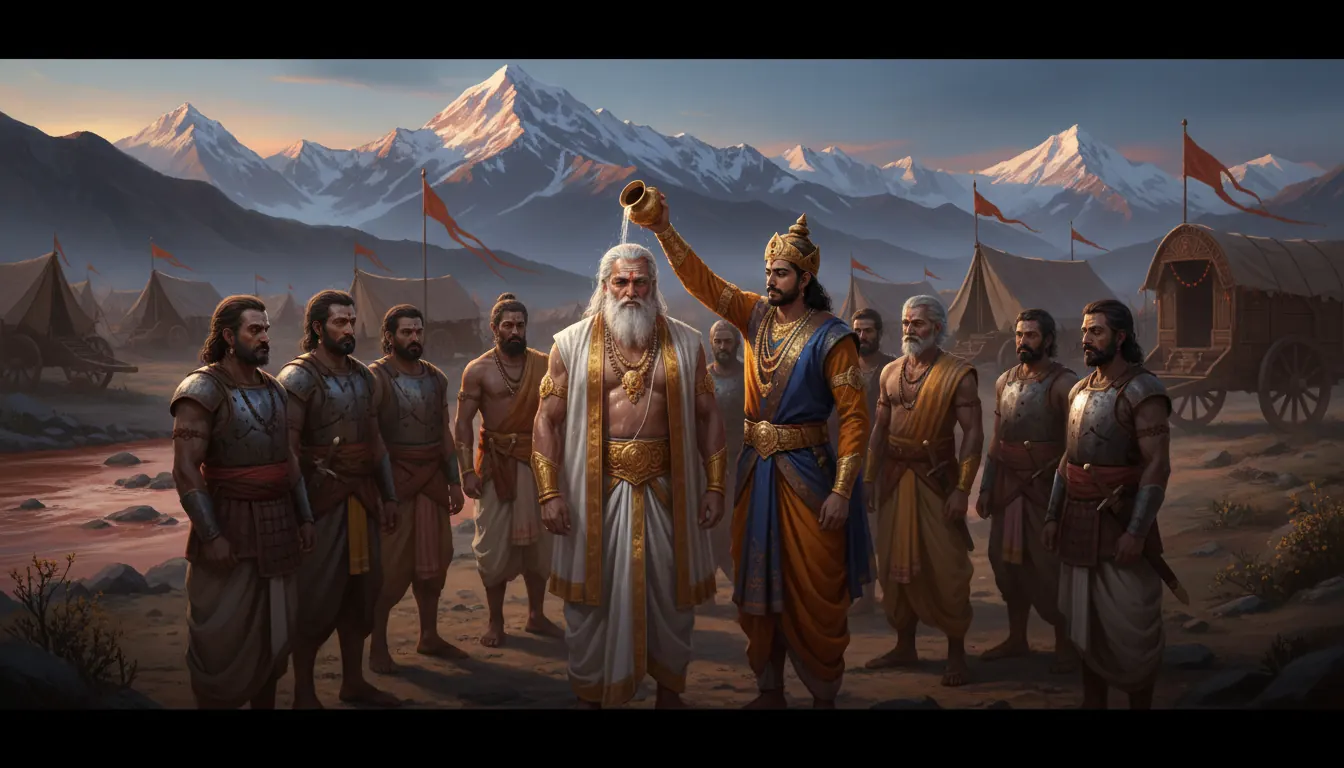
The Eighteenth Morning
Chekitana takes a lance, Suratha takes a single arrow, and Duryodhana is carried off his own field by bolting horses
In short
On the last morning of the war, with Shalya newly in command, the Kaurava and Pandava lines close and the field breaks into its pairs. Duryodhana kills Chekitana with a lance, Ashwatthama kills the Panchala Suratha with one arrow through the heart and takes the dead man's chariot, and Duryodhana trades arrows with Dhrishtadyumna before Bhima puts a dart in his chest and beheads his driver. Yudhishthira, telling his brothers that only one share of the war is left and it is his, drives at his own uncle and strips his chariot bare.
Told in the Shalya ParvaSet in Kurukshetra22 min read
The Two Maces and the Two Falls
Sanjaya was telling it in the hall at Hastinapura, to a blind king who wanted every hour of it, and the hour he had reached was the morning of the eighteenth day.
Karna had died the day before. Drona was dead, and Bhishma lay on his bed of arrows within sight of the field, and the command of what was left of the Kaurava army had passed to Shalya, the ruler of the Madras, who was uncle to Nakula and Sahadeva and had come to the war on the wrong side of it through a trick played on him at a wayside feast. That morning Bhima had already crushed the four swift horses of Shalya's chariot with his mace, and Shalya had answered with a lance through Bhima's armour, and Bhima had pulled the lance out of his own chest and killed Shalya's driver with it.
So the commander of the Kaurava host came down from his chariot on foot with his iron mace in his hands and stood as unmoving as a bull, and Bhima came at him.
The two of them roared like bulls and careered in circles and frequently sprang into the air, and Sanjaya said that no difference could be marked between them, not in the circling and not in the wielding. Shalya's mace was wrapped in cloth of gold and looked like a sheet of fire. Bhima's, as he wheeled, looked like lightning inside a cloud. Where the iron met, sparks went up into the sky and blazing coals came down.
Men in both armies stopped to watch and applauded them together. "Excellent, excellent. Except for the ruler of the Madras, or Rama, the delight of the Yadus, no one could dare to withstand Bhima's onslaught in battle. And except for Bhima, there is no warrior who could withstand the force of the illustrious king of the Madras's mace."
They struck each other on the left and on the right until both were bathed in blood and looked handsomer for it, like two flowering kinsukas. They rested a moment. Then they advanced eight steps each and struck again, like mountains striking with their crests in an earthquake, and both of them went down at the same instant, like a pair of poles set up for Indra's worship.
Both armies cried out. Kripa took Shalya up into his own chariot and carried him off the field. And within the twinkling of an eye Bhima was on his feet again, still reeling like a drunk man, lifting his mace and calling for the king of the Madras to come back.
The Lance in Chekitana's Chest
Nobody answered the challenge. Instead the whole line moved.
Duryodhana's warriors came on with their arms and their weapons lifted, making trumpets and drums sound in front of them, and the sons of Pandu came to meet them with lion-like roars, and in the closing of those two masses there was one killing that Sanjaya set down by name.
Among the heroes rushing at him Duryodhana singled out Chekitana. Chekitana was one of the seven who led the Pandava divisions, a Vrishni, a man of Krishna's own people who had brought his troops across to Yudhishthira's side before the first day and had been in the front of the fighting since. Duryodhana did not shoot at him. He drove at him with a lance and pierced him deeply in the chest with it, and Chekitana fell on the platform of his own chariot, covered with blood, and sank into a faint he did not come out of.
The great chariot warriors of the Pandavas saw him fall and poured out their showers of arrows without stopping, and they careered beautifully, said Sanjaya, on all sides through the Kaurava divisions, driven that morning by the desire for victory.
After that the field sorted itself into its pairs, as it did every day, and the pairs that morning were these. Kripa and Kritavarma and the mighty son of Subala put the ruler of the Madras in front of them and fought with king Yudhishthira the just. Duryodhana took Dhrishtadyumna, the slayer of Bharadwaja's son, a hero of abundant energy and prowess. And three thousand chariots, sent by the king and led by Drona's son, went out to hold Arjuna.
All of those men, said Sanjaya, had firmly resolved to win, and had cast off fear along with life itself. The Kaurava warriors penetrated into the middle of the Pandava army like swans going into a large lake.
Kill, Pierce, Seize, Strike, Cut Off
The dust came up first, terrible to see, raised by the wind out of a battle that was destroying great heroes. For a while nobody on either side could see anything, and Sanjaya said that they knew who was fighting whom only from the names being shouted, the Pandava names called out by the Kurus and the Kuru names called out by the Pandavas. Then blood fell and laid the dust and every point of the compass came clear again.
No man on either side turned his back that morning. They were fighting for the regions of Brahman and they wanted to get there by fair fight. Some were paying off the debt they owed their masters for the food they had eaten in their houses. Some had promised things to friends and allies and meant to keep the promises. All of them had their hearts fixed on heaven, which is a strange thing to say of men shouting what they were shouting.
"Kill, pierce, seize, strike, cut off." Those were the words heard in that battle, from both sides, all morning.
Shalya came back onto the field wanting Yudhishthira dead and pierced him with many sharp arrows. Yudhishthira knew the vital parts of a man and struck his uncle with fourteen cloth-yard shafts aimed at them. Shalya answered with arrows winged with kanka feathers, too many to count, and then with one straight shaft in the sight of all the troops.
Yudhishthira, filled with rage, shot back. He killed Chandrasena with seventy arrows and Drumasena with sixty-four and put nine into Shalya's driver, and when both the guards of Shalya's chariot wheels had fallen, Shalya killed twenty-five warriors among the Chedis in reply. Then with one broad-headed arrow Yudhishthira cut the top off the standard of his uncle's chariot in front of him, and the whole army saw it come down like a riven mountain peak.
That was the moment Shalya stopped being careful. He poured arrows over the kshatriyas like the god of the clouds pouring rain, and put five into Satyaki and five into Bhima and five into each of the twins, and then shrouded Yudhishthira alone. Sanjaya said they saw a net of arrows standing in front of the son of Pandu's chest like a mass of risen cloud, and that the king inside it felt his own prowess go out of him, as the asura Jambha had felt his go, long ago, in front of the slayer of Vritra.
Five Weapons Thrown at One Man
Satyaki and Bhimasena and the two sons of Madri saw the king smothered and brought their chariots round Shalya to take the pressure off him.
What followed was watched from above. The Siddhas were filled with delight at it, and the ascetics who had assembled to see the war declared it wonderful, because Shalya was unsupported and did not give a step. Bhima pierced him with one arrow and then with seven. Satyaki put a hundred into him and roared. Nakula gave him five, Sahadeva seven and seven again. Shalya drew a bow that could bear a great strain and answered all of them by name: twenty-five for Satyaki, seventy-three for Bhima, seven for Nakula, and for Sahadeva a broad-headed arrow that cut the bow out of his hands with the shaft still fixed on the string, and then seventy-three more.
Sahadeva strung another bow and shot five arrows like snakes into his maternal uncle, and struck his driver, and struck him again with three.
Blood was running down Shalya by then in crimson streams, the way water runs down a mountain of red chalk, and he was still cutting bows. He cut Yudhishthira's. He cut Satyaki's with a razor-faced arrow. So the five of them stopped shooting and threw.
Satyaki hurled a lance with a golden staff, decked with jewels and gems. Bhima sent a cloth-yard shaft that looked like a blazing snake. Nakula threw a dart, Sahadeva an excellent mace, and Yudhishthira a Sataghni, hurled with the desire of finishing him.
All five came at his chariot at once and none of them arrived. He cut the lance apart with broad-headed arrows. He cut Bhima's gold-decked arrow in two. He beat down Nakula's dart and Sahadeva's mace with clouds of arrows, and he cut the Sataghni in two with a pair of arrows before the very eyes of the sons of Pandu, and laughed at them with a lion's roar.
Duryodhana, watching from his own quarter of the field, looked at that and counted the Pandavas and the Panchalas and the Srinjayas as already slain.
And Yudhishthira, seeing his troops going down under one man's arrows, began to think: how will those grave words of Madhava come true? I hope the ruler of the Madras, in his rage, will not wipe out my army in battle.
The Track of Partha's Chariot
Away on the other flank, Arjuna had three thousand chariots in front of him and Drona's son at the head of them.
They shot well. The gold-decked arrows they sent filled the platform of Arjuna's chariot, and then the pole and the wheels and the shaft and the traces and the yoke, until the whole vehicle stood bristling. Sanjaya, who was not generous to the Pandava side without reason, said that what the Kaurava warriors did to Partha then had never before been seen or heard, and that the chariot, with those sharp and beautifully feathered arrows standing in it, looked like a celestial vehicle blazing with a hundred torches, dropped onto the earth. The men who had done it looked at the two Krishnas covered over with their arrows and were filled with delight.
Then Arjuna answered.
He covered that hostile division with straight shafts the way a cloud covers a mountain with rain, and the men in it, struck by arrows that had Partha's name written on them, looked around and thought the field was full of Parthas. The Partha-fire took hold, with the twang of Gandiva for the wind that fanned it, and the fuel of it was that army.
Along the track his chariot took, Sanjaya counted what was lying there: wheels and yokes, quivers, banners and standards with the vehicles that had carried them, shafts and axles and traces and goads, heads still wearing their earrings and their headgear, arms and thighs in thousands, umbrellas and fans, diadems and crowns. The ground behind him was muddy with blood and impassable, like the playground of Rudra. It filled the timid with fear and the brave with delight, and two thousand chariots with their fences were destroyed, and the man in the middle of it looked like a smokeless fire.
Ashwatthama saw that and drove out to check him, and the two of them met with white horses under both of them, each counted the greatest of chariot warriors, each wanting the other dead. They mangled each other for a long time like two bulls tearing with their horns, and the fight stayed level, and then Drona's son put twelve gold-winged arrows into Arjuna and ten into Vasudeva.
Bibhatsu had shown some regard for his teacher's son up to that point. Now, smiling, he drew Gandiva hard, and in very little time and without much effort he left Ashwatthama without horses, without a driver and without a chariot, and put three arrows into him where he stood.
The Panchala Named Suratha
Standing on the wreck of his own chariot, Ashwatthama smiled and threw things.
First a heavy mallet decked with cloth of gold, like a dreadful mace with iron spikes on it. Arjuna cut it into seven pieces in the air. Then a terrible spiked mace that looked like a mountain summit, hurled with all the skill of a man accomplished in battle, and Arjuna cut that apart with five excellent shafts and it fell on the earth, and Sanjaya said it rived the hearts of the kings who were watching. Three more arrows went into Drona's son after it. He did not flinch and he showed no sign of fear, relying, said Sanjaya, upon his own manliness.
Then, in front of all the kshatriyas there, he turned and shrouded Suratha with showers of shafts.
Suratha was a Panchala, one of the great chariot warriors of Drupada's house, of the family whose son had killed Ashwatthama's father three days before. He did not wait to be shot at twice. He came at Drona's son in a chariot whose rattle was as deep as the roar of the clouds, and he drew a superb bow, firm and able to bear a great strain, and covered Ashwatthama with arrows that looked like flames of fire, or like snakes full of deadly poison.
Ashwatthama watched him come and filled with rage like a snake that has been struck with a stick. He furrowed his brow into three lines. He licked the corners of his mouth with his tongue. He looked at the man in rage, and rubbed his bowstring, and sped one keen cloth-yard shaft that resembled the fatal rod of Death.
It went through Suratha's heart and out of his back and into the ground, riving the earth through, like the thunderbolt of Shakra hurled down out of the sky. Suratha fell like a mountain summit split by thunder.
Then Drona's son, who had been standing on a broken chariot with no horses in front of him, walked across and climbed up onto the vehicle of the man he had just killed, took the reins of it, and went back to Arjuna with his armour and his weapons about him and the Samsaptakas at his back.
That fight, one against many, ran on into the hour of noon and enlarged the population of Yama's domains. Wonderful was the sight, Sanjaya said. Alone and unsupported, Arjuna fought all of them at the same time, as Indra long ago fought the vast host of the asuras.
The King Against the Fire-Born
Duryodhana and Dhrishtadyumna, the son of Prishata, were fighting their own battle in another part of the field, with arrows and darts in profusion, both of them pouring shafts like clouds in the rainy season.
The king shot first and shot well. He pierced the slayer of Drona with five arrows and then with seven more. Dhrishtadyumna, a man of great might and steady prowess, struck Duryodhana with seventy.
That was the second time that morning the Kauravas saw their king in trouble, and his brothers born of the same mother came with a large force and surrounded the son of Prishata on every side. Surrounded by Atirathas, the Panchala hero careered among them displaying his quickness in the use of weapons, and would not be closed on. Nearby, Shikhandi with the Prabhadrakas behind him took on two Kuru bowmen at once, Kritavarma and the great chariot warrior Kripa.
The battle in that quarter became fierce and awful, said Sanjaya, because the warriors there were all resolved to lay down their lives, and every one of them was fighting with his life as the stake.
Shalya meanwhile was shooting on all sides, battering the Pandavas, Satyaki and Vrikodara among them, and fighting the twins at the same time with patience and great strength, though each of the twins was like the Destroyer himself. The mangled Pandava chariot warriors around him could find no one to protect them.
Then Nakula, seeing his eldest brother in distress, drove at his maternal uncle. He shrouded Shalya with arrows and, smiling while he did it, put ten shafts into the centre of his chest, iron the whole length of them, polished by the smith, winged with gold, whetted on stone. Shalya, afflicted by his illustrious nephew, afflicted his nephew back with straight arrows, and then cut Nakula's bow with a razor-headed arrow while the shaft was still fixed to it, so that the bow broke into pieces in his hands.
Yudhishthira and Bhima and Satyaki and Sahadeva all rushed him together, filling the points of the compass with the rattle of their chariots and making the earth tremble. Shalya met them. He cut Satyaki's bow at the handle and sent his four horses to Yama's realm and struck the man, now without a chariot, with a hundred arrows from every side.
Satyaki got into another chariot and came straight back, and the two of them met like one maddened elephant meeting another. Satyaki pierced him with ten arrows and shouted, "Wait, wait!"
Sanjaya, watching from where he watched, said that Shalya's chariot careered through that dreadful battle like Shakra's chariot in the old days when the asuras were destroyed.
The Share That Was Left
By then the Kaurava troops, though afflicted, were simply more numerous where it counted, and they agitated the Pandava line until it would not stand. Men went back in the sight of the two Krishnas, and Bhima could not check them, and Yudhishthira shouted at them to stop and they went anyway.
So the king got down off the argument he had been having with himself all morning.
He called his brothers and Krishna of Madhu's race together and said this to them.
"Bhishma, and Drona, and Karna, and the other kings who showed their prowess for the Kauravas, have all perished in battle. All of you have shown your valour as your courage allowed, each against the share allotted to you. Only one share is left, mine, and it is the mighty chariot warrior Shalya. I mean to defeat that ruler of the Madras in battle today."
Then he gave the orders for it, and they were the orders of a man who has thought the thing through.
"These two heroes, the two sons of Madravati, will guard my wheels. They are counted heroes whom Vasava himself could not defeat. With the duties of a kshatriya before them, these two, who deserve every honour and are firm in their vows, will fight their maternal uncle. Either Shalya will kill me in battle or I will kill him. Blessings on you. Listen to these true words, greatest heroes in the world. Keeping to kshatriya duty, I will fight my maternal uncle, lords of the earth, firmly resolved either to win or to be killed. Let those who equip chariots quickly supply my vehicle, by the rules of their craft, with weapons and every kind of gear, in greater measure than Shalya's. The grandson of Shini will guard my right wheel, and Dhrishtadyumna my left. Let Pritha's son Dhananjaya guard my rear today. And let Bhima, the greatest of all wielders of weapons, fight in front of me. In this way I will be stronger than Shalya in the great battle to come."
His well-wishers did exactly as they were asked. The Pandava troops filled with joy at it, and the Panchalas and the Somakas and the Matsyas most of all. They blew conchs and beat drums past counting and roared, and they made the earth resound with elephant-bells and trumpets, and went forward with shouts of joy against the ruler of the Madras.
Duryodhana and Shalya received that charge standing side by side, like the hill of the sunrise and the hill of the setting.
The Chariot With No Driver
The Panchala prince and Satyaki and the two sons of Madri took Shakuni and the other Kuru heroes on their own account, and in that place, said Sanjaya to the old king, in consequence of your evil policy, there occurred once more an awful battle between your warriors and those of the enemy, all of whom were inspired with the desire of victory.
Bhima had been given the front, and the man who came into the front was Duryodhana, who delighted in battle.
The king shot first and shot at the standard. One straight shaft took the gold-decked pole of Bhima's banner, and the beautiful standard with all its bells came down on the field. A second, razor-faced, cut Bhima's bow, which was as thick as an elephant's trunk, in half.
Bhima had no bow then and did not wait to find one. He put out his strength and drove a dart into Duryodhana's chest, and Duryodhana sat down on the platform of his chariot and lost his senses.
While he was sitting there Bhima took a razor-faced shaft and cut the head of the king's driver off his trunk.
The horses of that chariot, with nobody holding them, bolted. They ran wildly in every direction dragging the chariot and the fainting king after them, and a loud wail went up out of the Kaurava army at the sight, and Ashwatthama and Kripa and Kritavarma went after the chariot to save him. The troops were thrown into turmoil. The followers of Duryodhana were terrified. And the wielder of Gandiva, drawing his bow, began to kill them while they were watching it go.
The man for whose sake the whole war had been fought went out of the middle of it senseless, dragged by his own horses, and three of his best warriors turned their chariots around and left the battle to go and get him.
Wait, Wait
Shalya, meanwhile, was pouring arrows on Yudhishthira like Maghavat pouring rain, and Yudhishthira had taken up his beautiful bow and was displaying the diverse lessons that Drona had taught him, shooting shower after shower quickly and with great skill, so that nobody watching could mark a single lapse in him. Then he urged on his horses, white as ivory and fleet as thought.
Sanjaya said they saw something wonderful in the son of Kunti then, for though he was a very mild and gentle man he became terribly fierce, with his eyes wide open and his body trembling with rage. Whoever he went against was overthrown like a mountain peak split by a thunderbolt. He felled chariots with their horses and drivers and standards, and destroyed horses with riders and horses without riders and foot-soldiers by thousands, like Rudra at the dissolution of the world.
When he had emptied the field around him with his arrows, he drove at Shalya and called out, "Wait, wait!"
The Kaurava warriors were frightened of him by then. Shalya was not. The two of them blew their conchs and turned and charged, and covered each other with showers of arrows, and stood bathed in blood, one like a salmali tree and the other like a kinsuka, both of them in flower. Nobody looking on could tell which of them would live. Whether the son of Pritha would kill Shalya and enjoy the earth, or whether Shalya would kill the son of Pandu and make a present of the earth to Duryodhana, none of the warriors there could tell.
Yudhishthira put his enemies on his right and kept working. Shalya shot a hundred of his finest arrows at him and cut his bow with another. Yudhishthira took up a second bow, put three hundred arrows into his uncle, cut his uncle's bow with a razor-faced arrow, killed his four horses with straight ones, cut down the two Parshni drivers who guarded his wheels, and with one more arrow, blazing and well-tempered, cut the standard that stood in front of him.
At that the army of Duryodhana broke. Drona's son drove fast to the place where the commander of the Kauravas stood on a stripped chariot, took him up, and carried him away, and they had gone only a little distance when they heard Yudhishthira roaring behind them.
Shalya made him stop. He got down, and mounted another chariot that had been made ready, one whose rattle was as deep as the roar of the clouds, well furnished with weapons and instruments and every kind of utensil, a vehicle that made the hair of enemies stand on end. Then he turned it round.
Dharma Lesson
Yudhishthira's speech is the quiet centre of this morning: the war has been divided into shares, and every other man has spent his. What is left to him is his mother's brother, a man he loves and has no quarrel with, and the duty of a kshatriya gives him no way around that. The morning offers no comfort about it either. Chekitana dies without a word, Suratha dies in the time it takes one arrow to cross the space between two chariots, and Ashwatthama climbs onto the dead man's chariot and goes straight back to work, because the fighting does not pause for anybody's grief.