In short
Two days after Virata struck his dice-player in the face, the five Pandavas bathe, dress in white and ornaments, walk into the Matsya council hall and sit on the seats reserved for kings. The angry king demands to know how a courtier dares. Arjuna answers with a long praise that ends in the name Yudhishthira, then points out the cook, the groom, the cowherd and the maidservant.
Told in the Virata ParvaSet in Virata20 min read
Blood in a Golden Bowl
The dice went badly for the king of the Matsyas all that afternoon, and he did not care, because the news from the northern pastures had reached the palace ahead of his son and it was better than any throw.
"My slave women and my cows, my gold and whatever other wealth I have," Virata said, sweeping a hand across the board, "you will not be able to protect any of it today, even if I do not gamble."
"Why gamble at all, you who honour others?" said Kanka, who had kept the ivories for him for a year and had never once been seen to want to win. "It brings a great many evils and should be avoided. You have seen, or at least heard of, Yudhishthira the son of Pandu. He lost a great and prosperous kingdom at dice, and his godlike brothers with it. That is why I have no taste for the game. But if you like, king, I will play."
They played. The king could not keep off the subject that was warming him. "Look," he said, "the Kauravas, formidable as they are, have been beaten in battle by my son."
"Why should he not conquer," said Kanka, without lifting his eyes from the board, "who has Brihannala for his charioteer?"
Virata's hand stopped above the dice. "You wretch of a brahmana. Do you compare one of the third sex with my son? Have you no idea what is fit to say and what is not? You are plainly showing me disrespect. Only because you are my friend do I forgive you this. But do not say it again, if you want to live."
A prudent servant would have bowed his head. The courtier went on.
"Where Bhishma stands, and Drona, and Drona's son, and the son of Vikartana, and Kripa, and King Duryodhana, with other royal and mighty chariot warriors gathered round them, or where Indra himself stands among the Maruts, who but Brihannala could fight them all? No one has ever been his equal in strength of arm, and no one ever will be. He is the only one whose heart fills with joy at the sight of a terrible battle. With such a man on his side, why should your son not beat the enemy?"
"I have told you again and again to stop, and still you will not hold your tongue," Virata said. "If no one is ever punished, no one will practise virtue."
He took up a die and struck the courtier in the face with it.
Blood ran from Kanka's nose. He did not put a hand up to stop it. He cupped both palms beneath his own chin and caught the blood there before a drop of it could reach the floor, and over his full hands he looked at the sairindhri standing behind his seat. She understood him without a word being said, went out, and came back with a golden vessel, and knelt, and held it under his face until the bleeding stopped.
The Vow Whispered to the Doorkeeper
While she was still holding the bowl, a porter came in and said that the prince Uttara waited at the gate with Brihannala for his companion.
"Show them both in," said Virata, cheerful again. "I can hardly wait to see them."
The man turned to go, and the bleeding courtier said his name, quietly, and the porter bent down to him.
"Let Uttara come in alone," Yudhishthira whispered. "Brihannala must not come in. That mighty-armed hero has sworn that whoever wounds me or sheds my blood, except in battle, will not live. In his fury he will never stand calmly by and see me bleeding. He will kill Virata within the hour, with his counsellors and his troops and his horses."
So Bhuminjaya, the king's eldest son, came in by himself. He worshipped his father's feet and then went across to the courtier, and stopped. Kanka was sitting on the ground at one end of the court, covered in blood, and the queen's sairindhri was crouched beside him with a golden vessel in her hands.
"Who struck this man, king?" the prince said. "Who has done this wicked thing?"
"I struck this crooked brahmana," Virata said. "He deserves worse. When I was praising you, he praised that person of the third sex."
"You have done wrong," said Uttara. "Make peace with him quickly, before the deadly poison of a brahmana's curse destroys you root and branch."
Virata heard his son and went to work at once on the man he had just struck, coaxing him, apologising, asking pardon of a fire that was hidden in ashes and did not look like fire at all.
"King, I forgave it long ago," the Pandava said. "I feel no anger. If this blood from my nose had fallen on the ground, there is no doubt that you would have been destroyed, king, and your kingdom with you. But I do not blame you for striking an innocent man. The powerful are often harsh without reason."
When the bleeding had stopped, Brihannala came in, saluted the king and the courtier both, and stood without speaking. Nobody in that hall thought anything of it. A dancing master had come in from the door, that was all, with a braid down her back and bangles on her arms, and had taken up a position where she could see the blood.
The Son of a God Who Would Not Stay
Then the king began to praise his son, and he took his time about it, because Brihannala was standing there and a father likes an audience.
"You who are the joy of the Kekaya princess, in you I truly have a son. I have never had a son to equal you, and never will. How could you stand up to Karna, who never misses a single mark, even if he aims at a thousand at once? How could you stand up to Bhishma, who has no equal in the whole world of men? How could you stand up to Drona, greatest of all fighters with weapons, who can be called the teacher of all kshatriyas? How could you meet the famous Ashwatthama in battle? How could you stand up to Duryodhana, who can pierce a mountain with his mighty arrows? All my enemies have been thrashed."
"I did not win back the cows," Uttara said, "and I did not beat the enemy. All of it was done by the son of a god. When he saw me running away in fear, that young man of heavenly birth stopped me and took my place in the chariot himself. It was he who won back the cows and beat the Kauravas. The deed is that hero's, father, not mine. He drove back Kripa and Drona and Drona's son and the Suta's son and Bhishma with his arrows. To Duryodhana, who was running away like the leader of a herd of elephants, he said, 'Prince of the Kuru line, I do not see that you will be safe anywhere, even in Hastinapura. Save your life by fighting with all your strength. You will not escape me by running.' When I saw all this, father, my thighs began to shake. He broke through that crowd of chariots, laughing at them, and stripped them of their clothes and finery. Six great chariot warriors of the Kurus were beaten by that one hero, as a single raging tiger scatters the herds of a forest."
"Where is that famous, mighty-armed young man of heavenly birth?" said Virata. "I want to see him and honour the warrior who has saved you, and my cows as well."
"The mighty son of a god vanished there and then," Uttara said. "But I think he will show himself either tomorrow or the day after."
The king of the Matsyas nodded and let it go, and the son of Pandu who had done all of it stood four paces from his elbow with a braid hanging down his back. Later, permitted by the king, Brihannala carried in the fine garments taken from the routed Kurus and put them into the hands of the princess Uttaraa herself, and the girl was delighted with them, and so was her brother.
The Third Morning
Vaishampayana said: Then, on the third day, king, the five brothers bathed, and finished their morning rites, and did not put on the clothes they had worn for a year.
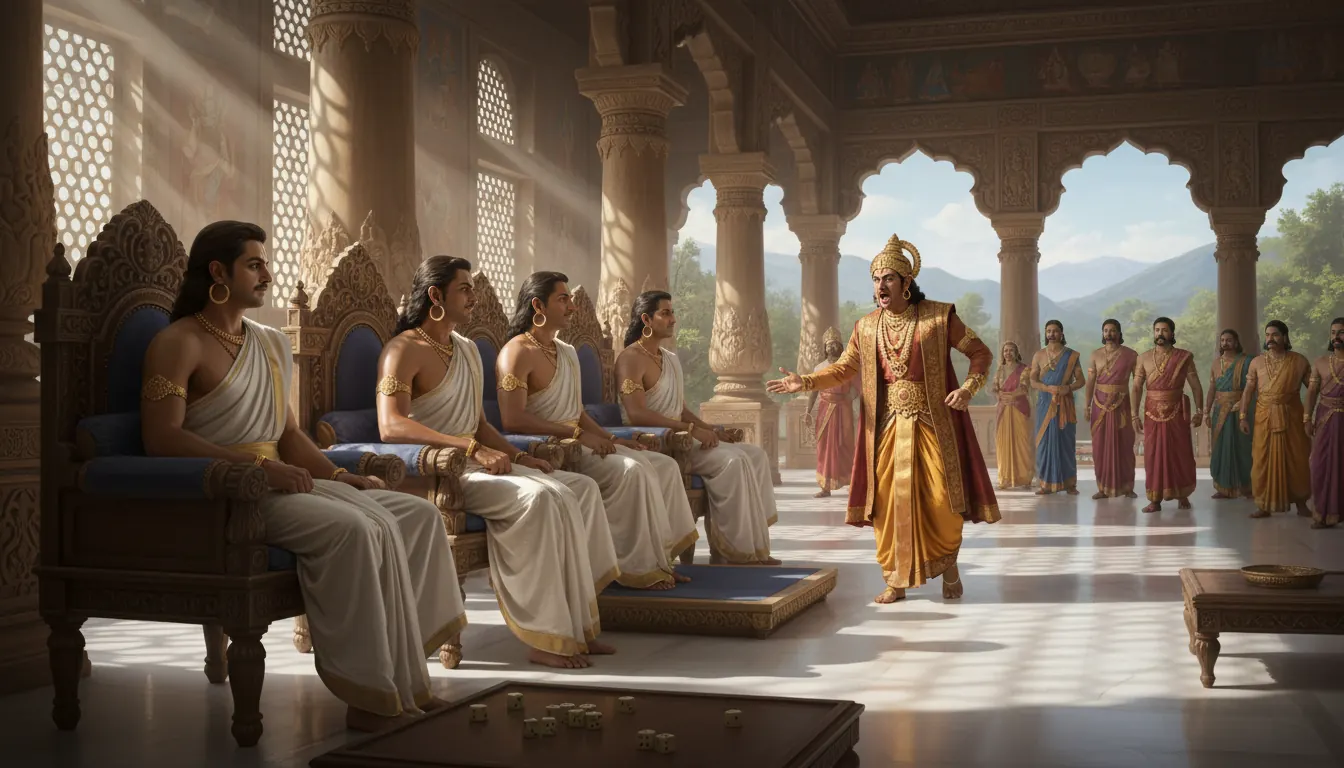
They dressed in white robes. They put on ornaments of all kinds, ear-rings and armlets and chains, the sort of things a cook and a groom and a cowherd do not own and had kept hidden somewhere in that palace for twelve months and three days. Then those five great chariot warriors, with Yudhishthira at their head, walked in through the palace gate like five elephants in rut, went into the council hall of Virata, and sat down on the thrones that were reserved for kings.
They did not speak. They sat there and shone, like fires on a sacrificial altar.
The counsellors saw them and said nothing. The servants who had carried their food to them saw them and said nothing. Word went along the corridors the way water goes along a crack.
Then Virata came in, in his own time, to hold his council and discharge the other offices of a king, and stopped in his own doorway. Five men were sitting on his kings' seats, blazing like fires, and he knew every one of their faces and not one of their names. He reflected for a moment. Then the anger came up in him, and it fixed, as anger does, on the smallest and safest of the five things in front of him: on the dice-player he had struck two days ago, who was seated there like a celestial and looking like the lord of the celestials surrounded by the Maruts.
"You were a dice-player I took on as a courtier," the king of the Matsyas said. "How dare you sit on the royal seat, dressed up like this in fine robes and ornaments?"
Nobody moved. Then the tall one at Yudhishthira's left, the one who had been teaching the king's daughter to dance since the last rains, began to smile, because he had been waiting a year for somebody to ask him a question like that one.
This One Deserves to Sit With Indra
"This man, king," Arjuna said, "is worthy to share a seat with Indra himself."
Virata began to answer and did not get to it, because the dancing master had not stopped.
"He is devoted to brahmanas and knows the Vedas. He cares nothing for luxury or the pleasures of the flesh. He performs sacrifices as a matter of course and keeps his vows. He is virtue itself. He is the first of all men in energy and wiser than anyone on earth. He is given to austerity and skilled in many weapons. Of all the creatures of the three worlds, moving or still, no one has or ever will have such knowledge of weapons as he has. Not among the gods, nor the Asuras, nor men, nor Rakshasas, nor Gandharvas, nor the chiefs of the Yakshas, nor the Kinnaras, nor the mighty Uragas, is there anyone like him.
"He has great foresight and great energy, and the people of the city and the provinces love him. He is the mightiest chariot warrior among the sons of Pandu. He performs sacrifices, he holds to what is right, he has mastered his passions, he is like a great rishi, and this royal sage is famous in every world. He is strong and wise, capable and truthful, and he has every one of his senses under control. He is Indra's equal in wealth and Kubera's in treasure, and like Manu himself he is a protector of the worlds."
Somewhere behind the throne a counsellor put a hand over his mouth. The king had asked how a servant dared to sit down, and the answer coming back was a catalogue of virtues delivered in the tone in which heralds announce an emperor, and the man himself sat quite still on the seat in question with a healing cut across the bridge of his nose.
The Count of What He Had
"The deeds of this king are like the blazing sun itself," Arjuna went on, "and his fame has spread in every direction like the sun's rays. As rays follow the risen sun, ten thousand swift elephants followed him, king, when he lived among the Kurus. Thirty thousand chariots covered in gold and drawn by the finest horses used to follow him then. A full eight hundred bards, wearing ear-rings set with shining gems and accompanied by minstrels, sang his praises in those days, as the rishis praise Indra. The Kauravas and the other kings of the earth waited on him always like slaves, as the gods wait on Kubera. This great king made all the rulers of the earth pay him tribute, as farmers do. Eighty-eight thousand great-souled Snatakas lived on the bounty of this king of noble vows. This illustrious lord looked after the old and the helpless, the maimed and the blind, as if they were his own sons, and he ruled his subjects righteously.
"He is steady in virtue and self-control, he can hold back his anger, he is generous, devoted to brahmanas and truthful: this is the son of Pandu. His prosperity and his prowess torment King Suyodhana and his followers, Karna and the son of Subala among them. And, lord of men, his virtues are too many to count. He holds to what is right and never does harm. He is kind to every creature. He is none other than the bull of the Kuru line, King Yudhishthira the just."
Arjuna let the name stand in the hall by itself for a moment.
"With such virtues as these, king, does this bull among kings, this son of Pandu, not deserve a royal seat?"
Virata did not answer that. A man does not answer that. He was standing in his own council hall looking at a courtier he had hired to play dice with him and kept for entertainment, and he was doing arithmetic with two days and one thrown die and the blood that a woman had caught in a golden vessel so that it should not touch the floor of his house.
Then Which of These Is Bhima
"If this really is the Kuru king Yudhishthira, the son of Kunti," Virata said at last, and his voice had changed, "then which of these is his brother Arjuna, and which is the mighty Bhima? Which is Nakula, and which Sahadeva, and where is the famous Draupadi? Since they lost at dice, no one has heard anything of the sons of Pritha."
"This man, king, who is called Vallava and is your cook," Arjuna said, "is Bhima himself, mighty-armed, terrible in his strength and furious in his charge. It was he who killed the furious Rakshasas on the slopes of Gandhamadana and brought Krishna heavenly flowers of great fragrance. He is the Gandharva who killed the wicked Kichaka, and it was he who killed the tigers and bears and boars in the inner rooms of your palace.
"The man who has kept your horses is Nakula, the destroyer of enemies, and this is Sahadeva, the keeper of your cows. Both these sons of Madri are great chariot warriors, famous and handsome, and these two bulls of the Bharata line, dressed in fine robes and fine ornaments, are a match between them for a thousand great chariot warriors.
"And this lady with eyes like lotus petals, slender-waisted and sweetly smiling, is Drupada's daughter, your wife's sairindhri, for whose sake, king, the Kichakas were killed.
"I am Arjuna. You have surely heard of me, the son of Pritha, younger than Bhima and older than the twins. We have passed our year in hiding happily in your house, king, like infants in the womb."
The cook. The groom of horses. The boy who slept in the cow-pen. The maidservant whose Gandharva husbands had killed a hundred and five Sutas in one night, and who stood now against the same pillar she had stood against on the day they took her out to the burning ground.
What the Prince Saw From the Chariot
Then Virata's son spoke, and he identified the sons of Pritha a second time, because he had spent a day on a chariot floor watching one of them and he had learned to look at men.
"That one with skin as bright as pure gold, built like a full-grown lion, with the high nose, the large wide eyes and the broad, copper-coloured face, is the king of the Kurus. And look, that one who walks like a furious elephant, with skin like heated gold, broad, wide shoulders and long, thick arms, is Vrikodara. And the one standing beside him, that dark young man like the leader of a herd of elephants, with shoulders as broad as a lion's and eyes large and wide like lotus leaves, is Arjuna, the greatest of bowmen. And close to the king are those two finest of men, the twins, like Vishnu and Indra, who have no equal in the world of men in beauty, strength or conduct. And beside them, look, stands Krishna, lovely as gold, like light itself made flesh, with the colour of the blue lotus, like Lakshmi herself come to life."
Then he described what that dark youth had done in front of him.
"This is the man who cut down the enemy like a lion tearing through a herd of deer. He ranged through crowds of enemy chariots, killing their best warriors. With a single arrow he killed a huge, furious elephant, and that great beast, its flanks armoured in gold, fell and drove its tusks into the earth. He won back the cows and beat the Kauravas in battle. The blast of his conch has deafened my ears. It was this hero of fierce deeds who beat Bhishma and Drona, and Duryodhana with them. That achievement is his, and not mine."
It was the second time in three days the boy had said that last sentence in that hall. The first time nobody had believed him.
The Sceptre, the Treasury and the City
The king of the Matsyas heard his son out and understood, all at once and completely, what he had done with a die two days ago.
"I think the time has come for me to make amends to the sons of Pandu," he said to Uttara, low. "And, if you agree, I will give my daughter Uttaraa to Arjuna."
"They deserve our homage and our worship and our respect," the prince answered. "The time has come to honour the illustrious sons of Pandu, who deserve all honour from us."
Then Virata turned and spoke to the whole hall, and to the five men on the thrones.
"When the enemy had me in their power in battle, it was Bhimasena who rescued me. And it was Arjuna who won back my cows. We owe our victory to the strength of their arms. That being so, let all of us, with our counsellors, make amends to Yudhishthira the son of Kunti. Blessings on you and all your brothers, bull among the sons of Pandu. If we have ever said or done anything in ignorance to offend you, king, please forgive us. The son of Pandu is virtuous."
He came down to Yudhishthira and made an alliance with him, and offered him his whole kingdom, with the sceptre and the treasury and the metropolis, in front of his court.
Then he could not stop talking. "What good fortune to see you," he said, again and again. He embraced Yudhishthira, and Bhima, and the two sons of Madri, and smelt their heads as a father does, and stood back and looked at them and was not satisfied with looking, and embraced them again. "What good fortune to see you safe out of the woods. What good fortune that you have come through your exile, hard as it was, without those wicked wretches finding you. I hand over my whole kingdom to the sons of Pritha, and everything else I have. Let the sons of Pandu take it without a moment's hesitation."
As My Daughter-in-Law
"And let Dhananjaya, who is called also Savyasachin, accept the hand of Uttaraa," Virata finished. "For that best of men is fit to be her lord."
It was the highest thing the king had left to give, and he gave it to the one who had recovered his cattle. Everyone in the hall looked at Arjuna. Arjuna looked at his eldest brother, and Yudhishthira met his eyes and said nothing at all, which was permission.
"King," Arjuna said, "I accept your daughter as my daughter-in-law. An alliance like this between the Matsyas and the Bharatas is a good thing indeed."
He had lived a year in the women's apartments of that palace. He had dressed the girl's hair and corrected her steps and let her lean against him unafraid, and men had watched her come and go from his rooms and thought nothing of it, and he would not now take as a wife a girl who had trusted him as she would have trusted a father. He would take her for his son, and the son's name was Abhimanyu, and Uttaraa would go to him instead.
So the year ended. Not with a discovery, not with a spy at a door or a name shouted in the street, but with five men who chose one morning to bathe, and dress, and walk in, and sit down on the seats that were theirs, and wait to be asked why.
Vaishampayana said: Thus, Janamejaya, did the sons of Pandu complete the thirteenth year, and the king of the Matsyas, who had housed them, and fed them, and struck one of them in the face, became their kinsman and their ally. From that hall the messengers went out to Dwaraka and to Panchala, and the war that had been waiting thirteen years for them began to gather its kings.
Dharma Lesson
A disguise ends not when it is discovered but when the wearer chooses to set it down. Yudhishthira endured a die thrown in his face and forgave it, because the vow he had made covered the insult and the year was not yet complete; when the year was complete he did not announce himself, he simply sat where he belonged. Virata's greatness is that on learning the truth he did not defend himself but asked forgiveness and handed over everything he had.